

Rugby
Mastering the Offload in Contact: The 3v2 Channel Attack
Teach your players how to keep the ball alive through contact with this high-intensity, progressive offloading drill designed to improve decision-making and support lines.

What you need
8-10 Cones, 2-3 Rugby Balls, Tackle Shields (optional), Bibs (two colours)
1. Overview
The ability to offload effectively in contact is a game-changer in modern rugby. It disrupts defensive structures, creates front-foot ball, and forces the opposition to scramble. This drill focuses on the mechanics of the offload—specifically, driving through the tackle, freeing the arms, and delivering a sympathetic pass to a support runner. It also trains support players to read the body language of the ball carrier and run intelligent, dynamic lines.
This session is ideal for developing continuity in attack and is highly effective when preparing for matches against aggressive, blitzing defences where breaking the gainline and keeping the ball alive is crucial.
2. Setup
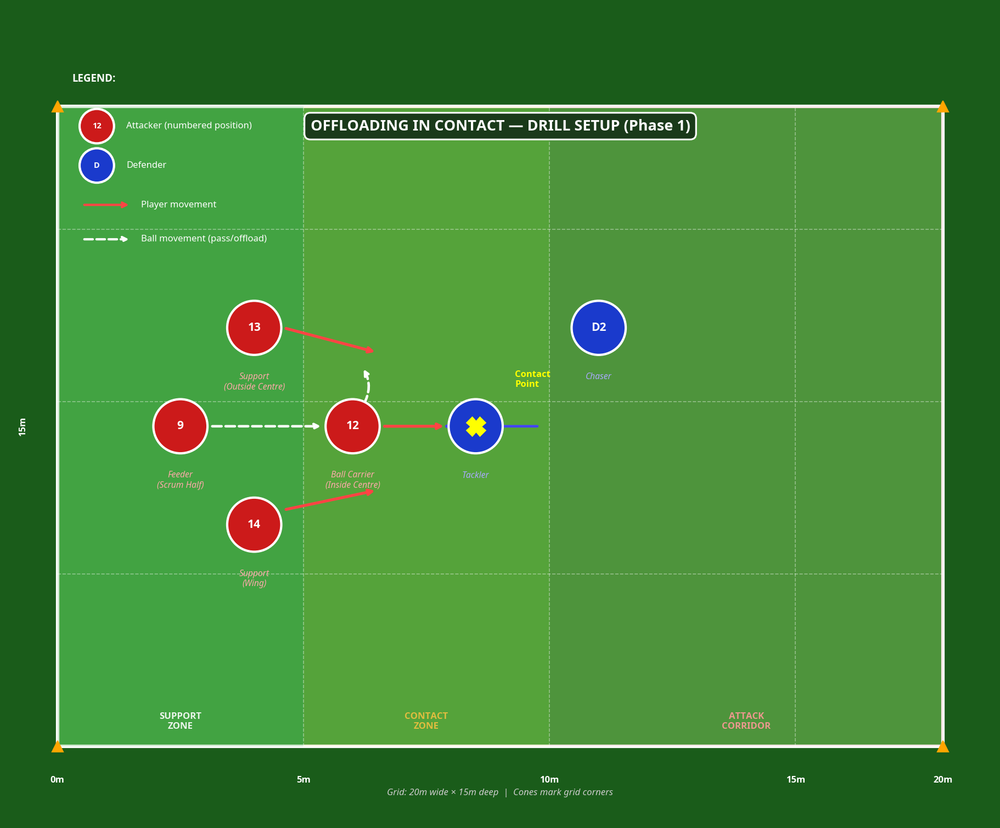
Pitch Dimensions: Create a grid 20m wide by 15m deep for Phase 1. Extend the depth to 25m for Phase 2 progressions.
Equipment: 8-10 cones (to mark the grid), 2-3 rugby balls, tackle shields (optional for early progressions).
Players Required: 6-8 players per grid (3 attackers, 2 defenders, 1 feeder/scrum-half).
Player Positions:
- Attackers: 1 Ball Carrier (e.g., No. 8 or Inside Centre), 2 Support Runners (e.g., Flankers or Outside Backs).
- Defenders: 1 Primary Tackler, 1 Chaser/Cover Defender.
- Feeder: 1 Scrum-half (No. 9) to initiate the drill.

3. Step-by-Step Instructions
Phase 1: The Basic Offload (3v1+1)
- Initiation: The Scrum-half (9) feeds the ball to the primary Ball Carrier standing 5m deep.
- The Carry: The Ball Carrier attacks the gainline aggressively, targeting the outside shoulder of the Primary Tackler (D1).
- The Contact: As contact is made, the Ball Carrier must drive their legs, fight to stay square, and keep the ball away from the defender's wrap.
- Support Lines: Simultaneously, the two Support Runners must anticipate the contact point. One runner holds a deep line (axle), while the other runs a flat, hard line off the ball carrier's hip.
- The Offload: The Ball Carrier punches their arms through the tackle and delivers a soft, one-handed pop pass or out-the-back offload to the supporting player.
- Completion: The receiver catches the ball at pace and accelerates through the 'Attack Corridor' to finish the drill.
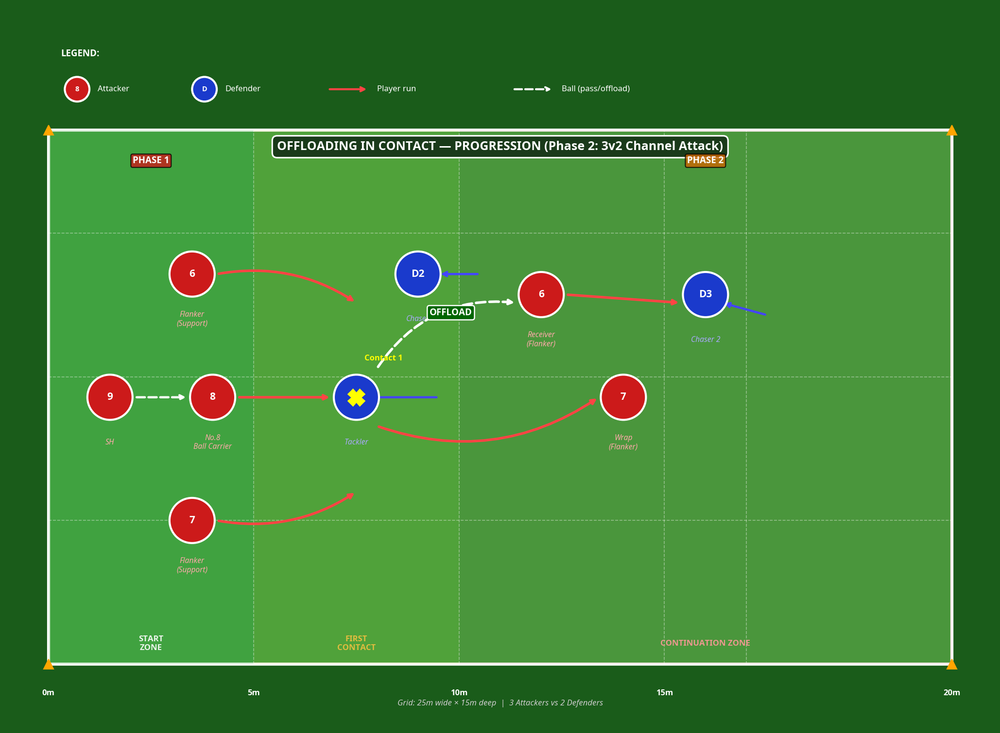
Phase 2: Progression - 3v2 Channel Attack
- Introduction of Second Defender: Introduce a second defender (D2) who starts 5m behind the Primary Tackler.
- Decision Making: The drill runs as before, but now the receiver of the offload must immediately assess the position of D2.
- Continuation: If D2 bites on the receiver, the receiver must execute a quick draw-and-pass to the second Support Runner wrapping around.
- Reset and Repeat: Rotate attacking and defending roles every 3-4 repetitions to ensure all players practice both skill sets.
4. Key Coaching Points
- Win the Collision First: The offload is only effective if the ball carrier gets over the gainline. Emphasise footwork before contact and aggressive leg drive.
- Ball Presentation: The ball carrier must fight to keep the ball free from the tackler. Carry the ball in two hands until the point of contact, then shift it away from the defender.
- Sympathetic Passing: The offload should be a 'soft' pass. The ball carrier must look at the support runner and pop the ball into their space, not fire a bullet pass.
- Support Depth and Timing: Support runners must not overrun the ball carrier. They should communicate early ("With you left!", "Pop!") and time their run to hit the ball at pace.
- Read the Shoulders: Support players should watch the ball carrier's shoulders. If the shoulders turn in, expect a pop pass; if they stay square, expect an out-the-back offload.
5. Common Mistakes
- Forcing the Offload: Players trying to offload when the tackle is dominant or the ball is wrapped up. Correction: Coach players to recognize when the offload is 'on' and when to simply go to ground and present the ball cleanly.
- Flat Support Lines: Support runners standing too flat and overrunning the pass. Correction: Emphasise starting deeper and accelerating onto the ball.
- Poor Ball Security: Carrying the ball loosely into contact, leading to turnovers. Correction: Reinforce two-handed carries prior to contact and strong grip strength.
- Lack of Communication: Silence from support players. Correction: Demand loud, clear, and specific communication (e.g., "Pop right!", "Hold!").
6. Variations & Progressions
- Make it Easier (Regression): Remove the defenders and use tackle shields instead. This allows players to focus purely on the mechanics of the offload and support lines without the pressure of a live tackle.
- Make it Harder (Progression 1): Introduce a 'touch-down' rule. The ball carrier must go to ground, pop back up immediately, and then offload to a supporting player. This simulates a dynamic breakdown scenario.
- Make it Harder (Progression 2): Add a time limit (e.g., 5 seconds) to complete the phase and score, forcing quicker decision-making and execution.
7. Age Adaptations
- Under 8s - Under 10s: Focus entirely on the concept of passing before being tagged/tackled. Use touch rugby rules and emphasize running into space rather than contact.
- Under 12s - Under 14s: Introduce tackle shields. Focus on leg drive and two-handed ball carries. Keep the offload simple (pop passes only).
- Under 16s - Open Age: Full live contact. Emphasise decision-making (when to offload vs. when to take the tackle) and complex support lines (wraps, switch lines).
