

Rugby
Mastering the Offload in Contact: A Comprehensive Drill
Equip your players with the technical skills and decision-making ability to execute effective offloads in contact and keep the attack alive.
What you need
Rugby balls, Cones, Tackle shields (optional)
Overview
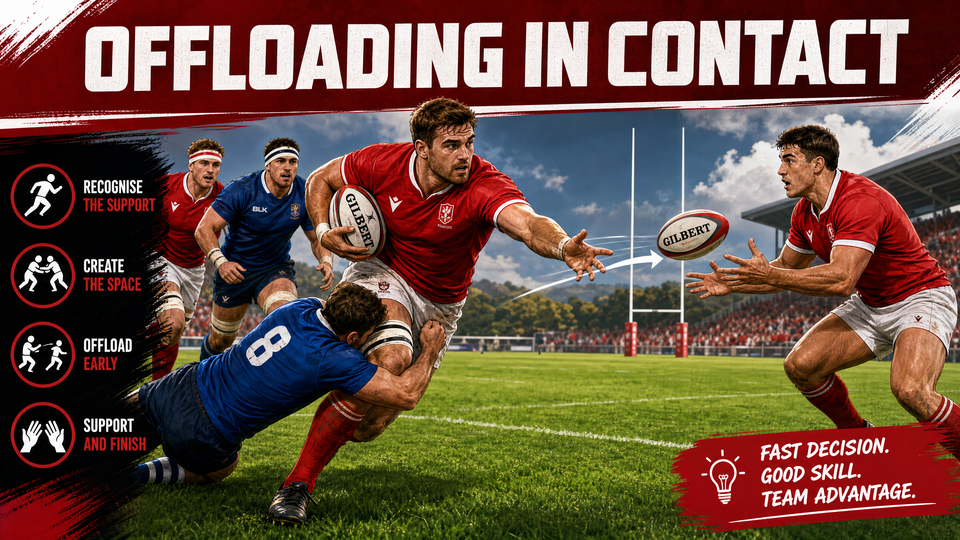
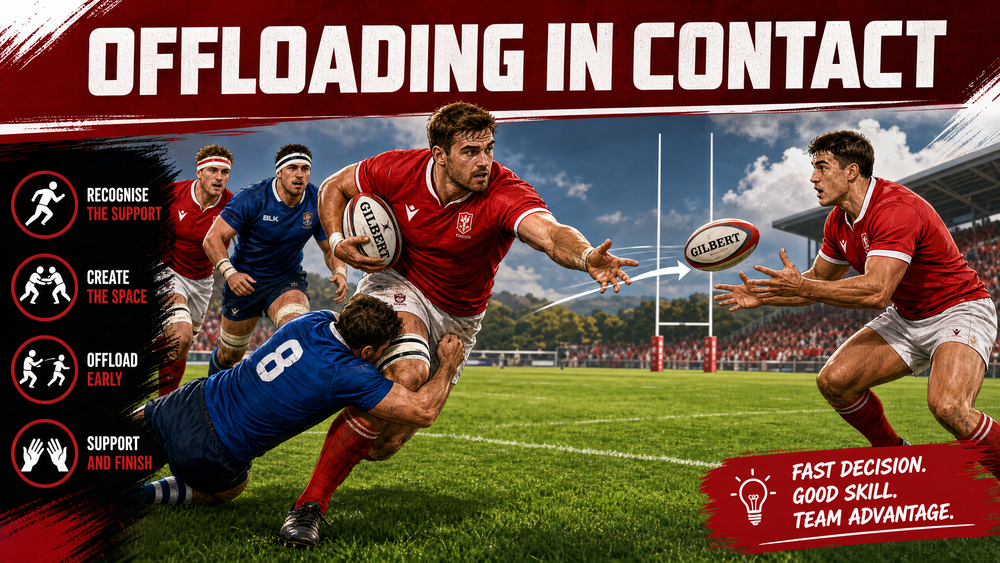
The offload in contact is one of the most potent attacking weapons in modern Rugby. When executed correctly, it breaks the defensive line, maintains momentum, and creates line breaks before the defense can reset. This drill focuses on the technical execution of the one-handed offload, the timing of the support runners, and the decision-making required to identify when the offload is on.
This session is designed to progress from unopposed technical execution to a live, decision-making scenario under pressure.
Setup
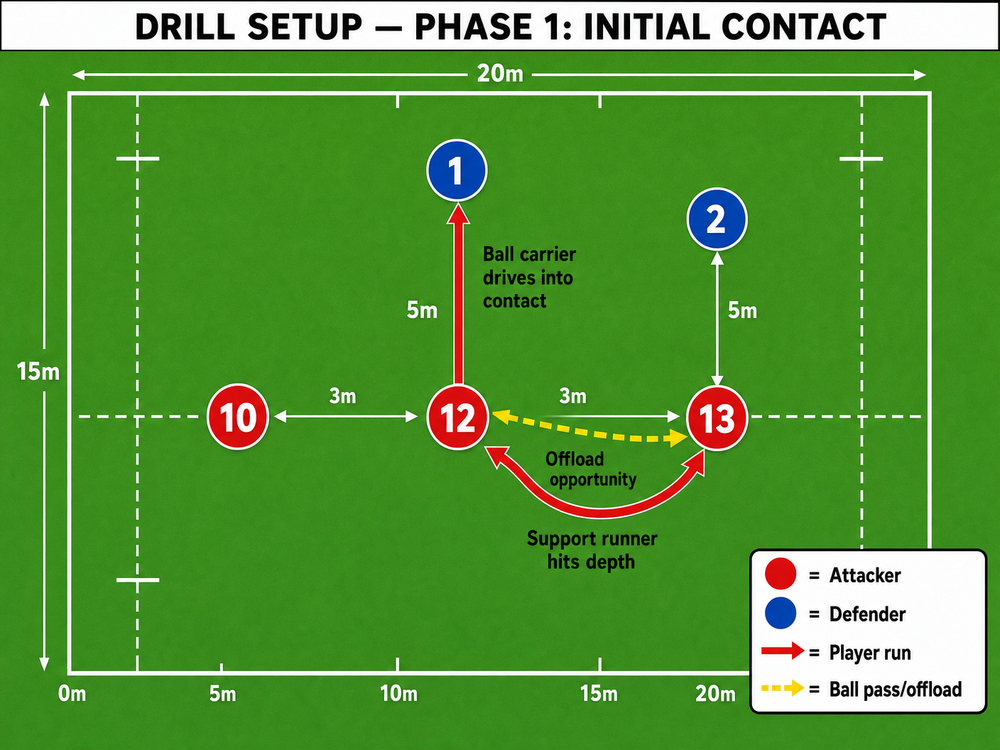
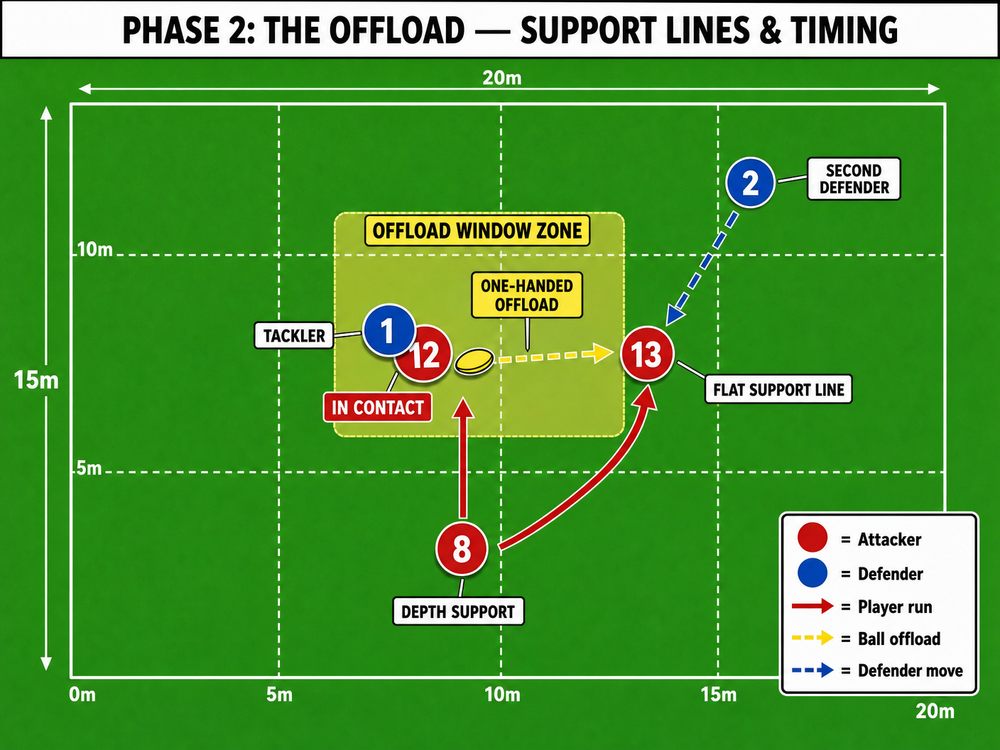
Grid Size: 20m x 15m for Phases 1 & 2; 30m x 20m for Phase 3.
Equipment: 4-6 Rugby balls, 10-15 cones, tackle shields (optional for Phase 1).
Players: Groups of 5-6 players per grid (3 Attackers vs 2 Defenders).
Player Positions
- Attackers: #12 (Ball Carrier), #10 (Inside Support), #13 (Outside Support).
- Defenders: #1 (Primary Tackler), #2 (Covering Defender).
Step-by-Step Instructions
Phase 1: Technical Execution (Unopposed/Static Defender)
- The ball carrier (#12) starts 10m from the static defender (#1).
- On the coach's whistle, #12 drives forward, initiating contact on their terms (driving low and hard).
- As contact is made, #12 fights to keep the ball-carrying arm free.
- The support runner (#13) times their run to arrive flat and late on the outside.
- #12 executes a one-handed offload (pop pass or flick) to #13.
Phase 2: Timing and Lines of Running
- Introduce a second support runner (#8) running a depth line.
- The ball carrier (#12) takes contact with the primary defender (#1).
- The defenders now offer passive resistance.
- #12 must decide whether to offload flat to #13 or deep to #8 based on the positioning of the second defender (#2).
Phase 3: Live Channel Attack (3v2)
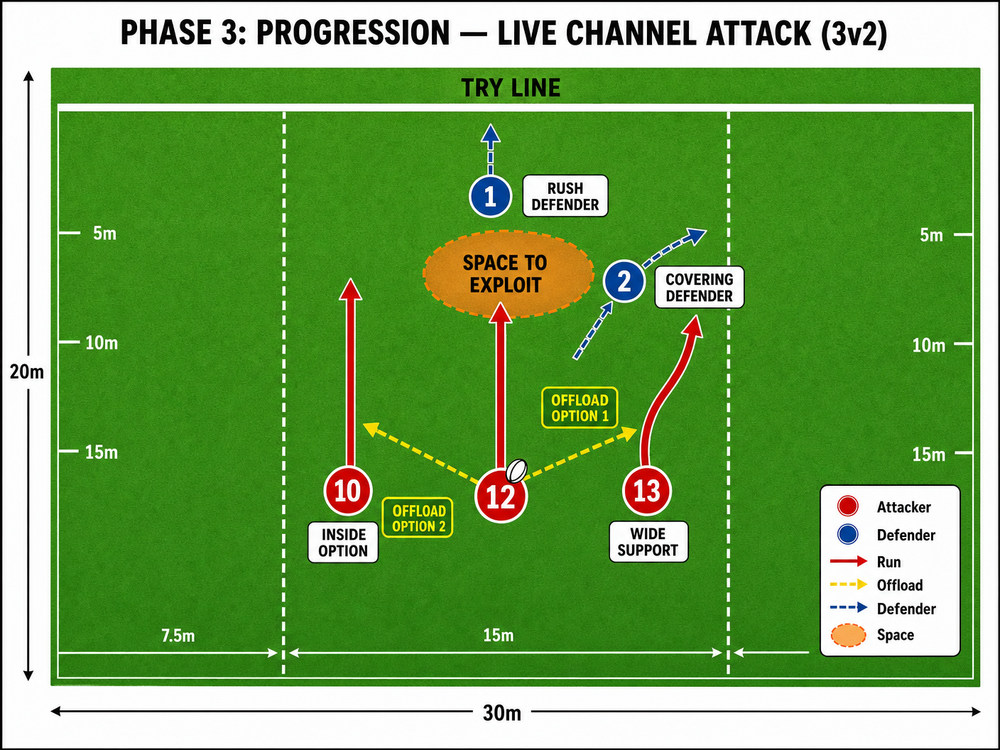
- Expand the grid to 30m x 20m.
- Attackers (#10, #12, #13) align against two live defenders (#1, #2).
- The ball carrier (#12) attacks the line, aiming to isolate the primary defender.
- Defenders aim to complete the tackle and stop the offload.
- The ball carrier must make a live decision: take the tackle and present the ball, or execute the offload if the hands are free and support is available.
Key Coaching Points
- Win the Collision: The ball carrier must initiate contact on their terms, staying low and driving through the tackle to create forward momentum.
- Ball Presentation: Keep two hands on the ball until the last possible moment. Only free the offloading arm once the tackle is secured and the support is identified.
- Eyes Up: The ball carrier must scan the defense before and during contact to locate support runners.
- Support Timing: Support runners must arrive 'late and fast'. Arriving too early kills the space; arriving too late misses the offload window.
- Communication: Support runners must communicate their position clearly (e.g., "Left!", "Right!", "Deep!").
Common Mistakes
- Forcing the Offload: Attempting an offload when wrapped up or when no support is available, leading to turnovers.
- Poor Support Lines: Support runners overrunning the ball carrier or running too flat, making the pass impossible.
- Losing the Collision: Being driven backward in the tackle, which neutralizes the offload opportunity.
Variations & Progressions
- Add a Sweeper: Introduce a full-back (sweeper) behind the defensive line to force the support runners to make an immediate decision after receiving the offload.
- Conditioned Touch: Play a game of conditioned touch where offloads count for double points, encouraging players to look for the pass in contact.
Age Adaptations
- Under 10s/12s: Focus heavily on Phase 1. Use tackle bags instead of live defenders to build confidence in the technical execution of the one-handed pass.
- Under 14s/16s: Introduce live tackling but control the intensity. Focus on the decision-making aspect of when not to offload.
- Open/Senior: Run Phase 3 at full game speed with aggressive defense to simulate match conditions.
