

Rugby
Offloading in Contact: Breaking the Defensive Line Through Continuity
Master the art of keeping ball alive through contact — this drill teaches ball carriers and support runners to execute clean offloads under pressure, turning defensive tackles into attacking opportunities.
What you need
cones (16), tackle bags / hit shields (4), rugby balls (6), bibs in 2 colours (12), agility poles (4, optional)
Overview
The offload in contact is one of the most dynamic and high-reward skills in modern rugby. When executed correctly, it transforms a potential breakdown — where momentum stalls and defenders reset — into a seamless continuation of attack that can break defensive lines and create try-scoring opportunities. This drill is designed to develop the technical proficiency, spatial awareness, and communication required for players to offload consistently and safely under match-realistic pressure.
Use this drill in the attacking skills block of your training session, ideally after a thorough warm-up and basic ball-handling exercises. It is most effective mid-season when players have the fitness base to sustain intensity across multiple repetitions. The drill is structured in three phases — isolated technique, conditioned practice, and game-realistic application — allowing coaches to dial the complexity up or down based on the squad's readiness.
Setup
Equipment Required
| Item | Quantity | Purpose |
|---|---|---|
| Cones (orange or yellow) | 16 | Grid marking and channel boundaries |
| Tackle bags / hit shields | 4 | Simulating contact in early phases |
| Rugby balls | 6 | Continuous repetitions without stoppages |
| Bibs (2 colours) | 12 | Distinguishing attackers from defenders |
| Agility poles (optional) | 4 | Defining support runner channels |
Pitch Setup
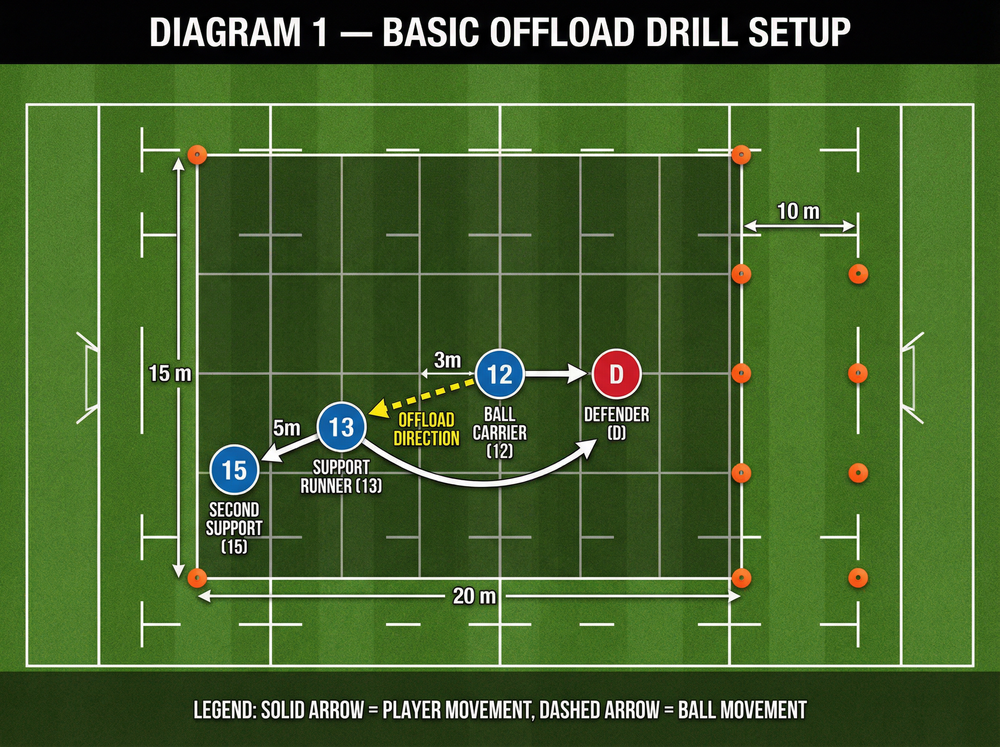
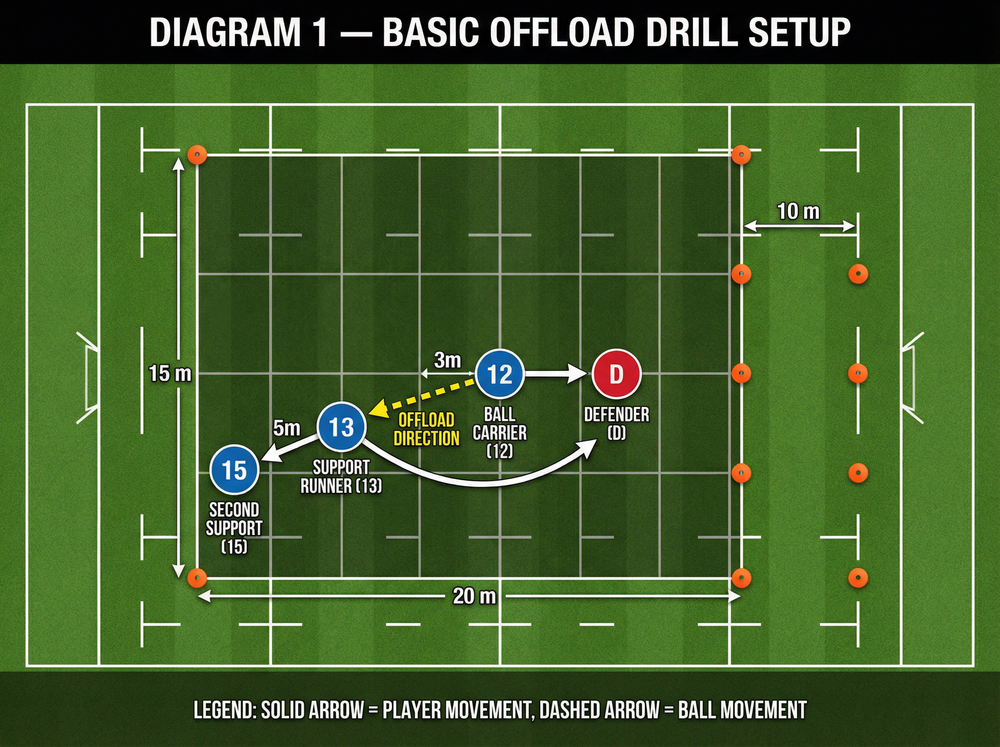
Mark out a 20m x 15m grid using cones on a standard 100m x 70m rugby pitch. Position the grid between the 22m line and the halfway line, using one of the existing pitch channels. This gives players the visual reference of real pitch markings while working within a controlled space. For the progression phase, expand the grid to 25m x 20m to accommodate the 3v2 scenario.
Player Positions (Phase 1 — Isolated Technique)
You need a minimum of 8 players to run this drill effectively, though groups of 10–12 allow for continuous rotation without long rest periods.
- Ball Carrier (No. 12 / Inside Centre): Starts at the right-hand cone, holds the ball in two hands.
- Support Runner (No. 13 / Outside Centre): Starts 3m behind and 2m to the outside of the ball carrier.
- Second Support (No. 15 / Fullback): Starts 5m behind and 4m outside the first support runner.
- Defender / Tackler (D): Starts 8m directly in front of the ball carrier, holding a tackle bag.
Diagram 1 shows the basic drill setup. Note the staggered depth of support runners — this is non-negotiable. Flat support invites the offload to be intercepted; depth creates the passing window.
Step-by-Step Instructions
Phase 1 — Isolated Technique (10 minutes)
- Coach calls "Go." The ball carrier (No. 12) runs forward at three-quarter pace toward the defender holding the tackle bag.
- Ball carrier makes contact with the tackle bag, driving through with their inside shoulder. They must keep their outside arm free — this is the offload arm.
- As contact is made, the ball carrier rotates their torso toward the support runner (No. 13) and releases a one-handed or two-handed offload at hip-to-chest height.
- Support runner (No. 13) must be running at full pace on a hard, flat line 1–2m outside the ball carrier's hip at the moment of contact. They call "BALL!" loudly as they approach.
- No. 13 receives the offload and immediately accelerates through the contact zone, running 5m beyond the tackle bag before the rep is complete.
- Second support (No. 15) continues running a wider arc as a secondary option, arriving in space in case the first offload is not on.
- Rotate roles after every 3 repetitions. Ball carrier becomes defender, defender joins the support line, supports rotate up.
Phase 2 — Conditioned 3v2 (15 minutes)
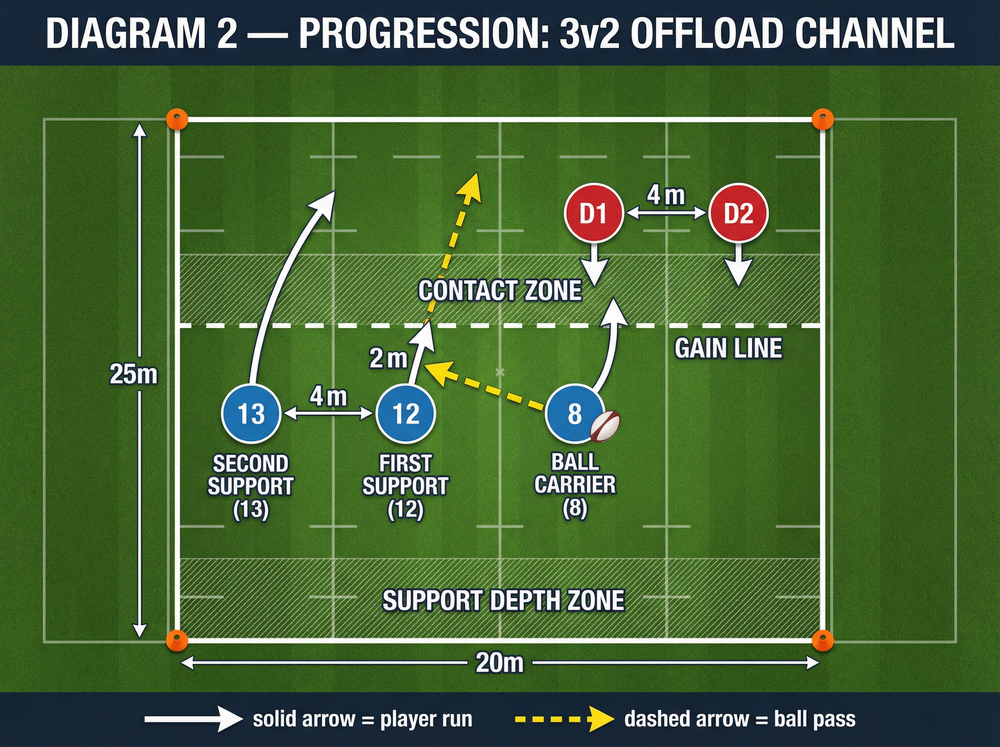
Expand to the larger 25m x 20m grid. Introduce a live defender (no tackle bag) who makes a controlled, shoulder-height tackle.
- Three attackers (Nos. 8, 12, 13) align in a staggered formation — No. 8 as ball carrier, No. 12 as first support 2m behind and outside, No. 13 as second support 4m wider still.
- Two defenders (D1 and D2) stand on the gain line, 5m apart, and move forward on the coach's signal.
- Ball carrier (No. 8) identifies which defender is committing to the tackle and runs hard at that defender.
- As the tackle is initiated, No. 8 executes the offload to No. 12, who runs a hard line off No. 8's outside hip.
- No. 12 now has the option to continue running or offload again to No. 13 if D2 is committing.
- The rep ends when the ball crosses the far try line or goes to ground.
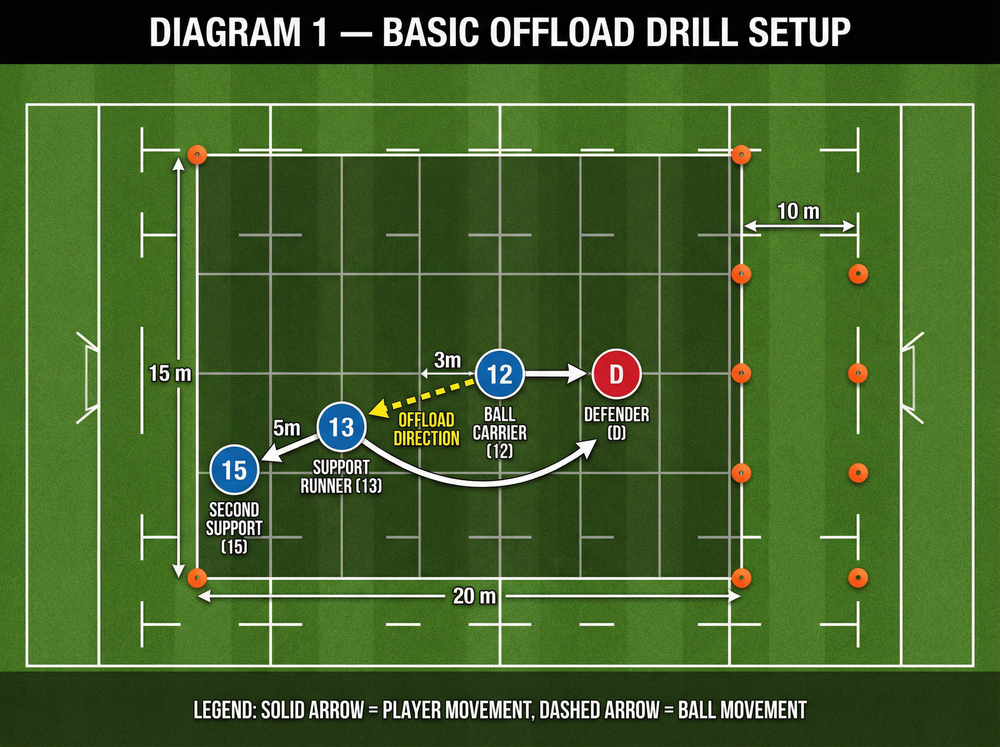
Diagram 2 illustrates the 3v2 progression. The gain line is the critical reference point — the offload must be completed before the ball carrier is driven back behind it.
Phase 3 — Game-Realistic Backline Application (15 minutes)
This phase integrates the offload skill into a full backline movement, connecting the scrum half through to the wings.
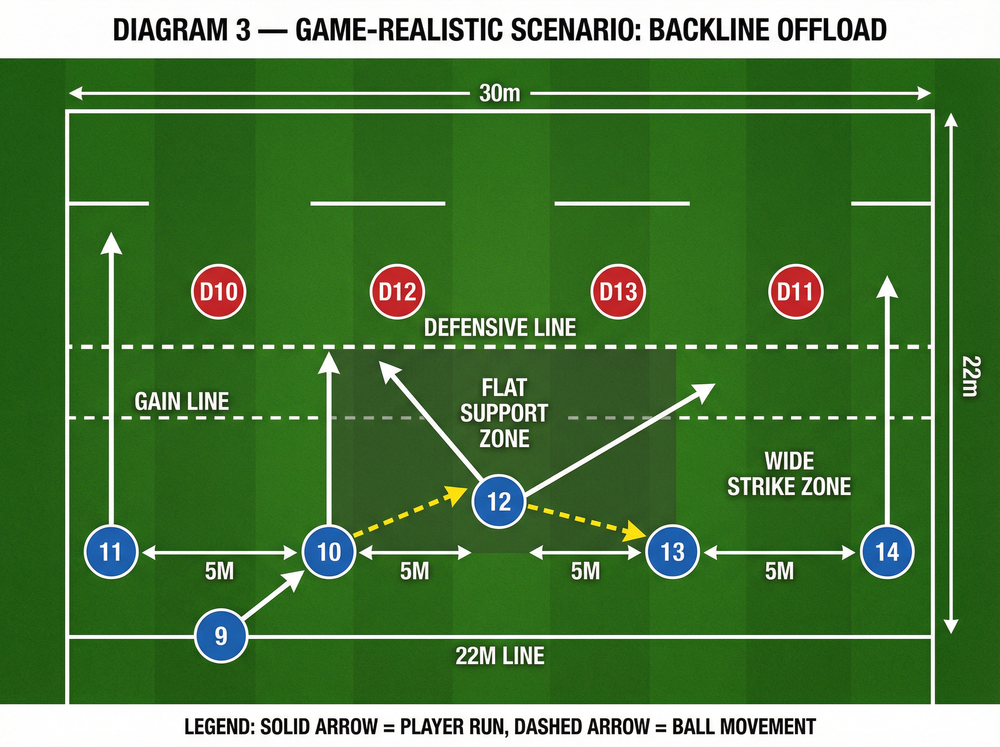
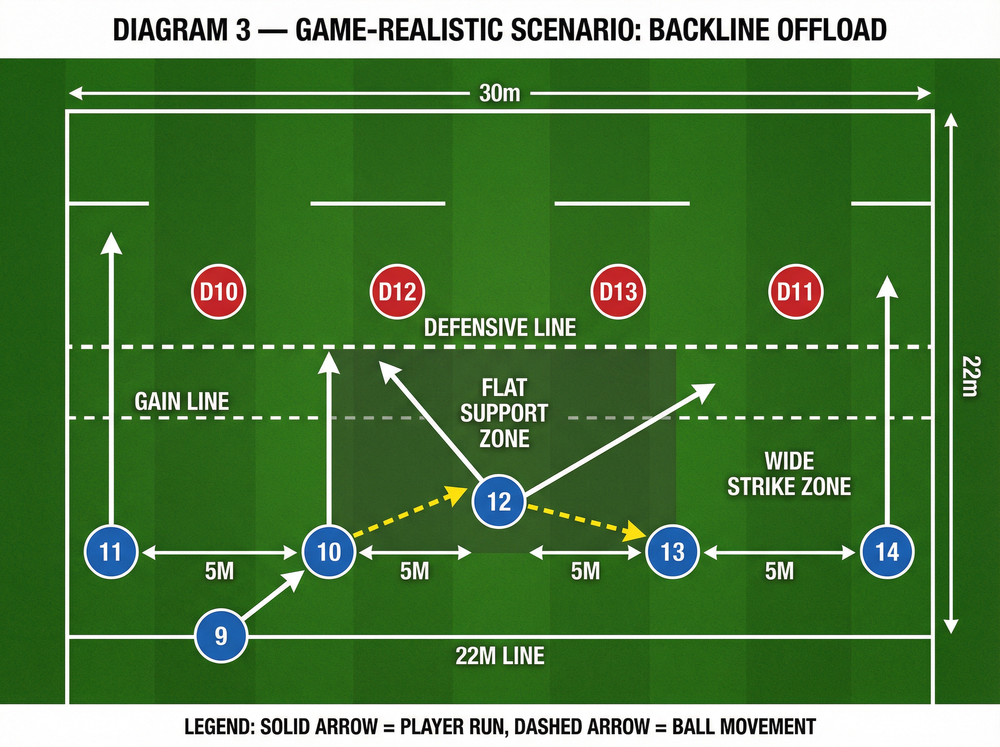
- Set up a 30m x 22m zone with a full defensive line of four players (D10, D12, D13, D11) standing 8m in front of the attacking backline.
- Scrum half (No. 9) passes to fly half (No. 10). No. 10 runs a hard line at D10.
- Inside centre (No. 12) runs a flat, hard support line off No. 10's inside hip, calling "INSIDE!" as they approach.
- No. 10 executes the offload to No. 12 in contact. No. 12 immediately looks wide for No. 13 (outside centre) who is running a wide arc.
- No. 13 receives and attacks the space behind D13, with No. 14 (right wing) providing the final support option.
- Left wing (No. 11) tracks the play as a secondary support in case the ball is recycled.
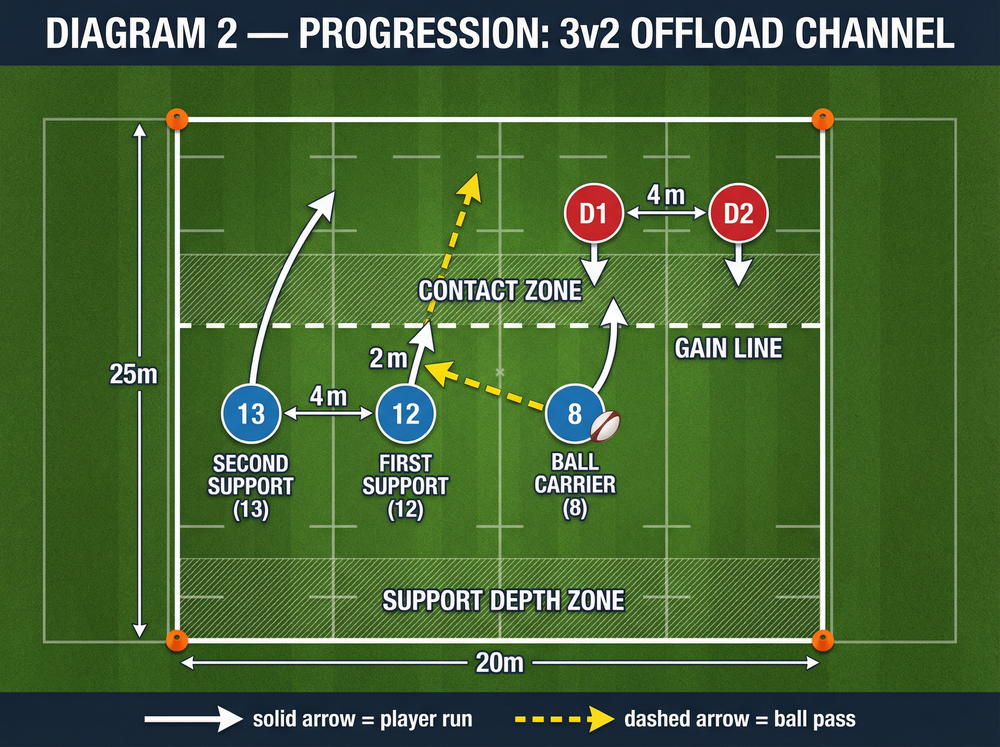
Diagram 3 shows the full backline offload sequence. Emphasise to players that the offload is a decision — it is only the right choice when the support runner is in position and moving at pace.
Key Coaching Points
1. Protect the Ball Before the Offload
The ball carrier must secure the ball in two hands as they approach contact. A loose ball grip leads to knock-ons. Cue: "Two hands until the last moment."
2. Drive Through Contact — Do Not Flinch
Players who brace for the tackle and slow down make the offload impossible. The ball carrier must accelerate into contact, keeping their legs driving. This creates the body position needed to release the ball. Cue: "Feet fast, chest through."
3. Outside Arm Stays Free
The ball carrier must make contact with their inside shoulder, keeping the outside arm and the ball away from the tackler's reach. If the tackler pins both arms, the offload window is closed. Cue: "Lead with the inside shoulder, protect the outside arm."
4. Support Runners Must Be Moving at Pace
An offload to a stationary or slow-moving support runner is a turnover waiting to happen. Support runners must time their run so they are at full pace and in the correct position — 1–2m outside the ball carrier's hip — at the exact moment of contact. Cue: "Arrive late, arrive fast."
5. Communication Is Non-Negotiable
The support runner calls "BALL!" loudly as they enter the offload window. This tells the ball carrier where the support is and triggers the release. Without communication, the ball carrier is guessing. Cue: "If you don't call, you don't get the ball."
6. Read the Tackle — Choose the Right Option
Not every contact situation is an offload opportunity. If the tackler has both arms around the ball carrier's body, the offload is not on — the ball carrier should go to ground and present cleanly. Teach players to make this decision in the last two steps before contact. Cue: "Read the tackle, choose your option."
Common Mistakes
Mistake 1 — Offloading Too Early (Before Contact)
Some players, anxious about being tackled, release the ball before the defender has committed. This creates a flat pass with no gain line advantage and allows the defence to reset. Correction: Use a cone 1m in front of the tackle bag as a "contact gate" — the offload cannot happen until the ball carrier has passed through the gate.
Mistake 2 — Support Runner Running Too Deep
When support runners are too far behind the ball carrier, the offload becomes a backward pass and the defence has time to cover. Correction: Use an agility pole or cone to mark the maximum depth support runners can start from. Enforce the flat, hard line with verbal feedback.
Mistake 3 — Ball Carrier Going to Ground Unnecessarily
Players who habitually go to ground in contact will never develop the offload skill. In this drill, going to ground when the offload was available should be flagged immediately. Correction: Award a point to the attacking team for every successful offload, and subtract a point for every unnecessary grounding of the ball. Make it competitive.
Mistake 4 — Offloading Across the Body (Inside Pass)
Some ball carriers instinctively pass back inside to the scrum half or a trailing forward. This is the lowest-percentage option and often leads to turnovers. Correction: In Phase 1, physically restrict the inside pass by placing a cone or pole on the inside — the ball must go outside.
Mistake 5 — Poor Body Height in Contact
Ball carriers who go into contact too upright are easily stopped and have no leverage to offload. Correction: Set a low cone or hurdle 2m before the tackle bag that players must dip under — this enforces the correct low, powerful body position going into contact.
Variations & Progressions
Progression 1 — Live Tackling (Advanced)
Replace the tackle bag with a live defender making full, controlled tackles. The ball carrier must now read a real body and make a genuine decision under physical pressure. Introduce a referee to call any offloads that are forward or from the ground. This is the highest-intensity version of the drill and should only be used with senior players who have mastered the technique.
Progression 2 — Defender Choice (Decision-Making Under Pressure)
In the 3v2 phase, give the two defenders the freedom to choose which attacker they mark. The ball carrier must now read the defence in real time and decide whether to offload or carry. This develops the decision-making component of the skill and prevents players from running pre-programmed patterns.
Variation 1 — Easier: Passive Defender with Tackle Tube
For players new to the skill, replace the tackle bag with a tackle tube held by a passive defender who simply wraps their arms around the ball carrier without applying resistance. This allows the ball carrier to focus entirely on the mechanics of the offload without the physical challenge of driving through contact.
Variation 2 — Easier: Stationary Contact Point
Place a tackle bag on a stand (or have a player hold it stationary) and have the ball carrier run into it at walking pace. This isolates the release mechanics — body position, arm freedom, and pass accuracy — before adding movement and resistance.
Age Adaptations
| Age Group | Key Modifications |
|---|---|
| Under 10 | Use touch or tag rugby rules — no physical contact. Focus purely on the support runner's timing and communication. The "offload" is a normal pass made while being tagged. |
| Under 12 | Use tackle tubes and passive defenders only. Emphasise body position and the concept of keeping the outside arm free. Reduce grid size to 15m x 10m. |
| Under 14 | Introduce tackle bags with resistance. Begin Phase 2 (conditioned 3v2) with semi-active defenders. Focus on the "read the tackle" decision-making element. |
| Under 16 | Full Phase 1–3 progression. Introduce live tackling in Phase 3 with experienced players. Add the competitive scoring element to drive intensity. |
| Open / Senior | Run all three phases at full intensity. Add a time constraint (complete 10 successful offloads in 8 minutes) to simulate match fatigue. Introduce opposition line speed variation. |
Coach's Note: Regardless of age group, never sacrifice safety for intensity. The offload is a high-skill, high-reward action — but it must be built on a foundation of correct tackling and contact technique. If your players are not yet confident in their contact skills, spend additional time on those fundamentals before introducing this drill at full intensity.
