

Rugby
Penalty Corner Attack: The Blindside Wrap & Switch
A devastating attacking set piece from a 5-metre penalty, designed to manipulate the defensive line and create scoring opportunities on the blindside or through a wide overlap.
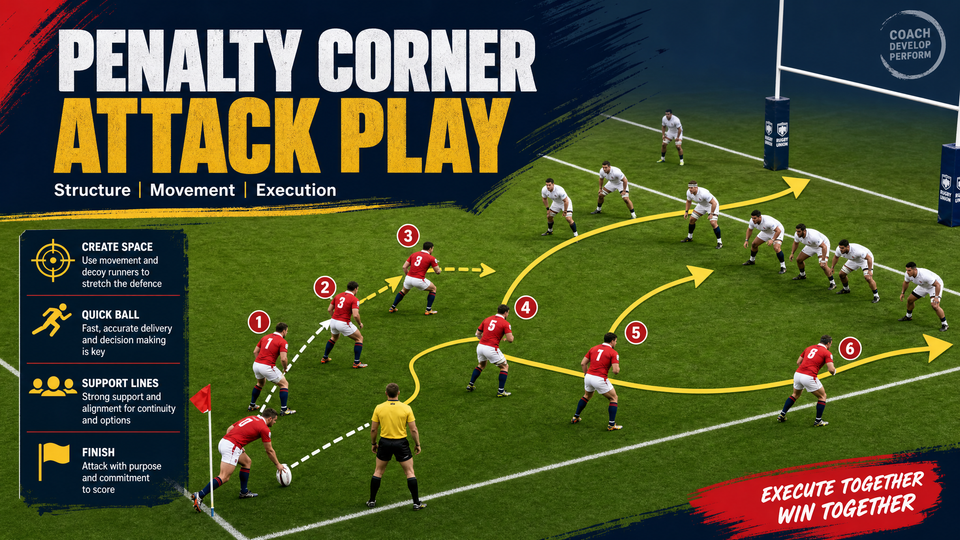
What you need
Rugby balls, Cones (for marking setup positions), Tackle shields (optional, for defensive simulation)
1. Overview
The Penalty Corner Attack is a highly effective set piece utilized when awarded a penalty within 5 metres of the opposition's try line, close to the touchline. This specific play, featuring a 'Blindside Wrap' as the primary strike move and an 'Open-Side Switch' as a variation, is designed to immediately challenge the defensive structure. By employing hard, flat running lines and coordinated decoy movements, the attacking team forces defenders to commit early. The primary objective is to create a localized numerical advantage (an overload) either by wrapping a forward around the corner or by rapidly shifting the point of attack to exploit space out wide.
2. Setup
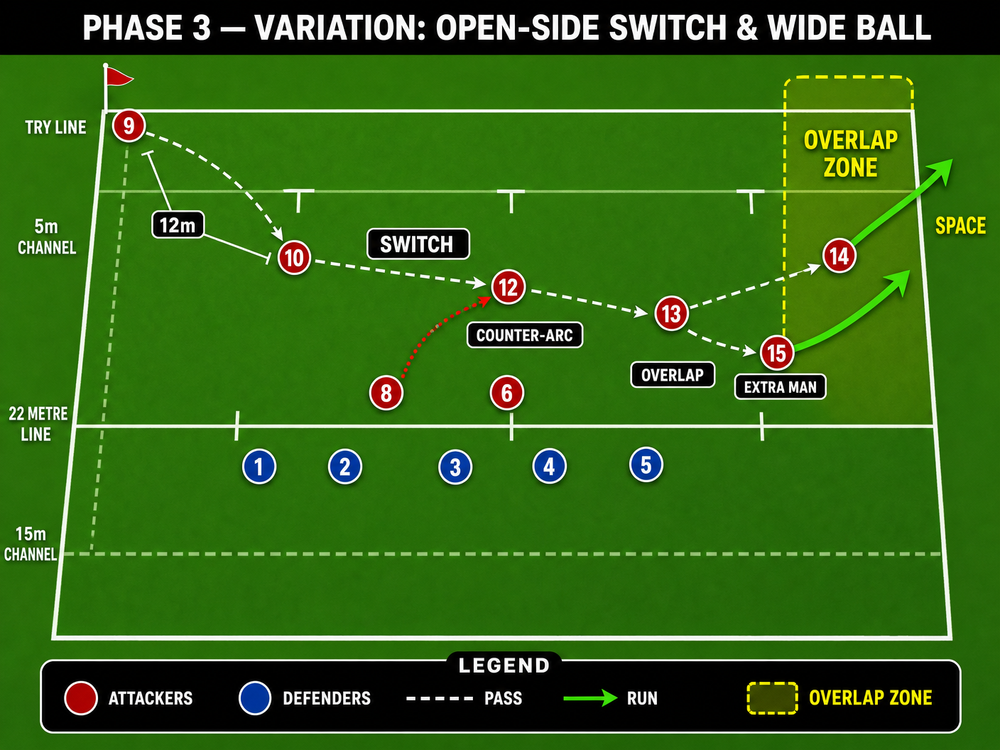
Pitch Location: 5-metre line, close to the touchline (the 'corner').
Player Alignment:
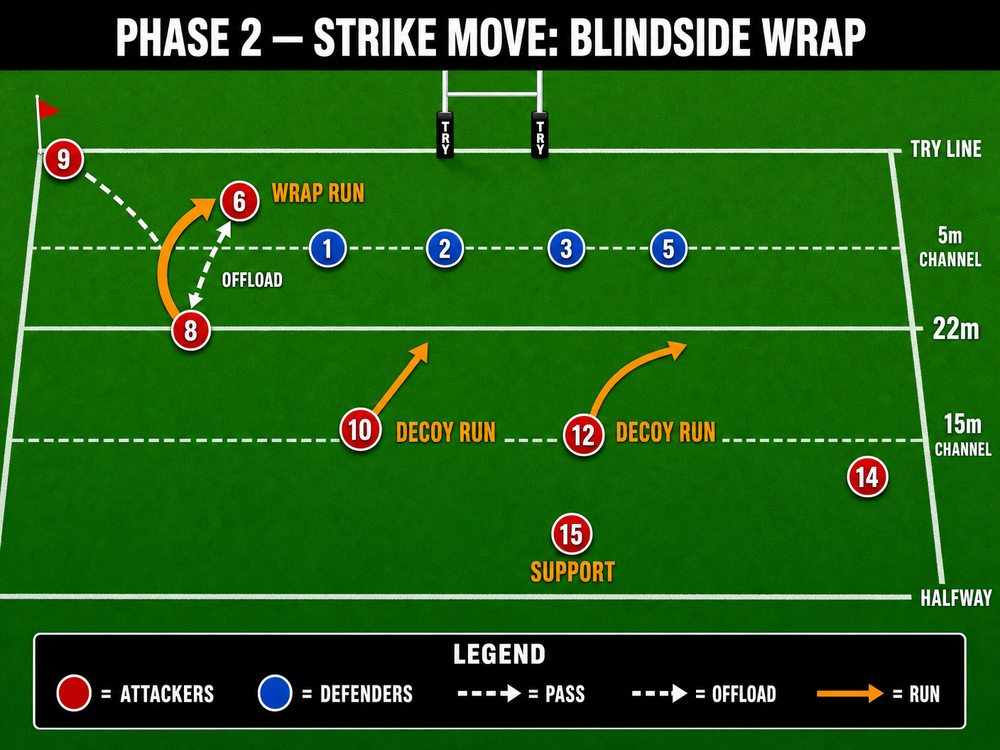
- 9 (Scrum-half): Positioned at the mark with the ball, ready to initiate the play.
- 8 (Number Eight): Aligned 3 metres directly behind the 9, acting as the primary ball carrier.
- 6 (Blindside Flanker): Positioned 2 metres behind the 8, prepared for the wrap run.
- 10 (Fly-half): Aligned 5 metres infield, acting as the first receiver for wide options or as a decoy.
- 12 (Inside Centre): Positioned 10 metres infield, providing a secondary crash or distribution option.
- 13 (Outside Centre): Aligned 15 metres infield.
- 14 (Right Wing): Holding width near the far touchline.
- 15 (Fullback): Positioned deep, ready to inject into the line.
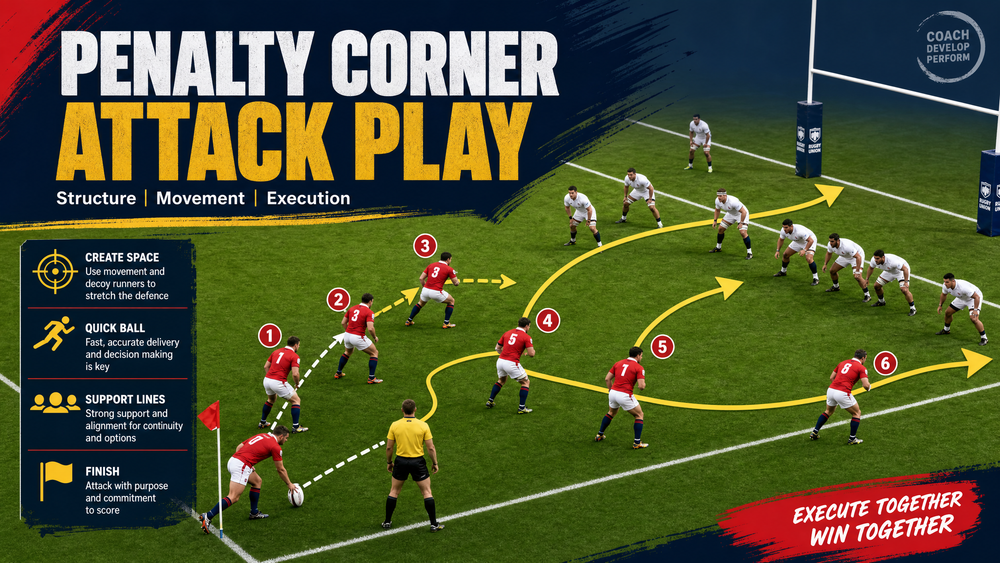
3. Step-by-Step Instructions
The Primary Strike: Blindside Wrap
- The Trigger: The scrum-half (9) taps the ball to initiate the play, signaling the start of the coordinated movement.
- The Hard Line: The Number Eight (8) accelerates on a hard, flat trajectory directly towards the defensive line on the short side (blindside).
- The Decoys: Simultaneously, the fly-half (10) and inside centre (12) run aggressive decoy lines infield. Their movement is crucial to fix the inside defenders and prevent them from drifting towards the corner.
- The Wrap: As the 8 engages the first defender, the blindside flanker (6) accelerates, wrapping tightly around the back of the 8.
- The Offload: The 8 executes a short, well-timed pop pass or offload to the wrapping 6, who should be hitting the gap at pace.
- The Finish: The 6 drives through the created seam towards the try line, supported closely by the 8 and 9.
4. Key Coaching Points
- Pace and Timing: The success of the wrap relies entirely on the speed of the 8's run and the precise timing of the 6's wrap. If the 6 is too early, the pass is forward; if too late, the defense adjusts.
- Convincing Decoys: The 10 and 12 must run their lines as if they are receiving the ball. If they jog or look disinterested, the inside defenders will simply drift across to cover the wrap.
- The 8's Body Position: The Number Eight must stay square to the try line to commit the defender before turning slightly to deliver the offload to the wrapping player.
- Depth of Alignment: Ensure the 8 and 6 start deep enough to hit the gain line at maximum velocity.
5. Common Mistakes
- Telegraphing the Play: The 9 looking directly at the intended receiver before the tap, allowing the defense to anticipate the move.
- Flat Decoys: Decoy runners (10, 12) starting too flat, meaning they are already past the gain line when the ball is tapped, rendering them ineffective.
- Poor Offload Execution: The 8 forcing an offload when the defender has successfully enveloped the ball, leading to a turnover.
- Lack of Support: The 6 making a line break but becoming isolated because the 8 and 9 failed to follow up immediately.
6. Variations & Progressions
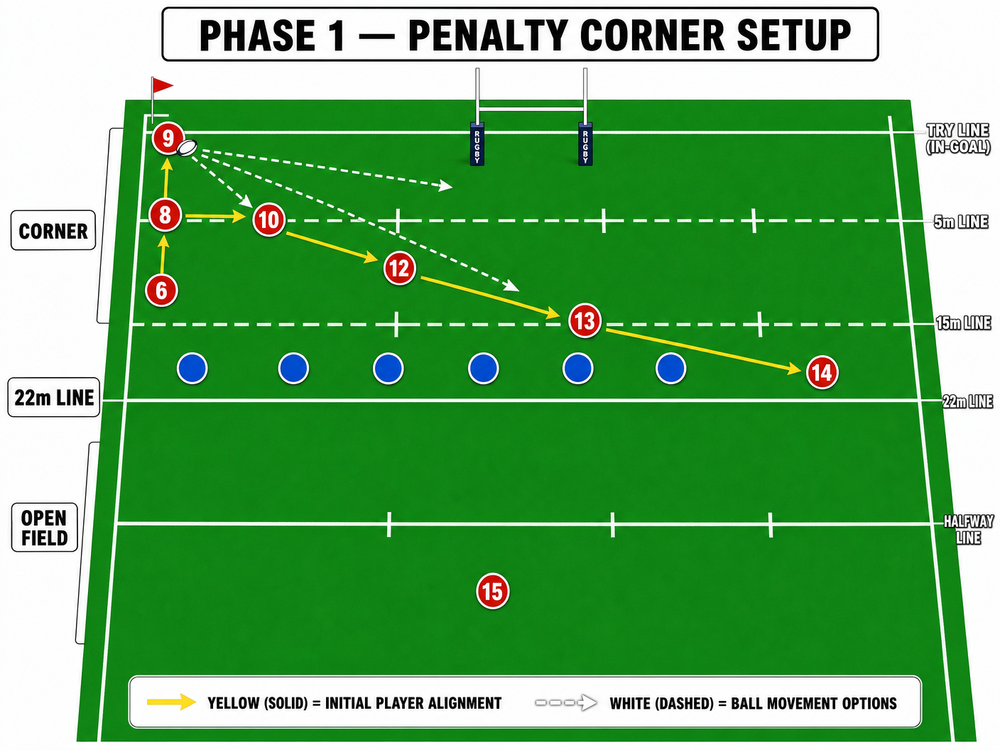
Variation: Open-Side Switch & Wide Ball
If the defense begins to over-commit to the short side to stop the wrap, utilize this variation to exploit the space out wide.
- The Long Pass: The 9 taps and throws a long, flat pass directly to the 10, bypassing the forwards.
- The Switch: The 10 receives the ball and immediately executes a switch pass with the 12, who is running a hard counter-arc back towards the middle.
- Wide Distribution: The 12 straightens the attack and distributes the ball wide to the 13.
- Creating the Overlap: The fullback (15) injects into the line between the 13 and 14, creating a 3v2 or 2v1 overlap against the remaining wide defenders.
- The Finish: The ball is shifted to the 14 in space to score in the far corner.
7. Age Adaptations
- Under 10 / Under 12: Focus purely on the primary strike (the wrap). Simplify the decoy lines. Ensure the pass from 9 to 8 is clean and accurate before introducing the offload to 6.
- Under 14 / Under 16: Introduce the wide variation. Focus heavily on the timing of the switch pass and the fullback's injection into the line. Emphasize the importance of the 10 and 12 fixing their opposite numbers.
- Open / Senior: Execute at full game speed. Introduce further variations, such as the 8 taking the ball into contact and setting a rapid ruck for a subsequent wide attack.
