Scrum Half Passing Accuracy: Base to Pressure Drill
Develop your number 9's core passing mechanics, accuracy over multiple distances, and decision-making under defensive pressure with this progressive drill.

Equipment Needed
1. Overview
The scrum half (9) is the heartbeat of any rugby team's attack. Their ability to deliver fast, accurate, and perfectly weighted passes dictates the speed of the game. This drill is designed to isolate and refine the core passing mechanics of the scrum half, progressing from static target practice to dynamic passing under defensive pressure.
Use this drill during the skills block of your session, particularly when focusing on attacking shape, phase play speed, or individual halfback development. It is highly effective for building muscle memory and ensuring the 9 can clear the ball efficiently from the base of the ruck.
2. Setup
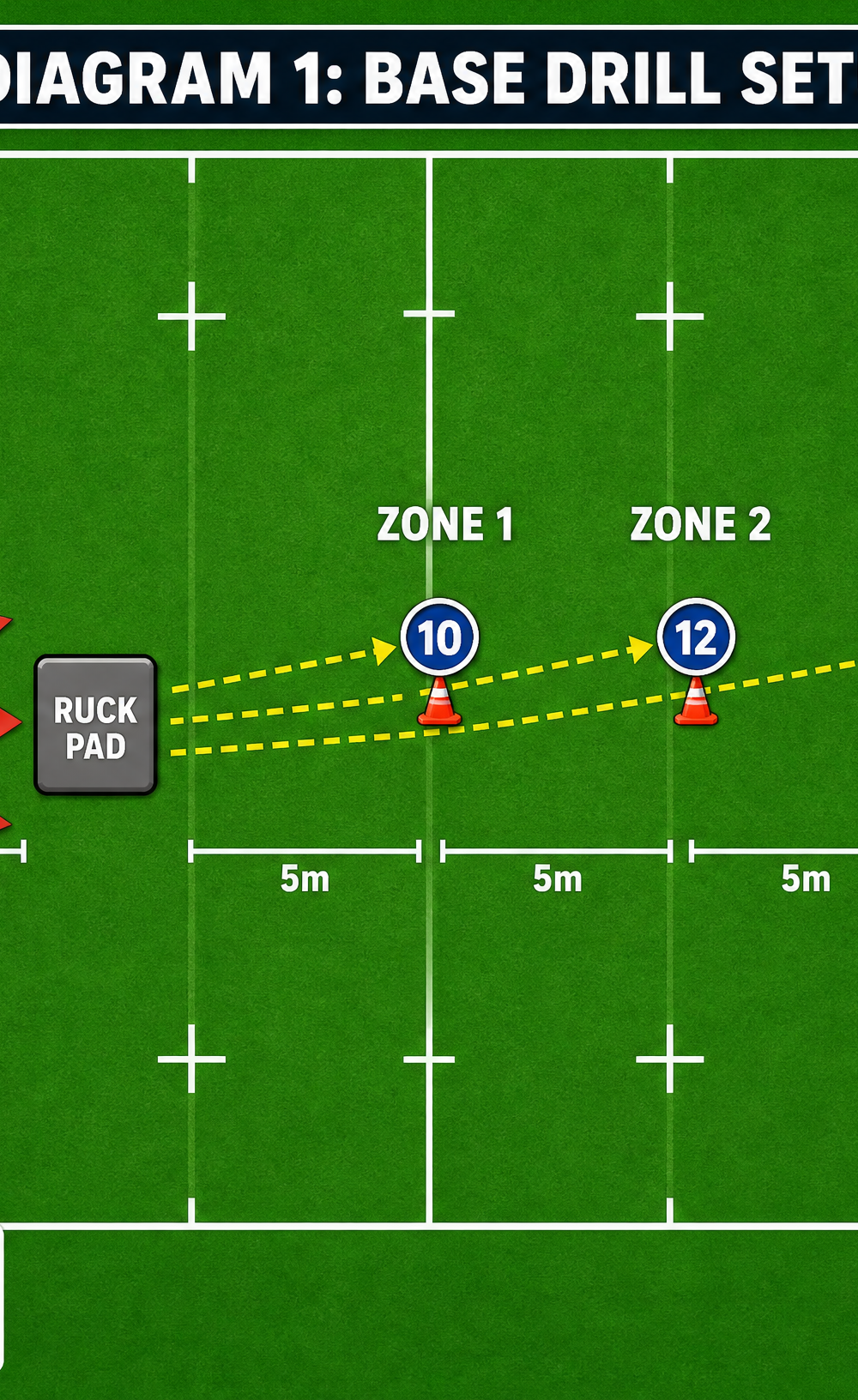
Pitch Area: A 20m x 20m grid (can be set up anywhere on the pitch, ideally using existing lines for reference).
Equipment: 1 Ruck pad or tackle bag, 3 cones, 4-6 rugby balls.
Players: Minimum of 4 players (1 Scrum Half, 3 Receivers). Can add a defender for progressions.
Positioning:
- Place the ruck pad flat on the ground to simulate the breakdown.
- Place a ball at the base of the pad.
- Set up three cones to represent receivers at varying distances and depths from the ruck pad:
- Zone 1 (Fly-half/10): 5 metres wide, slightly deep.
- Zone 2 (Inside Centre/12): 10 metres wide, deeper than the 10.
- Zone 3 (Outside Centre/13): 15 metres wide, deeper again.

3. Step-by-Step Instructions
Phase 1: Base Accuracy (Uncontested)
- The scrum half (9) starts in a balanced, crouched position over the ball at the base of the ruck pad.
- On the coach's call (or their own initiative), the 9 sweeps the ball from the ground.
- The 9 executes a pass to the receiver in Zone 1 (5m).
- The receiver catches the ball, drops it, and the 9 immediately resets with a new ball at the ruck pad.
- Repeat the process, passing to Zone 2 (10m), then Zone 3 (15m).
- Complete 3 sets passing to the right, then switch the setup to complete 3 sets passing to the left.
Phase 2: Dynamic Delivery
- Instead of static targets, have the receivers (10, 12, 13) start deeper and run onto the ball.
- The 9 must now time their pass to hit the moving receiver perfectly in front of their chest.
- Vary the target. The coach calls "1", "2", or "3" just as the 9 approaches the ball, forcing them to adjust their target late.
4. Key Coaching Points
- Footwork and Base: The 9 must have a strong, wide base. The front foot should point towards the target to allow the hips to open up during the pass.
- Low Body Height: Stay low to the ground. Popping up too early ruins the passing trajectory and slows down the delivery.
- Sweep, Don't Lift: The ball should be swept across the body in one fluid motion, not lifted up and then passed.
- Follow Through: Both hands must follow through pointing directly at the target. The wrists should flick to generate the spin.
- Head Up: The 9 must scan the receivers before approaching the ball. They should not be staring at the ground.
5. Common Mistakes
- Taking a Step Before Passing: Taking an extra step away from the ruck before releasing the ball drastically slows down the attack and allows the defence to close the space.
- Passing Behind the Receiver: Failing to lead the runner. The pass must be out in front so the receiver can run onto it at pace.
- Standing Up: Losing body height at the base of the ruck results in a loopy, slow pass.
- Poor Non-Dominant Pass: A noticeable drop in speed and accuracy when passing off their weaker hand. Coaches must enforce equal reps on both sides.
6. Variations & Progressions
Once the base mechanics are solid, introduce defensive pressure to simulate match conditions.
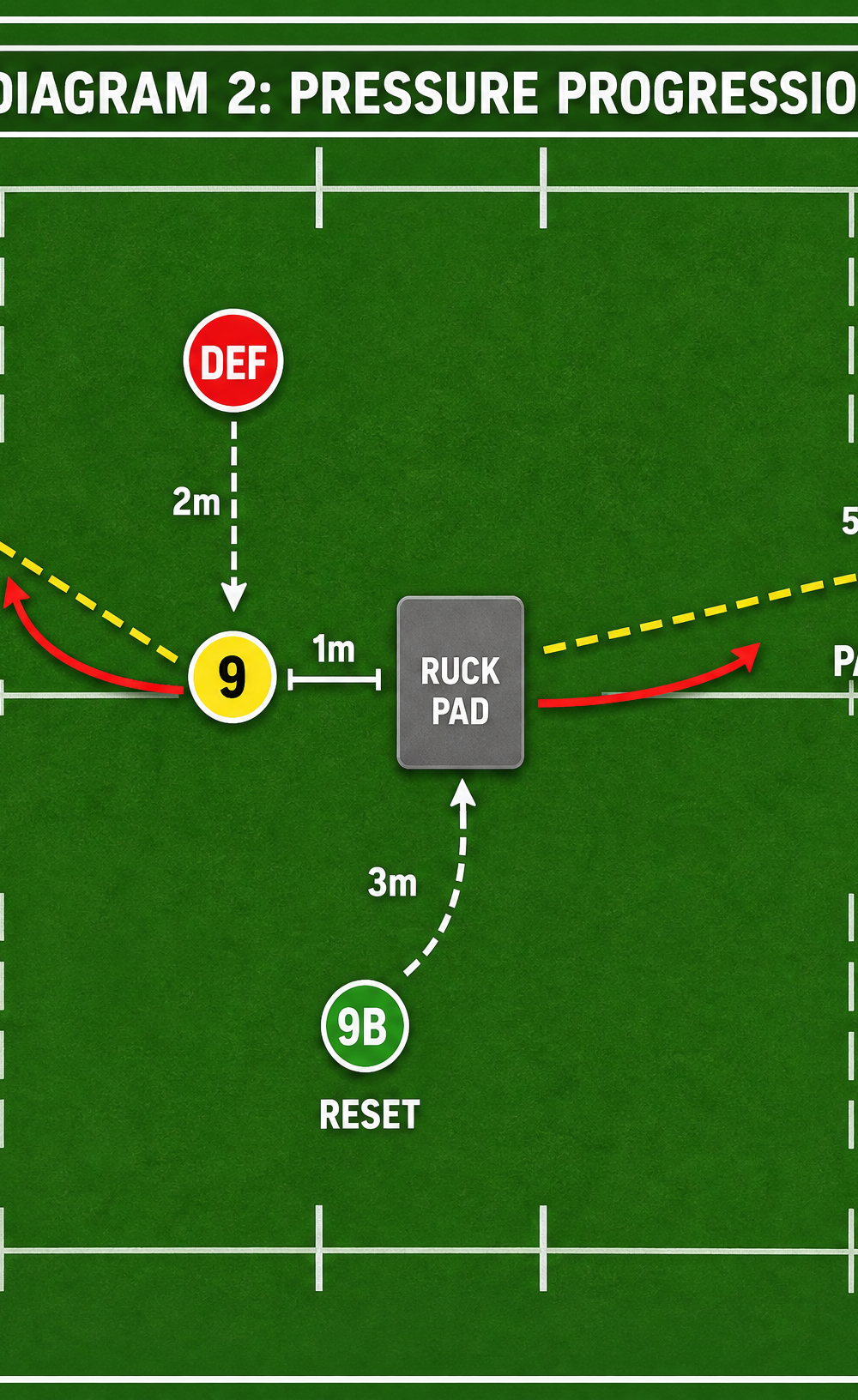
- Progression 1: The Rushing Defender: Introduce a defender standing 2 metres opposite the 9. As the 9 touches the ball, the defender rushes. The 9 must clear the ball quickly and accurately before being tagged.
- Progression 2: Decision Making: The defender rushes, but instead of tackling the 9, they either rush the 10 or stay wide. The 9 must read the defender and pass to the open man (e.g., if the defender rushes the 10, the 9 passes long to the 12).
- Variation: Fatigue Passing: Have the 9 complete a down-and-up (burpee) or a 10-metre sprint before arriving at the base to pass, simulating late-game fatigue.
7. Age Adaptations
- Under 8 - Under 10: Focus purely on the sweep pass mechanics over very short distances (2-5m). Use lighter balls. Do not introduce defensive pressure. Focus on having fun and hitting the target.
- Under 12 - Under 14: Increase the passing distance up to 10m. Introduce moving receivers. Emphasize passing off both hands equally.
- Under 16 - Open: Full distances (up to 15m+). Introduce complex decision-making with rushing defenders. Focus on the speed of delivery from the base.