

Rugby
Mastering the Standard 7-Man Lineout: Mechanics, Timing, and Execution
A comprehensive guide to coaching the standard 7-man lineout, focusing on the core mechanics of throwing, lifting, jumping, and delivery to secure clean set-piece possession.
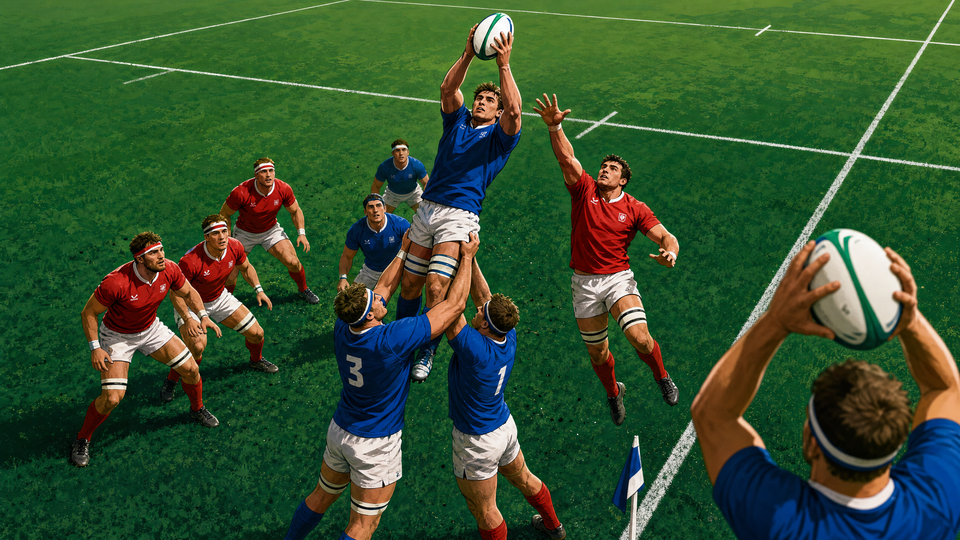
What you need
3-4 Rugby balls, 8-10 Cones, Hit shields (optional)
1. Overview
The lineout is a critical set piece in Rugby Union, providing a structured platform to restart play after the ball has gone into touch. This drill focuses on the Standard 7-Man Lineout, emphasizing the core mechanics of throwing, lifting, jumping, and delivery. By mastering these fundamentals, your team can secure clean possession and launch effective attacks. Use this drill during the set-piece phase of your training session to build timing, trust, and execution under pressure.
2. Setup
Equipment Needed:
- 3-4 Rugby balls
- 8-10 Cones (to mark the 5m and 15m lines, and the offside lines)
- Optional: Hit shields for defensive progression
Pitch Setup:
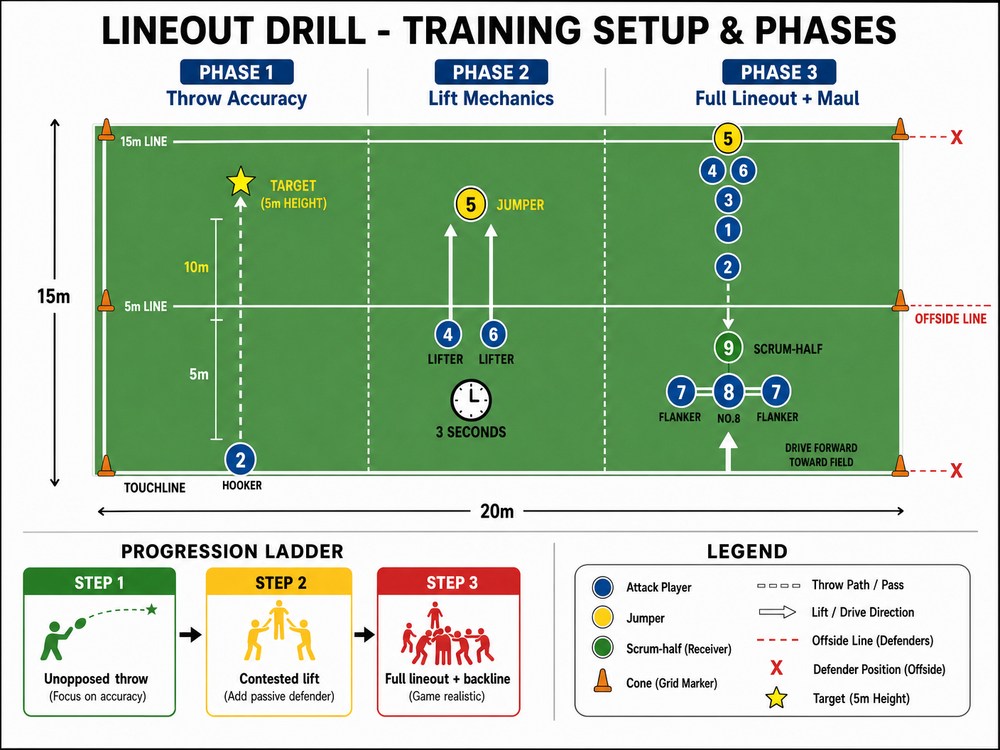
- Set up on a standard Rugby pitch or a marked 20m x 20m grid.
- Mark a touchline, a 5m line (parallel to the touchline, 5 meters in), and a 15m line (10 meters further in).
- Mark the offside lines for non-participating players (10 meters back from the line of touch).
Player Positions (Standard 7-Man):
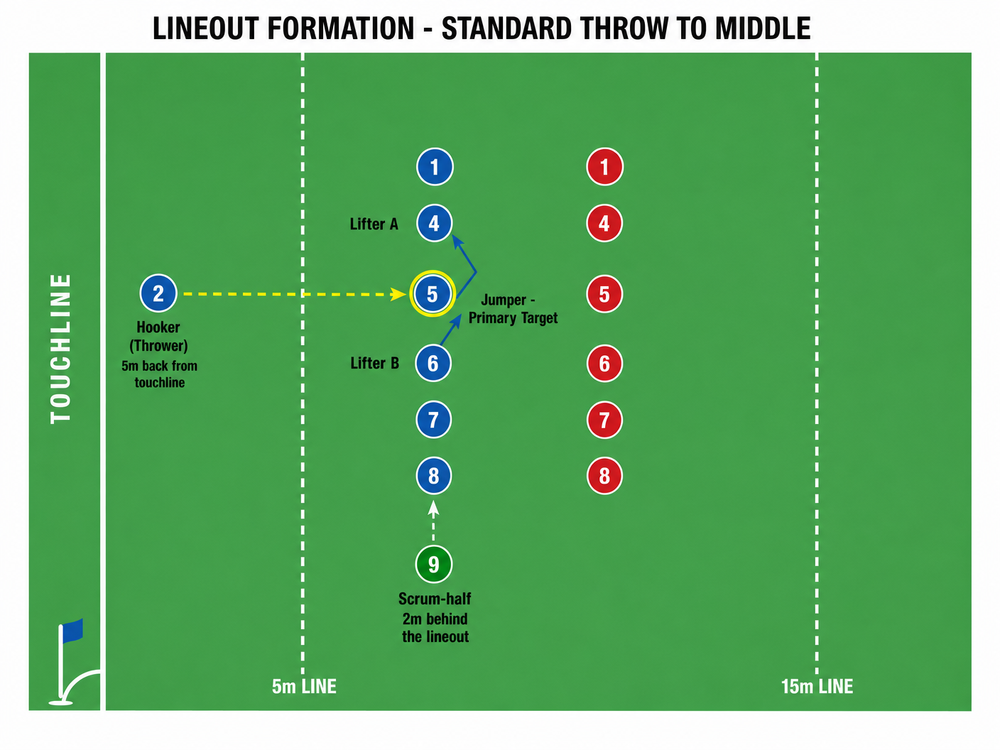
- Hooker (2): Thrower, positioned on the touchline.
- Props (1 & 3): Positioned in the line, often acting as lifters or front support.
- Locks (4 & 5): The primary jumpers and lifters.
- Flankers (6 & 7): Lifters or secondary jumpers.
- Number 8 (8): Tail support or secondary jumper.
- Scrum-half (9): Receiver, positioned 2 meters behind the lineout.
3. Step-by-Step Instructions
Phase 1: Unopposed Walkthrough
- Form the Line: Attacking players (1, 3, 4, 5, 6, 7, 8) align between the 5m and 15m lines, perpendicular to the touchline, with a 1-meter gap from the center line.
- The Call: The lineout caller (usually a Lock or Hooker) makes a clear, concise call to dictate the target jumper and the move (e.g., "Red, 5, Up!").
- The Movement: Players execute the pre-called movement (e.g., a dummy jump at the front, followed by the main jump in the middle).
- The Lift: The designated lifters step in, grip the jumper securely (front lifter on the lower thighs above the knee, rear lifter on the upper hamstrings/glutes), and drive upward powerfully.
- The Throw: The Hooker (2) throws the ball straight down the middle of the tunnel, timing the release to meet the jumper at the apex of their jump.
- The Catch and Delivery: The jumper catches the ball with two hands, brings it down securely, and either delivers it immediately to the Scrum-half (9) or sets it for a maul.
Phase 2: Contested Lift (Passive Defense)
- Introduce 3-4 defenders.
- The defenders attempt to read the call and jump to contest the throw, but without full aggressive lifting or tackling.
- Focus on the attacking team's speed of execution and the Hooker's accuracy under mild pressure.
Phase 3: Full Lineout and Phase Play
- Execute the lineout against a full defensive pod (7 players).
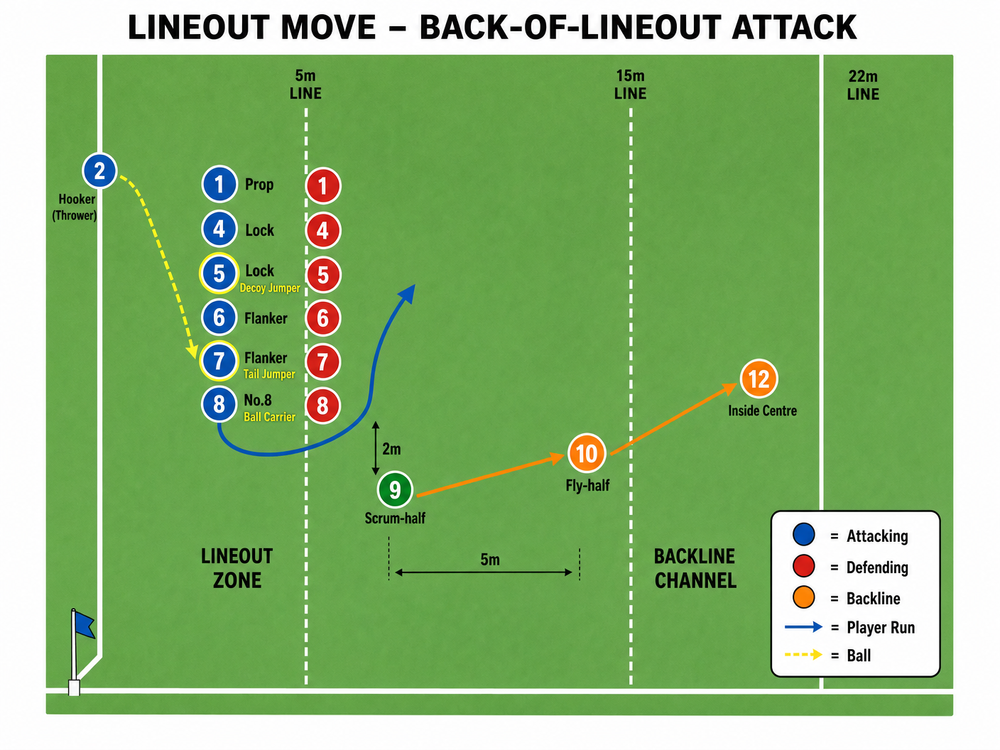
- Upon securing the ball, the Scrum-half (9) delivers a pass to the Fly-half (10) to initiate a backline attack, or the forwards transition immediately into a driving maul.
4. Key Coaching Points
- Throwing Mechanics: The Hooker must maintain a stable base, use a two-handed overhead throw, and follow through towards the target. The ball must travel straight.
- Lifting Technique: Lifters must get low, keep their backs straight, and drive up with their legs, not their arms. The grip must be firm and secure.
- Jumping Form: The jumper must explode upwards, extending their arms fully to catch the ball at the highest possible point, keeping their eyes on the ball throughout.
- Timing is Everything: The throw, the movement, and the lift must be perfectly synchronized. The ball should arrive exactly as the jumper reaches their peak.
- Communication: Clear, decisive calls from the lineout leader are essential to ensure everyone knows their role.
5. Common Mistakes
- Not Throwing Straight: A crooked throw results in a turnover. Ensure the Hooker's alignment and follow-through are correct.
- Lifting with the Back: Lifters bending at the waist rather than the knees risk injury and lack power. Emphasize leg drive.
- Jumping Early or Late: Poor timing leads to missed catches or easy turnovers. Practice the timing repeatedly without the ball first.
- Closing the Gap: Players stepping into the 1-meter gap before the ball is thrown is a penalty offense. Maintain discipline.
6. Variations & Progressions
- Shortened Lineouts: Practice 4-man or 5-man lineouts to create more space in the backline or to confuse the defense.
- Peel Moves: Instead of delivering to the Scrum-half, the ball is tipped to a forward peeling around the front or back of the lineout.
- Defensive Focus: Flip the drill to focus on defensive lineout reading, contesting, and sacking the maul.
7. Age Adaptations
- Under 8 - Under 12: Focus entirely on the throw and catch mechanics without lifting. Use softer balls and lower targets. Introduce basic lineout positioning.
- Under 14 - Under 16: Introduce safe lifting techniques with strict supervision. Emphasize core strength and correct body mechanics before adding the ball. Start with uncontested lineouts.
- Open (Adult): Full contested lineouts with complex calls, movement patterns, and immediate transition into phase play or mauling.
