Mastering Support Running & Angles: The 3v2 Breakout Drill
Teach your players how to run effective, aggressive support lines that manipulate defenders and guarantee offload success in contact.
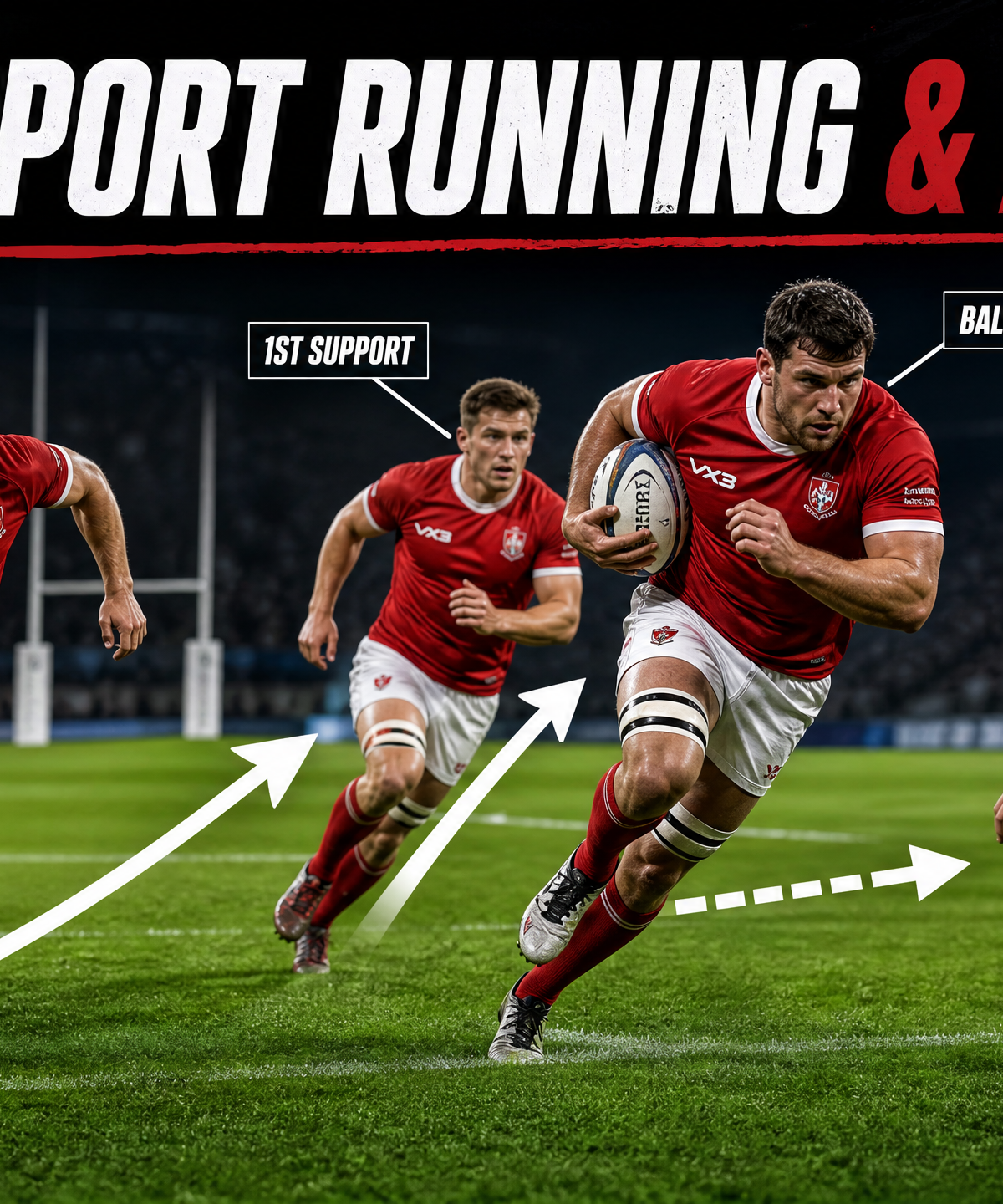
Equipment Needed
1. Overview
Effective support running is the lifeblood of a fluid rugby attack. Too often, players arrive at the breakdown flat-footed or run straight lines directly behind the ball carrier, severely limiting their options. The 3v2 Breakout Drill is designed to fix this by teaching players how to read the contact situation, maintain depth, and run sharp, angled support lines that exploit the spaces created by the ball carrier.
This drill emphasizes the timing of the run, the angle of approach, and the crucial communication required between the ball carrier and the support players. It is ideal for use during the mid-season when attacking structures need sharpening or as a high-intensity warm-up before a contact session.
2. Setup
Pitch Dimensions: 30m long x 20m wide grid.
Equipment: 8 cones (to mark the grid), 2-3 rugby balls, bibs for defenders.
Players: Groups of 5 (3 Attackers, 2 Defenders).
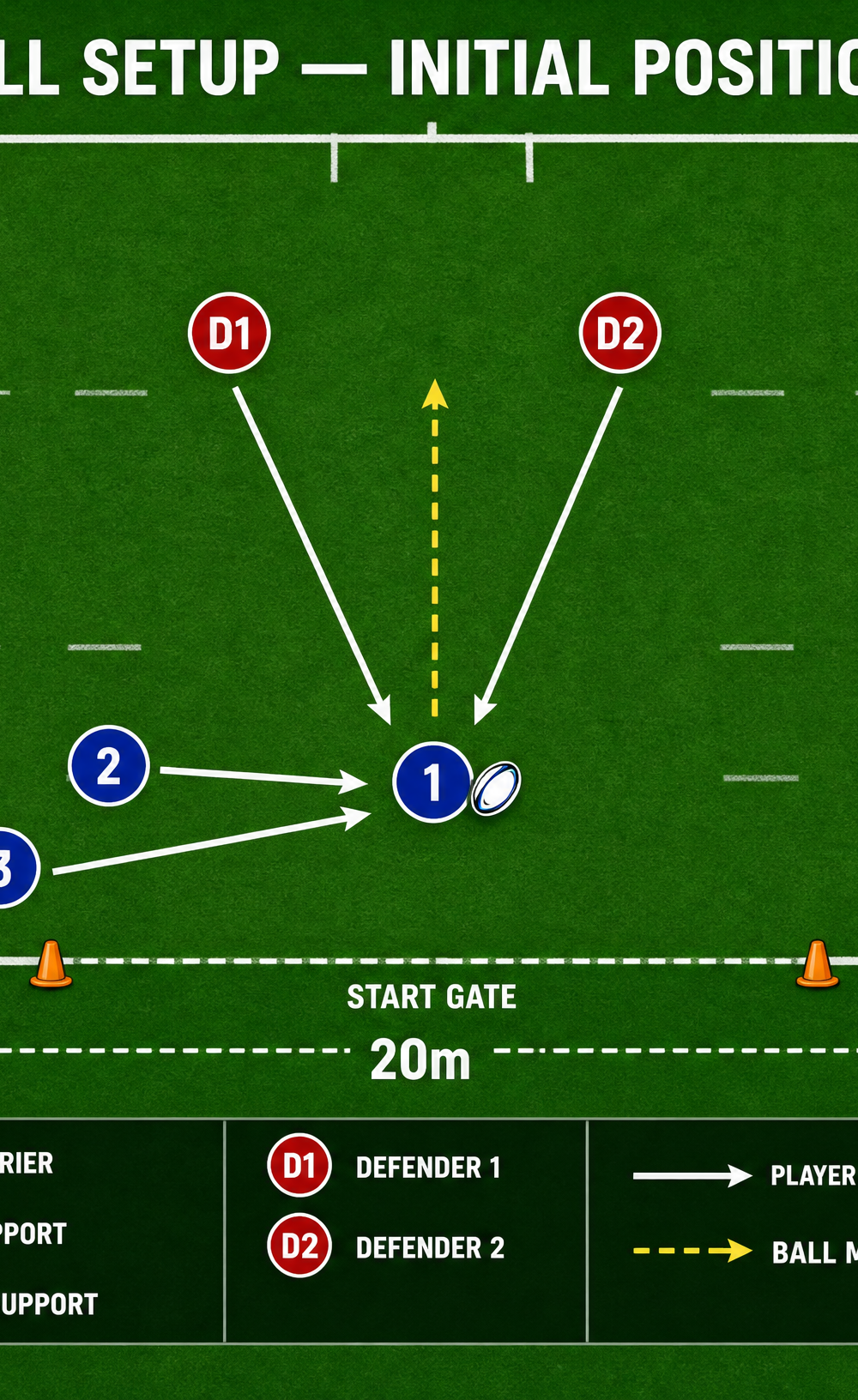
Initial Positions:
- Attacker 1 (Ball Carrier): Starts centrally at the bottom of the grid on the start line.
- Attacker 2 (First Support): Starts 3 metres behind and 2 metres to the left or right of the ball carrier.
- Attacker 3 (Second Support): Starts 5 metres behind and 4 metres to the opposite side of Attacker 2.
- Defenders (D1 & D2): Start 10 metres ahead of the ball carrier, positioned centrally to force the attack to make a decision.
3. Step-by-Step Instructions
- The Initiation: On the coach's whistle, Attacker 1 accelerates directly at the gap between the two defenders, holding the ball in two hands to commit them.
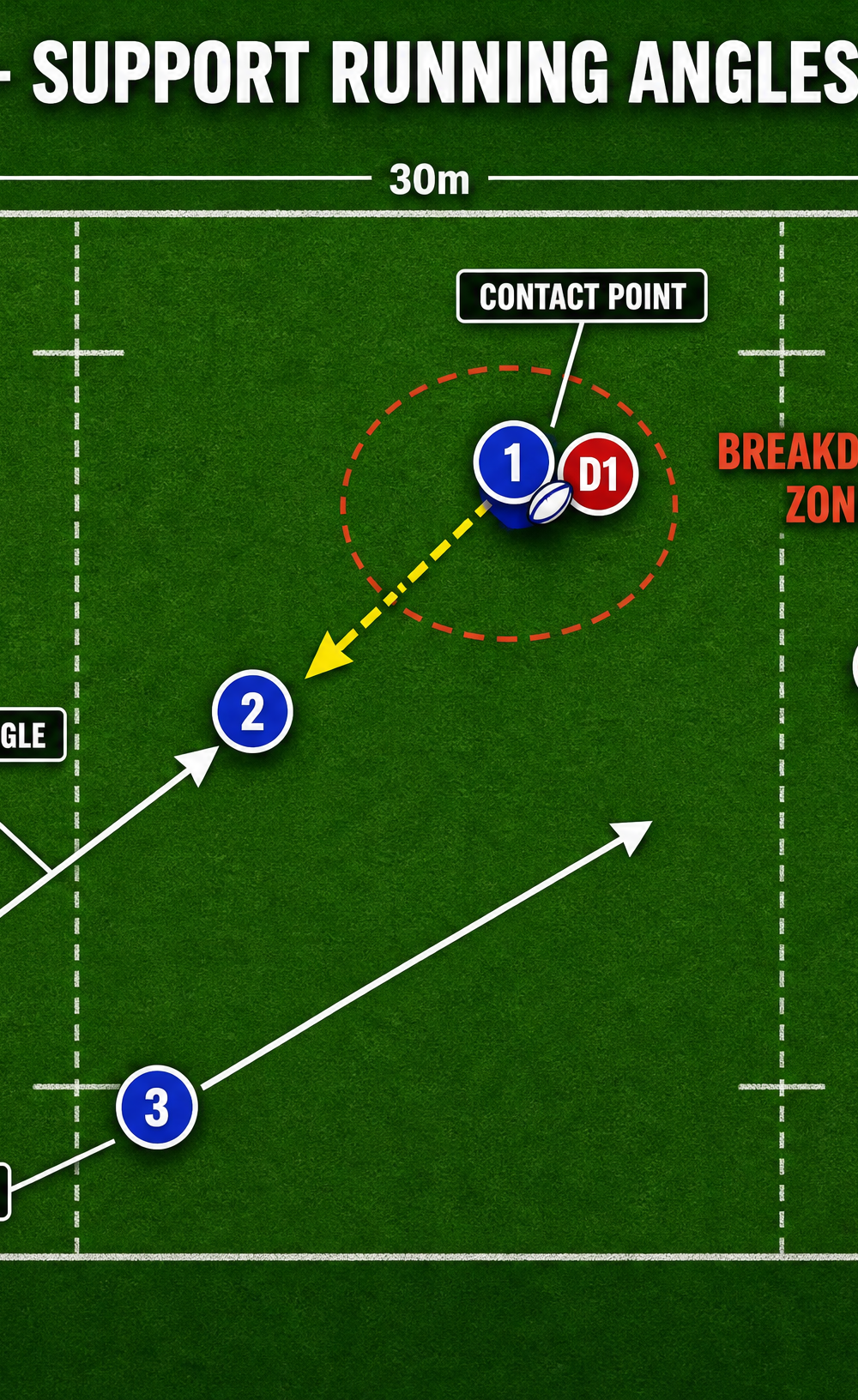
- The Angles: As Attacker 1 engages the defensive line, Attacker 2 must run a sharp, diagonal angle (45 degrees) cutting off the hip of the ball carrier. Attacker 3 maintains depth and runs a wider sweeping angle to provide an option outside.
- The Contact/Decision: Attacker 1 must read the defenders. If D1 steps in to make the tackle, Attacker 1 executes a late footwork shift and attempts to free their arms for an offload.
- The Execution: Attacker 2 must burst onto the ball at pace, communicating loudly (e.g., "Left! Left!" or "Pop!"). Attacker 1 offloads the ball to Attacker 2.
- The Continuation: Once Attacker 2 receives the ball, they must immediately accelerate. Attacker 3 now becomes the primary support, adjusting their angle to support the new ball carrier against the remaining defender (D2).
- The Finish: The attacking team must score over the far 30m line without being tackled to ground.
4. Key Coaching Points
- Depth is Non-Negotiable: Support runners must start deep. It is impossible to accelerate onto a flat pass. If you are flat, you are out of the game.
- Run at Shoulders, Not Spaces: Support runners should aim their runs at the inside or outside shoulder of the defender tackling the ball carrier. This isolates the defender and forces them to make a decision.
- Late Angles: The support line should only be cut late. Running the angle too early allows the defense to drift and cover the threat.
- Two-Handed Carry: The ball carrier must hold the ball in two hands until the last possible second. This keeps the defenders guessing and keeps both passing options alive.
- Vocal Dominance: Support players must dictate the play with clear, loud, and specific communication (e.g., "Inside!", "Pop!", "Hold!").
5. Common Mistakes
- Running Too Flat: Players creep up alongside the ball carrier, resulting in forward passes or being easily tackled simultaneously with the carrier.
- Running Directly Behind: Support players run straight up the back of the ball carrier, offering no angle for an offload and crowding the breakdown.
- Committing Too Early: The ball carrier passes before committing the defender, allowing the defense to simply slide across and make the tackle on the next man.
- Silent Running: Support players expect the ball carrier to find them without any verbal cues. In a chaotic contact situation, the ears are as important as the eyes.
6. Variations & Progressions
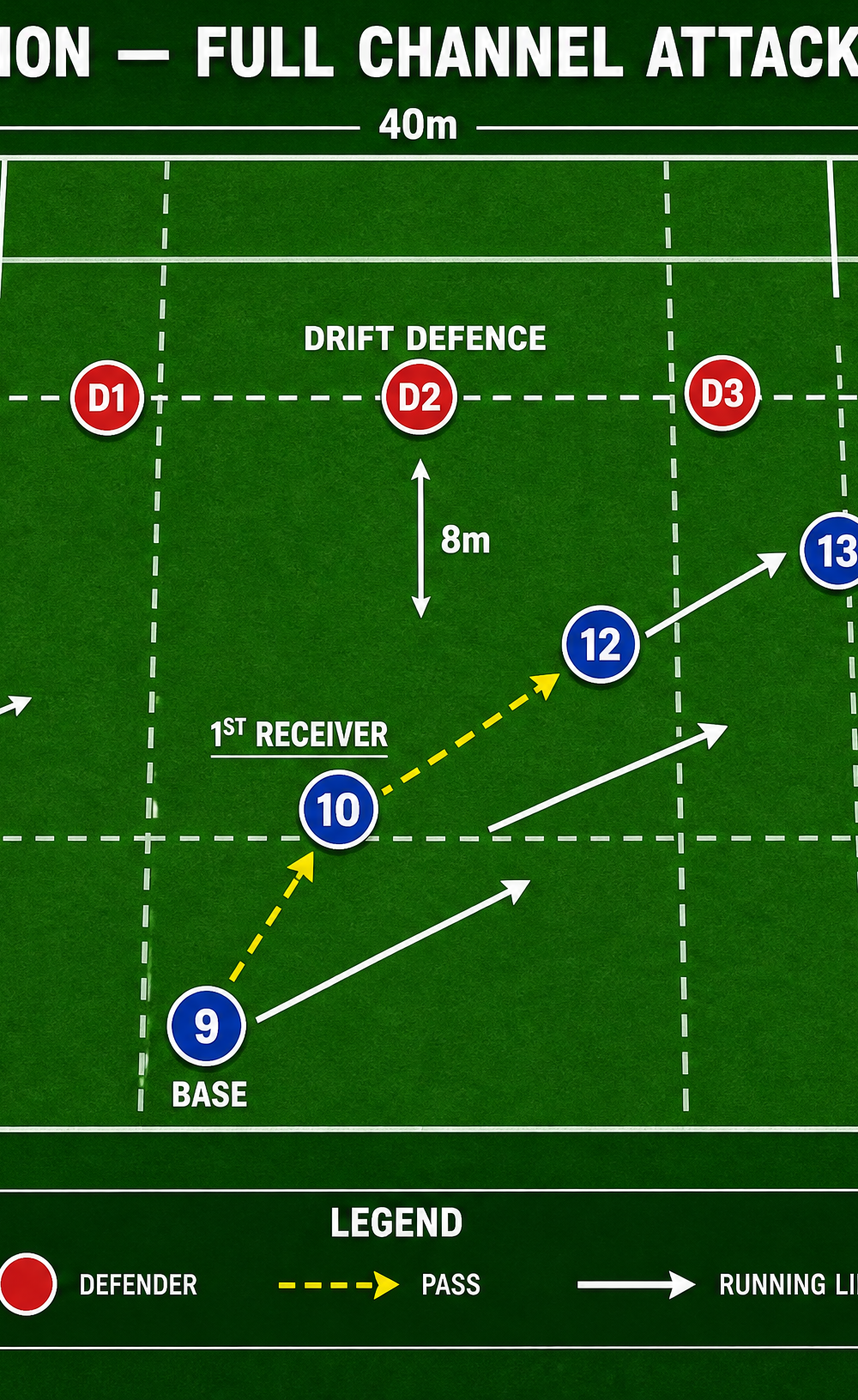
- Progression 1: Full Channel Attack (4v3). Widen the grid to 40m x 30m. Add a scrum-half (9) to initiate the play and a third defender. This simulates a more realistic backline move, requiring the fly-half (10) and centres (12, 13) to run coordinated lines off the base.
- Variation 1: The Tip Pass. Instead of taking the tackle, the ball carrier tips the ball on early to a forward running a hard, flat line off their shoulder before contact is made.
- Variation 2: The Inside Ball. The first support runner fakes an outside line and cuts hard back against the grain on the inside shoulder of the ball carrier.
7. Age Adaptations
- Under 8 - Under 10: Remove the defenders entirely initially. Focus solely on the mechanics of running onto the ball at pace and catching it while moving. Introduce passive defenders (touch only) later.
- Under 12 - Under 14: Introduce the 3v2 setup but use tackle shields for the defenders to build confidence in the contact area and the offload.
- Under 16 - Open: Full contact. Emphasize the speed of the breakdown if the offload is not on. The support runners must immediately transition from potential receivers to effective clear-out players.