

Rugby
The 'Safe House' Exit: Executing a Flawless 22m Clearance
Master the art of relieving pressure from deep in your own 22 with this structured, low-risk kick-exit strategy that guarantees territory gain and sets up a robust defensive chase.

What you need
Rugby balls, Cones (for marking target zones), Scrum machine (optional, for forward pack isolation drills)
Overview
Operating deep within your own 22-metre area is often the most high-pressure scenario a rugby team can face. The primary objective when defending this zone is simple: relieve pressure, gain territory, and reset the defensive line on your terms. The 'Safe House' Exit is a structured set play designed to transition a team from a defensive scrum or breakdown inside their own 22 into a dominant territorial position near the halfway line.
This play minimises risk by establishing a secure platform, utilising a designated kicker (usually the Fly-half, 10), and deploying a coordinated chase line. By executing this exit strategy, coaches can ensure their team avoids turning the ball over in dangerous areas while simultaneously putting the opposition under pressure with a well-placed kick to touch or a contestable high ball.
Setup
To run this set play effectively in training, you will need the following setup:
- Pitch Area: A full 100m x 70m pitch, or at least a marked area from the try line to the halfway line, including the 22m and 10m lines.
- Player Positions: A full 15-man team (or modified for smaller sided games), with specific focus on the tight five (1-5), back row (6-8), Scrum-half (9), Fly-half (10), and the back three (11, 14, 15).
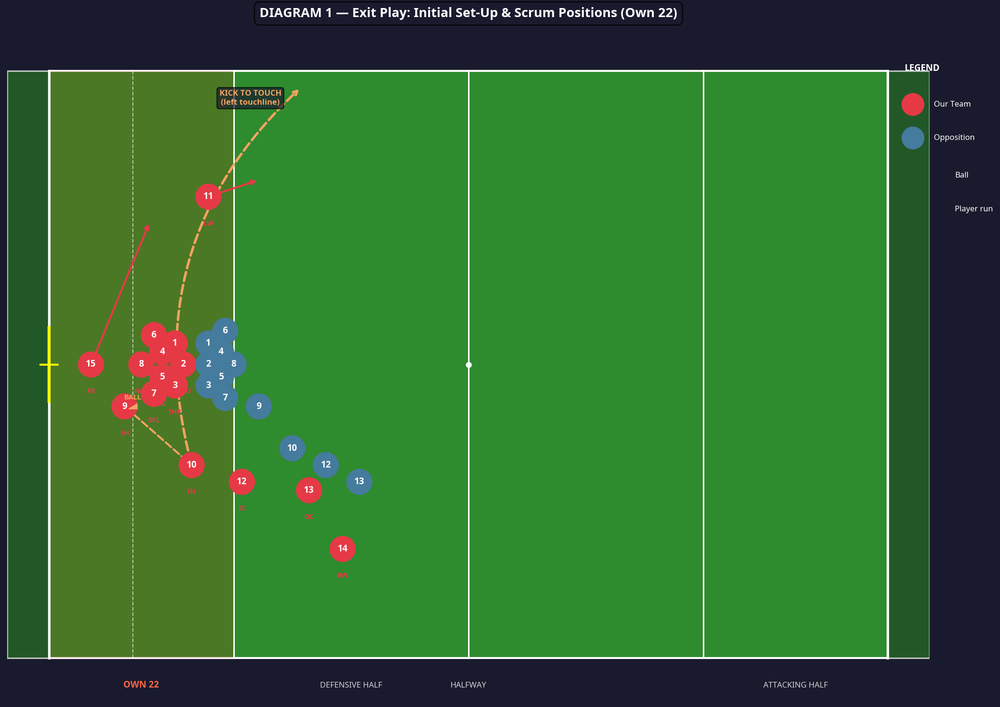
- Starting Point: A scrum awarded to your team approximately 15 metres from your own try line, slightly offset from the centre.
Step-by-Step Instructions
Phase 1: Securing the Platform
- The Scrum Assembly: The forward pack (1-8) must focus entirely on stability. The goal is not to push for a penalty, but to provide a rock-solid platform. The Number 8 must control the ball securely at the base.
- The Scrum-half Positioning: The Scrum-half (9) positions themselves directly behind the Number 8, ready to clear the ball rapidly. They must scan the opposition defensive line to ensure the passing channel to the Fly-half is clear.
- The Kicker's Alignment: The Fly-half (10) drops deep, approximately 10 to 12 metres behind the scrum, creating sufficient time and space to execute the kick without being charged down. They should align slightly to the side of their preferred kicking foot.
Phase 2: The Execution and Chase
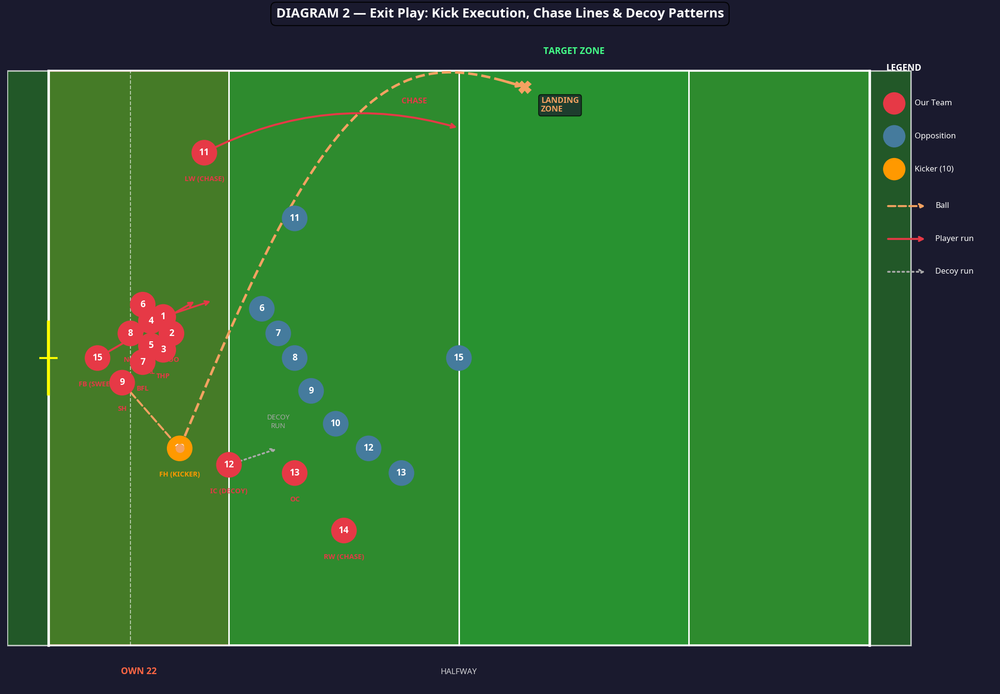
- The Delivery: Upon the Number 8 securing the ball, the Scrum-half delivers a swift, accurate pass directly to the Fly-half's hands. Speed of delivery is paramount to maintain the time advantage.
- The Kick: The Fly-half receives the ball and immediately executes a driving kick aimed at the touchline near the halfway mark. The trajectory should be high enough to allow the chase to develop, but long enough to secure significant territory.
- The Decoy: Simultaneously, the Inside Centre (12) runs a hard, flat decoy line to hold the opposition's midfield defence, preventing them from drifting across to cover the kick.
- The Chase Line: The Left Wing (11) and Right Wing (14) immediately sprint upfield, tracking the flight of the ball. Their objective is to either contest the catch or make an immediate, dominant tackle on the receiver if the ball does not find touch.
- The Sweeper: The Full-back (15) drops back to cover any potential return kick, acting as a sweeper behind the primary chase line.
Key Coaching Points
- Scrum Stability Over Dominance: Emphasise to the forward pack that a stable ball is more important than driving the opposition backwards. A disrupted scrum ruins the timing of the exit.
- Speed of Service: The Scrum-half must clear the ball in one fluid motion. Any hesitation allows the opposition flankers to detach and pressure the kicker.
- Kicker's Depth: Ensure the Fly-half is deep enough. A common error is standing too flat, which increases the risk of a charge-down and limits the angle for the kick.
- Coordinated Chase: The kick is only as good as the chase. The wingers must remain onside (behind the kicker) but accelerate instantly once the ball is struck. A fragmented chase line creates gaps for counter-attacks.
Common Mistakes
- Holding the Ball Too Long: The Number 8 keeping the ball at the base of the scrum unnecessarily, allowing the opposition to reset their defensive pressure.
- Poor Pass Quality: A slow or inaccurate pass from the Scrum-half forces the Fly-half to adjust their feet, disrupting the kicking motion and increasing charge-down risk.
- Lack of Communication: Failure of the Fly-half to communicate their intended target zone to the chasing wingers, resulting in a disconnected defensive effort.
Variations & Progressions
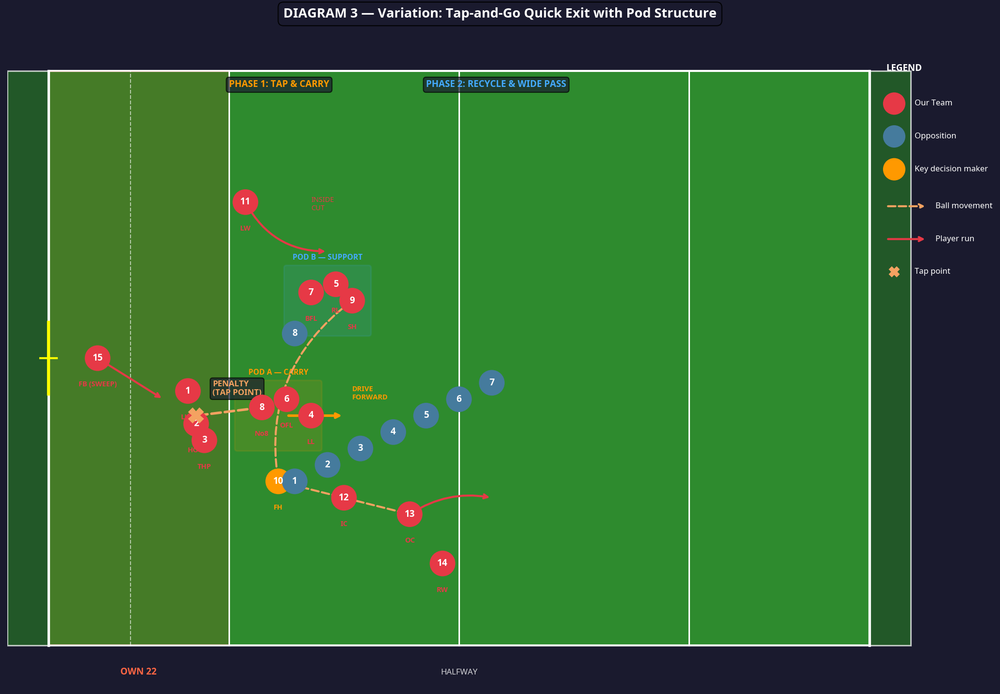
Variation 1: The Tap-and-Go Quick Exit
If a penalty is awarded instead of a scrum, the team can execute a rapid 'Tap-and-Go' variation. This involves a quick tap by the Number 8 or a designated forward, who carries hard into the defensive line supported by a tight 'Pod' of forwards. This draws in defenders, creating space out wide. The ball is then quickly recycled to the Fly-half, who now has a wider channel to kick or pass through a secondary pod structure.
Progression 1: Contestable Box Kick
Instead of kicking directly for touch, progress the play by having the Scrum-half execute a high box kick just outside the 22. This requires exceptional coordination from the chasing winger to compete in the air, aiming to regain possession rather than just territory.
Age Adaptations
- Under 10s / Under 12s: Focus heavily on the basic mechanics of passing and catching under minor pressure. Replace the long kick with a structured passing sequence to move the ball away from the danger area safely. Emphasise keeping possession.
- Under 14s: Introduce the concept of kicking for territory, but focus on accuracy over distance. Begin teaching the fundamental mechanics of the chase line and the importance of staying onside.
- Under 16s and Above: Implement the full 'Safe House' Exit as described, focusing on the speed of execution, the depth of the kicker, and the aggressive, coordinated nature of the defensive chase.
