

Rugby
Scrum Half Precision: The 3-Target Passing Accuracy Drill
Develop your number 9's passing speed, accuracy, and decision-making under pressure with this progressive target drill.
What you need
5-8 Rugby balls, 10 Marker cones, 1 Ruck pad or tackle bag, 3 Tackle shields (optional)
1. Overview
The scrum half (9) is the heartbeat of any rugby team, dictating the tempo and direction of the attack. A half-second delay or a pass slightly behind the receiver can mean the difference between breaking the gain line and being driven backward. This drill focuses entirely on the scrum half's core skill: delivering fast, accurate, and perfectly weighted passes from the base of the ruck to various depths and widths.
By incorporating multiple targets at different distances, this exercise forces the 9 to adjust their body height, footwork, and follow-through dynamically. It is an essential routine for developing consistency, ensuring your halfback can hit the fly-half (10) flat on the gain line or launch a wide pass to the centres (12/13) to exploit space on the edges. Use this drill during the skills block of your session, or as a high-intensity primer before moving into team attacking structures.
2. Setup
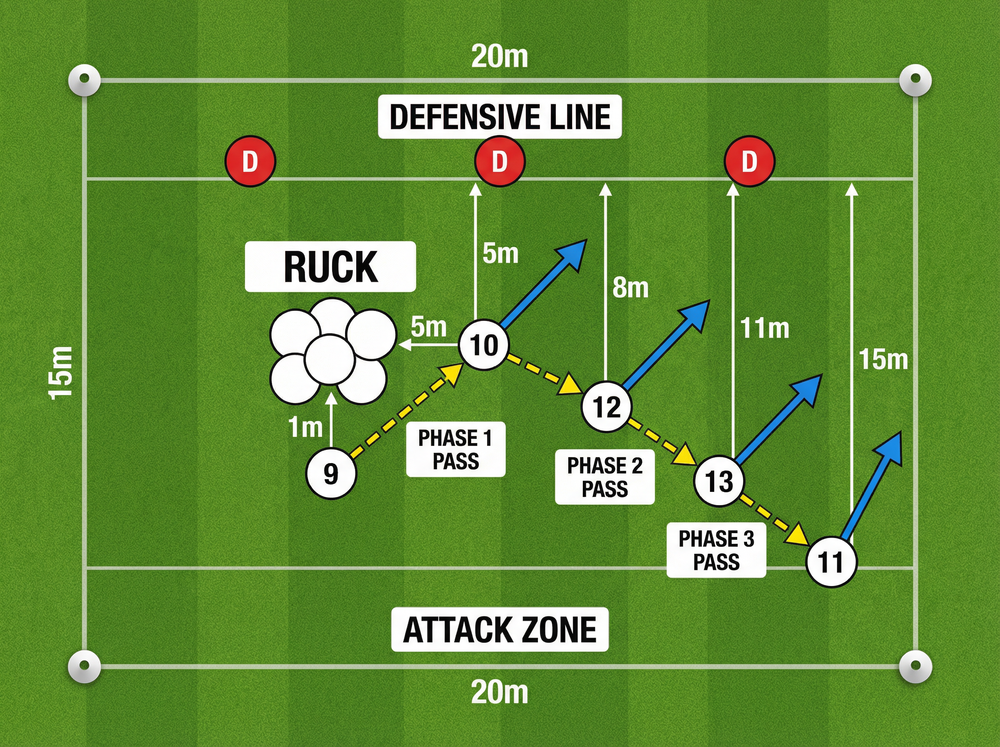
To run this drill effectively, you will need a dedicated 20m x 20m area of the pitch, preferably near the 22-metre line to simulate match conditions.
Equipment Required:
- 5-8 Rugby balls (ensure they are match quality and properly inflated)
- 10 Marker cones (different colours if possible)
- 3 Tackle shields or hit shields (optional, for target progression)
- 1 Ruck pad or tackle bag to simulate the base of the ruck
Pitch Setup:
- Place the ruck pad flat on the ground to represent the hindmost foot of the ruck.
- Position the scrum half (9) 1 metre behind the ruck pad.
- Set up three distinct passing targets using cones (or players holding shields):
- Target 1 (Short/Flat): 5 metres wide, 2 metres deep (simulating a crash ball forward or flat 10).
- Target 2 (Medium): 10 metres wide, 5 metres deep (simulating the standard pass to the 10).
- Target 3 (Long/Wide): 15 metres wide, 8 metres deep (simulating a wide pass to the 12 or 13 bypassing the 10).
- The coach stands 3 metres behind the scrum half to observe mechanics and call the targets.
3. Step-by-Step Instructions
Execution is everything. Ensure your players follow these steps meticulously to build the correct muscle memory.
Step 1: The Approach and Setup
The scrum half starts 2 metres away from the ball. On the coach's whistle, the 9 approaches the ball, dropping their hips and adopting a wide, stable base. The front foot should be pointing towards the intended target.
Step 2: The Grip and Sweep
The player sweeps their hands onto the ball. The back hand provides the power and spin, while the front hand guides the trajectory. The ball should not be lifted unnecessarily before the pass; the movement must be a single, fluid motion from the ground to the target.
Step 3: The Call and Execution
As the 9 arrives at the ball, the coach calls out a number: "One!", "Two!", or "Three!". The scrum half must instantly process the call, adjust their body alignment if necessary, and fire the pass to the corresponding target.
Step 4: The Follow-Through
After releasing the ball, the scrum half's hands and fingers must point directly at the target. Their body weight should transfer towards the receiver, demonstrating full commitment to the pass.
Step 5: Reset and Repeat
The 9 immediately resets to the starting position. The coach rolls another ball to the ruck pad, and the sequence repeats. Aim for 10 passes off the left hand, then switch the setup to practice 10 passes off the right hand.

4. Key Coaching Points
When observing this drill, focus on these critical technical elements:
- Sink the Hips: The power for a long pass comes from the legs and core, not just the arms. Ensure the 9 is dropping their hips and staying low over the ball.
- Point the Front Foot: The front foot acts as the steering wheel. It must point directly at the target to ensure accuracy and prevent the body from twisting off-balance.
- Punch the Hands Through: The follow-through is non-negotiable. Both hands must finish pointing at the target, with the palms facing down or slightly outward.
- Head Position: Keep the head over the ball during the sweep, but snap the eyes to the target just before release. Do not look up too early, which can cause the pass to sail high.
- Clear the Ball Quickly: Minimize the time the ball spends in the hands. The sweep and pass should be one continuous motion. Avoid the "double pump" or taking an extra step unless specifically required by the game situation.
5. Common Mistakes
Watch out for these frequent errors and correct them immediately:
- Standing Up Too Early: Players often pop up from the base before passing, losing power and telegraphing the pass to the defence. Cue them to "stay in the tunnel."
- Spinning Unnecessarily: Over-rotating the ball on short passes (Target 1) makes it difficult for the receiver to catch. Emphasize a soft, end-over-end pop pass for short distances.
- Passing Behind the Target: Failing to lead the receiver. Remind the 9 that they are passing to where the receiver will be, not where they are standing. The ball must be put out in front.
- Taking Steps Away from the Ruck: Taking lateral steps before passing slows down the delivery and allows the defensive line to advance. The pass must be cleared directly from the base.
6. Variations & Progressions
Once the core skill is mastered, introduce these variations to increase the difficulty:
- Moving Targets: Replace the cones with actual players (10, 12, 13) who run onto the ball from depth. The 9 must now time the pass to hit the moving player perfectly in stride.
- Fatigue Element: Have the 9 complete a down-and-up (burpee) or run around a cone 5 metres away before approaching the ruck. This simulates late-game fatigue and tests their ability to execute under physical stress.
- Defensive Pressure: Introduce a defender (the opposition 9 or a flanker) standing opposite the ruck. On the whistle, the defender can attempt to charge down the pass or pressure the 9, forcing quicker decision-making and execution.
7. Age Adaptations
Tailor the drill to suit the developmental stage of your players:
- Under 8s to Under 10s: Focus entirely on the basic pop pass. Remove the long targets and emphasize simply getting the ball from the ground to a stationary receiver 2-3 metres away. Do not worry about spin passing at this stage.
- Under 12s to Under 14s: Introduce the spin pass for Targets 2 and 3. Focus heavily on the grip and the follow-through. Ensure they are practicing equally off both hands.
- Under 16s to Open Grade: Implement all progressions, including moving targets, defensive pressure, and fatigue elements. Demand high speed, perfect accuracy, and rapid decision-making based on the coach's calls.
