

Cricket
Spin Bowling Variations Drill: Mastering the Art of Deception
Equip your spin bowlers with the ability to deceive batsmen through subtle variations in flight, turn, and bounce using this comprehensive target-based drill.

What you need
6-8 cricket balls, Target markers (cones or chalk), 1 set of stumps, Full 22-yard pitch
1. Overview
The ability to bowl variations is what separates a good spin bowler from a great one. This drill is designed to help spin bowlers develop and master their variations—such as the top-spinner, arm ball, googly, or slider—without losing their core stock delivery. By utilizing target zones and specific field settings, coaches can simulate match pressure and encourage bowlers to think tactically about when and how to use their variations to deceive the batsman in flight, turn, or bounce.
2. Setup

Equipment Needed:
- 6-8 high-quality cricket balls (preferably a mix of new and slightly worn)
- Target markers (flat cones or chalk to mark the pitch)
- 1 set of stumps (at the batting end)
- A full 22-yard cricket pitch (turf or artificial)
Pitch and Field Setup:
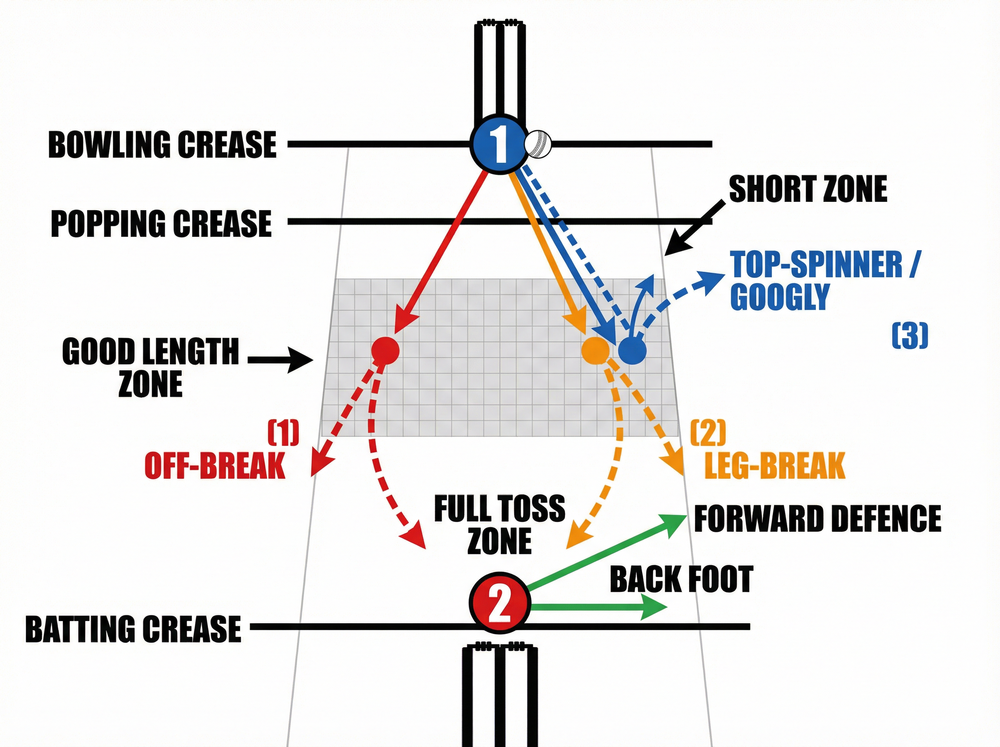
Set up the pitch by placing target markers on a 'good length' area, typically 3 to 4 meters from the batting crease, depending on the age and skill level of the bowler. Create a primary target zone for the stock delivery and a secondary, slightly adjusted target zone for the variation.

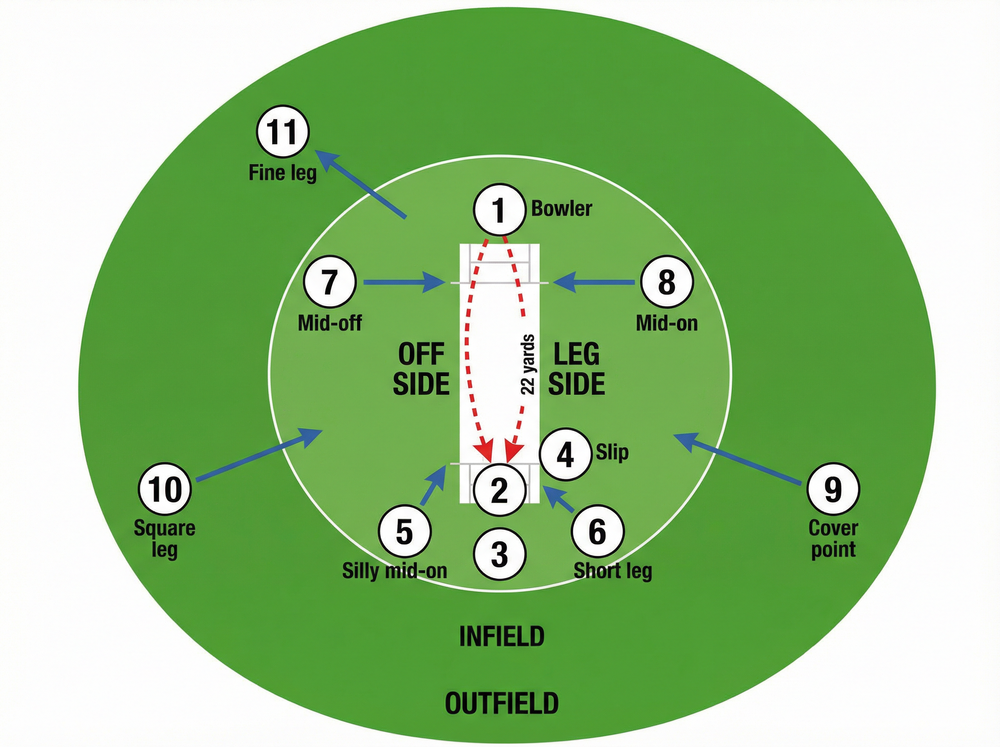
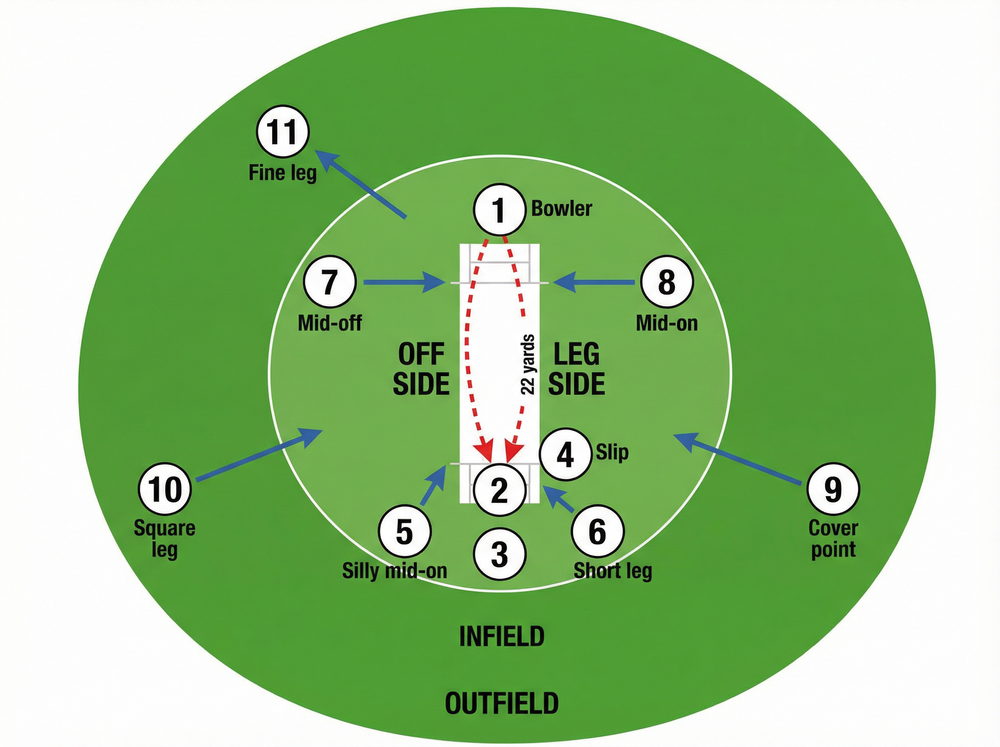
Diagram 1: A standard attacking field setting for an off-spin bowler, showing key fielding positions.
Player Positions:
- 1 = Bowler: Operating from the bowling crease.
- 2 = Batsman: (Optional) A batsman can stand at the crease to provide a visual reference, but should only defend or leave the ball during the initial stages.
- 3 = Wicket-keeper: Standing up to the stumps to provide immediate feedback on flight and bounce.
3. Step-by-Step Instructions
- Warm-up and Stock Ball: Have the bowler bowl 2-3 overs of purely their stock delivery (e.g., standard off-breaks or leg-breaks). The goal is to consistently hit the primary target zone marked on the pitch.
- Introduce the Variation: Ask the bowler to bowl their chosen variation (e.g., a top-spinner or googly). Discuss the slight changes in grip, wrist position, or release point required.
- Target Practice: The bowler now bowls sets of six deliveries. In each set, they must bowl four stock deliveries and two variations. The coach dictates when the variation should be bowled (e.g., ball 3 and ball 6).
- Visualizing the Trajectory: Encourage the bowler to visualize the flight path. The variation should ideally start on the same trajectory as the stock ball to deceive the batsman.
- Match Simulation: Introduce a batsman who will actively play the ball. The bowler must now set a field (as shown in Diagram 1) and bowl to a plan, using their variation to exploit the batsman's weaknesses or the field setting.

Diagram 2: Side-on view of the 22-yard pitch illustrating the different trajectories and bounce of stock deliveries versus variations.
4. Key Coaching Points
- Maintain Arm Speed: The most crucial element of a successful variation is maintaining the same arm speed as the stock delivery. Any slowing of the arm will immediately alert the batsman.
- Subtle Changes: The changes in grip or release should be subtle. If the action changes drastically, the variation loses its element of surprise.
- Consistency is Key: A variation is only effective if the stock ball is consistent. Ensure the bowler can land their stock delivery 8 out of 10 times before heavily focusing on variations.
- Tactical Awareness: Teach the bowler why they are using a variation. Is it to get a wicket, stem the flow of runs, or set the batsman up for the next delivery?
5. Common Mistakes

- Telegraphing the Delivery: Changing the run-up, load-up, or arm speed when bowling a variation, which tips off the batsman.
- Overusing Variations: Bowling too many variations in an over, which allows the batsman to get comfortable and diminishes the stock ball's effectiveness.
- Loss of Accuracy: Sacrificing line and length in an attempt to get extra spin or bounce on the variation.
6. Variations & Progressions

- Progression 1: Blind Targets: Remove the physical markers on the pitch and ask the bowler to hit the imaginary zones. The wicket-keeper calls out whether the length was correct.
- Progression 2: Pressure Scenarios: Give the bowler a specific match scenario (e.g., "The batting team needs 10 runs off the last over, and this batsman struggles against the googly").
- Variation: The 'Mystery' Ball: For advanced bowlers, introduce the concept of a 'mystery' delivery that spins the opposite way with an almost identical action.
7. Age Adaptations
- Under 10 - Under 12: Focus purely on the stock delivery. Introduce the concept of changing pace (bowling slightly faster or slower) rather than complex spin variations.
- Under 14 - Under 16: Introduce one primary variation (e.g., the top-spinner). Emphasize maintaining arm speed and hitting the correct length.
- Open / Advanced: Full integration of multiple variations, tactical field settings, and match-scenario pressure training.
