Football
Set Play
intermediate
under 14
Throw-In Play for Quick Advantage: The 'Wedge' Routine
Learn how to turn an attacking third throw-in into an immediate goal-scoring opportunity by using coordinated decoy runs and quick combinations.
May 17, 20265 min read15 min drill5 players

Equipment Needed
1 Football
Full-size pitch or scaled training area
Bibs (2 colors)
Overview
Throw-ins in the attacking third are often wasted opportunities. Many teams simply throw the ball down the line, resulting in a 50/50 challenge or immediate loss of possession. This set play, which we call the 'Wedge' Routine, is designed to create a numerical advantage and exploit the space left behind by defenders drawn to the initial movement.
By utilizing a sharp decoy run and a well-timed diagonal check, you can quickly transition from a static restart into a dynamic attacking phase, bypassing the first line of defense and delivering a dangerous cross or cutback into the penalty area.
Setup
- Location: Attacking third, either touchline (diagrams show right touchline).
- Equipment Needed: 1 Football, full-size pitch (100-110m x 64-75m) or appropriately scaled training area, bibs for two teams.
- Player Positions:
- Player 2 (Thrower): Needs a strong, accurate throw.
- Player 7 (Decoy): Positioned 5m from the thrower, needs explosive acceleration.
- Player 10 (Target Runner): Positioned 10m inside the pitch, needs good close control and vision.
- Player 9 (Striker): Positioned centrally, ready to attack the near post.
- Player 11 (Opposite Winger): Positioned wide on the far side, arriving late into the box.
Step-by-Step Instructions
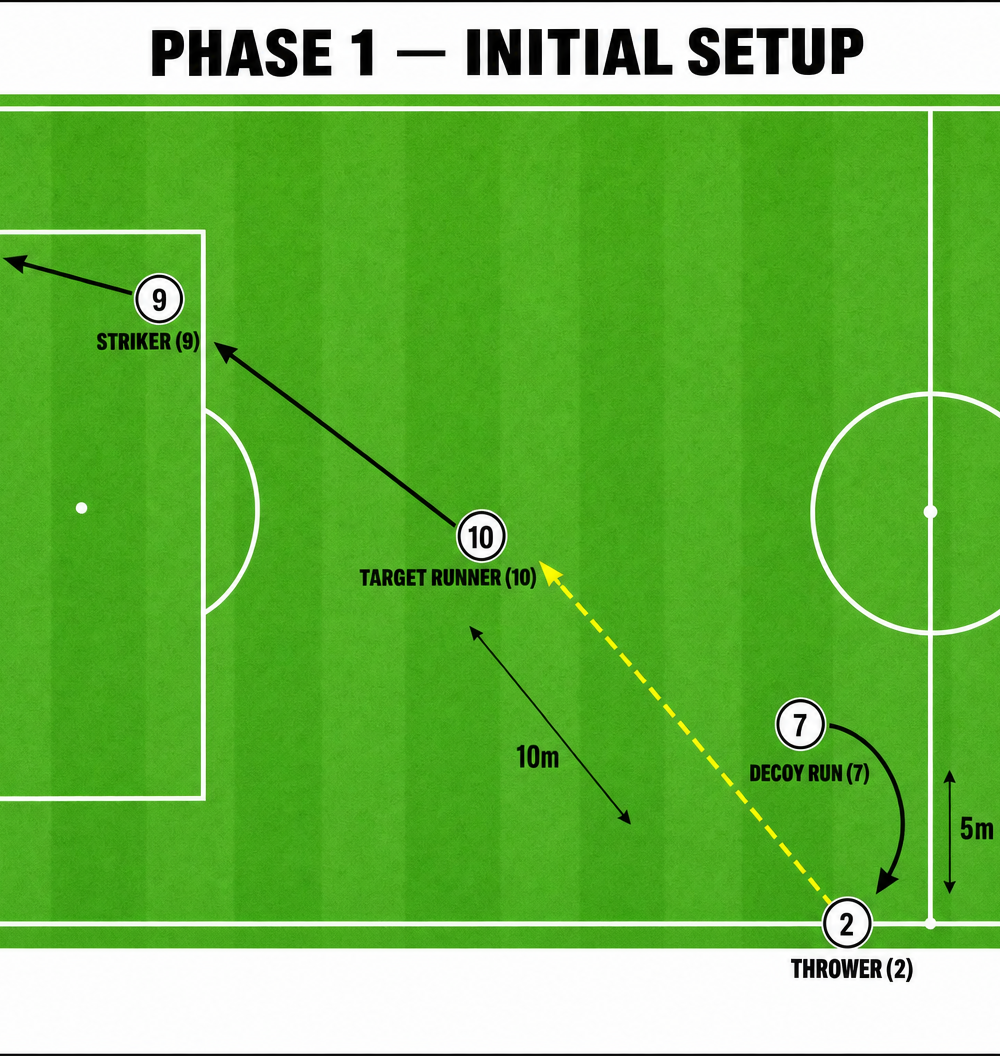
Phase 1: The Setup and Decoy
- Trigger: The play begins when Player 2 (Thrower) raises the ball above their head with both hands. This is the visual cue for the movement to start.
- The Decoy Run: Player 7 sprints aggressively toward the thrower, curving their run slightly to drag the marking defender with them. This movement must look like a genuine attempt to receive a short throw.
- The Target Check: As Player 7 drags the defender out of position, Player 10 makes a sharp, diagonal run into the space vacated by Player 7. This run should be angled toward the corner of the penalty area.
- The Throw: Player 2 delivers a firm, flat throw to the feet or chest of Player 10. The throw must be paced so Player 10 can control it smoothly while moving.
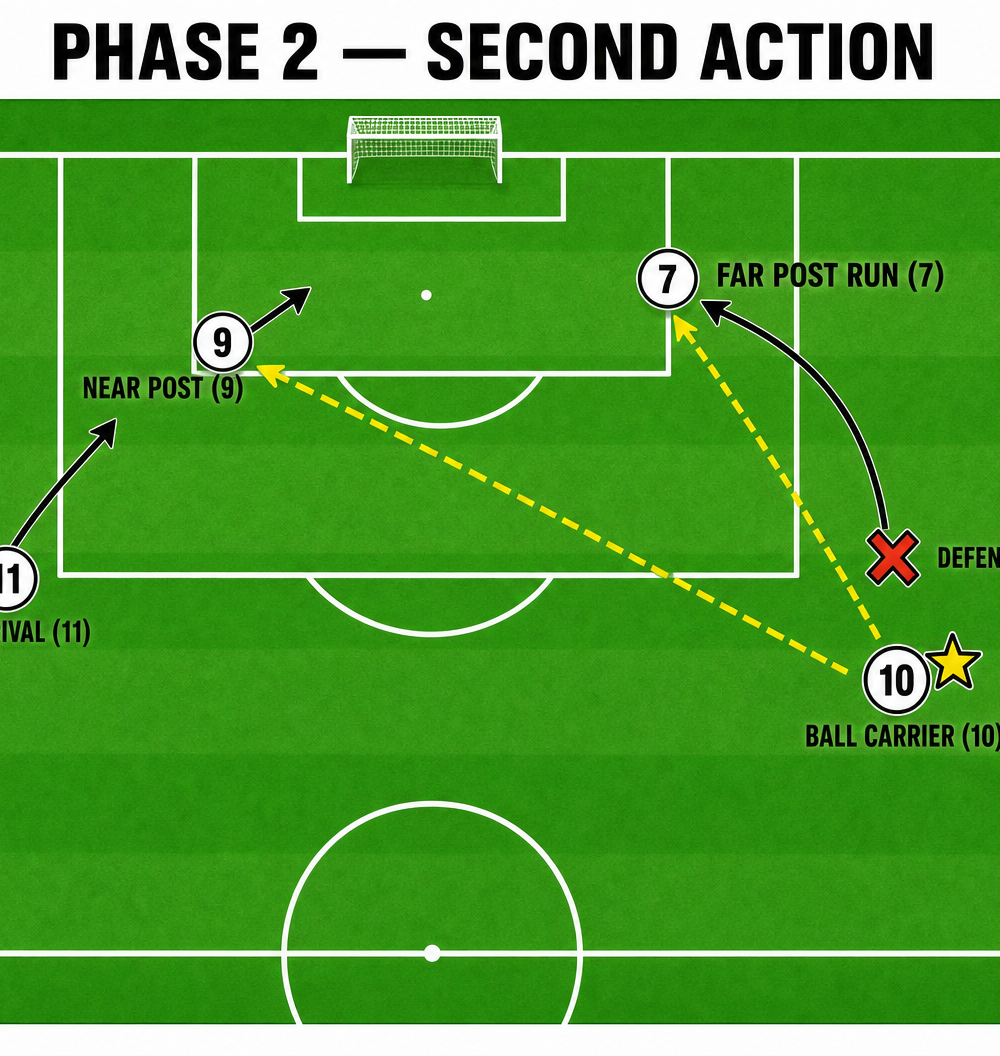
Phase 2: The Execution
- The Turn: Player 10 receives the ball and immediately opens their body to face the goal, bypassing the initial defender who followed the decoy run.
- The Continuation: Player 7, after completing the decoy run, immediately spins and makes a penetrating run down the touchline or into the far post area, offering a passing option.
- Box Movement: Simultaneously, Player 9 makes a hard, near-post run to drag the center-backs, while Player 11 arrives late at the back post.
- The Final Ball: Player 10 assesses the options and delivers a cross to Player 9 (near post), a floated ball to Player 11 (far post), or plays a through ball to Player 7 who has continued their run.
Key Coaching Points
- Timing is Everything: The trigger (ball over the head) must dictate the movement. If Player 10 runs too early, the space won't be open. If they run too late, the defender will recover.
- Sell the Decoy: Player 7 must sprint with 100% effort. If the run is lazy, the defender will not follow, and the space for Player 10 will not materialize.
- Quality of the Throw: The throw must be firm and flat. A loopy throw gives the defense time to adjust and challenge for the ball.
- First Touch Direction: Player 10's first touch must take them aggressively toward the goal or into space, never backward toward the touchline.
- Coordinated Box Runs: The runs from Players 9 and 11 must be synchronized with Player 10's touch. They should arrive in their zones exactly as the ball is ready to be delivered.
Common Mistakes
- Static Starting Positions: Players standing still before the trigger makes them easy to mark. Encourage subtle movements before the explosive runs.
- Throwing Down the Line: Throwers often default to throwing down the line if they panic. They must trust the routine and wait for the space to open.
- Poor Spacing: If Player 10 starts too close to Player 7, the runs will cross, and the defenders will not be adequately separated. Maintain the 10m distance.
- Forgetting the Continuation Run: Player 7 often stops after the decoy run. They must immediately transition into an attacking run to overload the defense.
Variations & Progressions
- The Return Pass: If Player 10 is tightly marked upon receiving the ball, they can play a quick one-touch pass back to Player 2 (Thrower), who has stepped onto the pitch, to deliver a first-time cross.
- The Dummy: Player 10 lets the ball run through their legs for Player 9, who has dropped slightly deeper, creating chaos in the penalty area.
- Adding a Defender: In training, start with passive defenders and progress to full pressure to ensure the timing holds up under match conditions.
Age Adaptations
- Under 8 - Under 10: Focus simply on the concept of one player moving to create space for another. Keep the throw-in distances shorter and don't worry too much about complex box runs.
- Under 12 - Under 14: Introduce the specific triggers and the continuation run from the decoy player. Emphasize the quality of the throw and the first touch.
- Under 16 - Open: Execute the full routine with all variations. Demand high-speed execution, precise timing, and ruthless finishing in the penalty area.