

Netball
Mastering the Wing Attack (WA) Feeding Patterns: Lead, Dummy, and Overlap
Equip your Wing Attack with dynamic leading patterns, dummy drives, and advanced overlaps to break defensive lines and feed the circle effectively.

What you need
2-3 Netballs, 4-6 Cones, 1 Set of bibs
Mastering the Wing Attack (WA) Feeding Patterns: Lead, Dummy, and Overlap
The Wing Attack (WA) is the crucial link between the midcourt and the shooting circle. To effectively feed the shooters, the WA must consistently find space on the circle edge, requiring agility, timing, and intelligent movement. This comprehensive drill resource breaks down three essential WA feeding patterns: the Basic Lead, the Dummy & Drive, and the Advanced Overlap & Rotation.
1. Overview
This drill focuses on developing the Wing Attack's ability to lose their defender (Wing Defence - WD), receive the ball in a strong feeding position, and deliver an accurate pass to the Goal Attack (GA) or Goal Shooter (GS).
What this drill achieves:
- Enhances the WA's change of direction and explosive speed.
- Improves the timing between the Centre (C) and the WA.
- Develops court awareness and decision-making on the circle edge.
- Introduces advanced rotational play to confuse the defense.
When to use it:
Incorporate this drill during the attacking phase of your training sessions. It is particularly useful when your team is struggling to transition the ball smoothly from the centre third into the attacking third, or when your WA is being heavily contested by the opposition WD.
2. Setup

Proper setup is essential for maximizing repetitions and simulating match conditions.
Equipment Needed:
- 2-3 Netballs
- 4-6 Cones (optional, to mark starting positions)
- 1 Set of bibs (if incorporating defenders)
Court Setup & Player Positions:
- Utilize one half of a standard netball court (30.5m x 15.25m).
- Centre (C): Starts with the ball in the centre third, near the transverse line.
- Wing Attack (WA): Starts wide in the centre third.
- Goal Attack (GA) & Goal Shooter (GS): Positioned inside the attacking third and goal circle.
- Wing Defence (WD): Starts on the WA (can be passive initially, then active).
3. Step-by-Step Instructions
We will progress through three distinct movement patterns, starting with the fundamentals and advancing to complex rotations.
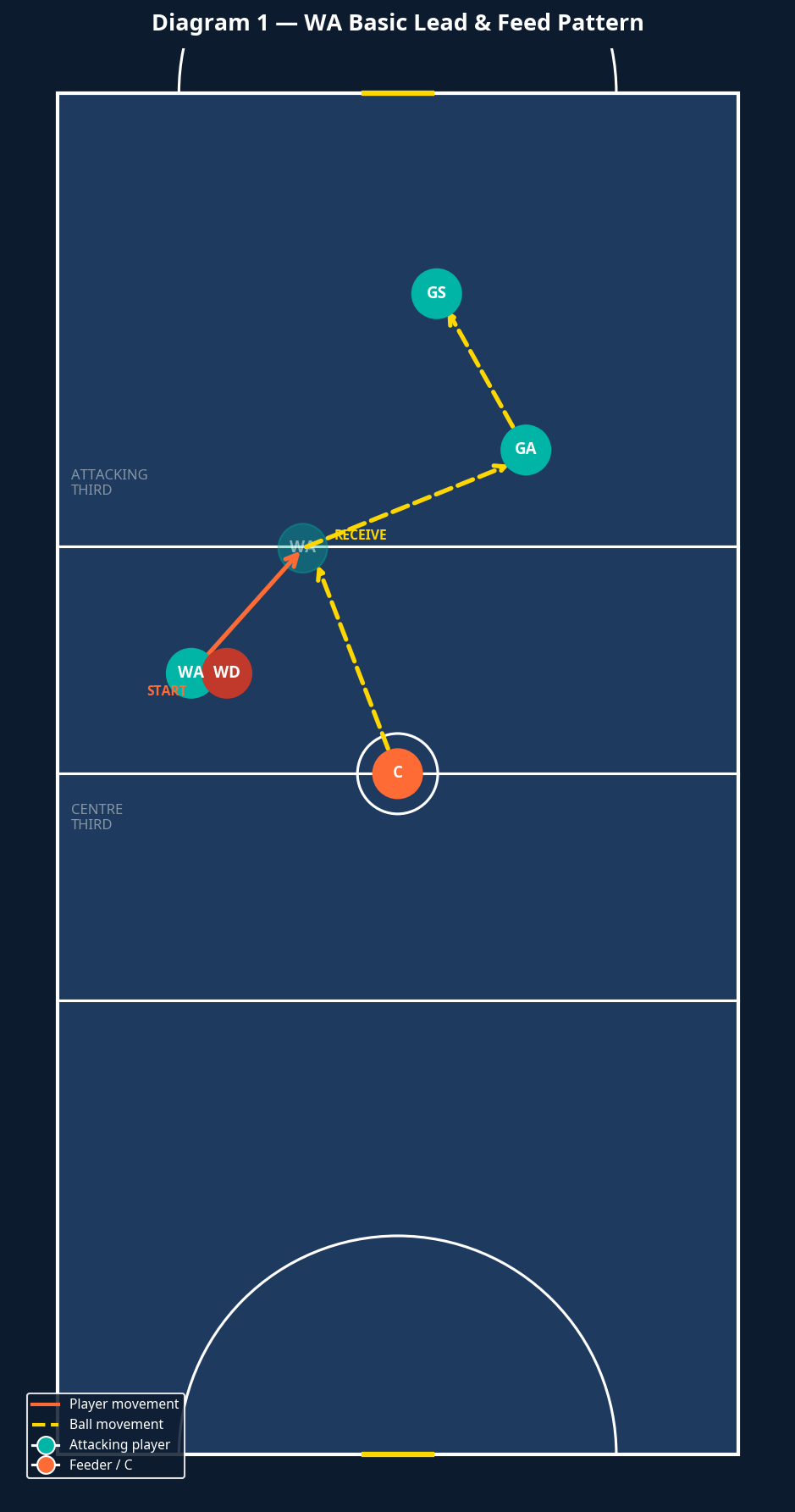
Pattern 1: Basic Lead & Feed
This pattern establishes the foundational movement required to hit the circle edge.

- Starting Position: The WA sets up wide in the centre third, drawing the WD away from the middle channel.
- The Drive: The WA pushes off their outside foot and drives hard and diagonally toward the space near the transverse line, aiming for the top of the goal circle.
- The Pass: The C delivers a strong, flat pass to the WA as they hit the space. The pass must be timed so the WA receives it on the run, facing the goal circle.
- The Feed: Upon receiving the ball, the WA immediately turns their hips and shoulders toward the post, spots the GA or GS, and delivers an accurate feed into the circle.
Pattern 2: Dummy & Drive (Double Lead)
When the WD starts anticipating the basic lead, the WA must use deception.
- The Dummy: The WA initiates a sharp, short drive toward the centre channel. This "dummy" lead is designed to pull the WD out of position.
- The Change of Direction: As soon as the WD commits to the dummy lead, the WA firmly plants their foot, changes direction, and explodes into the newly created space on the wide side of the transverse line.
- The Pass: The C reads the change of direction and passes the ball into the open space for the WA to run onto.
- The Feed: The WA receives the ball on the circle edge, balances quickly, and feeds the GA or GS.
Pattern 3: Advanced Overlap & Rotation
This pattern introduces dynamic midcourt rotation to overload the defense and create confusion.

- Initial Pass: The C passes the ball to the WA, who has made a short lead to receive just over the transverse line.
- The Overlap: As the WA turns to look for the shooters, the C immediately makes a hard, overlapping run past the WA into the deep attacking space.
- The Decision: The WA can either feed the shooters directly OR pass to the overlapping C if they are in a better feeding position.
- The Rotation: If the C drives deep, the WA must rotate back to cover the C's vacated space near the transverse line, ensuring defensive balance in case of a turnover.
4. Key Coaching Points
To ensure your players execute these patterns effectively, emphasize the following coaching points:
- Explosive Change of Direction: The WA must use sharp, definitive movements. The dummy lead must look convincing before the explosive drive into space.
- Timing of the Pass: The C must release the ball into the space the WA is running into, not where they currently are. Passing too early or too late will result in an interception.
- Strong Receiving Posture: The WA should aim to receive the ball with strong, balanced footwork (ideally a 1-2 step or outside foot landing), allowing them to turn fully toward the goal post immediately.
- Vision on the Turn: As the WA receives the ball, their eyes should already be scanning the circle for the GA and GS.
- Commit to the Overlap: The C must sprint hard on the overlap run. A slow jog will not draw the defense or create a viable passing option.
5. Common Mistakes
Watch out for these frequent errors during the drill:
- Curved Runs: The WA runs in a curved "banana" shape rather than making sharp, angular cuts, making it easy for the WD to stay with them.
- Receiving Flat-Footed: The WA stops moving before receiving the ball, allowing the defense to catch up and contest the pass.
- Turning Blind: The WA turns their back to the shooters after receiving the ball, delaying the feed and allowing the circle defense to set up.
- C Crowding the Space: During the overlap, the C runs too close to the WA, bringing their defender (Centre - C) into the passing lane.
6. Variations & Progressions
Adapt the drill to suit the skill level of your players.
Progressions (To make it harder):
- Active Defense: Introduce a fully active WD to contest every lead and a GK/GD in the circle to contest the feeds.
- Time Limits: Challenge the WA to receive the ball and feed the circle within 3 seconds to simulate match pressure.
Variations (To change the focus):
- Switch Sides: Run the drill from both the left and right sides of the court to ensure the WA is comfortable driving and feeding off both hands.
- Include the GA on the Lead: Have the GA initiate a preliminary lead out of the circle to clear space for the WA, then drive back in for the feed.
7. Age Adaptations
Tailor the complexity of the drill based on the age group you are coaching.
- Under 10s & Under 12s: Focus purely on Pattern 1 (Basic Lead). Emphasize running straight to the ball and stopping without stepping. Use passive defense.
- Under 14s: Introduce Pattern 2 (Dummy & Drive). Work on the mechanics of the change of direction and planting the outside foot. Introduce semi-active defense.
- Under 16s & Open: Implement all three patterns, including the Advanced Overlap. Expect high intensity, sharp changes of direction, and quick release times on the feeds. Use fully active defense.
