

Netball
WD to GA Transition Play: The Fast Break
Master the art of rapid counter-attacks by connecting your Wing Defence directly to your Goal Attack for quick scoring opportunities.
What you need
1 Netball, Court markings, Goal posts, Bibs
Overview
The WD to GA transition play is a high-speed counter-attacking strategy designed to capitalize on turnovers in the mid-court. By bypassing the Centre and Wing Attack in the initial phase, this play catches the opposition off-guard, moving the ball rapidly from defence to attack before the opposing team can set their defensive structures. This set play is particularly effective when your Wing Defence secures an interception or a loose ball near the defensive transverse line.
Setup
- Equipment Required: 1 netball, full court markings (30.5m x 15.25m), standard goal posts.
- Player Positions: Full team of 7, but focusing on WD, GA, GS, WA, and C.
- Court Setup: Start the drill with the WD positioned near the defensive transverse line (mid-court centre third). The GA should be positioned near the edge of the attacking goal circle, ready to lead.
Step-by-Step Instructions
Phase 1: The Intercept and Initial Break
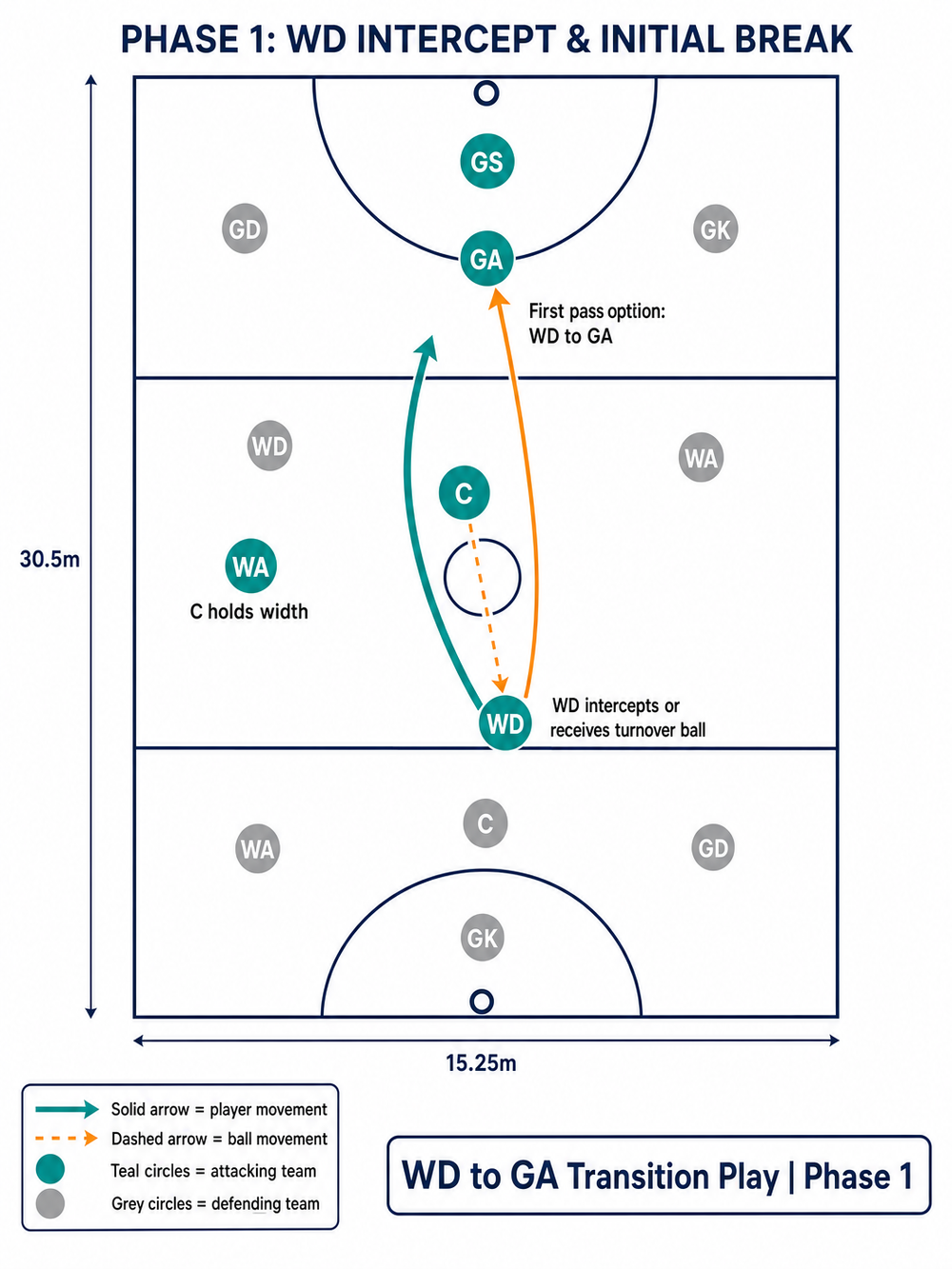
- The Turnover: The play initiates when the WD secures an interception or picks up a loose ball in the defensive third or lower mid-court.
- Immediate Vision: Upon securing the ball, the WD must immediately turn and look down-court, identifying the GA as the primary target.
- The Outlet: The C and WA must quickly clear the immediate space to open up the direct passing lane from WD to GA.
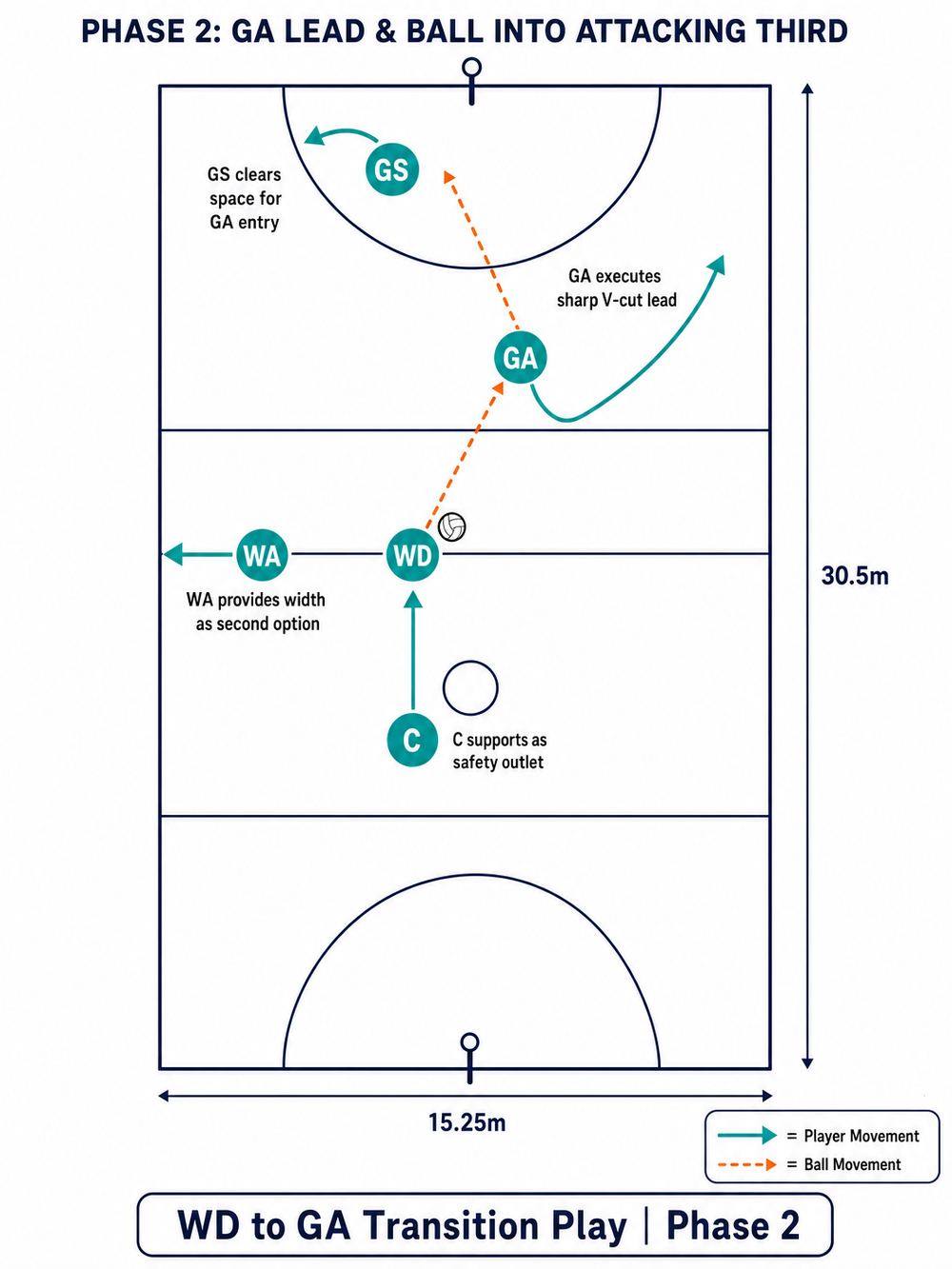
Phase 2: GA Lead and Ball Delivery
- The V-Cut Lead: The GA executes a sharp V-cut. They drive away from the ball carrier (towards the baseline or sideline) to draw their defender, then plant their outside foot and drive hard back towards the ball carrier, aiming for the top of the attacking third.
- The Pass: The WD delivers a strong, flat, and accurate chest or shoulder pass into the space the GA is driving into. Timing is crucial; the pass must meet the GA as they hit the top of the circle edge.
- Secondary Options: If the GA is heavily defended, the WA should be providing width on the opposite side as a secondary outlet, while the C moves forward to offer a safe reset option.
Phase 3: Goal Circle Entry and Finish
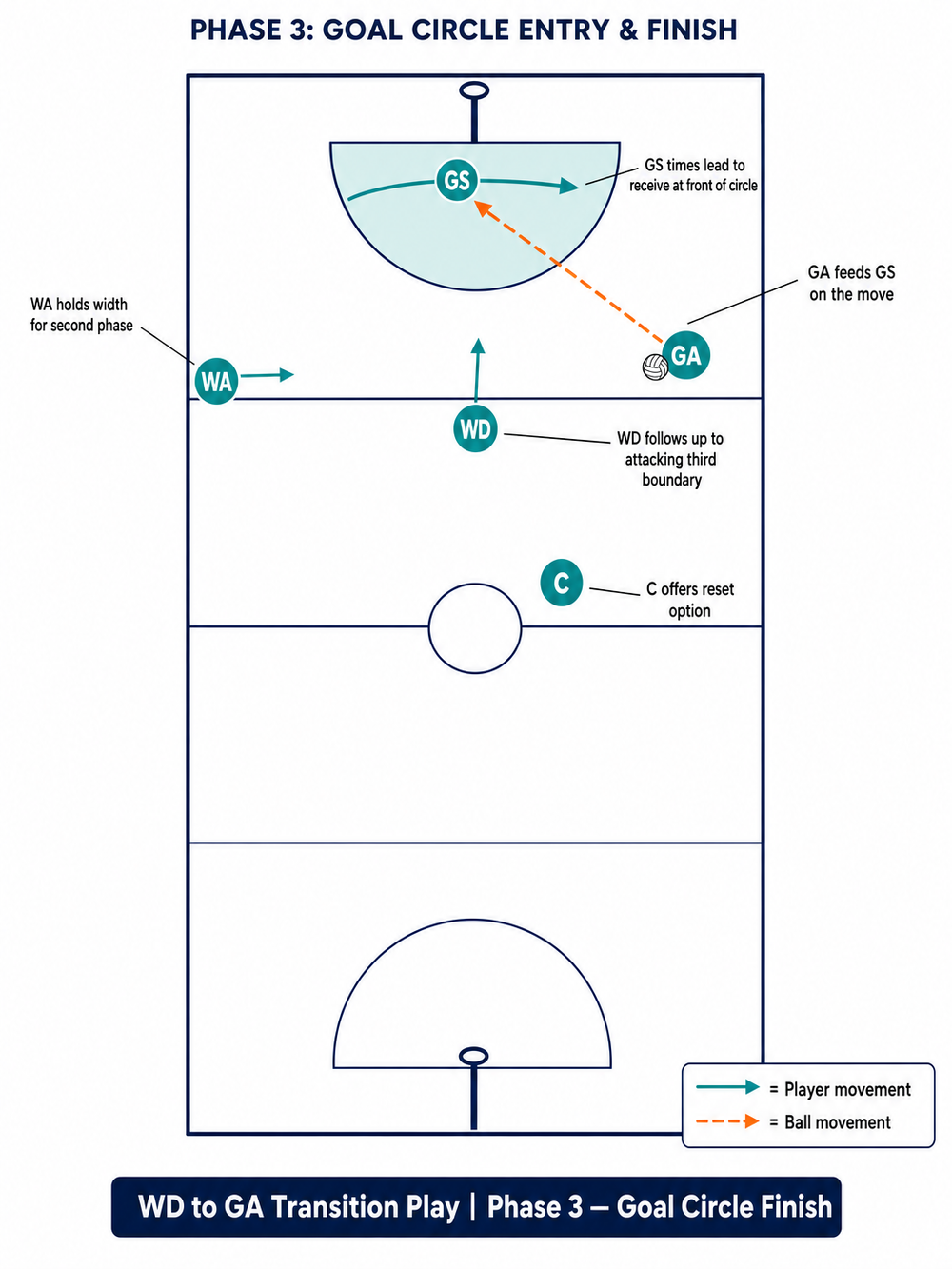
- The Feed: As the GA receives the ball, they should land balanced and immediately look into the goal circle.
- GS Movement: The GS must time their lead to coordinate with the GA's reception. A common and effective movement is a sharp cut across the front of the defender to receive the ball near the post.
- The Finish: The GA delivers a quick feed to the GS, who then turns and shoots.
Key Coaching Points
- Speed of Transition: The success of this play relies entirely on speed. The WD must transition from defence to attack the moment the ball is secured.
- Quality of the First Pass: The pass from WD to GA must be strong and direct. Loopy passes give the defence time to recover and intercept.
- GA's Change of Direction: The GA's V-cut must be sharp and convincing to create separation from their defender.
- Vision and Awareness: All players must be aware of the court dynamics. If the primary option (GA) is closed down, players must quickly adapt to secondary options (WA or C).
Common Mistakes
- WD Hesitation: The WD takes too long to look up-court after securing the ball, allowing the defence to set.
- Poor Pass Execution: The WD throws a floating pass, leading to an easy interception by the opposing GD or WD.
- GA Leading Too Early: The GA makes their lead before the WD is ready to pass, resulting in them running out of space or having to stop and wait for the ball.
- Crowding the Space: The C or WA fail to clear the passing lane, cluttering the mid-court and making the long pass impossible.
Variations & Progressions
- Progression 1: Add Defensive Pressure: Introduce passive, then active, defenders on the WD and GA to simulate game conditions and increase the difficulty of the pass and the lead.
- Progression 2: Second Phase Play: If the direct pass to the GA is covered, practice the WD hitting the WA wide, who then immediately feeds the GA driving into the pocket.
- Variation: WD to GS Long Bomb: For advanced teams with a tall GS, if the GA is covered, the WD can look for a direct, high-release pass into the goal circle for the GS holding space.
Age Adaptations
- Under 10s/12s: Focus on the basic mechanics of the V-cut and ensuring the WD looks up before passing. Shorten the passing distance if necessary.
- Under 14s/16s: Emphasize the speed of the transition and the timing of the GA's lead. Introduce defensive pressure.
- Open/Advanced: Focus on the precision of the pass, rapid decision-making under pressure, and executing the play flawlessly at high speed.
