

Basketball
Mastering the Horns Set Play for a Three-Pointer
A detailed guide for basketball coaches on how to execute the Horns set play to create a high-percentage three-point shot opportunity.
What you need
Basketball, Cones (optional for marking spots)
Overview
The Horns set is one of the most versatile and widely used offensive alignments in modern basketball, from youth leagues to the professional ranks. Its balanced structure, with two screeners at the elbows and shooters in the corners, creates multiple scoring opportunities. This specific play, the "Horns Three-Point Flare", is designed to leverage that structure to free up your best shooter for an open three-point shot from the top of the key. It is particularly effective against man-to-man defenses and is best used when you need a quick, high-percentage perimeter shot, such as at the end of a quarter or when the defense is focused on stopping inside scoring.
Setup
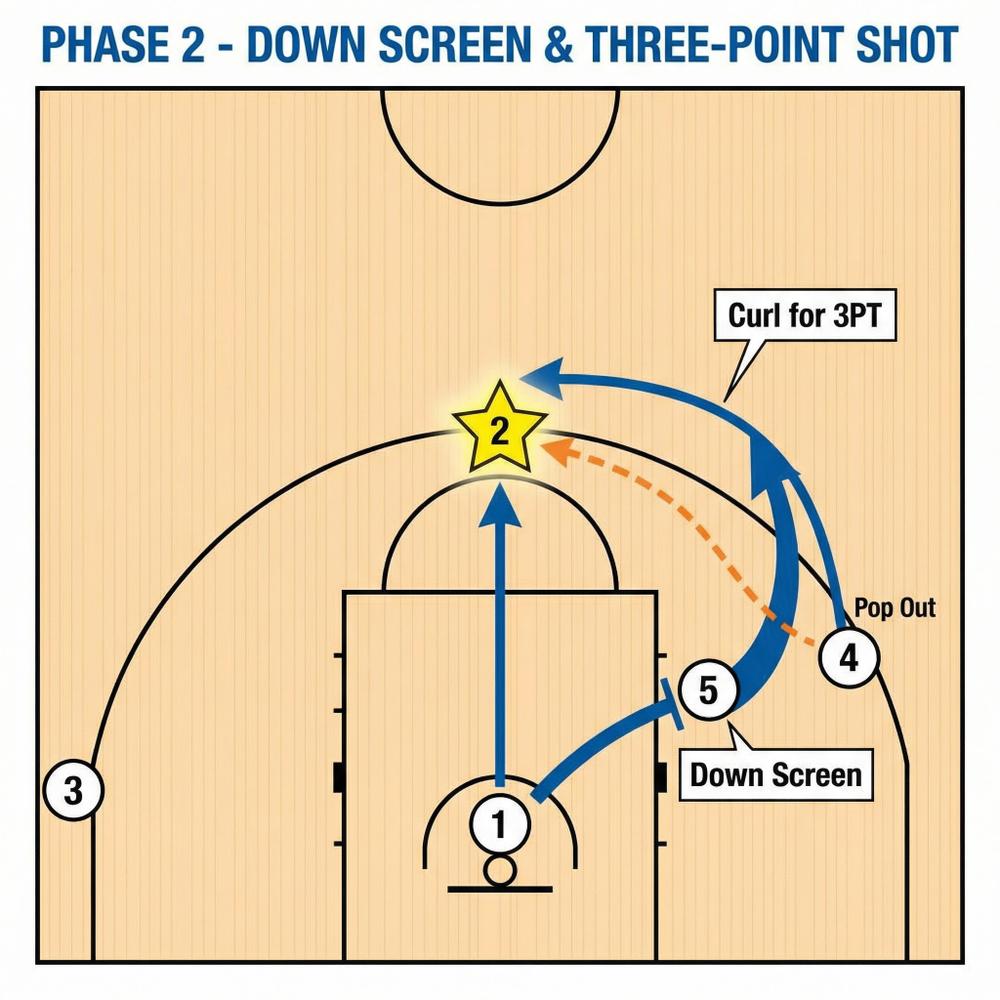
- Equipment: 1 Basketball, cones for marking player starting positions (optional).
- Court Setup: The play is initiated from the frontcourt on a standard 28m x 15m FIBA court.
- Player Positions:
- Point Guard (1): Starts with the ball at the top of the key, aligned with the center of the basket.
- Shooting Guard (2): Positioned in the strong-side corner (right side).
- Small Forward (3): Positioned in the weak-side wing/corner area (left side).
- Power Forward (4): At the right elbow (high post).
- Center (5): At the left elbow (high post).

Step-by-Step Instructions
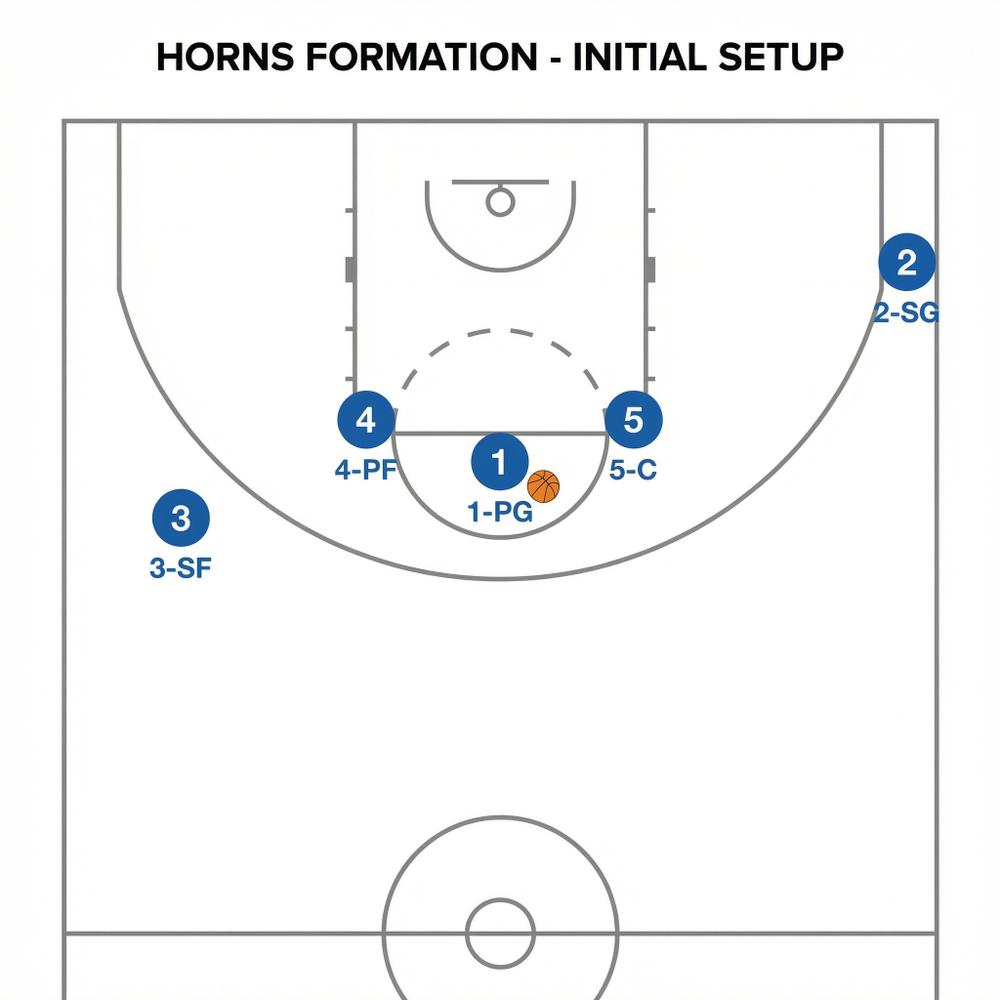
Step 1: The Initial Action - Ball Screen & Wing Cut
- The play begins with the Point Guard (1) dribbling towards the Power Forward (4) at the right elbow.
- As this happens, the Power Forward (4) sets a solid ball screen for the Point Guard (1).
- Simultaneously, the Small Forward (3) on the weak side makes a hard cut towards the basket, drawing their defender with them and clearing out the space on the wing.
- The Point Guard (1) uses the screen, looking to attack the paint. This action forces the defenders to react and often draws help, which is the primary goal of this initial movement.
Step 2: The Flare Screen & Three-Point Shot
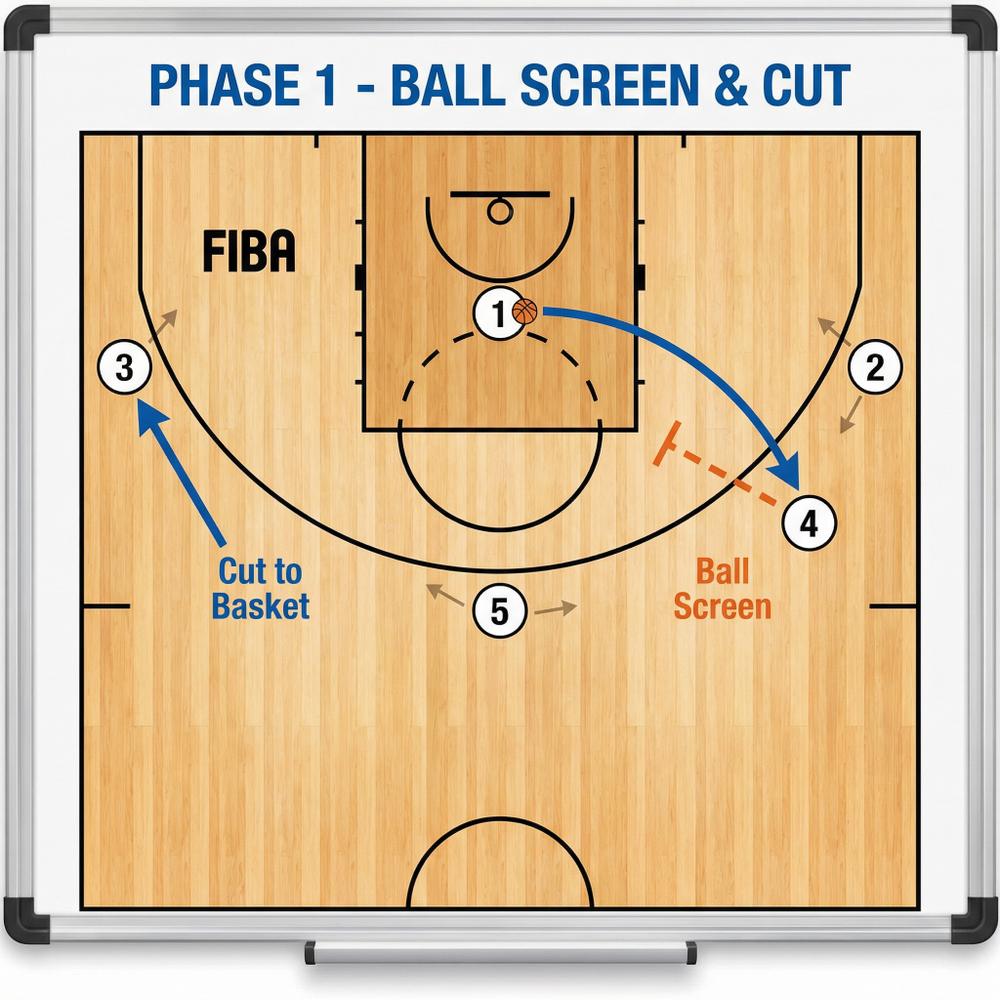
- After setting the initial ball screen, the Power Forward (4) "pops" out to the right wing area behind the three-point line. This forces their defender to make a choice.
- The key action unfolds on the weak side. The Center (5) dives down from the elbow to set a down screen (or flare screen) on the defender guarding the Shooting Guard (2) in the corner.
- The Shooting Guard (2) curls tightly around the screen, moving towards the top of the key.
- The Point Guard (1), after drawing the defense in, makes a sharp pass to the now-open Shooting Guard (2) for a high-percentage three-point shot.
Key Coaching Points
- Timing is Everything: The actions must be synchronized. The pass from (1) to (2) should happen the instant (2) comes off the screen from (5).
- Set Solid Screens: Players (4) and (5) must set firm, legal screens. Teach them to have a wide base and absorb contact. The quality of the screens determines the success of the play.
- Read the Defense: The Point Guard (1) must read the defense. If the defenders switch on the initial ball screen, (1) might have a quick pass to (4) popping out. If the defender of (2) cheats over the screen, (2) can make a backdoor cut to the basket.
- Shooter's Footwork: The Shooting Guard (2) must come off the screen ready to shoot. Teach a "1-2 step" into the shot, with feet squared to the basket upon receiving the pass.
- Spacing is Key: All players must maintain proper spacing to stretch the defense. The cut by (3) is crucial to occupy the weak-side help defender.
Common Mistakes
- Lazy Screens: Players (4) and (5) setting soft or moving screens will result in an offensive foul or an ineffective play.
- Poor Timing on the Pass: The Point Guard (1) passing too early or too late will allow the defense to recover and contest the shot.
- Shooter Drifting: The Shooting Guard (2) must cut decisively to the spot. Drifting or a lazy cut allows the defender to recover easily.
- Ignoring the Roll/Pop: If the screener's defender helps too much on the ball handler, the screener (4 or 5) will be open. The Point Guard must see this option.
Variations & Progressions
- Horns Flare to Lob: If the defender guarding (2) tries to fight over the top of the screen from (5), (2) can fake the curl and make a sharp backdoor cut to the basket for a lob pass from (1).
- Horns Slip: The Center (5), instead of setting the down screen for (2), can fake the screen and immediately "slip" to the basket for a quick pass from (1) if their defender is overplaying.
- Dribble Hand-Off (DHO) Entry: Instead of a pass, the Point Guard (1) can dribble towards either (4) or (5) and execute a dribble hand-off to initiate the offense, which can be quicker and more deceptive.
Age Adaptations
- Under 12: Simplify the play. Focus on the initial Horns setup and a simple ball screen. The second screen is often too complex. The goal is to teach the concept of screening and creating space.
- Under 14/16: Introduce the full play but walk through it slowly. Use cones to mark the spots where players need to cut and screen. Focus on the timing and reading the first defensive reaction.
- Open Age/Advanced: At this level, players should be able to read the defense and execute the variations. Coaches can add counters to how the defense plays the screens, making it a complete offensive system.
