

Basketball
Mastering the Baseline Inbound: A High-Percentage Set Play
A detailed guide for basketball coaches on executing a versatile and effective baseline inbound set play designed to create high-percentage scoring opportunities.
What you need
1 Basketball
1. Overview
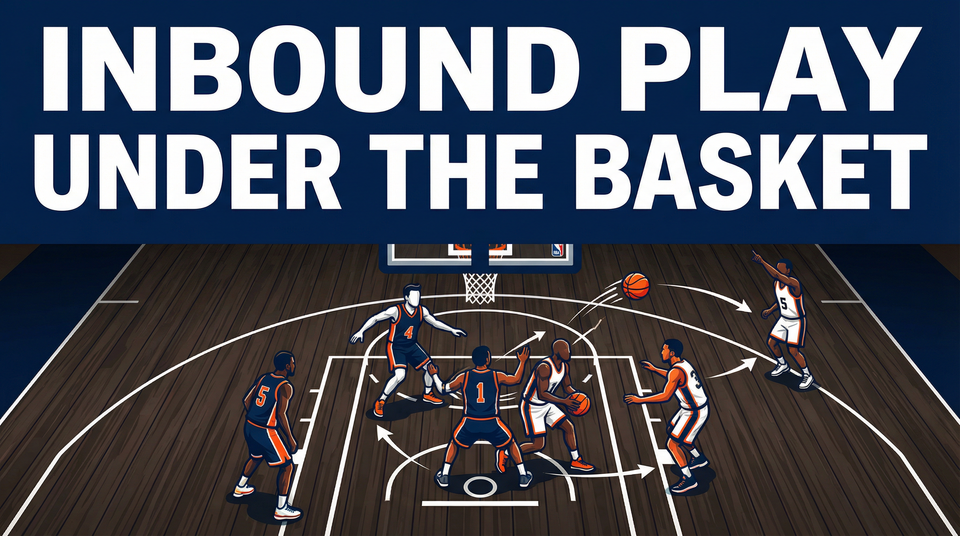
This baseline inbound set play, often called a 'Box' or 'Stack' formation, is a fundamental yet highly effective strategy for creating a quick, high-percentage scoring opportunity directly under the basket. It is designed to be executed from a dead-ball situation on the offensive baseline. The primary objective is to use a series of screens and cuts to free up a player for either a direct layup or a short-range shot. Its strength lies in its simplicity and the multiple scoring options it generates, making it a reliable tool for any coach's playbook, especially in late-game or high-pressure situations where a quick basket is needed.
2. Setup

- Equipment: 1 Basketball
- Court Setup: Half-court, using the baseline under the offensive basket. The court dimensions are based on FIBA standards (28m x 15m).
- Player Positions:
- Player 5 (Center/Inbounder): Stands out of bounds on the baseline, ready to pass the ball in. Must have good vision and passing accuracy.
- Player 4 (Power Forward) and Player 3 (Small Forward): Form a 'stack' or 'box' on the strong side of the key, approximately 3-4 meters from the basket.
- Player 2 (Shooting Guard): Positioned on the weak-side wing, just outside the three-point line.
- Player 1 (Point Guard): Acts as the safety valve, positioned at the top of the key.

3. Step-by-Step Instructions
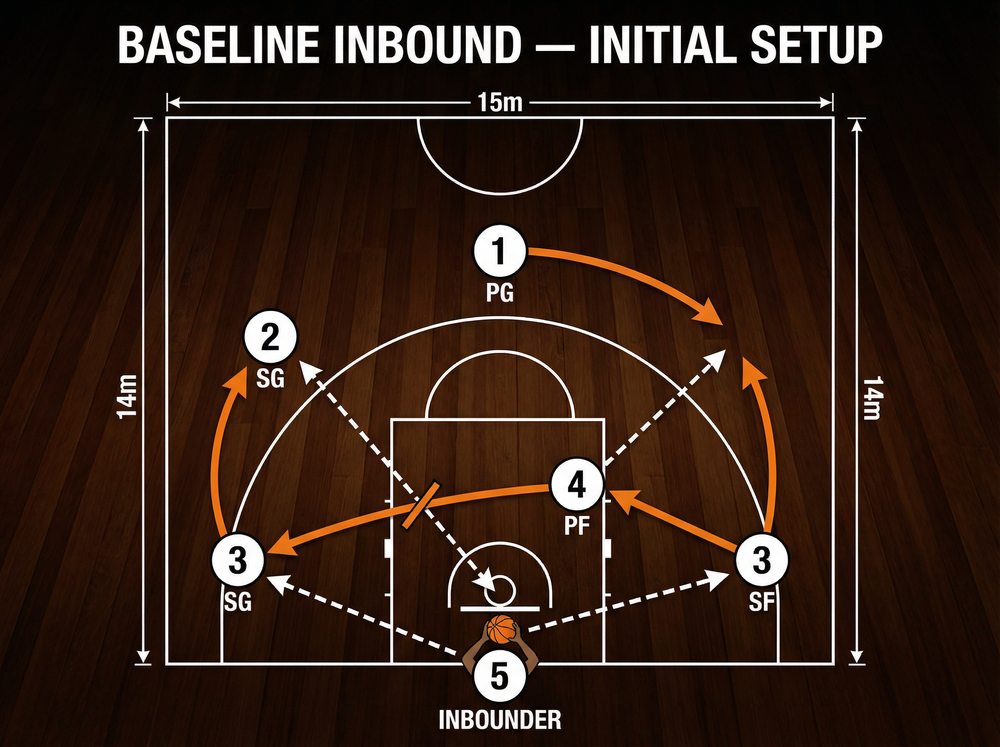
- Initiation: The play begins with Player 5 slapping the ball to signal readiness. This is the cue for the on-court players to begin their movements.
- First Screen: Player 4, the player closer to the basket in the stack, turns to set a screen for Player 3. Player 3 cuts hard off the screen, moving towards the ball-side corner. This initial action is designed to occupy the defenders and create space.
- Weak-Side Cut: Simultaneously, Player 2 cuts from the weak-side wing along the baseline towards the basket. This cut provides a secondary option if the primary action is well-defended.
- Back Screen & Primary Cut: After setting the initial screen, Player 4 immediately pivots and moves up the key to set a back screen on Player 2's defender. Player 2 uses this screen to cut directly to the basket, looking for the pass from Player 5 for a layup.
- The Pass: Player 5 must read the defense. The primary look is for Player 2 cutting to the rim. The pass should be a sharp, accurate bounce or chest pass leading the cutter to the hoop.
- Safety Option: If Player 2 is not open, Player 5 looks to Player 1 at the top of the key. This pass resets the offense and avoids a 5-second violation.

4. Key Coaching Points

- Timing is Everything: The success of this play hinges on the precise timing of the cuts and screens. Players must initiate their movements as soon as the inbounder signals.
- Set Solid Screens: Player 4 must set a firm, legal screen. The goal is to create separation, not to commit a foul. Coach players to have a wide base and absorb contact.
- Hard, Decisive Cuts: Cutters (Players 2 and 3) must move with purpose. A slow or hesitant cut will not create enough separation. Teach them to 'sell' their movement.
- Inbounder's Read: Player 5 is the quarterback of this play. They must be patient, read the defense, and not force a pass. Emphasize looking for the best available option, not just the primary one.
- Communication: Players should communicate throughout the play. A simple hand signal or call-out can confirm the screen is set or that a player is open.
- Practice the Safety: Regularly practice the pass to the safety (Player 1) to ensure it's a reliable option and not an afterthought.
5. Common Mistakes

- Moving Screens: Players setting screens, particularly Player 4, may be impatient and move before the cutter has used the screen, resulting in an offensive foul.
- Poor Spacing: If players don't maintain their designated spacing, the lane can become clogged, making it easy for defenders to switch or help.
- Lazy Cuts: A half-hearted cut by Player 2 will not be effective. The player must sprint to the basket as if their life depends on it.
- Telegraphed Passes: The inbounder (Player 5) staring down the primary target (Player 2) can alert the defense. Teach them to use their eyes to look off defenders.
- Ignoring the Safety: In a panic, inbounders can forget about the safety valve (Player 1), leading to a turnover or a 5-second call.
6. Variations & Progressions

- Variation - Flare Screen: If the defense overplays the cut to the basket, Player 4 can turn the back screen into a flare screen for Player 2, who then fades to the corner for an open three-point shot.
- Variation - Hand-Off: If the pass goes to the safety (Player 1), Player 5 can immediately enter the court and receive a hand-off from Player 1, creating a quick pick-and-roll situation.
- Progression - Add Defenders: Start by running the play 5-on-0 to teach the movements. Progress to 5-on-3, and finally to a full 5-on-5 scrimmage to simulate game conditions.
7. Age Adaptations

- Under 10/12: Simplify the play. Use a basic stack with one primary cutter and a safety. Focus on the fundamentals of inbounding the ball safely and making a good pass. The back screen may be too complex for this age group.
- Under 14/16: Introduce the back screen and the concept of reading the defense. Spend time drilling the timing and execution of the screens and cuts. Emphasize the importance of the safety pass.
- Open Age/Advanced: At this level, all elements of the play should be executed with precision. Introduce the variations (flare screen, hand-off) and empower the inbounder to make reads based on how the defense reacts. You can also add a tertiary option, such as a screen-the-screener action.
