

Basketball
Mastering the Half-Court Trap: A Defensive Set Play for Dominating Possession
A detailed guide for basketball coaches on implementing a high-pressure half-court trap to force turnovers and control the game's tempo.

What you need
1 Basketball, 10 cones for marking positions (optional)
Overview
The Half-Court Trap is an aggressive defensive strategy designed to disrupt the offensive flow, force turnovers, and create high-percentage scoring opportunities in transition. It is a calculated gamble, aimed at surprising the opponent by applying intense pressure on the ball-handler just as they cross the half-court line. This play is most effective when used intermittently, preventing the offense from becoming accustomed to it. Ideal situations to deploy the trap include after a made basket, coming out of a timeout, or specifically to target an opponent with weaker ball-handling skills. When executed correctly, it can swing the momentum of a game, but it requires precise timing, communication, and disciplined rotations from all five defensive players.
Setup
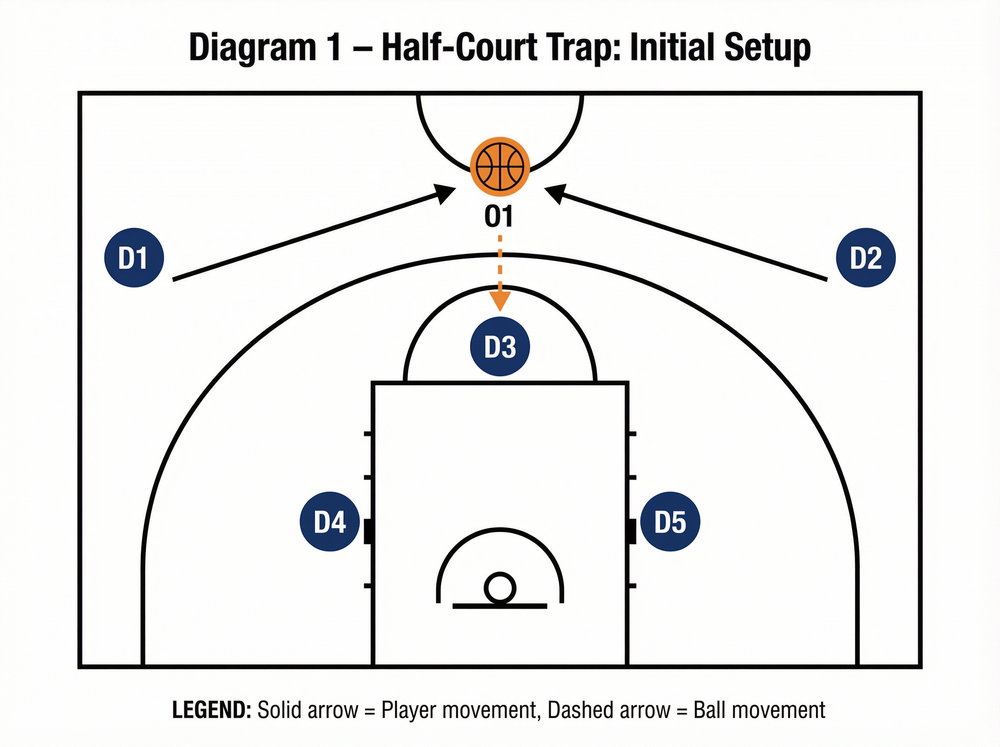
To effectively drill this set play, you will need a full-sized basketball court, a single basketball, and at least ten players to simulate a 5-on-5 game situation.
- Equipment: 1 Basketball, 10 cones for marking positions (optional).
- Court Setup: The play is executed on a standard FIBA-regulated court (28m x 15m). The key area of focus is the zone immediately surrounding the half-court line.
- Player Positions:
- Defenders (The Trappers): Your two quickest guards, typically the Point Guard (D1) and Shooting Guard (D2), will initiate the trap.
- Interceptor: The Small Forward (D3) acts as the primary interceptor, reading the ball-handler's eyes to anticipate the pass.
- Help-Side & Safety: The Power Forward (D4) and Center (D5) provide help-side defense and protect the basket against any successful passes out of the trap.

Step-by-Step Instructions

- The Trigger: The play begins the moment the offensive player with the ball (O1) dribbles across the half-court line. This is the visual cue for the defense to execute the trap. D1 should initially be applying light pressure, lulling the ball-handler into a false sense of security.
- Initiate the Trap: As O1 crosses the timeline, D1 forces them towards the sideline. Simultaneously, D2 sprints from the weak side to close out on O1, creating a trap. The objective is to get O1 to stop their dribble in the corner formed by the sideline and the half-court line—often called the "coffin corner." The trappers should have their hands high to obstruct vision and passing lanes.
- The Interceptor's Role: While the trap is being set, D3 denies the most immediate and obvious pass out of the trap (usually to the nearest wing player, O2). D3 must anticipate this pass and position themselves in the passing lane, ready to steal the ball.
- Help-Side Rotation: D4 rotates to cover the middle of the court, preventing any simple pass to the high post. D4 must be vocal, directing traffic and reading the developing play.
- Basket Protection: D5 drops back to protect the paint and the basket. Their primary responsibility is to prevent any easy layups if the trap is broken. They must be prepared to defend against a long pass over the top to the opposing big man (O5).

Key Coaching Points

- Trap with Intent: The two trappers (D1 and D2) must sprint to the spot and close the trap aggressively. They should not reach in and foul; the goal is to force a bad pass or a 5-second violation.
- High Hands: All defenders, especially the trappers, must keep their hands up to take away vision and make passing difficult. This creates panic and forces lob passes that are easier to intercept.
- Anticipate, Don't React: The interceptors (D3 and D4) must read the ball-handler's eyes and body language to anticipate the pass. They should be moving as the pass is being made, not after.
- Communicate Loudly: The defense must be in constant communication. The back-line defenders (D4 and D5) have the best view of the court and should be directing the rotations.
- Sprint to Recover: If the offense successfully passes out of the trap, all five defenders must sprint back to their defensive matchups. Do not admire the pass; the play is not over until you have secured the ball or the offense has scored.
Common Mistakes

- Fouling the Ball-Handler: Over-aggressive trappers reaching in instead of using their position and high hands to create pressure. This negates the trap and gives the offense free throws.
- The Middle Split: The trappers allow the ball-handler to dribble between them, breaking the trap and creating a 4-on-3 advantage for the offense.
- Slow Rotations: The help-side defenders (D3, D4, D5) are slow to rotate, leaving offensive players wide open for an easy pass and shot.
- Watching the Ball: Defenders who are not directly involved in the trap or interception become spectators. They must stay engaged and cover their assigned areas.
Variations & Progressions
- Progression (3-on-3): Start by teaching the trap in a 3-on-3 scenario. This simplifies the rotations and allows players to understand the core concepts of trapping and intercepting before adding more complex reads.
- Variation (Trap on the Wing): Instead of trapping at half-court, allow the ball to be passed to a wing player and then initiate the trap along the sideline. This can be effective against teams that use their wings to initiate the offense.
- Variation (Early Trap): For a more aggressive approach, have the second trapper (D2) cross the half-court line early to set the trap just before the ball-handler crosses into the frontcourt. This is high-risk, high-reward.
Age Adaptations
- Under 12: Focus on the fundamental concept of two players trapping the ball. Use drills where two defenders work together to stop a ball-handler without fouling. The rotational aspect is too advanced for this age group.
- Under 14/16: Introduce the 3-player interceptor role. Run 3-on-3 drills focusing on the trap and the immediate pass denial. Emphasize communication and reading the play.
- Open Age/Advanced: The full 5-player rotation should be expected. At this level, coaches can introduce different triggers for the trap and scout opponents to exploit specific player weaknesses.
