

Basketball
Mastering the UCLA Cut: A Comprehensive Coaching Guide
A detailed guide for basketball coaches on how to teach, execute, and master the classic UCLA cut for effective offensive plays.

What you need
Basketball, Cones (optional for marking spots)
1. Overview
The UCLA Cut is a fundamental offensive action, named after the legendary UCLA Bruins teams coached by John Wooden. It is a classic 'give-and-go' style play initiated by a pass from the top of the key to the high post, followed by the passer cutting sharply to the basket off a screen set by the player in the high post. The primary objective is to create a high-percentage scoring opportunity, typically a layup, right at the rim. It is an excellent entry play to run against man-to-man defenses as it forces defenders to navigate a screen in a dangerous area of the court, creating confusion and opening up multiple scoring avenues.
2. Setup

To run this play effectively, the setup is crucial for proper spacing and timing. Ensure your players understand their starting positions before initiating any movement.
- Equipment: 1 Basketball, cones for marking starting spots (optional).
- Court Setup: Half-court, standard FIBA dimensions (28m x 15m).
- Player Positions:
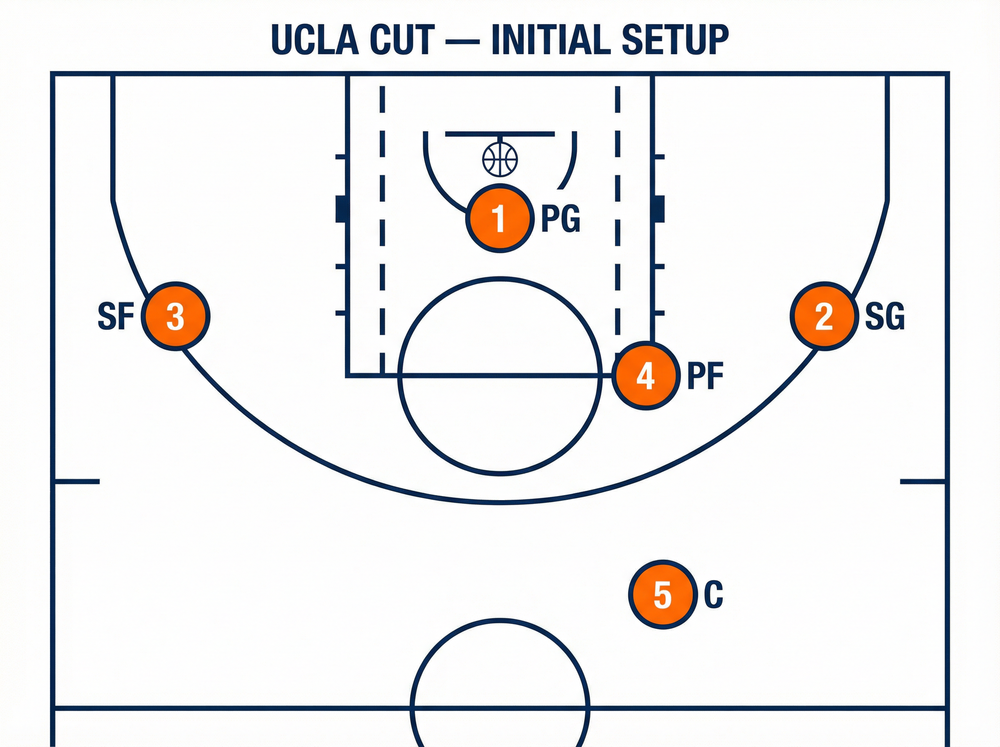
- 1 (Point Guard): Starts at the top of the key with the basketball.
- 2 (Shooting Guard): Positioned on the right wing, outside the three-point line.
- 3 (Small Forward): Positioned on the left wing, outside the three-point line.
- 4 (Power Forward): At the right elbow of the free-throw line (the high post).
- 5 (Center): In the low post on the right block.

3. Step-by-Step Instructions

Execution relies on precise timing and sharp movements. Walk your team through these steps before going live.
The Entry Pass: The play begins when the Point Guard (1) makes a crisp pass to the Power Forward (4) at the high post (elbow).
The UCLA Cut: Immediately after passing, Player 1 executes the 'UCLA Cut' – a hard, decisive cut directly to the basket, using Player 4 as a screen. The cutter should aim to brush shoulders with the screener to prevent the defender from getting through.

Read and React: Player 4, now with the ball at the elbow, has several options and must read the defense. This is the decision-making point of the play.
Scoring Options:
- Option A (The Layup): If Player 1's defender is caught on the screen, Player 4 should deliver a quick bounce pass or lob pass to Player 1 for an easy layup. This is the primary look.
- Option B (The Weak Side Swing): If the defense collapses to stop the cut, Player 4 can pivot and look to the weak side. Player 5 sets a cross-screen for Player 3, who comes to the top of the key for an open shot or to reset the offense.
- Option C (The Elbow Jumper): If the defenders sag off, Player 4 can face the basket and take the open mid-range jump shot from the elbow.

4. Key Coaching Points
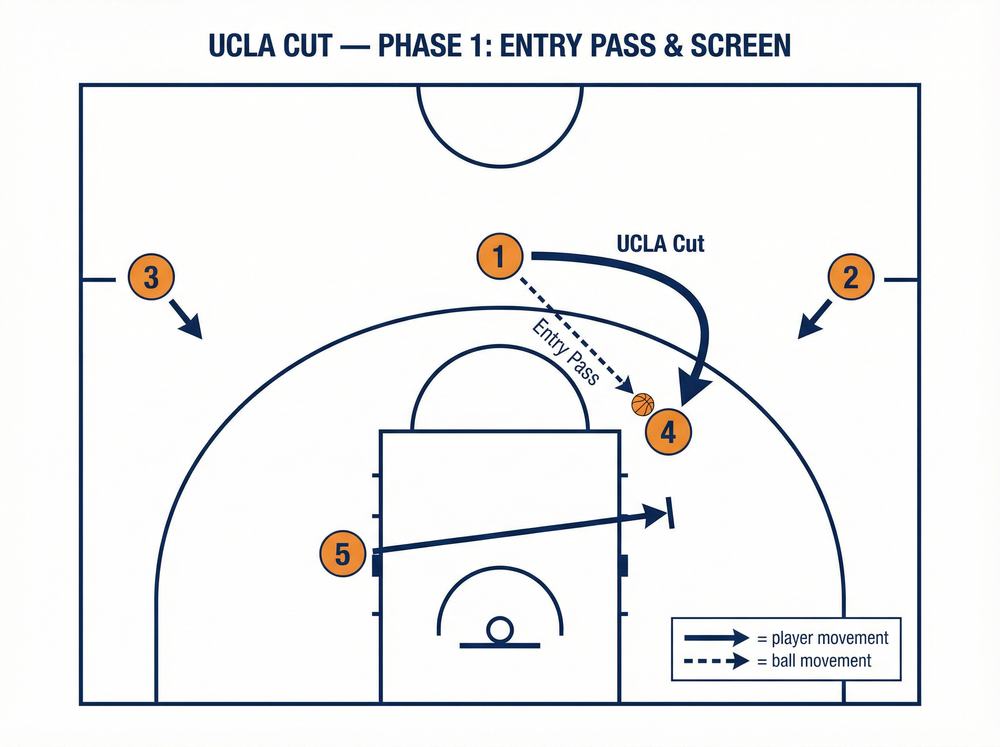
- Pass Sets Up the Cut: The pass from 1 to 4 must be sharp and accurate. A lazy pass gives the defense time to react and disrupt the play.
- Set a Solid Screen: Player 4 must set a firm, legal screen. They should have a wide base and be stationary on contact. Teach them to anticipate the cut and present a solid target.
- Change of Pace: The cutter (Player 1) should set up their defender by being patient initially, then explode into the cut as soon as the pass is released. A deceptive first step is key.
- Read the Defender: The cutter must read their defender's position. If the defender goes over the screen, the cut should be tight to the basket. If they go under, the cutter can flare out slightly for a short jumper.
- Passer's Vision: The passer (Player 4) must keep their head up, read the defense, and not pre-determine their decision. They must see the whole floor to identify the best scoring option.
5. Common Mistakes

- Poor Timing: The most common error is the cutter leaving too early or too late. The cut must happen immediately as the pass is made.
- Illegal Screen: The screener (Player 4) moving or leaning into the defender will result in an offensive foul. Emphasize staying stationary.
- Telegraphed Pass: The passer (Player 4) staring down the cutter makes the play easy to defend. Encourage them to use their peripheral vision.
- Bad Spacing: Wing players (2 and 3) creeping in from the three-point line will clog the lane and bring their defenders into the play, ruining the spacing needed for the cut to be effective.
6. Variations & Progressions
- Variation 1 (Screener Slip): If the defense is aggressively switching or hedging the screen, the screener (Player 4) can fake the screen and immediately 'slip' to the basket, creating another passing option for Player 1 (who would hold the ball instead of passing).
- Variation 2 (Staggered Screen): After the initial UCLA cut, Player 5 can move up from the block to set a second screen for Player 1. This staggered action is very difficult to defend.
- Progression (Read and Counter): Progress to a 3-on-3 or 4-on-4 scenario where the defense is live. This forces the players to read the reactions and make the correct decision among Options A, B, and C, rather than just running the pattern.
7. Age Adaptations

- Under 12: Focus exclusively on the basic cut and pass (Option A). Use cones to mark the spots for the passer, screener, and cutter. Run it as a 2-on-0 or 2-on-1 drill to build the fundamental timing and movement before introducing more players.
- Under 14/16: Introduce the weak-side screen (Option B) and the elbow shot (Option C). Begin teaching the screener (Player 4) how to read the defense and make decisions. Use controlled scrimmage situations (3-on-3, 4-on-4) to develop these reads.
- Open Age/Advanced: At this level, all options should be fluid. Introduce more complex variations, such as the slip and staggered screens. Expect players to execute the play at game speed and make reads against various defensive coverages (man-to-man, zone, switching).
