

Basketball
Mastering the UCLA Cut: A Foundational Set Play for Offensive Success
A comprehensive coaching guide to implementing the classic UCLA cut, a versatile offensive entry that creates high-percentage scoring opportunities at the rim and opens up multiple secondary options.

What you need
Basketball, Cones for marking positions (optional)
1. Overview
The UCLA cut is a timeless offensive concept, named after the legendary UCLA Bruins program where Coach John Wooden perfected it. It is a fundamental entry play designed to get the ball into the high post and create a quick scoring opportunity for a guard cutting hard to the basket. Its simplicity makes it an excellent starting point for teaching players about off-ball screens and movement, while its layered options make it effective even at advanced levels. This play is best used to initiate a half-court offense, test the defense's communication, and generate a high-percentage shot early in the shot clock.
2. Setup

Equipment
- 1 Basketball
- 5 players
- A standard FIBA basketball court (28m x 15m)
Court Setup & Player Positions
The play begins with a standard 1-4 high alignment. This setup spreads the floor, occupies defenders, and creates a clear lane for the cut.
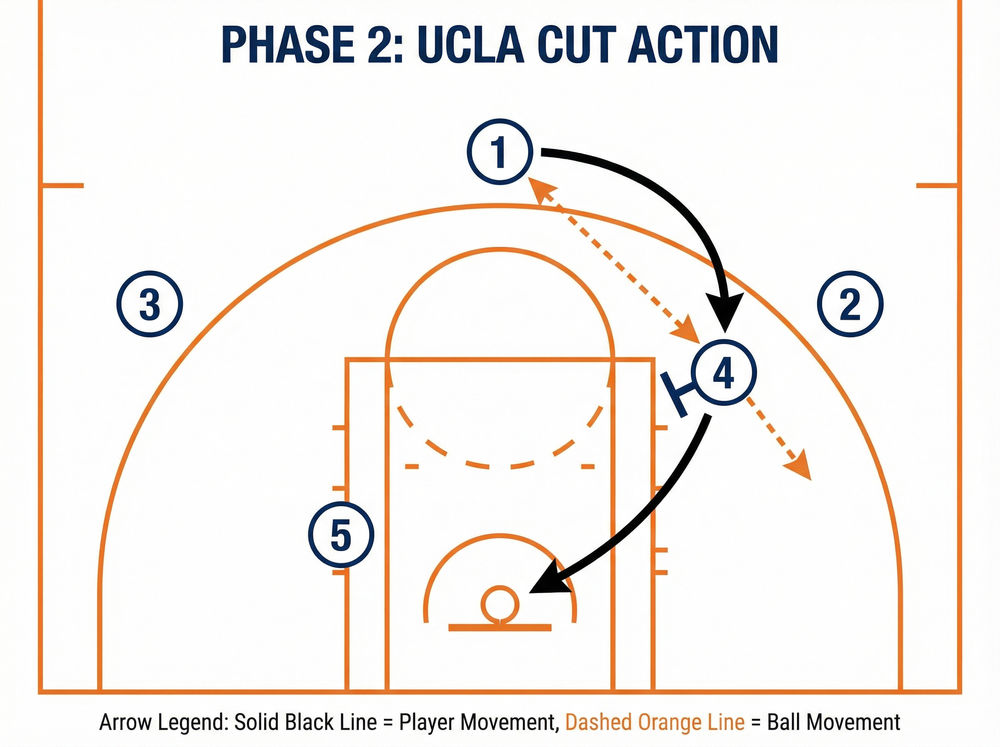
- Player 1 (Point Guard): Starts at the top of the key, initiating the offense.
- Player 2 (Shooting Guard): Positioned on the right wing, outside the three-point line.
- Player 3 (Small Forward): Positioned on the left wing, mirroring Player 2.
- Player 4 (Power Forward): Sets up at the right elbow (the corner of the free-throw line and lane line).
- Player 5 (Center): Starts on the weak-side (left) low block, creating space in the paint.

3. Step-by-Step Instructions

The execution of the UCLA cut is about timing, precision, and reading the defense. Each step flows directly into the next.
Step 1: The Entry Pass
- Player 1 initiates the play by making a crisp pass to Player 4 at the right elbow. The pass should be firm and lead Player 4 slightly.
Step 2: The UCLA Cut
- Immediately after passing, Player 1 executes the UCLA cut. This involves making a sharp, decisive cut directly off Player 4's shoulder. Player 1 should aim to brush past their defender, using Player 4 as a screen.
- The destination is the strong-side (right) low block, with hands ready for a quick return pass.
Step 3: The First Look
- Player 4's primary read is to feed the ball to Player 1 on the cut for a layup. This pass must be a quick bounce pass or a small pocket pass, delivered as soon as Player 1 clears the screen and has a step on their defender.

Step 4: Secondary Options
- If the pass to Player 1 is not available, Player 4 becomes the decision-maker. The defense's reaction to the initial cut will open up other opportunities.
- Option A (Drive): If Player 1's defender sags under the screen, Player 4 can attack the now-open lane and drive to the basket.
- Option B (Wing Pass): If the weak-side defense helps on the cut, Player 4 can look to Player 3 on the opposite wing for a skip pass and an open shot.
- Option C (Post Feed): Player 5 can work to gain position on the low block for a post-entry pass from Player 4.
4. Key Coaching Points

- The Cut Must Be Sharp: Emphasize to the cutter (Player 1) that this is not a jog. They must sprint through the cut to create separation. The setup is the pass, the payoff is the cut.
- Set a Solid Screen: Player 4 is not just a passer; they are a screener. They must hold their ground and provide a solid target for the cutter to run off. Teach them to be strong with the ball and read the defense.
- Passer Reads the Defense: The player at the elbow (Player 4) must keep their head up. Their decision-making determines the success of the play after the initial cut. They must see if the cutter is open, if the lane is open for a drive, or if a skip pass is available.
- Timing is Everything: The pass to the cutter must be delivered at the precise moment they are open. Too early and the defender recovers; too late and the lane is clogged. Drill the timing repeatedly.
- Wing Spacing is Crucial: Players 2 and 3 must hold their positions on the wings to maintain floor spacing. If their defenders sag into the paint to help, it clogs the cutting lane. Teach them to be shot-ready.
5. Common Mistakes

- Lazy Cut: The most common error is the cutter (Player 1) jogging or drifting through the cut instead of sprinting. This allows the defender to easily trail the play and deny the pass.
- Poor Entry Pass: A slow, looping pass to the high post allows the defense to get into a denial position, disrupting the play before it even starts.
- Screener Drifting: Player 4 must be stationary when setting the screen. Drifting or leaning creates an illegal screen and lessens the effectiveness of the pick.
- Cutter Running Too Wide: The cutter must run shoulder-to-shoulder with the screener. Running too wide gives the defender a clear path to follow and contest the play.
6. Variations & Progressions

- Variation: UCLA to DHO (Dribble Hand-Off): If the initial cut is not open, Player 4 can dribble towards Player 2 on the wing and execute a dribble hand-off. This flows seamlessly into a two-person game on the side.
- Progression: Add a Down Screen: After the initial UCLA cut, Player 5 can set a down screen for Player 3 on the weak side. Player 4 can swing the ball to Player 1 (who has cleared to the corner), who then looks for Player 3 coming off the down screen for a shot.
7. Age Adaptations

- Under-12: Focus purely on the initial pass and cut. Make it a 2-on-0 or 2-on-1 drill to teach the basic movement pattern. Do not add secondary options until the core concept is mastered.
- Under-14/Under-16: Introduce the secondary options. Start with 3-on-3 to simplify the reads before progressing to 5-on-5. Emphasize reading the help defense.
- Open Age/Advanced: At this level, the play can be a quick-hitter or an entry into a more complex motion offense. Players should be able to read and react to defensive overplays, such as automatically back-cutting if their defender denies the pass to the high post.
