The Box Kick Chase and Pincer Press: A Masterclass in Territory Control
Master the art of the box kick chase with this comprehensive guide to establishing a dominant pincer press, forcing turnovers, and exploiting disorganized defenses in the opposition 22m.

Equipment Needed
1. Overview
The box kick is far more than just a clearing mechanism; when executed with a coordinated chase and press, it becomes a potent attacking weapon. The "Box Kick Chase and Press Play" is designed to achieve three primary objectives: regain territory, apply suffocating pressure on the opposition's back three, and create immediate turnover opportunities in the "red zone" (the opposition 22m).
By launching a high, hanging kick from the base of a ruck or maul, the scrum-half (9) provides the time necessary for a structured chase line—typically led by the back row (6, 7, 8)—to advance downfield. The goal is not merely to tackle the catcher but to execute a "pincer press," shutting down all escape routes, isolating the ball carrier, and initiating a counter-ruck or jackal to win back possession in a highly advantageous field position.
2. Setup
Pitch Area: The play is initiated from the attacking team's own half, ideally between their 22m and the 10m line, near the touchline to narrow the angle and limit the opposition's counter-attacking options.
Equipment Needed:
- 1 Rugby ball
- 10-15 Cones (to mark the ruck, the "landing zone" target, and the chase lanes)
- Bibs (to differentiate the chasing team from the defending back three)
- Tackle shields (optional, for the initial contact phase during practice)
Player Positions:
- Scrum-half (9): Positioned at the base of the ruck, ready to execute the box kick.
- Primary Chasers (6, 7): Positioned on the blindside or immediate openside, forming the first wave of the chase line.
- Secondary Chaser/Sweeper (8): Positioned slightly deeper and central, ready to plug gaps or support the primary chasers.
- Second Wave (10, 12, 11/14): Positioned 10-15 metres back, fanning out to cover potential return kicks or to exploit quick turnover ball.
- Opposition (15, 14, 11): Positioned deep, anticipating the kick.

3. Step-by-Step Instructions
Phase 1: The Setup and Strike
- Secure the Ruck: The forwards must establish a stable, secure ruck near the touchline (e.g., 5-15 metres infield). This "caterpillar ruck" extends the distance between the 9 and the opposition defensive line, providing a safe kicking platform.
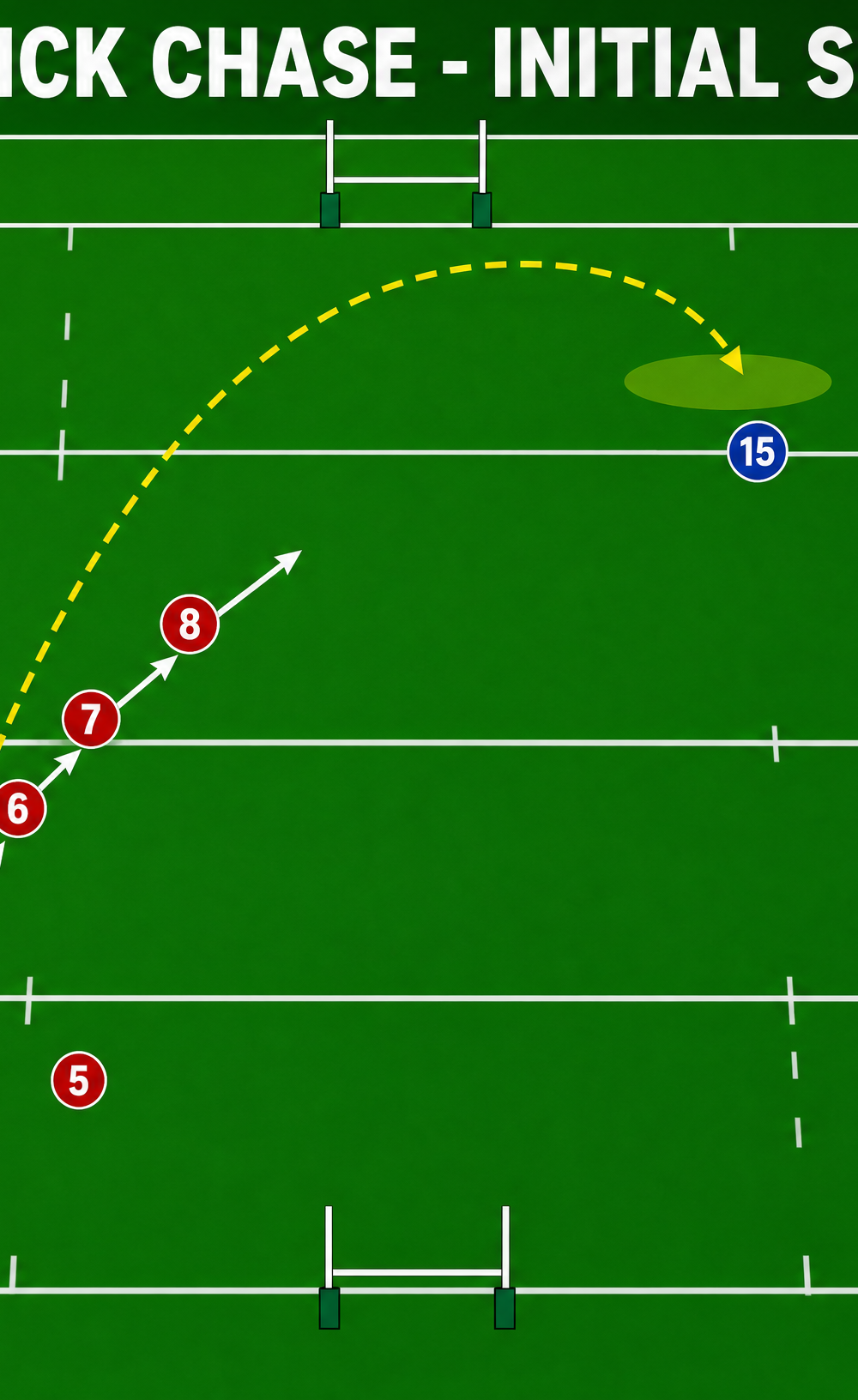
- Set the Chase Line: The primary chasers (6 and 7) align themselves onside, directly behind the hindmost foot of the ruck, facing downfield. The 8 positions themselves slightly deeper and more central.
- The Kick: The 9 executes a high, hanging box kick. The target is typically just outside the opposition 22m line, aiming for a "hang time" of 3.5 to 4.5 seconds. The trajectory should be steep enough to allow the chasers to arrive simultaneously with the ball.
Phase 2: The Chase and Pincer Press
- The Sprint: As soon as the ball leaves the 9's boot, the primary chasers (6 and 7) sprint downfield in their designated lanes. They must remain onside until the kick is made.
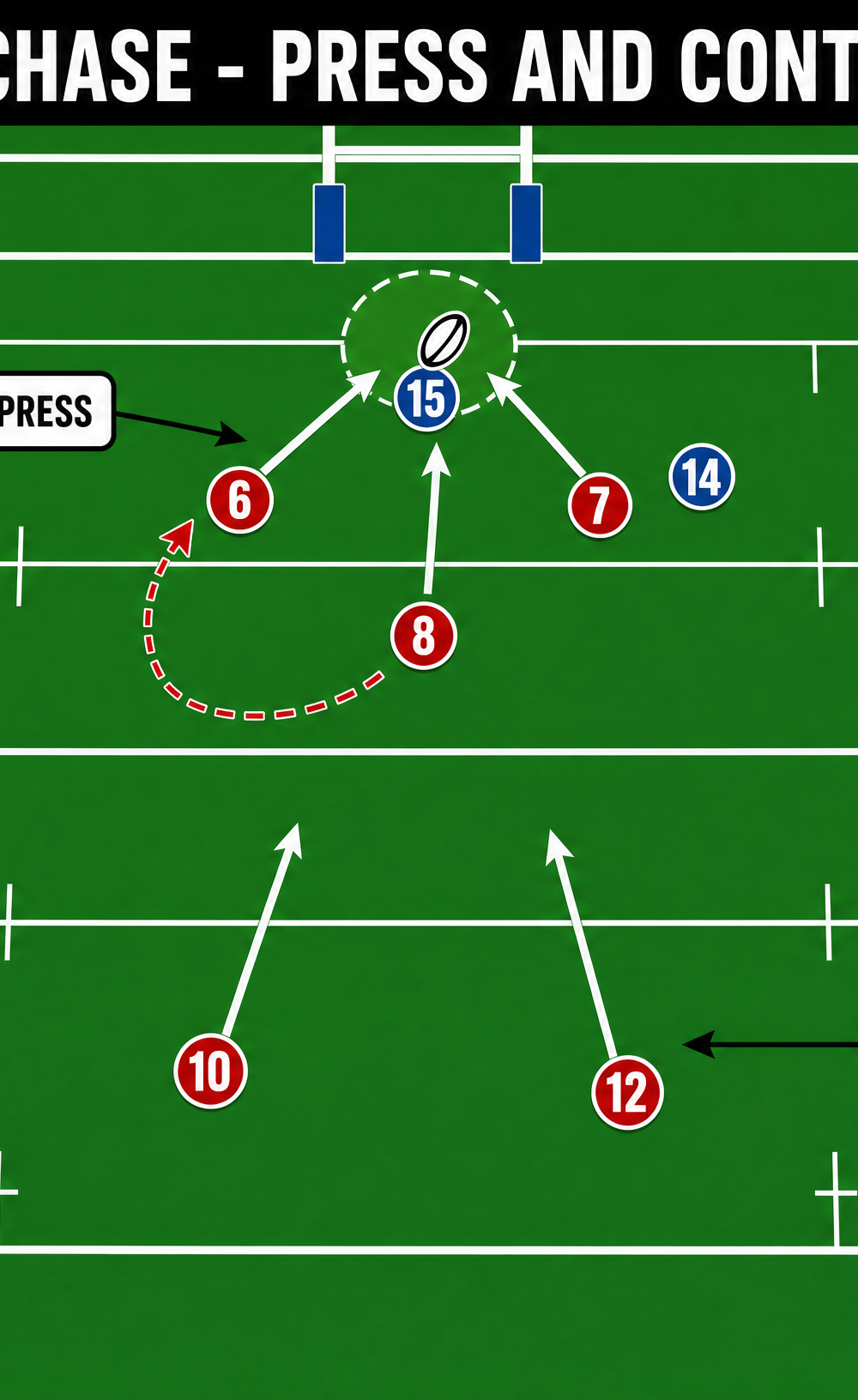
- The Convergence: As they approach the landing zone, 6 and 7 adjust their angles to form a "pincer" movement. They aim to arrive at the catcher (usually the 15 or a winger) at the exact moment the ball is caught.
- The Tackle/Contest: If the catcher secures the ball, 6 and 7 execute a dominant, aggressive tackle, aiming to hold the player up or drive them backward. If the ball is spilled, they immediately dive on the loose ball or initiate a counter-ruck.
Phase 3: The Turnover and Exploit
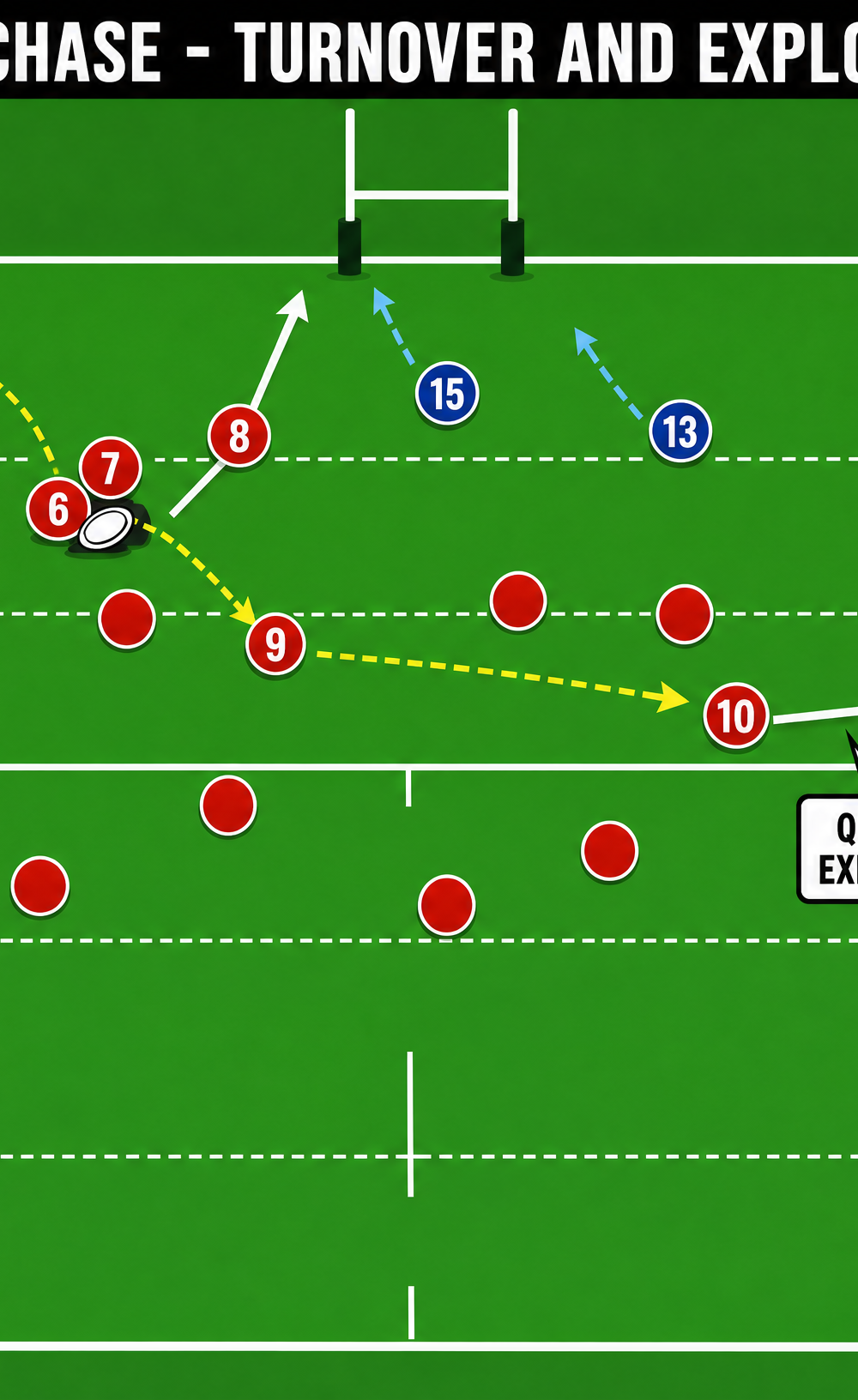
- The Jackal: If the tackle is made and the player goes to ground, the first arriving chaser (often the 7) immediately attempts a "jackal" to steal the ball before the opposition support arrives.
- Securing the Ball: The second arriving chaser (6 or 8) clears out any opposition threats to secure the turnover.
- The Counter-Attack: Once the ball is secured, the 9 (who has followed the play) delivers quick ball to the second wave (10, 12, or the blindside winger). The defense is now disorganized, presenting significant overlaps and attacking opportunities.
4. Key Coaching Points
- Hang Time over Distance: The kick must be high enough to allow the chasers to compete. A 30-metre kick with 4 seconds of hang time is far superior to a 50-metre kick with 2 seconds of hang time.
- Stay Onside: Chasers must be disciplined. Creeping offside negates the entire play and hands the opposition an easy penalty.
- The Pincer Movement: The primary chasers must not run in a straight line directly at the catcher. They must curve their runs slightly to attack the catcher's outside and inside shoulders, eliminating stepping options.
- Communication: The 9 must clearly call the play and the timing of the kick so the chasers can time their runs perfectly.
- Aggression at the Breakdown: The moment the ball hits the ground or the catcher is tackled, the transition from defense to attack must be instantaneous and ruthless.
5. Common Mistakes
- Kicking Too Long/Flat: If the kick lacks height, the chasers will not arrive in time, allowing the opposition to counter-attack against a fragmented defensive line.
- Running in a Straight Line: If chasers run straight at the catcher, they are easily stepped. The pincer angle is crucial.
- Lack of Support: If the primary chasers secure a turnover but the 9 or the second wave is too slow to arrive, the opportunity to exploit the disorganized defense is lost.
- Offside Penalties: Over-eager chasers creeping ahead of the kicker before the ball is struck.
6. Variations & Progressions
- The "Short" Box Kick: Instead of kicking deep into the 22m, the 9 executes a shorter, highly contestable kick (15-20 metres) specifically targeting a weaker opposition winger, aiming for a direct aerial contest rather than a tackle/jackal.
- The "Cross-Field" Box Kick: Used when the defense has overloaded the blindside. The 9 kicks diagonally across the field to the openside winger, who chases aggressively against an isolated defender.
- Progression - Live Defense: Introduce a live, full-contact opposition back three who are actively trying to counter-attack. This forces the chasers to adjust their angles and tackle technique dynamically.
7. Age Adaptations
- Under 10s / Under 12s: Focus primarily on the technique of the kick (getting height) and the concept of running forward together (the chase line). Avoid complex pincer movements. Emphasize safety in the tackle and the aerial contest.
- Under 14s / Under 16s: Introduce the specific roles (primary chasers, sweeper) and the concept of the jackal/turnover. Begin practicing the pincer movement against semi-active opposition.
- Open / Senior: Full implementation of the play, including the "caterpillar ruck" setup, precise hang-time targets, and complex second-wave attacking structures following the turnover.