

Cricket
Mastering the Short Ball: A Coach's Guide to Batting Against Short-Pitched Bowling
A comprehensive coaching resource detailing a progressive drill to develop batsmen's confidence and technique against short-pitched bowling, complete with tactical diagrams and expert tips.

What you need
Cricket bats, Cricket balls (leather or soft), Helmets, Batting pads and gloves, Cones or markers, Wicketkeeping gear
1. Overview
This drill is designed to build a batsman's confidence and technical proficiency when facing short-pitched bowling. Fast, aggressive bowling is a significant part of modern cricket, and the ability to confidently play the short ball—either by attacking it or defending against it—is a critical skill for any aspiring batsman. This session focuses on developing the two primary attacking strokes against the short ball: the pull shot and the hook shot. The drill creates a controlled, safe, and progressive environment for players to hone their recognition of length, footwork, and shot execution. It is best used in pre-season or mid-season training blocks when focusing on specific skill development.
2. Setup

To run this drill effectively, coaches will need a standard setup that ensures safety and allows for realistic practice. The setup can be adapted based on the number of players and available facilities.
Equipment Needed
- Cricket bats: 1 per batsman
- Cricket balls: A good supply of leather or appropriate-level hard balls. Softer balls (e.g., Incrediballs) can be used for younger age groups.
- Helmets: Mandatory for all batsmen.
- Batting pads, gloves, and other protective gear.
- Cones or markers to designate the 'Short Pitch Zone'.
- Wicketkeeping gear for the keeper.
Pitch & Field Setup
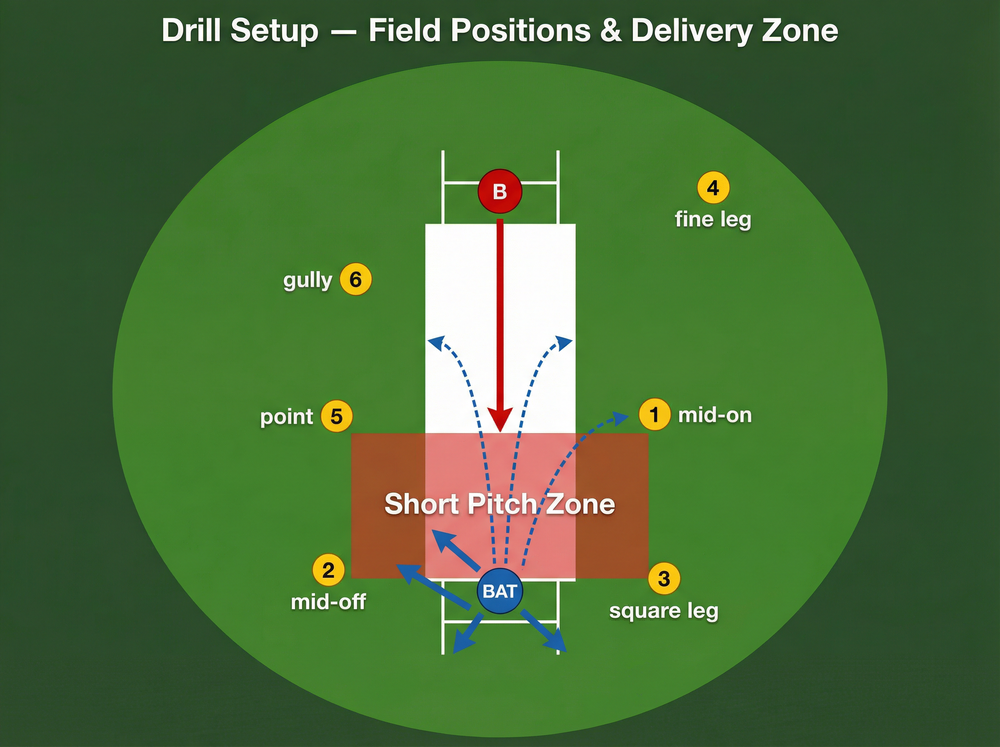
- Pitch: A standard 22-yard cricket pitch is required. Use cones to mark a 'Short Pitch Zone' on the pitch, approximately 6-8 metres from the batsman's stumps. This gives the bowler a clear target for landing the ball.
- Players: This drill can be run with as few as 4 players (1 batsman, 1 bowler, 1 wicketkeeper, 1 coach/feeder), but is more effective with a small group to allow for rotation.
- Fielders: Place fielders in realistic positions for short-pitched bowling. Key positions include Square Leg, Fine Leg, and Deep Square Leg for the pull and hook shots.
3. Step-by-Step Instructions

- Briefing (2 mins): The coach begins by explaining the objective of the drill: to practice identifying and attacking the short ball. Emphasise the importance of safety, watching the ball closely, and making a clear decision to play the shot.
- Warm-up (5 mins): Batsmen should perform a dynamic warm-up, including trunk rotations, shoulder mobility exercises, and practice swings focusing on a high backlift.
- Drill Start - Feeder/Coach Bowling (10 mins): The coach or a designated feeder starts by delivering underarm or overarm throws from a shorter distance (around 15 yards), aiming to land the ball in the 'Short Pitch Zone'. This allows the batsman to get their eye in and focus purely on the technique without the pressure of a full-paced delivery.
- Bowler Introduction (10 mins): A bowler now begins bowling from their full run-up, instructed to aim for the designated short-pitch zone. The bowler should not be aiming to intimidate, but to provide a consistent challenge.
- Execution: The batsman's goal is to:
a. Identify the Length: Watch the ball out of the bowler's hand and recognise the short length early.
b. Move into Position: Execute the correct footwork—back and across—to create a stable base and get inside the line of the ball.
c. Select the Shot: If the ball is at chest height, play the pull shot. If it is at head height or above, play the hook shot.
d. Execute the Shot: Swing the bat on a horizontal plane, making contact in front of the body and aiming to hit the ball down into the gaps in the field. - Rotation: Each batsman faces a set number of deliveries (e.g., 12-18 balls) before rotating with another player. This ensures high intensity and focus for each participant.

4. Key Coaching Points

Coaches should be actively observing and providing feedback throughout the drill. Focus on these critical points:
- Early Recognition of Length: The decision to play a pull or hook is made in a fraction of a second. Train the batsman to look for visual cues from the bowler's release and the ball's trajectory.
- Decisive Footwork: The 'back and across' movement is fundamental. It creates space and aligns the body for the shot. The back foot should move towards the off-stump, allowing the batsman to pivot and swing freely.
- Keep the Head Still: The head must remain level and still, with the eyes locked on the ball from the bowler's hand all the way to the bat. This is non-negotiable for safety and timing.
- High Elbows & Full Swing: Encourage a high backlift and a full, unimpeded swing through the horizontal plane. The top hand controls the shot, while the bottom hand provides the power.
- Roll the Wrists: To control the shot and keep it on the ground, coach the batsman to 'roll' their wrists over the ball at the point of impact. This directs the ball downwards, reducing the risk of being caught.
- Commit to the Shot: Hesitation is the enemy of good short-ball play. Encourage batsmen to be decisive. Either attack the ball with conviction or get out of its way.
5. Common Mistakes

- Backing Away: A common fear-based reaction is for batsmen to move away towards the leg side. This opens up their body and makes them more vulnerable to injury, as well as taking them out of position to play an effective shot. Correct this immediately.
- Playing with an Open Chest: The batsman should remain side-on for as long as possible. Opening the chest too early causes a loss of power and control.
- Taking Eyes Off the Ball: Even for a split second, losing sight of the ball is dangerous and will lead to a mishit. Reinforce the "watch the ball" mantra relentlessly.
- Swinging Too Hard: Over-hitting leads to a loss of balance and shape. A smooth, timed swing will generate more power than a wild slog.
6. Variations & Progressions
- Progression 1 (Increased Pressure): Introduce a second bowler from the other end to simulate a match scenario where the batsman must reset and refocus for each delivery.
- Progression 2 (Fielding Scenarios): Add more fielders in realistic catching positions (e.g., short leg, leg gully) to challenge the batsman to not only execute the shot but also find the gaps.
- Variation 1 (Defensive Focus): Change the objective of the drill to focus on defensive options. The batsman must practice swaying out of the line of the ball or ducking underneath it. This builds a more complete game against short bowling.
7. Age Adaptations
- Under 12 / Under 14: Safety is paramount. Use softer balls (e.g., tennis balls, Incrediballs) and focus exclusively on the pull shot from coach-fed deliveries. The core principles of footwork and watching the ball can be established without the risk associated with fast bowling.
- Under 16: Introduce leather balls in a controlled net environment. The bowler should be a coach or a competent, controlled player. Emphasise the pull shot and only introduce the hook shot once the player is confident and technically sound.
- Open Age / Senior: The drill can be run as described, with full-paced bowling. Introduce advanced concepts like using the pace of the bowler to guide the ball into gaps, rather than always trying to hit for power.
