

Rugby
Mastering the Defensive Drift Pattern: A Complete Guide
Learn how to implement an effective drift defence to force the attacking team wide and shut down overlaps with this comprehensive drill.

What you need
Rugby balls, Cones (for grid boundaries), Bibs (for attacking team)
1. Overview
The drift defence is a fundamental defensive system in rugby union designed to manage situations where the attacking team has a numerical advantage or significant width. Rather than committing to a hard rush, the defensive line shifts laterally (drifts) towards the touchline as the ball is passed. This pattern forces the attack towards the sideline, using the touchline as an extra defender, and buys time for the inside defence to cover across.
This drill focuses on developing the communication, spacing, and lateral movement required to execute a flawless drift defence. It is essential for outside backs and loose forwards who frequently find themselves defending in wide channels.
2. Setup

Pitch Setup:
Utilise a 40m wide by 30m deep grid, typically set up between the 22m line and halfway line to simulate open-play scenarios. Mark the boundaries clearly with cones.
Player Positions:
Divide players into an attacking line of 5 (wearing bibs) and a defensive line of 5.
- Attackers: Positioned flat, simulating a 10, 12, 13, 14, 15 backline spread, spaced roughly 5 metres apart.
- Defenders: Positioned opposite the attackers, but each defender aligns slightly on the outside shoulder of their opposite man.

3. Step-by-Step Instructions

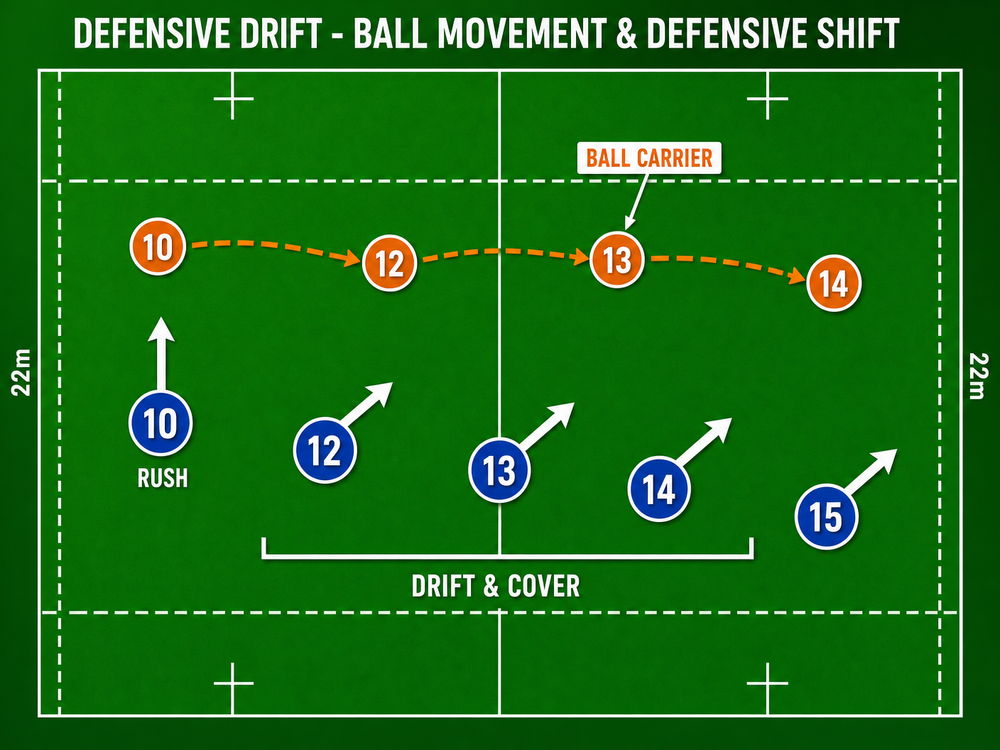
- Initial Alignment: The defending team lines up opposite the attacking team. Crucially, each defender must align on the outside shoulder of their corresponding attacker. The inside defender (simulating the 10) dictates the line speed.
- The Trigger: The coach, standing behind the attacking line, feeds the ball to the attacking 10.
- Inside Pressure: As the ball is caught, the defensive 10 rushes up to apply immediate pressure on the ball carrier, forcing a pass.
- The Drift: As the attacking 10 passes to the 12, the defensive 12, 13, 14, and 15 begin their lateral drift. They must maintain their spacing and avoid turning their shoulders completely to the sideline; they should slide diagonally.
- Passing Down the Line: The attacking team passes the ball through the hands out to the wing (15).
- Closing the Space: As the ball moves wider, the drifting defenders continue to slide, ensuring they always have the outside shoulder covered. The goal is to shepherd the final attacker towards the touchline.
- The Tackle/Touch: The drill concludes when the final defender makes a two-handed touch (or tackle, if full contact) on the attacking winger near the touchline, or forces them out of bounds.

4. Key Coaching Points
- Outside Shoulder Alignment: Defenders must consistently line up on the outside shoulder of the attacker to force them inside or towards the touchline.
- Maintain the Line: The defensive line must move as a cohesive unit. If one player rushes up out of turn (dog-legs), it creates a gap for the attack to exploit.
- Keep Shoulders Square: Defenders should slide laterally while keeping their shoulders relatively square to the attacking line. Turning the back to the inside creates vulnerability to step-backs.
- Communication: Constant chatter is vital. The inside defender must call the line speed ("Up, up, up!"), and outside defenders must communicate the drift ("Drift, drift!").
- Use the Touchline: Emphasise that the touchline is the ultimate defender. The objective is to run the attack out of space.
5. Common Mistakes

- Turning Shoulders Too Early: Defenders completely turning their bodies towards the touchline, making them susceptible to a step inside.
- Dog-Legging: Individual defenders rushing out of the line, breaking the defensive wall and creating huge gaps.
- Fixating on the Ball: Defenders watching the ball rather than their assigned man, leading to poor alignment and missed tackles.
- Lack of Inside Support: The inside defenders failing to fold around and provide cover once the ball has gone past them.
6. Variations & Progressions

- Add Attackers (Overload): Introduce a 6th attacker (e.g., a fullback entering the line) against the 5 defenders to increase the difficulty and force a sharper drift.
- Live Tackling: Progress from two-handed touch to full contact tackling once the pattern is established.
- Kick Option: Allow the attacking team the option to put a grubber kick through, forcing the defence to turn and cover.
7. Age Adaptations

- Under 10s: Focus purely on the concept of moving sideways together. Use walking pace initially and emphasize holding hands in a line to understand connectivity.
- Under 14s: Introduce the concept of outside shoulder alignment and the trigger of the pass. Use touch rugby to encourage faster ball movement.
- Under 16s & Open: Run at full match pace with full contact. Introduce complex attacking moves (loops, dummy runners) to test the decision-making of the drifting defence.
