

Football
Defensive Shape Transition Under Press: Switching and Escaping
Master the tactical movements required to safely transition from a compact defensive block into a structured attack when facing high pressure.
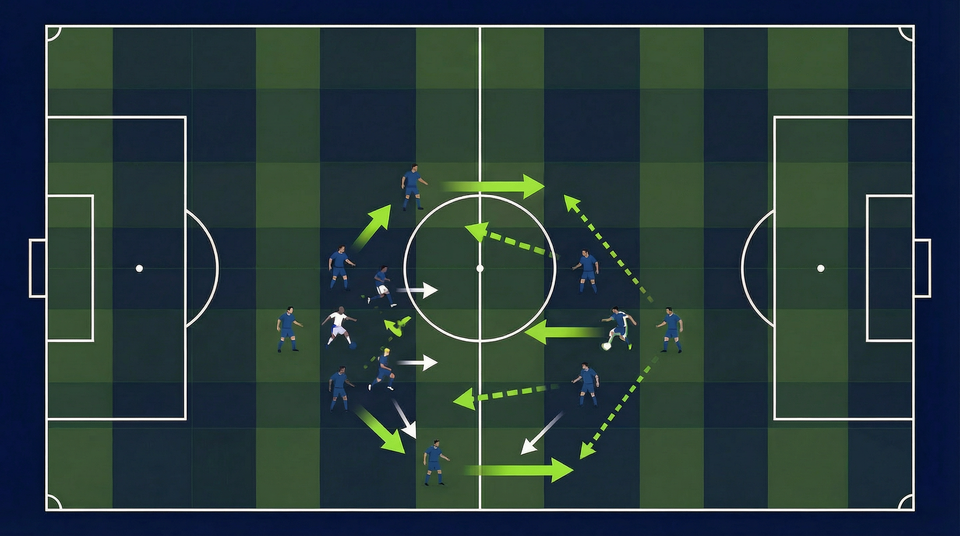
What you need
1 full-size goal, 2 mini-goals, 12-15 cones, Training bibs (2 colors), Footballs
1. Overview
The "Defensive Shape Transition Under Press" is a crucial tactical maneuver designed to help your team safely and effectively transition from a compact defensive block into a structured build-up phase when facing aggressive high pressure from the opposition. In modern football, winning the ball back is only half the battle; the immediate seconds following a turnover are when a team is most vulnerable.
This set play focuses on utilizing a 4-4-2 mid-block as the foundation. When the opposition initiates a press, the objective is to stretch the field horizontally and vertically, creating passing lanes to escape the pressure zone. By executing synchronized movements—such as the center-backs splitting, the pivot dropping, and the wingers stretching the pitch—your team can bypass the initial wave of pressure and launch a counter-attack or establish controlled possession.
2. Setup
Pitch Dimensions: Standard 11v11 pitch (100-110m x 64-75m). For training purposes, you can condense the length to 70m but keep the full width to emphasize stretching the play.

Equipment Needed:
- 1 full-size goal and 2 mini-goals (or target zones) on the halfway line.
- 12-15 cones to mark the "Press Zone" and "Escape Routes".
- Training bibs in two different colors (e.g., Blue for the defending/transitioning team, Red for the pressing team).
- Adequate supply of footballs placed in the goal or with the coach.
Player Positions:
- Defending Team (Blue): Set up in a 4-4-2 formation. GK (1), Right Back (2), Left Back (3), Center Backs (4, 5), Central Midfielders (6, 8), Right Winger (7), Left Winger (11), Strikers (9, 10).
- Pressing Team (Red): Set up with 3 to 4 attacking players (A1, A2, A3) positioned in the attacking third to initiate the press.
3. Step-by-Step Instructions
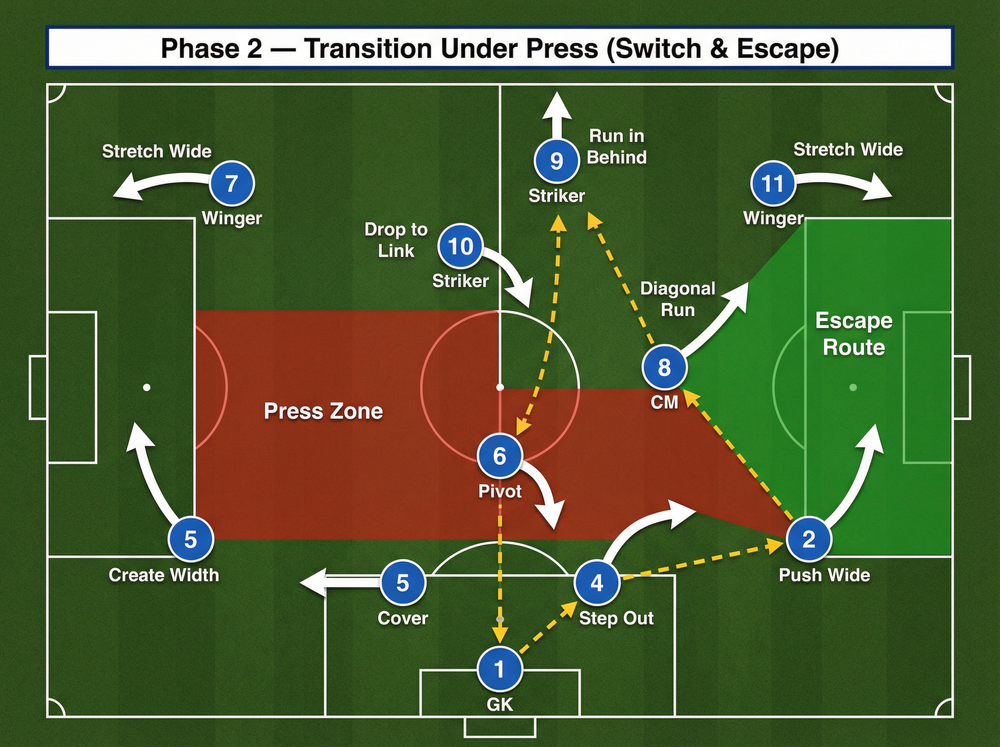
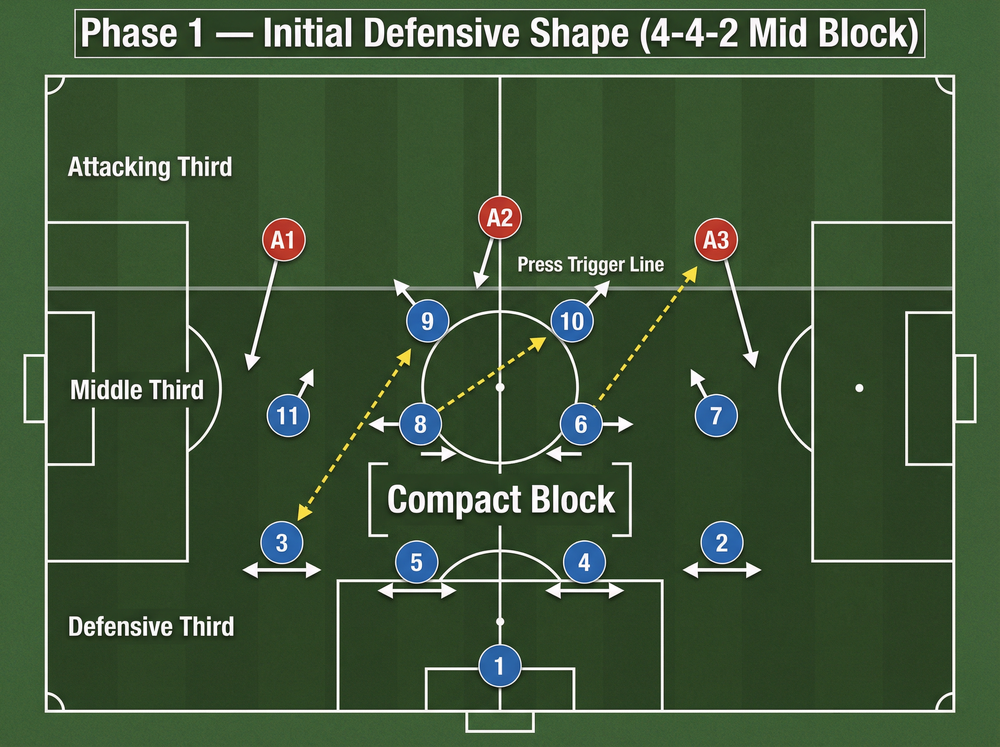
Phase 1: The Initial Defensive Shape
- Establish the Block: The defending team (Blue) organizes into a compact 4-4-2 mid-block. The distances between the defensive, midfield, and forward lines should be no more than 12-15 meters.
- Trigger the Play: The coach feeds the ball to the goalkeeper (1), or the play begins from a simulated turnover in the defensive third.
- Initiate the Press: Upon the goalkeeper receiving the ball, the pressing team (Red) immediately engages, stepping past the "Press Trigger Line" to apply high pressure on the ball carrier and the closest passing options.

Phase 2: Transition and Escape
- Create Width at the Back: As the goalkeeper (1) looks up, Center Backs (4 and 5) immediately split wide to the edges of the penalty area. Fullbacks (2 and 3) push higher and wider, hugging the touchlines to stretch the first line of pressure.
- The Pivot Drops: Central Midfielder (6) drops centrally to form a passing triangle with the two Center Backs, acting as the primary pivot and relief valve.
- Dynamic Midfield Movement: The other Central Midfielder (8) makes a sharp diagonal run into the half-space, dragging a marker and opening a central passing lane.
- Stretch the Pitch Vertically: Wingers (7 and 11) push high and wide, pinning the opposition fullbacks back. Striker (9) makes a penetrating run in behind the defensive line, while Striker (10) drops slightly to link the play.
- Execute the Pass: The goalkeeper or center-back plays a firm, accurate pass to the dropping pivot (6) or the advancing fullback (2/3), bypassing the initial press and entering the "Escape Route" to advance up the pitch.
4. Key Coaching Points
- Speed of Thought and Movement: The transition must happen instantly upon regaining possession or receiving the ball. Hesitation allows the press to close in.

- Body Shape: Players receiving the ball (especially the pivot and fullbacks) must have an open body shape, allowing them to see the incoming pressure and their forward passing options simultaneously.
- Passing Accuracy and Weight: Passes in the defensive third must be firm and played to the correct foot (the foot furthest from the defender) to prevent interceptions.
- Synchronized Rotations: The movement of the center-backs splitting and the pivot dropping must be coordinated. If one moves without the other, the passing structure collapses.
- Use the Goalkeeper: The GK must act as an 11th outfield player, providing a calm and composed passing option to switch the play if one side is overloaded.
5. Common Mistakes
- Closing the Space Too Slowly: Center-backs failing to split wide enough, making it easy for a single pressing forward to cut off multiple passing lanes.

- Midfielders Hiding: The pivot (6) standing behind an opposition player instead of actively stepping into a clear passing lane to demand the ball.
- Forcing the Central Pass: Playing a risky pass through the crowded central "Press Zone" when the safer, wider "Escape Route" is open.
- Lack of Communication: Players not verbally and physically demanding the ball, leading to confusion and turnovers in dangerous areas.
6. Variations & Progressions
- Progression 1: Add More Pressers. Increase the pressing team from 3 players to 5 or 6, forcing the transitioning team to make quicker decisions and execute under higher stress.
- Progression 2: Time Limit. Introduce a 6-second rule where the transitioning team must advance the ball past the halfway line (or score in the mini-goals) within 6 seconds of the goalkeeper playing the ball.
- Variation 1: Asymmetrical Shape. Instead of both fullbacks pushing high, keep one fullback deep to form a back three during the build-up, allowing the opposite winger to invert.
7. Age Adaptations
- Under-10 to Under-12: Focus heavily on the basic mechanics—center-backs splitting and the goalkeeper making a simple, safe pass. Reduce the number of pressing players to 1 or 2 to build confidence.
- Under-14 to Under-16: Introduce the complex midfield rotations (the dropping pivot and diagonal runs). Demand higher ball speed and firmer passes.
- Open/Senior: Run the drill at full match intensity with equal numbers. Focus on the nuances of body shape, third-man runs, and exploiting the specific weaknesses in the opponent's pressing structure.
