

Netball
Defensive Zone Intercept Drill: Mastering the Transverse Line Press
Learn how to build a cohesive defensive unit that forces high-pressure turnovers through coordinated zone coverage and explosive intercepts.
What you need
1 Netball, Defensive bibs (GK, GD, WD), Attacking bibs (GA, GS, WA), 4-6 flat markers
1. Overview
The Defensive Zone Intercept Drill is designed to transition your defensive unit from passive marking to active, ball-hunting zone defense. This drill focuses on dictating the attacking team's passing channels, specifically targeting the transverse line to force lateral or high-risk passes. It is an essential practice for developing anticipation, explosive off-the-mark speed, and the confidence to leave a direct opponent to secure an interception.
This drill is best utilized mid-season when players have established strong 1-on-1 defensive skills and are ready to operate as a connected defensive unit. It teaches the Goal Keeper (GK), Goal Defence (GD), and Wing Defence (WD) to work synergistically to create a 'wall' that the opposition struggles to penetrate.
2. Setup
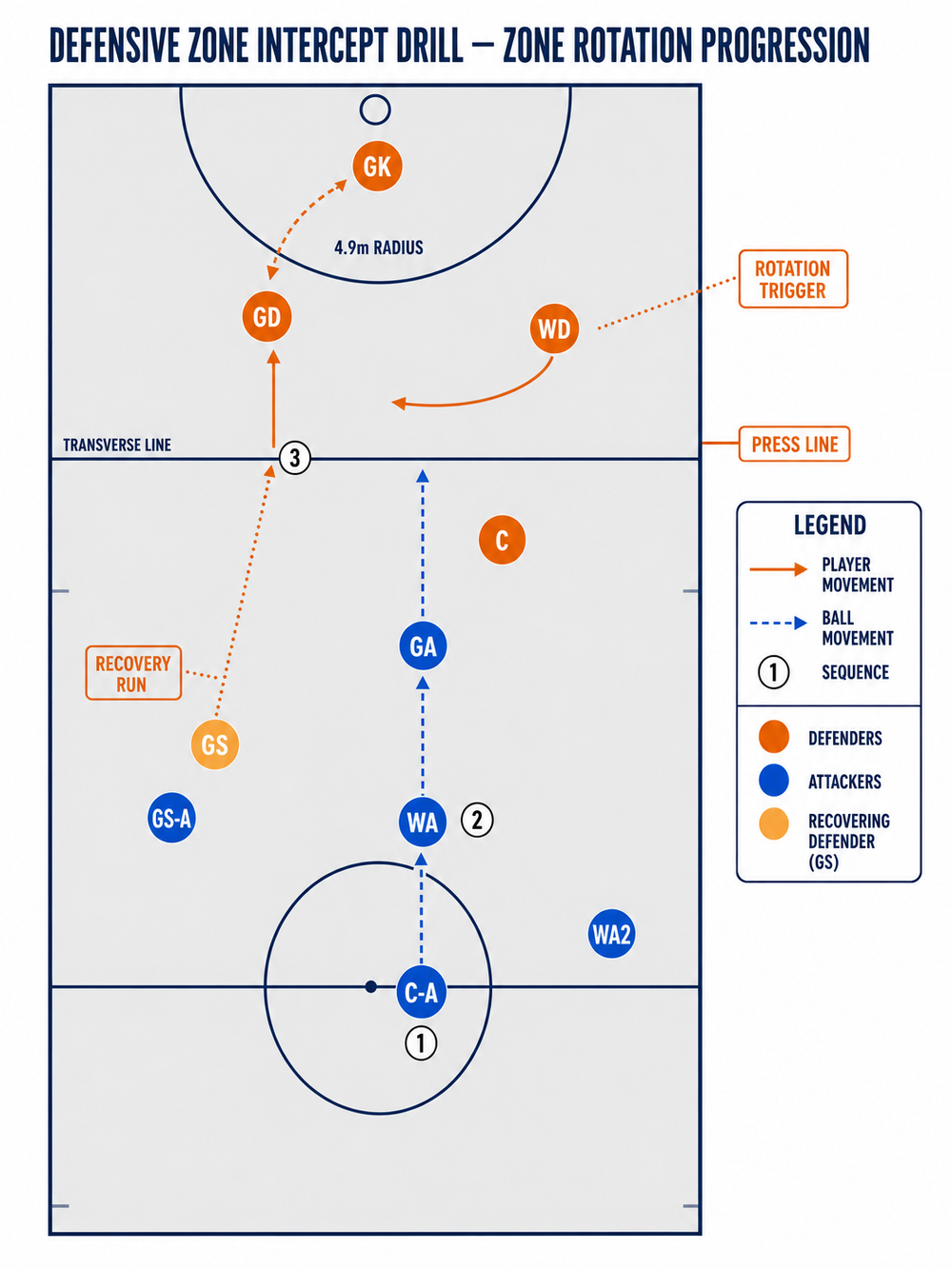
Court Area: One full defensive third and the centre third of a standard 30.5m x 15.25m netball court.
Players Required: Minimum 7 players (3 Defenders, 3 Attackers, 1 Feeder/Centre).
Equipment:
- 1 Netball
- Set of bibs for defenders (GK, GD, WD)
- Set of bibs for attackers (GA, GS, WA)
- 4-6 flat markers (optional, for defining initial zone boundaries)
Initial Positions:
- Defenders: GK starts deep in the goal circle. GD and WD start slightly above the transverse line in the centre third, forming a triangle formation with the GK.
- Attackers: GA and WA start near the top of the goal circle in the defensive third. GS starts deep in the circle.
- Feeder: The Centre (C) starts in the centre circle with the ball.
3. Step-by-Step Instructions

- The Trigger: The drill begins with the Centre (C) passing the ball to either the WA or GA who have made a preliminary drive into the centre third.
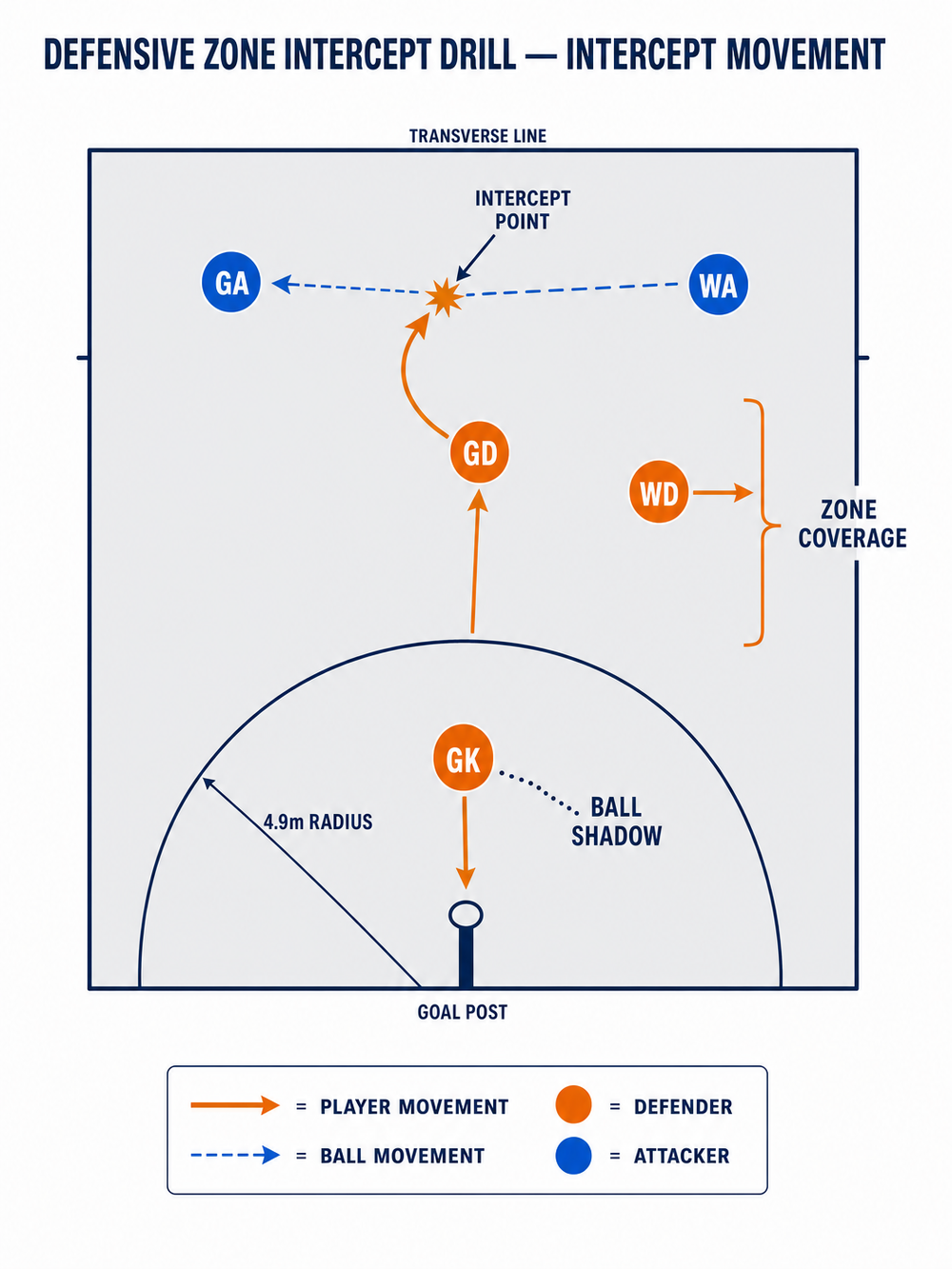
- Setting the Zone: As the first pass is made, the defensive trio (GK, GD, WD) must immediately adjust their positioning to set the zone. The player closest to the ball carrier applies a loose 3-foot mark to apply pressure, while the other two drop back slightly to cover the passing channels.
- Baiting the Pass: The defenders must deliberately leave a passing option looking slightly open. This is the 'bait'. For example, the GD might sit slightly off the GA, making a pass from WA to GA look viable.
- The Intercept Drive: As the attacker (WA) commits to the pass to the 'open' player (GA), the baiting defender (GD) explodes from their position, driving hard across the passing lane to take the intercept at the highest possible point.
- The Recovery: If the intercept is missed, the defender must immediately recover, and the unit must reset their zone structure to defend the next phase of play.
- Transition: Upon a successful intercept, the defenders must immediately transition into attack, looking for a quick outlet pass back to the Centre (C).
4. Key Coaching Points
- Vision and Awareness: Defenders must maintain 'open body' positioning, allowing them to see both the ball carrier and the players moving into their zone. They should not get caught ball-watching.
- Timing the Drive: The intercept drive must be explosive and timed perfectly. Going too early alerts the passer; going too late results in a contact penalty or a missed intercept. The trigger to move is the passer's shoulder drop or arm extension.
- Angle of Intercept: Defenders must attack the ball at an angle, driving through the line of the pass, rather than running parallel to it. They must take the ball at its highest point.
- Communication: The defensive unit must talk constantly. Calls like "Got ball," "Left channel," or "Drop" are crucial for maintaining the integrity of the zone.
- Landing and Balance: After securing the intercept, the player must land in a balanced position, ready to immediately transition the ball into attack without stepping.
5. Common Mistakes
- Flat Footedness: Defenders standing flat-footed cannot generate the explosive speed required for an intercept. They must be on the balls of their feet, ready to move.
- Over-Committing: A defender driving for an intercept they cannot reach leaves a massive hole in the defensive structure. Players must learn to judge which passes are interceptable and which require containment.
- Ignoring the Ball Carrier: Focusing solely on the intended receiver allows the ball carrier to easily manipulate the defense. Pressure on the pass is essential to force errors.
- Lack of Recovery: If an intercept is missed, the player often drops their head or stops moving. Immediate recovery is non-negotiable.
6. Variations & Progressions
- Progression 1: Add a Second Phase. Instead of stopping after the first intercept attempt, allow the attackers to reset if the pass is completed. The defenders must quickly re-establish their zone and attempt an intercept on the second or third pass.
- Progression 2: The Full Court Press. Integrate the Centre (C) and Wing Attack (WA) into the defensive structure, creating a full-court zone that starts from the opposition's baseline, increasing the pressure and complexity of the rotation.
- Variation 1: The 'Shadow' Defender. Introduce a rule where one defender (e.g., the GK) cannot attempt an intercept but must purely act as a 'shadow', constantly repositioning to block the most dangerous space, forcing the GD and WD to do the intercepting work.
7. Age Adaptations
- Under 10s / Under 12s: Focus purely on the concept of 'intercepting' rather than complex zones. Use stationary feeders and encourage players to practice driving in front of a stationary receiver to take the ball. Emphasize safe landing and pivoting.
- Under 14s / Under 16s: Introduce the basic triangle zone structure. Focus heavily on communication and the timing of the intercept drive. Start with slower, more predictable passes before increasing the speed and complexity.
- Open / Advanced: Implement full dynamic rotations, disguised zones, and high-speed, unpredictable passing from the attackers. Emphasize immediate transition into attack upon securing the turnover.
