

Basketball
Dominating the Paint: Essential Post Moves and Footwork Circuit
Equip your bigs with the essential footwork and finishing skills to dominate the low block with this high-repetition, progressive post play circuit.
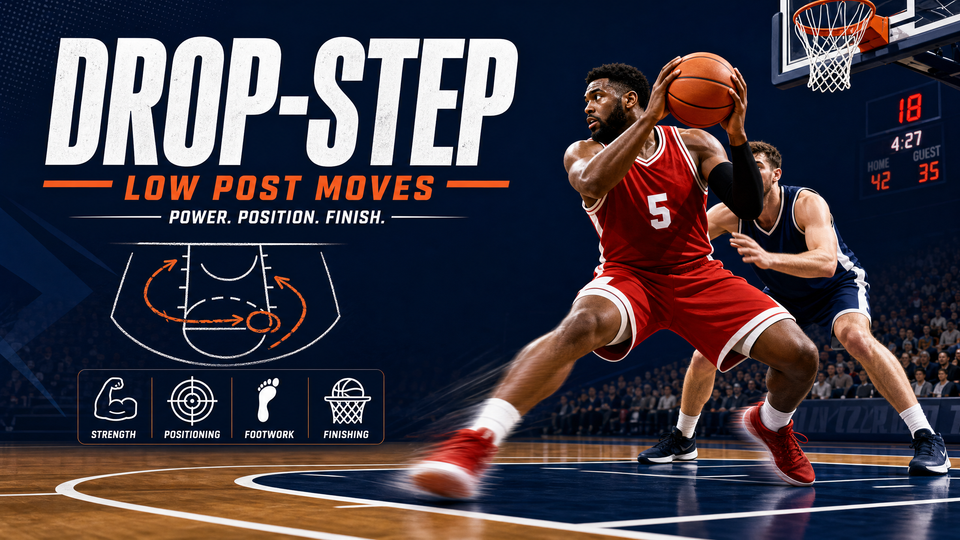
What you need
Basketballs (2-3), Contact Pad (optional, for coach), Cones (optional, for spacing marks)
1. Overview
The Essential Post Moves and Footwork Circuit is designed to build the foundational skills required for effective interior scoring. In modern basketball, while the game has expanded to the perimeter, the ability to score reliably in the low post remains a massive advantage. This drill focuses on the critical elements of post play: establishing position, reading the defender, executing precise footwork, and finishing strongly through contact.
By isolating the drop-step and the middle jump hook, coaches can provide high-repetition practice that builds muscle memory. This drill is ideal for use during the skill development portion of practice and is beneficial not just for traditional centers and power forwards, but for any player who might find themselves with a size mismatch near the basket.
2. Setup
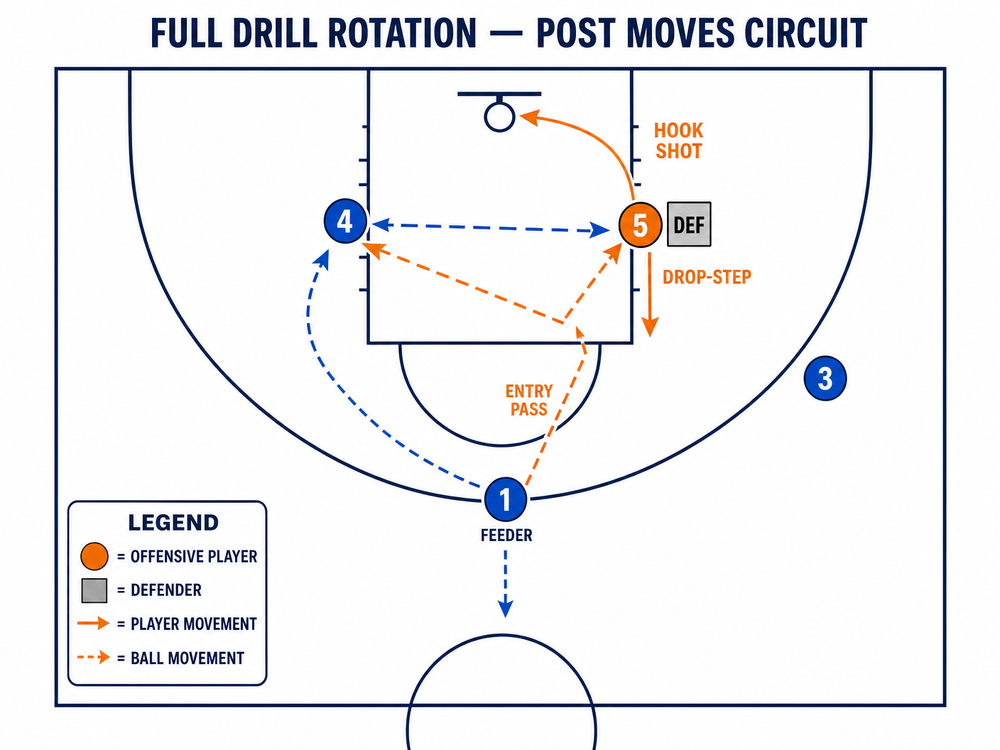
Proper setup is crucial for maximizing repetitions and ensuring the drill flows smoothly.
- Court Setup: Use one half-court (standard FIBA dimensions: 28m x 15m). The primary action occurs in the key/paint area and on the low blocks.
- Player Positions:
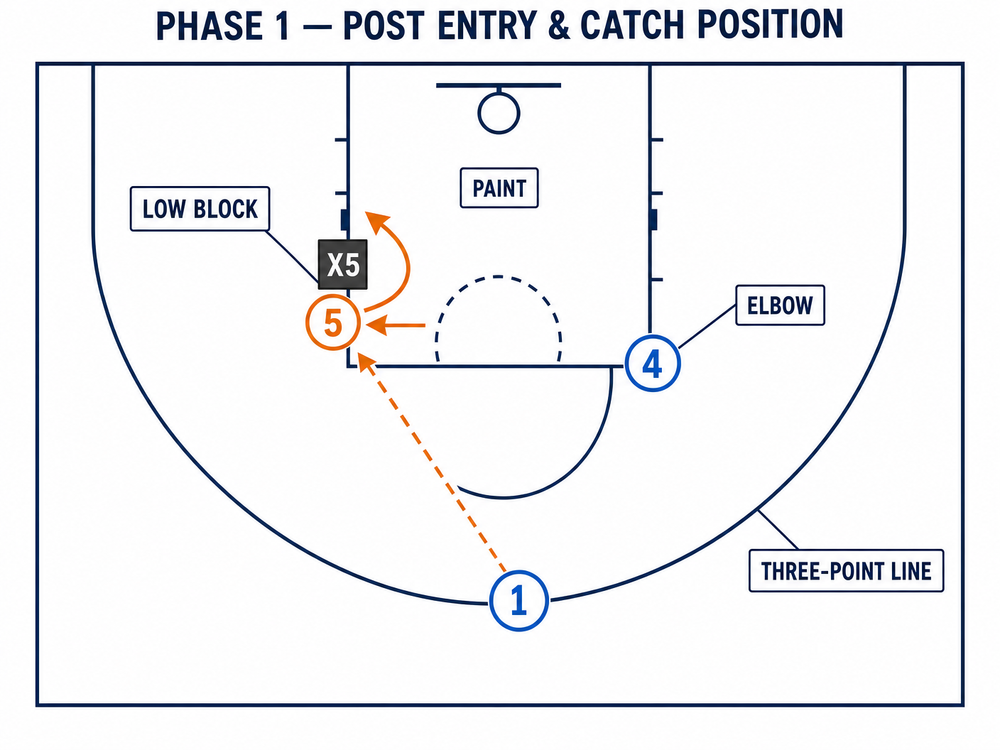
- Post Player (5): Starts on the low block.
- Feeder/Passer (1): Starts at the top of the key or the wing, depending on the entry angle desired.
- Defender (X5): Starts behind the Post Player (can be a coach with a pad initially, progressing to a live defender).
- Next in Line (4): Waiting at the opposite low block or elbow.
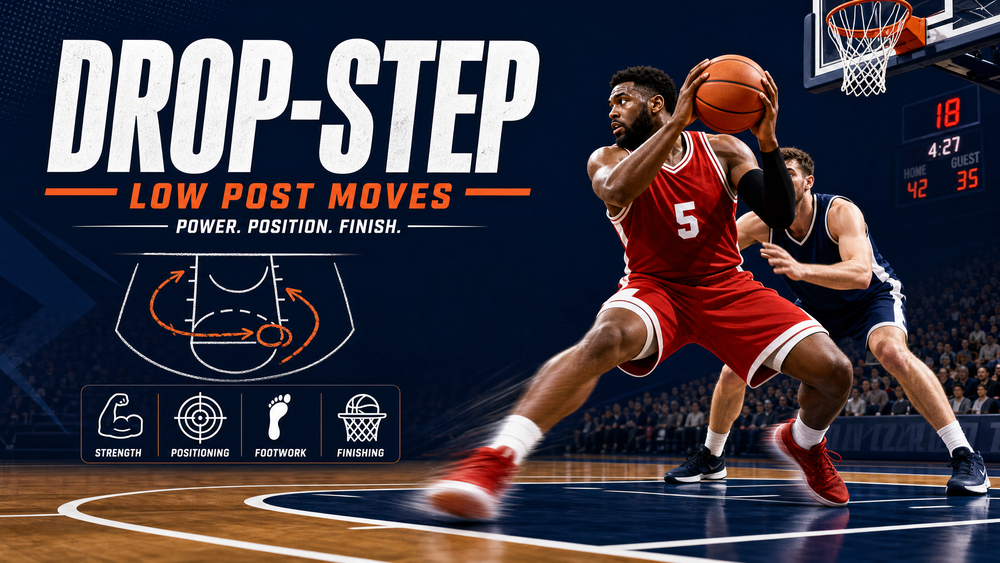
3. Step-by-Step Instructions
Follow these steps to execute the drill effectively. The drill should be run on both sides of the floor to ensure ambidextrous development.
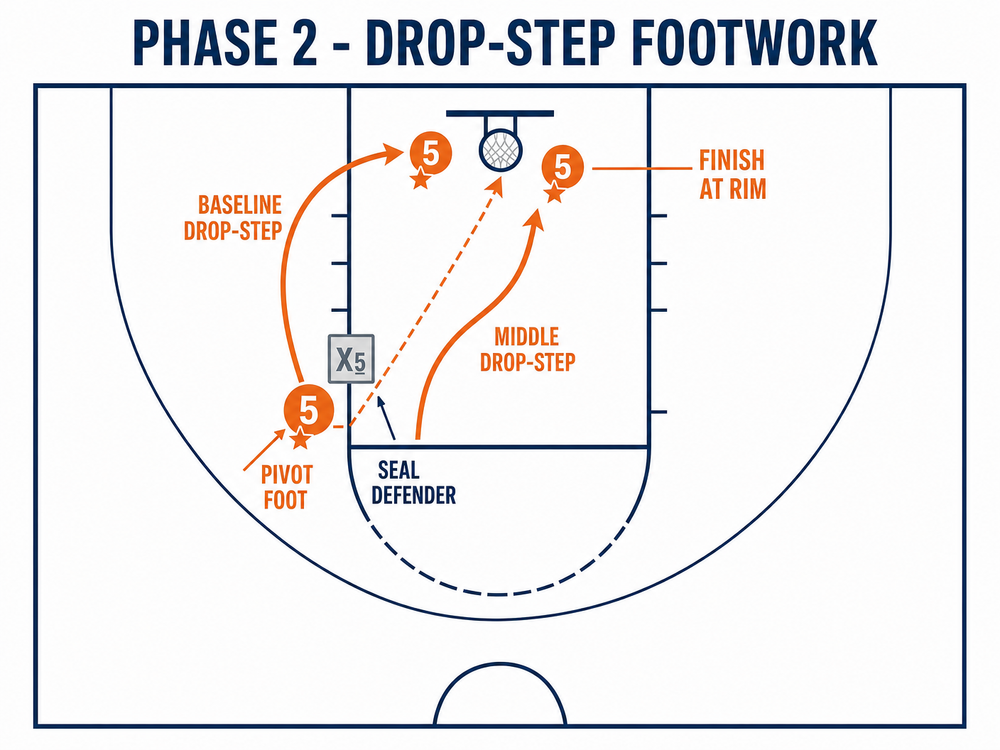
- Establish Position: The Post Player (5) starts on the low block, using their body to seal the Defender (X5). The player must provide a wide, clear target hand for the entry pass.
- The Entry Pass: The Feeder (1) delivers a crisp, accurate pass to the Post Player's target hand. The pass should be away from the defender.
- The Catch and Chin: Upon receiving the ball, the Post Player immediately "chins" the ball (secures it tightly under the chin with elbows out) and establishes a strong, wide base.
- Read the Defense: The Post Player quickly reads the defender's positioning.
- If the defender is playing high (towards the middle): The player will execute a baseline drop-step.
- If the defender is playing low (towards the baseline): The player will execute a middle move (jump hook or up-and-under).
- Execute the Move (The Drop-Step):
- Establish the pivot foot (the foot closest to the middle of the floor).
- Take a deep, powerful step with the non-pivot foot toward the baseline, sealing the defender on the back.
- Simultaneously power dribble (one hard bounce) to gather momentum.
- The Finish: Explode off two feet and finish strongly at the rim, protecting the ball with the body and off-arm.
- Rotation: After the shot, the Post Player rebounds their own ball (if missed) or passes it back to the Feeder line, then rotates to the back of the line. The Next in Line steps up to the block.
4. Key Coaching Points
To get the most out of this drill, coaches should emphasize the following details:
- "Meet the Pass": Post players should not wait for the ball to come to them. They must step toward the pass to prevent the defender from fronting or deflecting the entry.
- Low Center of Gravity: A high, upright stance is weak. Players must maintain a wide base with bent knees to hold their ground against a physical defender.
- Violent Pivots: The drop-step must be quick and aggressive. The footwork should create space and a clear path to the basket.
- Protect the Ball: When making the move, the ball should be kept high and tight, or swept low below the knees. Exposing the ball in the "stripping zone" (waist level) will result in turnovers.
- Finish Through Contact: Encourage players to initiate contact on the finish. Use a heavy pad during the drill to simulate game-like physicality.
5. Common Mistakes
Watch for these frequent errors and correct them immediately:
- Standing Straight Up on the Catch: This eliminates the player's power and makes them easy to move off their spot.
- Failing to Chin the Ball: Bringing the ball down to the waist after the catch allows guards to dig in and steal it.
- Weak or Shallow Drop-Steps: A drop-step that doesn't go deep enough toward the basket allows the defender to recover and contest the shot.
- Fading Away on the Finish: Post players should go up and through the defender, not fade away from the basket, which lowers the shooting percentage.
6. Variations & Progressions
Keep the drill challenging by introducing these progressions:
- Progression 1: Add a Live Defender: Move from a coach with a pad to a live, competitive defender (X5). The defender is instructed to vary their positioning (high side, low side, three-quarter front) forcing the offensive player to read and react.
- Progression 2: The Counter Move: If the initial drop-step is cut off by the defender, the offensive player must immediately counter with an up-and-under move back to the middle.
- Variation 1: Wing Entry vs. Top Entry: Practice receiving the ball from different angles. A pass from the top of the key requires different footwork to seal than a pass from the wing.
7. Age Adaptations
Tailor the drill to the age and skill level of your team:
- Youth (Under 10 - Under 12): Focus entirely on footwork without a defender. Use spots on the floor to show exactly where the feet should go. Emphasize catching the ball with two hands and finishing with a simple layup.
- Middle School (Under 14 - Under 16): Introduce the coach with a contact pad. Demand harder pivots and emphasize chinning the ball. Introduce the basic read (baseline vs. middle).
- High School/Open: Full live defense. Incorporate counter moves (up-and-under, jump hooks). Emphasize playing through significant contact and finishing with both hands.
