

Football
Mastering the Final Third: Dynamic Crossing and Finishing Drill
A comprehensive, high-intensity crossing and finishing drill designed to improve wide-area delivery and penalty box movement.

What you need
1 full-size goal, 12-15 footballs, Cones, Colored bibs
1. Overview
This dynamic crossing and finishing drill is engineered to replicate match-realistic scenarios in the final third. By isolating the wide delivery and the corresponding penalty box runs, coaches can meticulously refine the timing, technique, and decision-making required to convert crosses into goals. This session is particularly effective for teams looking to exploit wide areas and improve their conversion rate from wide deliveries. It focuses heavily on the synchronization between the crosser and the attackers arriving in the box.
2. Setup

Pitch Dimensions: Use the attacking half of a standard football pitch (approximately 50-55m long x 68m wide).
Equipment: 1 full-size goal, 12-15 footballs, cones to mark starting positions and crossing zones, and colored bibs to differentiate attackers and defenders.
Players: 8-12 players (1 Goalkeeper, 2-3 Wide Players/Wingers, 3-4 Forwards/Attacking Midfielders, 2-3 Defenders).
Positions:
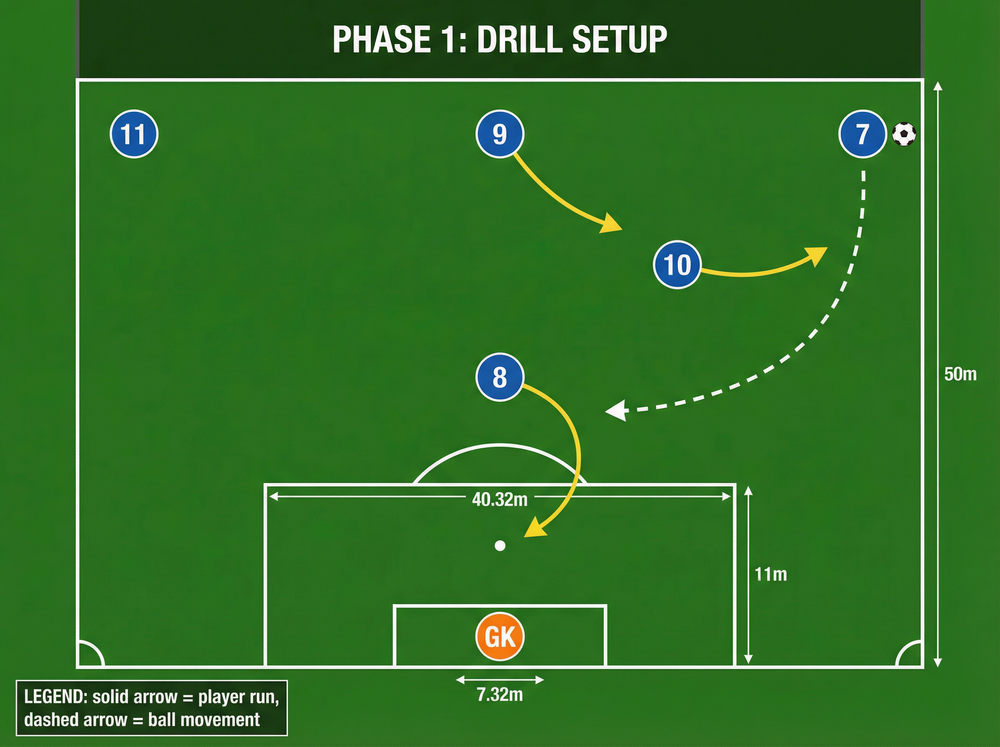
- Wide Players (7 & 11): Positioned wide near the touchlines, starting from around the halfway line.
- Central Attackers (9 & 10): Positioned centrally, starting around 35-40m from goal.
- Central Midfielder (8): Positioned slightly deeper, ready to make late runs to the edge of the penalty area.
- Defenders (CBs): Positioned inside the penalty area to provide passive or active resistance.

3. Step-by-Step Instructions
Phase 1: Unopposed Pattern Play
- Initiation: The drill begins with a central midfielder (8) playing a firm pass out wide to the right winger (7).
- Wide Delivery: The right winger takes a positive first touch down the line or cuts inside, depending on the coach's instruction, and delivers a cross into the penalty area.
- Box Movement: Simultaneously, the central attackers (9 & 10) make synchronized, crossing runs. The number 9 typically attacks the near post, while the number 10 attacks the far post.
- Late Arrival: The central midfielder (8) follows their pass, arriving late at the edge of the penalty area or the penalty spot to finish any cut-backs or clearances.
- Finishing: The attackers attempt to score past the goalkeeper with a first-time finish (header or volley).
- Reset: Players jog back to their starting positions, and the sequence is repeated on the opposite flank with the left winger (11).
Phase 2: Introducing Defensive Pressure
- Defensive Integration: Introduce 1 or 2 central defenders (CBs) into the penalty area.
- Active Defending: The defenders actively track the runs of the attackers and attempt to clear the cross.
- Decision Making: The wide player must now assess the positioning of the defenders and choose the appropriate type of cross (e.g., driven near post, lofted far post, or cut-back).

4. Key Coaching Points
- Quality of Delivery: The cross must have the correct pace, trajectory, and accuracy. Encourage wide players to pick out a specific zone or player rather than just hitting it into an area.
- Timing of Runs: Attackers must time their runs to arrive as the ball is delivered, not before. Arriving too early makes them static and easy to mark.
- Aggressive Finishing: Attackers should attack the ball aggressively, committing fully to the header or volley. Emphasize getting across the defender.
- Communication: Clear communication between the crosser and the attackers is crucial. The crosser should signal their intent, and attackers should call for the ball.
- Second Balls: Players must be alert to rebounds and clearances. The late-arriving midfielder is vital for securing second balls.
5. Common Mistakes
- Crossing Without Looking: Wide players delivering the ball without assessing the movement in the box.
- Static Runs: Attackers standing still in the box rather than making dynamic, angled runs to lose their markers.
- Poor Timing: Attackers arriving too early, forcing them to wait for the ball and lose momentum.
- Lack of Width: Wide players coming too far inside before crossing, reducing the angle and making it easier for the goalkeeper to intercept.
6. Variations & Progressions
- Overlaps/Underlaps: Introduce full-backs to create 2v1 situations out wide before the cross is delivered.
- Transition to Defend: If the defenders win the ball, they must immediately transition and try to score in mini-goals placed near the halfway line.
- Time Limit: Impose a strict time limit (e.g., 8 seconds) from the initial pass to the finish to increase the intensity and simulate match conditions.
7. Age Adaptations
- Under 8 - Under 10: Focus purely on the technique of striking a moving ball and basic coordination. Remove defenders and allow players to take a touch before finishing.
- Under 12 - Under 14: Introduce passive defenders and focus on the timing of runs. Emphasize different types of crosses (low, driven, lofted).
- Under 16 - Open: Full match realism with active defenders, high intensity, and complex movement patterns (e.g., dummy runs, crossing over).
