

Rugby
Dynamic Support Running & Angles: Breaking the Gain Line
Master the art of running lines and timing to create line breaks and overwhelm the defence with this high-intensity support running drill.
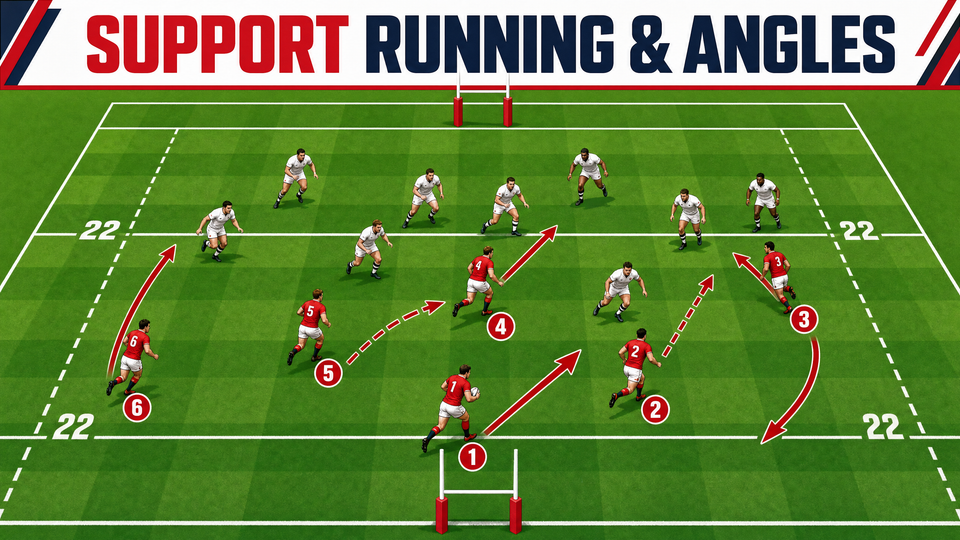
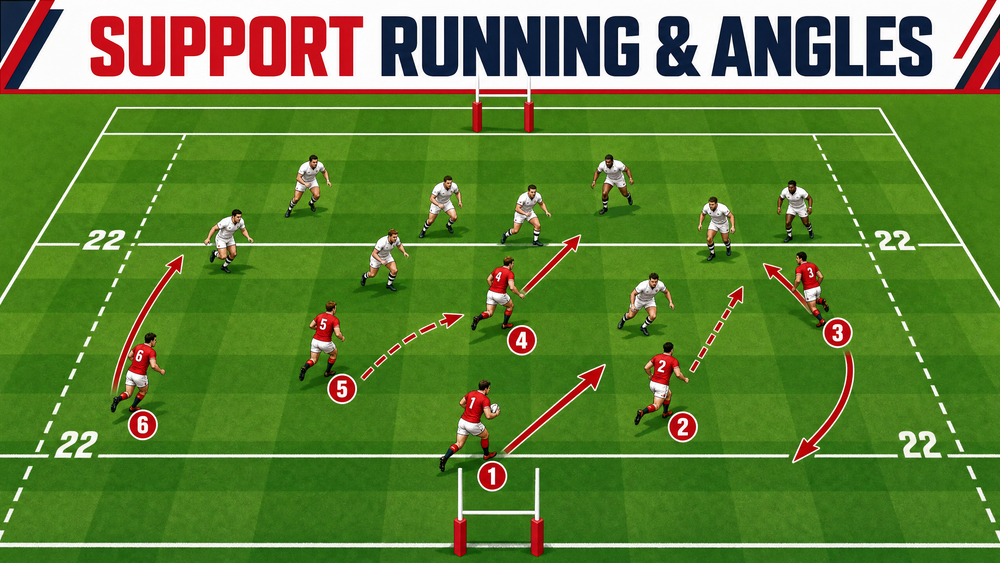
What you need
8-10 cones, 3-4 rugby balls, Colored bibs, Tackle shields (optional)
1. Overview
Support running is the lifeblood of an effective attacking rugby team. When players run predictable, static lines, the defence can easily drift and smother the attack. However, when players hit the line with pace, depth, and varied angles, they force defenders to make split-second decisions, creating gaps and line breaks.
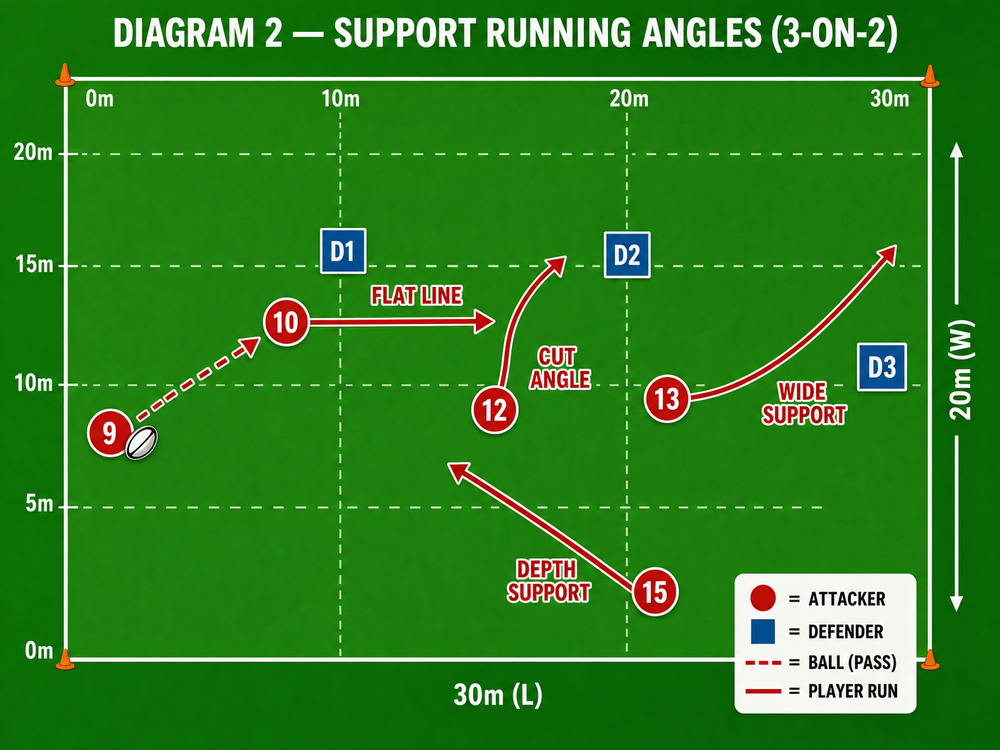
This drill focuses on the timing, communication, and angle of support runners. It teaches the ball carrier (often the 10 or 12) to square up the defence and commit a tackler, while the support runners (12, 13, 15) read the play and offer dynamic options—flat, cut, or deep support. By mastering these patterns, your team will consistently breach the gain line and maintain rapid momentum.
2. Setup
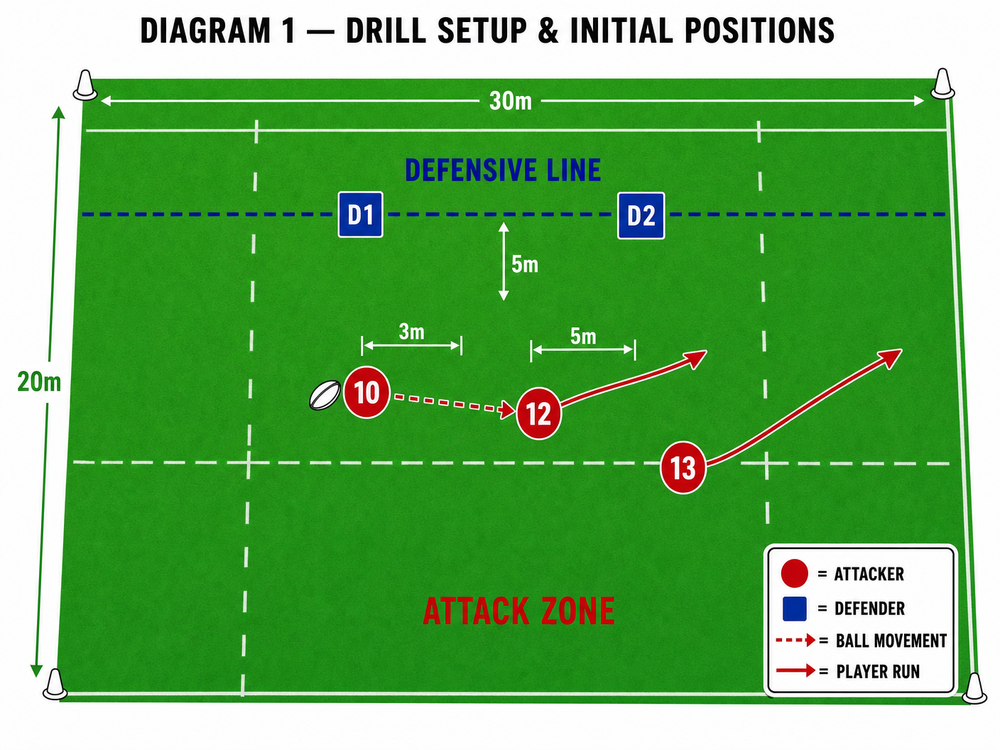
Pitch Area: 30m x 20m grid (can be expanded for older/faster age groups).
Equipment: 8-10 cones, 3-4 rugby balls, colored bibs for defenders.
Players: 5-7 attackers, 2-3 defenders.
Player Positioning
- Attackers: A scrum-half (9) starts with the ball at a designated 'ruck' point. The fly-half (10) stands 4m deep. The inside centre (12) and outside centre (13) stagger their depth. A fullback (15) or winger can start deep as a secondary support option.
- Defenders: 2-3 defenders (D1, D2, D3) start on a defensive line 5m back from the gain line, holding tackle shields if full contact is not desired.
3. Step-by-Step Instructions
- Initiate the Play: The drill begins with the scrum-half (9) passing the ball off the ground to the fly-half (10).
- Square Up: The 10 must catch the ball while moving forward, immediately squaring their shoulders toward the defensive line to commit the first defender (D1).
- Read and React: As the 10 attacks the line, the support runners (12 and 13) must read the body language of the defenders.
- Execute the Angle:
- The 12 runs a hard 'cut angle' (inside-out or outside-in) depending on D2's movement.
- The 13 runs a wider arc to offer an outside option.
- The 15 tracks behind the play, ready to exploit any half-breaks.
- The Pass: The 10 makes a decisive pass to the runner hitting the best angle at pace.
- Follow Through: The receiver must accelerate through the gap. If tagged/tackled, they must immediately present the ball cleanly for the next phase.
4. Key Coaching Points
- Catch Early, Square Up: The ball carrier must catch the ball early and run straight at the defender's inside shoulder. Drifting sideways kills space for the outside runners.
- Timing is Everything: Support runners should not arrive early. They must time their run so they hit the ball at top speed just as the pass is made.
- Loud, Clear Communication: Runners must demand the ball. Calls like "Flat!", "Cut!", or "Deep!" help the ball carrier make split-second decisions.
- Depth: Attackers must start deep enough to allow themselves to accelerate onto the ball. Flat attacks are easily shut down.
- Run Decoy Lines with Intent: Even if a player isn't getting the ball, they must run their line aggressively to hold the defence.
5. Common Mistakes
- Drifting: The ball carrier runs across the pitch instead of fixing the defender, pushing the attack toward the touchline and squashing their own support runners.
- Overrunning the Pass: Support players arrive too early and have to slow down to catch the ball, losing their momentum and making themselves easy targets for the defence.
- Silent Running: Players expect the ball carrier to find them without communicating, leading to missed opportunities and forward passes.
- Static Starts: Players catch the ball standing still rather than moving onto it.
6. Variations & Progressions
- Add a Sweeper: Introduce a full-back defender to challenge the attackers once they break the initial line, forcing a 2v1 decision.
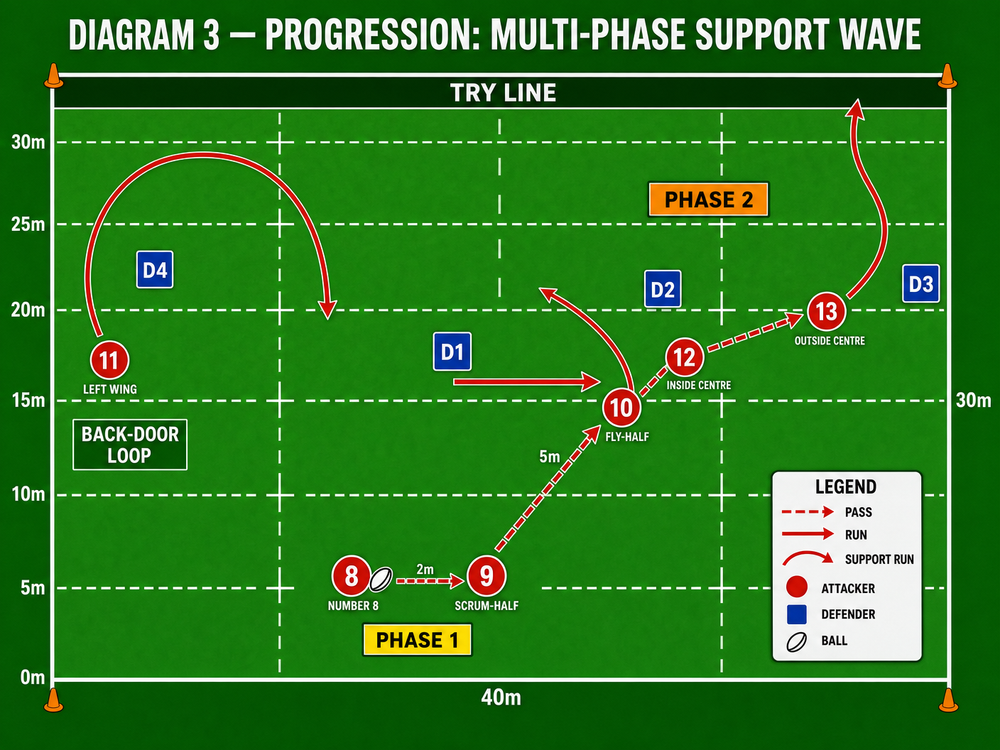
- Multi-Phase (The Wave): After the initial break, the ball carrier goes to ground. A second wave of attackers must immediately realign and attack the disorganized defence on the next phase.
- Constrained Vision: The ball carrier is not allowed to look at their support runners until the last second, forcing them to rely entirely on verbal communication.
7. Age Adaptations
- Under 10s: Focus purely on running straight and passing backward. Remove defenders and use cones to teach the concept of depth and angles.
- Under 12s/14s: Introduce 2v1 and 3v2 scenarios. Emphasize communication and catching the ball on the move. Use touch or tag instead of full contact.
- Under 16s/Open: Full contact. Introduce complex decoy lines, multiple phases, and defensive line speed pressure. Focus on the micro-skills of offloading in the tackle.
