

Football
Elite One-Touch Passing & Triangular Combination Drill
Develop rapid ball circulation, spatial awareness, and precise one-touch passing with this high-intensity combination drill designed to break down compact defenses.

What you need
10-12 marker cones (two colors), Minimum 6 footballs, Training bibs (two colors)
1. Overview
In modern football, the ability to circulate the ball rapidly and accurately under pressure is paramount. This Elite One-Touch Passing & Triangular Combination Drill is designed to develop the cognitive and technical speed required to execute one-touch combinations effectively. By establishing continuous triangular passing networks, players learn to anticipate the next pass before receiving the ball, thereby increasing the tempo of play and disorganizing opposition defensive blocks. Use this drill during the technical or tactical phase of your session to sharpen passing mechanics and instill a proactive, forward-thinking mindset in your squad.
2. Setup

Proper setup is crucial for the flow and intensity of this drill. The area should be tailored to the age and technical proficiency of your players.
- Pitch Dimensions: Create a grid of approximately 20m x 20m for the central combination zone, with a larger 30m x 30m outer area if incorporating overlapping runs.
- Equipment: 10-12 marker cones (two different colors to distinguish zones), an adequate supply of footballs (minimum 6) to ensure continuous play, and training bibs (two colors).
- Player Positions: This drill requires 6 to 8 players. For Phase 1, position 6 players in a structured triangular format. For Phase 2, utilize 8 players including a central target player and overlapping wide players.
3. Step-by-Step Instructions
Follow these steps to ensure the drill is executed with the correct tempo and technical precision.
Phase 1: Triangular Combination
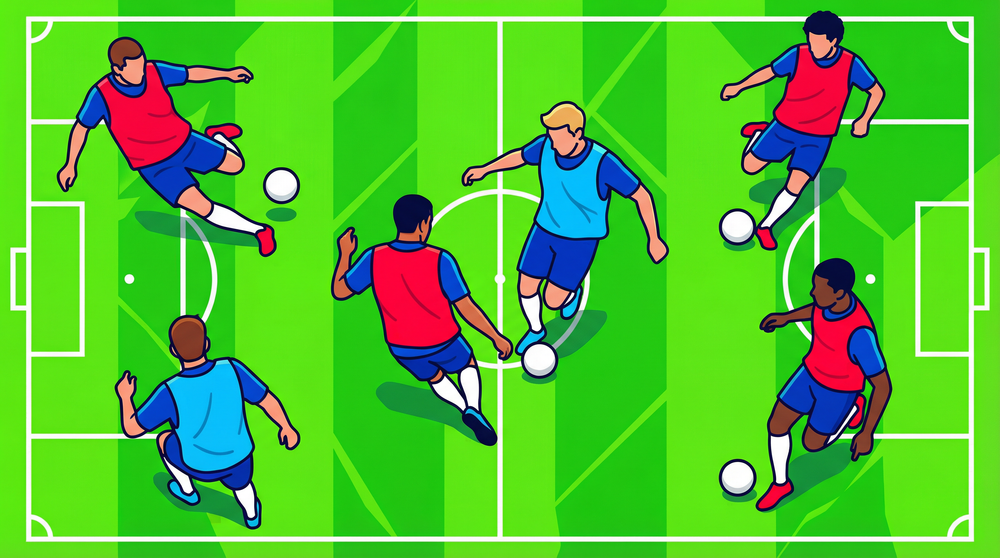
- Initial Positioning: Set up six players (numbered 1 through 6) in a dual-triangle formation as illustrated in Diagram 1. Player 1 starts with the ball at the base.
- The First Pass: Player 1 initiates the sequence with a firm, precise pass to Player 3 at the top of the formation.
- Continuous Circulation: Player 3 immediately plays a one-touch pass to Player 5. Player 5 then redirects the ball to Player 2.
- Completing the Circuit: Player 2 passes to Player 4, who then finds Player 6 in the center. Finally, Player 6 plays the ball back to Player 1 to restart the sequence.
- Rotation: After a set duration (e.g., 2-3 minutes), instruct players to rotate positions clockwise to ensure everyone experiences different passing angles and receiving pressures.
Phase 2: Overlap & Combination

- Advanced Setup: Transition to an 8-player setup. Introduce a central target player (Player 4) and designate two wide players (Players 7 and 8) as overlapping runners.
- Entry Pass: Player 1 plays a penetrating pass into the central target player (Player 4).
- Lay-off and Distribution: Player 4 lays the ball off to a supporting midfielder (Player 2 or 3). Let's assume the pass goes to Player 2.
- The Overlap: As Player 2 receives the ball, the wide player (Player 7) makes a dynamic overlapping run outside of Player 2.
- Final Action: Player 2 plays a perfectly weighted pass into the path of the overlapping Player 7, who then delivers a cross or pass into the 'Target Zone' to complete the sequence. The drill then resets or mirrors to the opposite side.
4. Key Coaching Points
To maximize the effectiveness of this drill, focus your coaching interventions on the following critical areas:
- Weight and Accuracy of Pass: Emphasize punching the ball firmly to the receiving player's preferred foot. A slow pass disrupts the one-touch rhythm.
- Body Shape and Scanning: Players must have an open body shape and scan the field before receiving the ball. They should already know their next passing option.
- Movement off the Ball: Encourage players to make sharp, purposeful movements to create passing angles. Standing still is not an option.
- Communication: Demand clear verbal and non-verbal communication (e.g., pointing, calling for the ball) to synchronize movements and passes.
- First Touch (if two-touch is required): If a player must take two touches, the first touch must aggressively set up the next pass, keeping the ball out of their feet.
5. Common Mistakes
Watch out for these frequent errors and correct them immediately to maintain the quality of the session.
- Playing the Ball Behind the Receiver: This forces the receiver to check their run and takes the momentum out of the combination.
- Lack of Pre-Scanning: Players receiving the ball blindly, resulting in a poor decision or a necessary extra touch that slows the play.
- Static Positioning: Players waiting for the ball to arrive rather than actively stepping into the pass or adjusting their angle.
- Poor Weight of Pass: Passes that are too soft get intercepted, while passes that are too hard are difficult to control with one touch.
6. Variations & Progressions
Adapt the drill to continually challenge your players as they master the basic movements.
- Introduce Passive Defenders: Add 1 or 2 defenders inside the grid who apply light pressure without tackling, forcing quicker decision-making.
- Two-Touch Maximum: If the one-touch requirement is too difficult initially, allow a maximum of two touches, but emphasize that the first touch must be a setup touch.
- Directional Play: Instead of a continuous loop, require the sequence to end with a shot on goal or a pass to a specific target area.
7. Age Adaptations
Tailor the drill's complexity and physical demands to suit the developmental stage of your squad.
- Under 8 - Under 10: Focus heavily on basic passing technique and receiving skills. Allow multiple touches and increase the size of the grid to provide more time and space.
- Under 12 - Under 14: Introduce the one-touch restriction but keep the patterns simple. Emphasize body shape and basic scanning.
- Under 16 - Open: Demand high intensity, strict one-touch play, and rapid decision-making. Introduce active defenders and complex overlapping variations to simulate match conditions.
