

Rugby
Elite Scrum Half Passing Accuracy Drill
Develop razor-sharp passing accuracy and lightning-fast delivery from the base of the ruck under pressure.
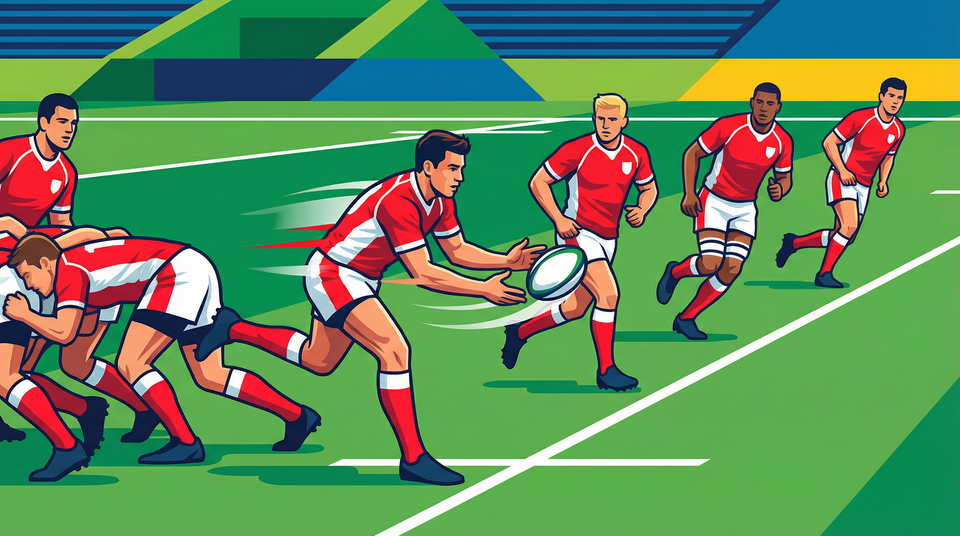
What you need
10-15 rugby balls, 8 cones, Tackle bags (optional)
1. Overview
The scrum half is the heartbeat of any rugby team, dictating the tempo and direction of the attack. This comprehensive drill is designed to refine the core skill of passing accuracy from the base of the ruck. By focusing on body position, footwork, and hand-eye coordination, coaches can help their number 9s deliver crisp, accurate ball to the fly-half (10) or forward pods. This drill is essential for maintaining attacking momentum and ensuring the first receiver has the time and space to execute the game plan effectively. It is best utilized during the early stages of a training session to groove technique before moving into opposed, high-pressure scenarios.
2. Setup
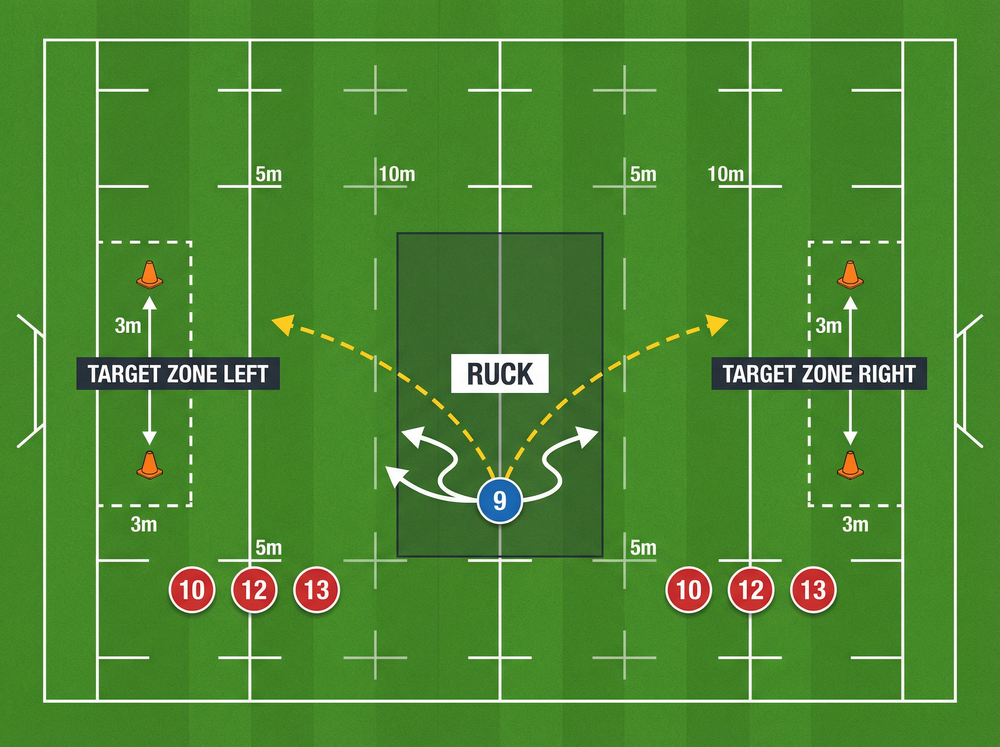
Proper setup is crucial for maximizing repetitions and ensuring the drill translates to match conditions. You will need a standard 100m x 70m rugby pitch, though this drill only requires a 20m x 20m grid.
- Equipment: 10-15 rugby balls, 8 cones (4 for the ruck, 4 for target zones), and optional tackle bags to simulate the ruck.
- Pitch Setup: Create a central ruck point using a tackle bag or cones on the 10-meter line. Measure 5 meters to the left and right of the ruck to establish the primary passing distance. Set up target zones (1 meter wide) using cones at these 5-meter marks.
- Player Positions: The scrum half (9) starts at the base of the simulated ruck. The fly-half (10) and centers (12, 13) align in a flat attacking structure 5 meters away, ready to receive the pass in the target zones.
3. Step-by-Step Instructions
Follow these precise steps to execute the drill effectively:
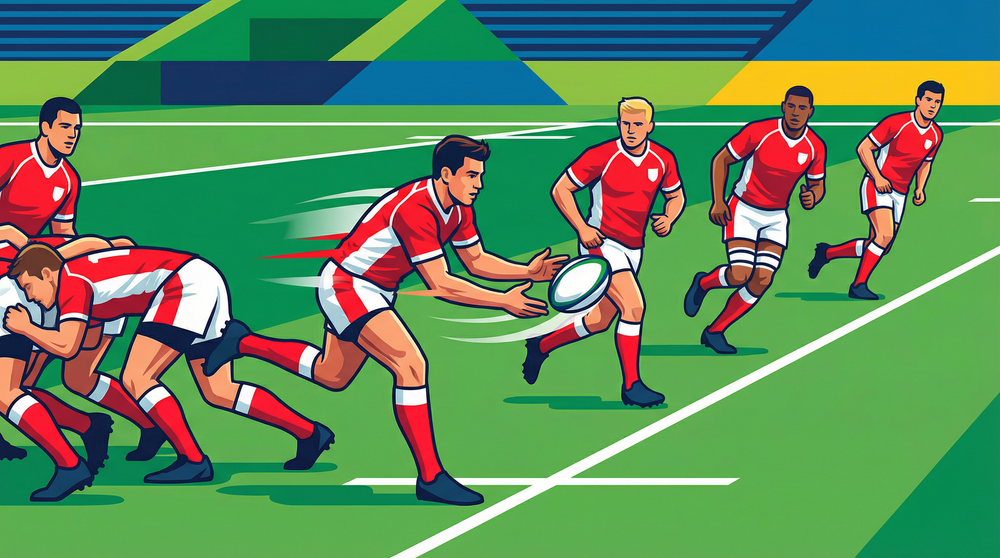
- Starting Position: The scrum half approaches the ruck, identifying the ball's position. They must adopt a low, athletic stance with their feet shoulder-width apart, ensuring their weight is balanced.
- Ball Presentation: The scrum half sweeps the ball from the base of the ruck, keeping their hands close to the ground. The dominant hand should be at the back of the ball for power, and the non-dominant hand at the front for direction.
- Footwork and Pivot: As the scrum half sweeps the ball, they must step toward the target with their lead foot. A quick, explosive pivot on the back foot generates the necessary torque for a powerful pass.
- The Pass: Extend the arms fully toward the target zone, releasing the ball with a strong flick of the wrists. The follow-through is critical; both hands should point directly at the target after release.
- Reset and Repeat: The scrum half immediately resets their position, receives another ball from a feeder, and repeats the action to the opposite side.
4. Key Coaching Points
To ensure players get the most out of this drill, focus on these critical coaching points:
- Low Body Height: The scrum half must stay low to the ground to maintain balance and generate power from their legs. Standing up too early will result in a weak, inaccurate pass.
- Target Identification: Before sweeping the ball, the scrum half must quickly scan and identify the target (the 10's hands or the target zone). Looking at the target ensures accuracy.
- Follow-Through: The hands must follow through toward the target. If the hands drop or pull away early, the ball will likely deviate from its intended path.
- Speed of Delivery: While accuracy is paramount, the speed of the pass is equally important. Encourage the scrum half to minimize the time the ball is in their hands.
5. Common Mistakes
Watch for these common errors and correct them immediately:
- Taking Extra Steps: Taking unnecessary steps before passing slows down the delivery and allows the defense to close the gap. Emphasize a single, decisive step toward the target.
- Passing Across the Body: Passing without properly pivoting the hips leads to inaccurate and weak passes. Ensure the scrum half's hips and shoulders are square to the target upon release.
- Looking at the Ball: Staring at the ball instead of the target will result in poor accuracy. The scrum half must trust their hands and keep their eyes on the receiver.
6. Variations & Progressions
Once the core technique is mastered, introduce these variations to increase the difficulty:
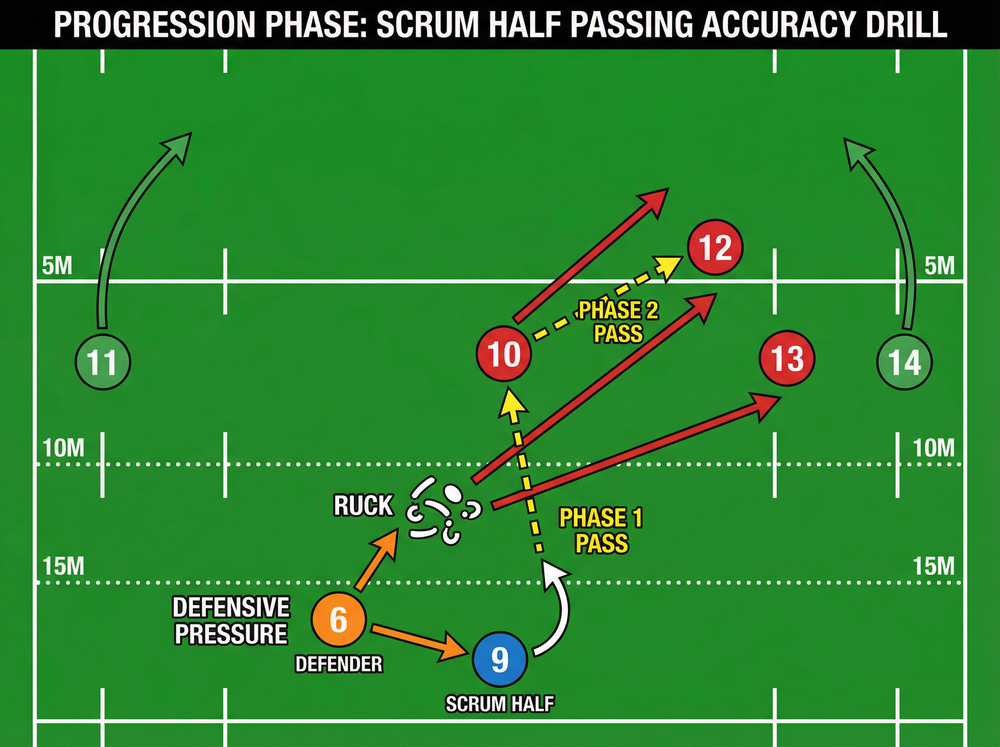
- Defensive Pressure: Introduce a defender (6 or 7) who starts 5 meters back and applies pressure as soon as the scrum half touches the ball. This forces the 9 to execute under time constraints.
- Moving Targets: Instead of static target zones, have the receivers (10, 12, 13) run onto the ball at pace. The scrum half must now judge the speed and angle of the runner to deliver an accurate pass.
- Extended Distance: Gradually increase the passing distance from 5 meters to 10 or 15 meters to challenge the scrum half's power and technique.
7. Age Adaptations
Tailor the drill to suit the age and skill level of your players:
- Under 8s - Under 10s: Focus purely on the mechanics of the pass. Use smaller, lighter balls and reduce the distance to 2-3 meters. Remove all time pressure.
- Under 12s - Under 14s: Introduce the pivot and step. Begin to emphasize the speed of delivery and start incorporating moving targets at a walking or jogging pace.
- Under 16s - Open: Execute the full drill with defensive pressure, varying distances, and full-speed runners. Demand high standards of accuracy and speed.
