

Football
Elite Shot-Stopping: Angle Play and Reaction Saves
Develop your goalkeeper's ability to dominate the penalty area through precise angle management and lightning-fast reaction saves under pressure.

What you need
1 full-size goal, 10-15 footballs, 3-5 cones or markers, Optional: mannequins for screening
Overview
This high-intensity shot-stopping drill is designed to sharpen a goalkeeper's positioning, reaction time, and ability to manage angles against multiple threats. In modern football, a goalkeeper rarely faces a single, predictable shot. They must constantly adjust their set position relative to the ball's location, ensuring they cover the optimal angles to maximize their chances of making a save. This session focuses on the fundamentals of angle play, quick footwork, and decisive shot-stopping from various distances within and around the 18-yard box.
By forcing the goalkeeper to reset quickly after each action, we simulate match-like scenarios where secondary chances often occur. The drill emphasizes the importance of the 'set position'—being balanced, on the toes, and ready to react the moment the striker makes contact with the ball.
Setup

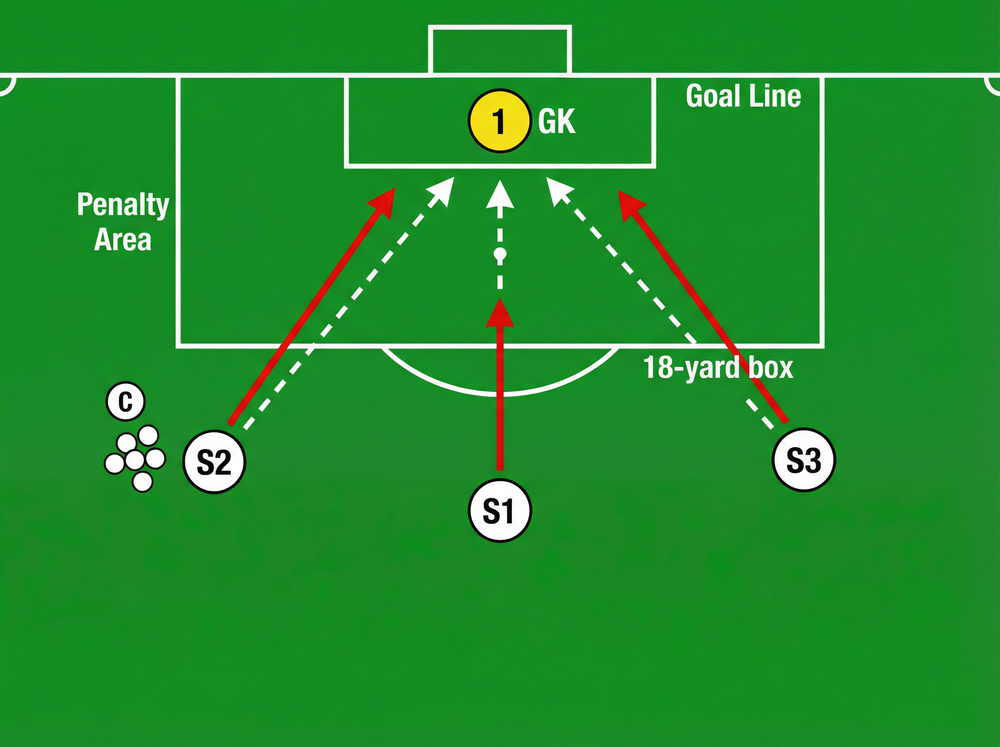
To run this drill effectively, you will need a standard penalty area (18-yard box) on a full-size pitch (100-110m x 64-75m). The setup requires precise positioning to ensure the angles are realistic.
- Players: 1 Goalkeeper (GK), 3 Shooters (S1, S2, S3), 1 Coach/Server (C).
- Equipment: 1 full-size goal, 10-15 footballs, 3 cones to mark shooting stations.
- Positioning:
- GK: Starts centrally on the goal line.
- S1 (Central): Positioned at or slightly behind the penalty spot (12-15 yards).
- S2 (Left Angle): Positioned 20 yards out, offset to the left of the D.
- S3 (Right Angle): Positioned 18 yards out, offset to the right of the D.
- Coach (C): Positioned to the side with a ready supply of balls to feed the shooters or dictate the tempo.

Step-by-Step Instructions

- Initial Set: The GK starts on the goal line, central to the goal. The Coach calls out a number (1, 2, or 3) corresponding to the shooters.
- Movement to Angle: Upon the call, the GK must rapidly close the distance and establish the correct angle relative to the designated shooter. They must find their 'set position' before the shot is taken.
- The Shot: The designated shooter takes a touch out of their feet and strikes firmly on goal. The shot should be realistic—aiming for corners or testing the GK's reactions.
- The Save and Recovery: The GK attempts the save. Regardless of the outcome (save, goal, or parry), the GK must immediately recover to their feet.
- Secondary Action (Optional): If the ball is parried into a dangerous area, any of the shooters can follow up for a rebound. The GK must react to the second ball.
- Reset: Once the sequence is dead, the GK quickly backpedals to the starting position on the goal line, ready for the next call.
Key Coaching Points

- The Set Position: Ensure the GK is completely still and balanced at the moment of the strike. Feet shoulder-width apart, knees slightly bent, weight forward on the balls of the feet, and hands positioned forward and ready.
- Angle Management: The GK must draw an imaginary line from the ball to the center of the goal and position themselves on that line. Closing the distance reduces the target area for the shooter, but coming too far out makes them vulnerable to a chip.
- Footwork: Emphasize quick, small steps (shuffling) to get into position rather than crossing the legs, which can leave the GK off-balance.
- Handling vs. Parrying: Encourage clean catches when possible to relieve pressure. If a catch isn't possible, the GK must actively parry the ball wide and away from the danger zone, not back into the center of the box.
- Recovery Speed: The drill isn't over after the first save. The speed at which the GK gets back to their feet and reassesses the situation is critical.
Common Mistakes

- Moving During the Strike: The most common error is the GK still moving their feet when the ball is hit. This makes it nearly impossible to react to changes in direction. They must be set.
- Poor Starting Position: Starting too deep on the goal line gives the shooter too much of the goal to aim at. Starting too high makes recovery difficult.
- Diving Backwards: When making a save, the GK's momentum should carry them forward or laterally, never collapsing backward into the goal.
- Ignoring the Rebound: Switching off after making the initial save. The GK must always expect a secondary shot.
Variations & Progressions

To increase the difficulty and realism, introduce the following progressions:
- Progression 1: Lateral Movement & Crossing: Replace S2 and S3 with wide servers (SRV-L, SRV-R) who deliver crosses or cutbacks to a central attacker (ATT). The GK must now deal with lateral movement across the goal face before setting for a close-range shot.
- Progression 2: Screened Shots: Place a passive defender or a mannequin between the central shooter (S1) and the GK to obstruct their vision. The GK must track the ball late and rely heavily on reaction speed.
- Variation: Rapid Fire: The Coach dictates a rapid sequence (e.g., S2, then immediately S1). The GK must make a save, instantly recover, and adjust their angle for the second shot with minimal reset time.
Age Adaptations

- Under 8 - Under 10: Focus heavily on the basic set position and catching technique. Reduce the distance of the shooters (8-10 yards) and use lighter, slower shots. Remove the rebound element to focus on primary success.
- Under 12 - Under 14: Introduce angle play. Teach them how stepping out one or two yards changes the picture for the striker. Introduce the rapid-fire variation but with manageable intensity.
- Under 16 - Open: Full intensity. Emphasize explosive power in dives, aggressive parrying away from danger, and dealing with screened shots. The physical demands of the rapid recovery should be high.
