

Netball
Fast Break Centre Pass Play
Master the high-speed transition from the centre circle to the goal circle with this dynamic, multi-phase attacking play designed to catch defenders off guard.

What you need
1 netball, Full court (30.5m x 15.25m), Standard positional bibs
1. Overview
The Fast Break Centre Pass is a high-tempo attacking strategy designed to move the ball from the centre circle to the goal shooter in three seconds or less. This play relies on decisive preliminary movements, sharp angles, and perfectly timed releases. It is particularly effective when you need to shift momentum, break a zone defence, or capitalise on a slower defensive transition from the opposition. By stretching the court and committing defenders early, this play opens up the top of the goal circle for an easy feed.
2. Setup
Equipment Needed: 1 netball, full court (30.5m x 15.25m), standard positional bibs.
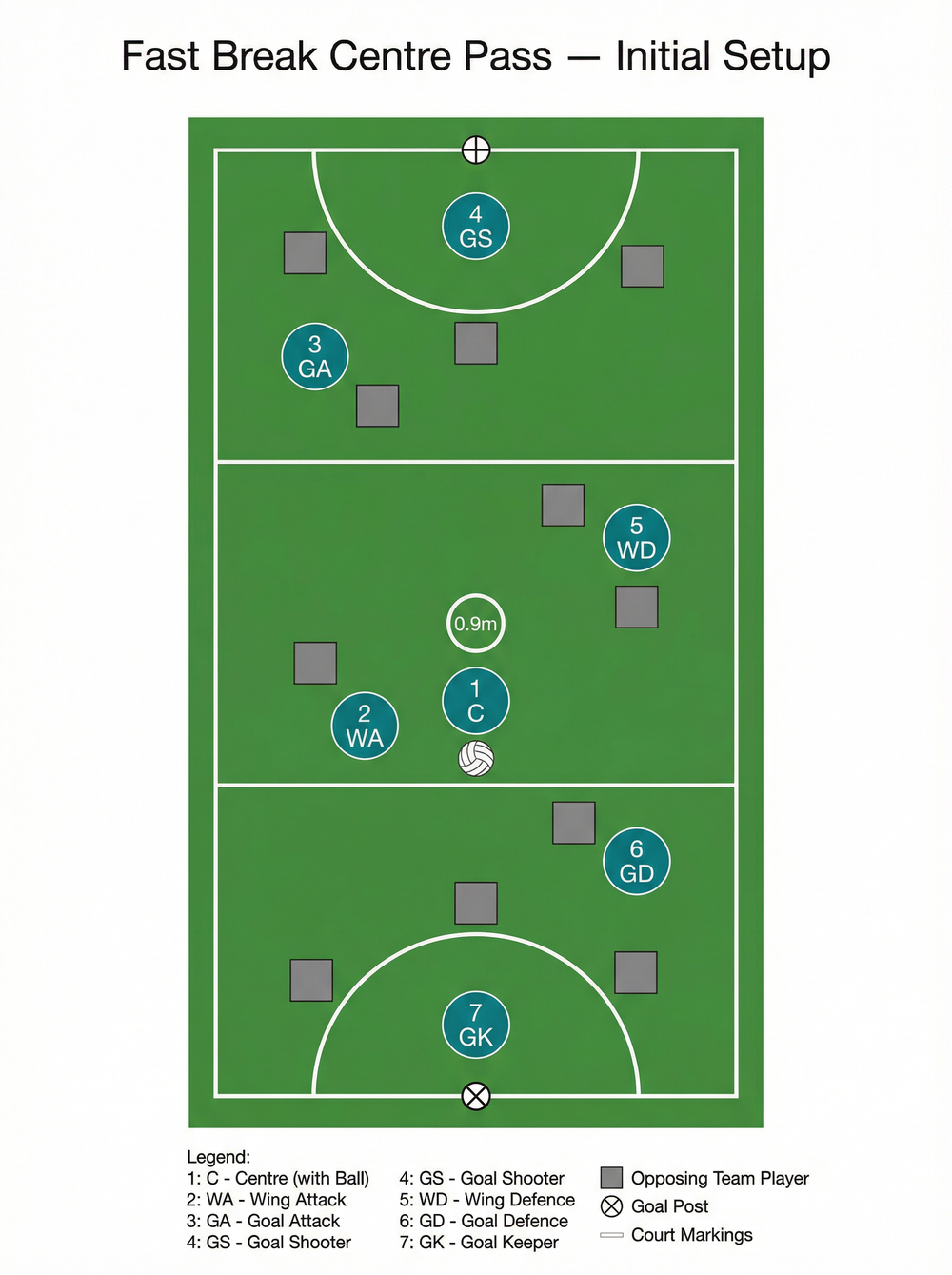
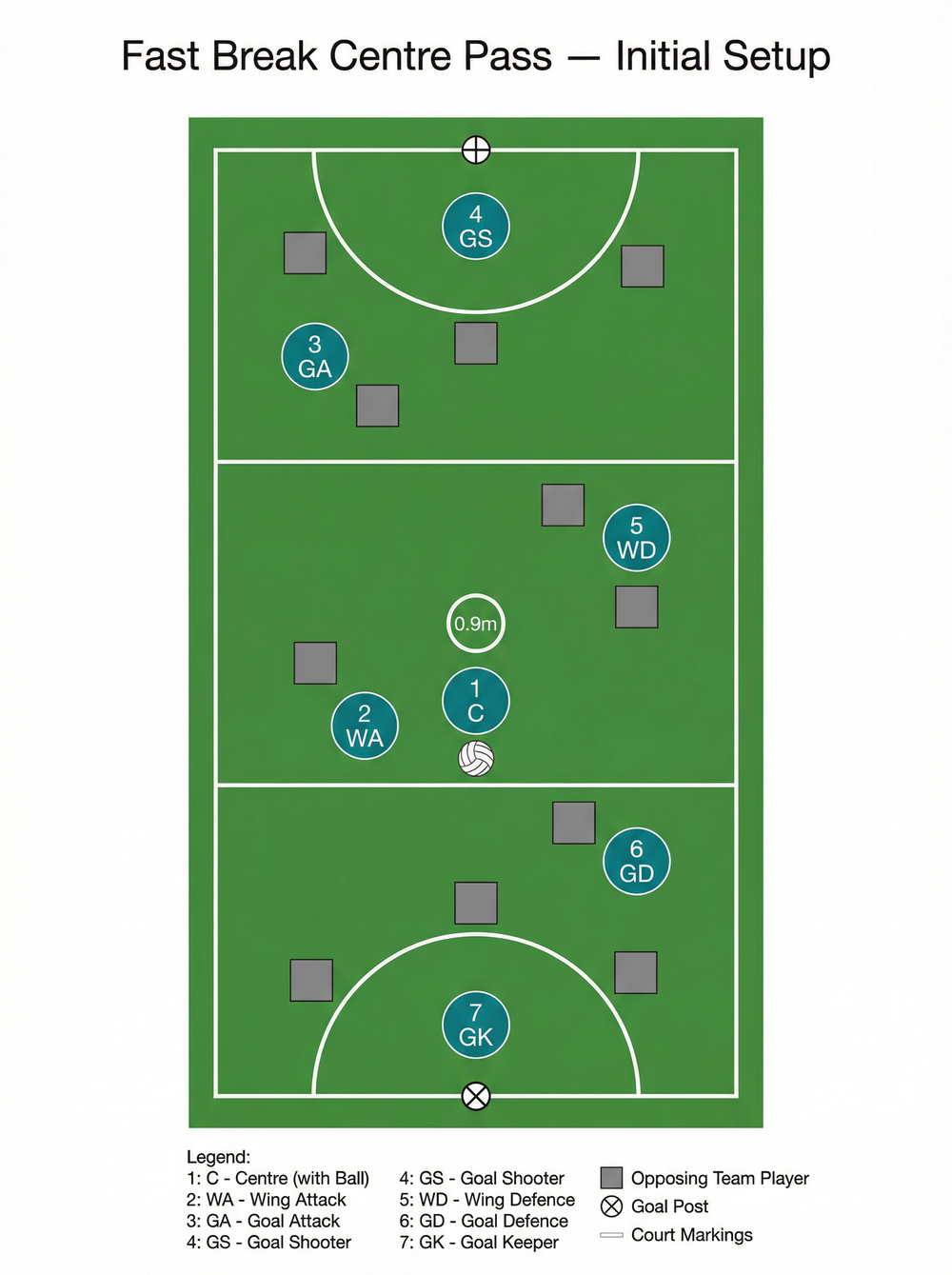
Court Setup: Standard match conditions.
Player Positions:
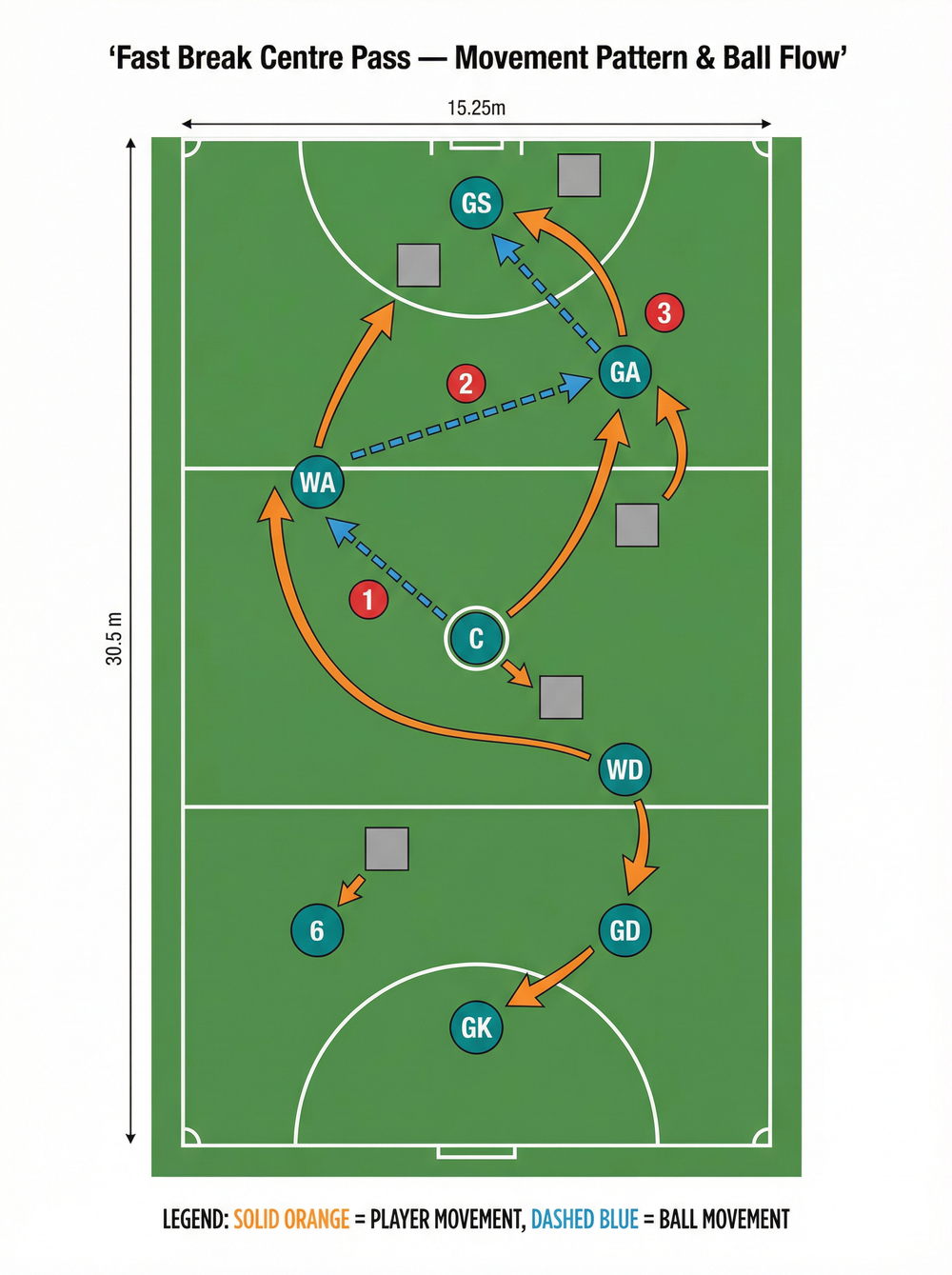
- C (Centre): Inside the 0.9m centre circle with the ball.
- WA (Wing Attack): Positioned on the transverse line, slightly favouring the left channel.
- GA (Goal Attack): Starting deep in the attacking third, near the top of the goal circle.
- GS (Goal Shooter): Holding space under the post or high in the circle.
- WD, GD, GK: Standard defensive setup behind the transverse line.

3. Step-by-Step Instructions
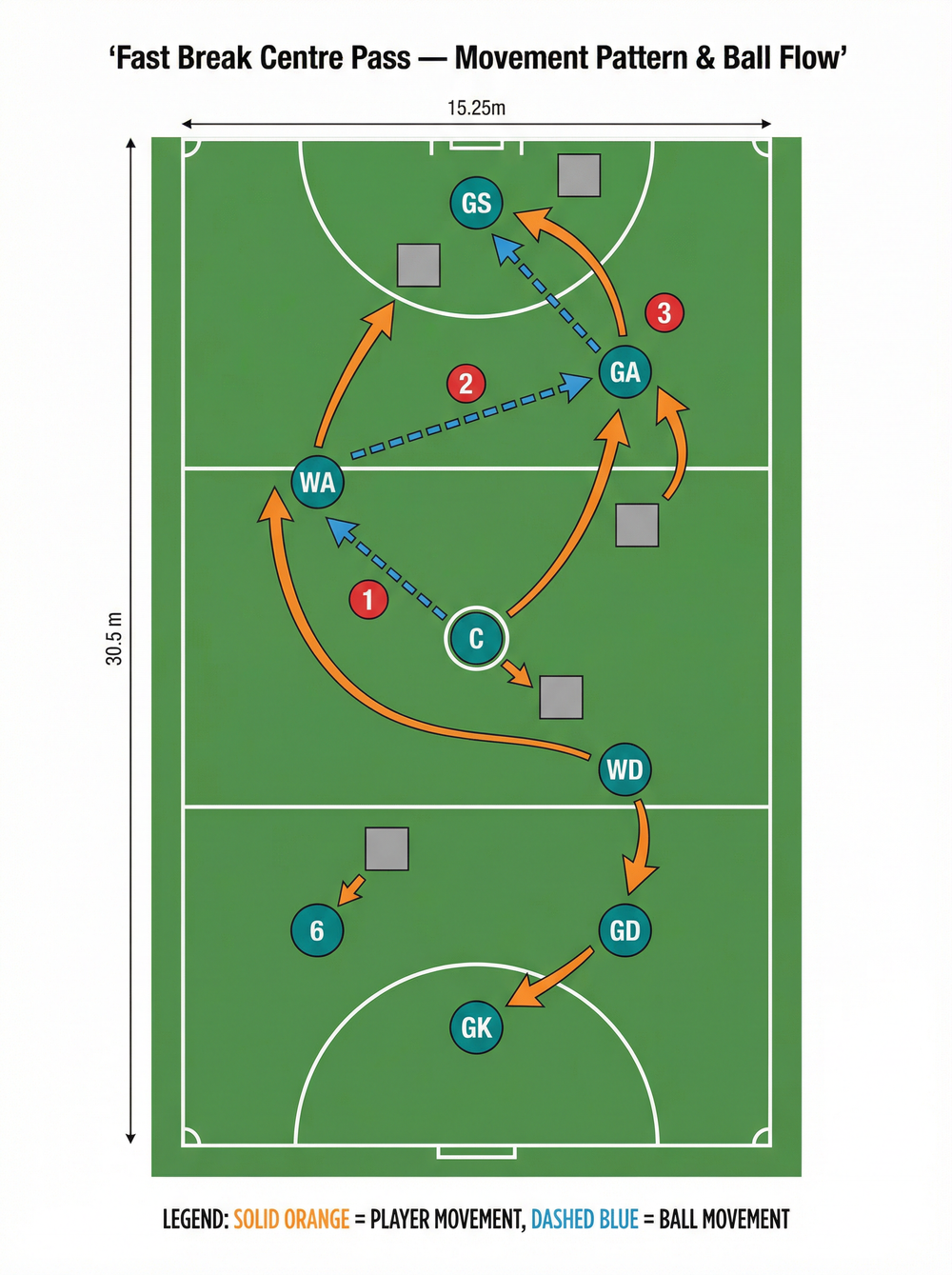
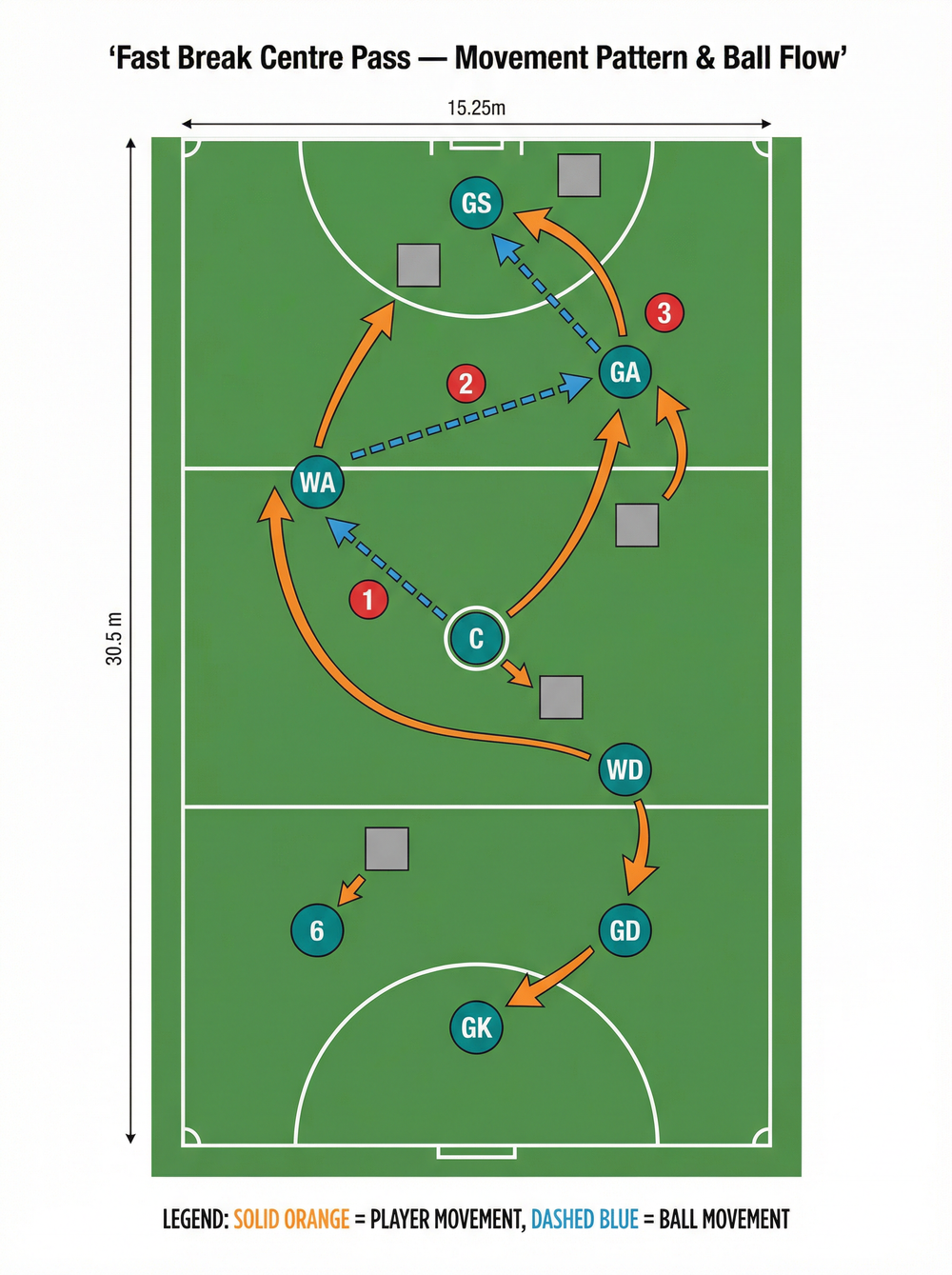
- The Trigger: The umpire blows the whistle. The C immediately pivots and looks for the primary option.
- First Phase (The Drive): The WA performs a sharp preliminary dodge (drop step) to commit the opposing WD, then drives hard and flat along the transverse line to receive the first pass. The pass from C must be flat and out in front.
- Second Phase (The Cut): As the ball is travelling to the WA, the GA initiates a hard diagonal cut from the top of the goal circle towards the pocket (side boundary), drawing the GD out of the middle channel.
- Third Phase (The Feed): The WA lands on the circle edge and immediately releases a shoulder pass to the GA.
- Final Phase (The Shot): The GS, having held their defender (GK) at the back of the circle, drops to the post. The GA delivers a high, lobbed pass or a sharp bounce pass to the GS for the finish.

4. Key Coaching Points
- Timing is Everything: The GA must not move too early; their drive should trigger only as the ball leaves the C's hands.
- Flat, Fast Passes: Loop passes will allow the defence to recover. Insist on chest or hard shoulder passes for the first two phases.
- Landing on the Circle Edge: The WA must aim to land perfectly on the circle edge to eliminate the need for an extra pass and immediately threaten the circle.
- Strong Holds: The GS must establish a strong, low body position to seal off the GK, providing a clear target for the GA.
5. Common Mistakes
- Crowding the Middle: The WA and GA driving into the same space. Emphasise using the full 15.25m width of the court.
- Hesitation on the Release: The C taking too long to assess options, allowing the defence to set their zone.
- Weak Preliminary Moves: Players simply running straight, making it easy for defenders to track and intercept.
6. Variations & Progressions
- The Decoy: If the WA is heavily marked, the GA can drive out to take the centre pass, with the WA cutting behind into the pocket.
- The Split: Both WA and GA drive to the line simultaneously in opposite directions, forcing the defence to split their focus.
- Adding Pressure: Introduce a floating defender (WD or GD from the opposing team) who is allowed to double-team the primary receiver.
7. Age Adaptations
- Under 10s: Focus purely on the C to WA pass and ensuring the WA lands without stepping. Reduce the speed expectations.

- Under 14s: Introduce the preliminary dodges and focus on the timing between the WA receiving and the GA driving.
- Open / Advanced: Execute at full match speed. Add complex defensive scenarios (e.g., facing a box zone) and require players to read and react.
