

Football
Corner Kick Set Play: The Near-Post Flick
A high-percentage corner kick routine designed to exploit space at the near post for a direct strike or a flick-on to the back post.

What you need
1 full-size goal, Minimum 5 footballs, Corner flags, Bibs (optional for defenders)
1. Overview
The near-post corner kick is one of the most effective set pieces in modern football. This specific routine is designed to overload the near-post area, drawing defenders out of position and creating two distinct scoring opportunities: a direct header at the near post, or a flick-on to an unmarked player arriving at the far post. This play is particularly useful against teams that employ a strict zonal marking system, as the dynamic movement disrupts their defensive structure.
2. Setup

Pitch Dimensions: Standard 11v11 pitch (approx. 100-110m x 64-75m).
Equipment Needed: 1 full-size goal, minimum 5 footballs, 10 outfield players (bibs optional for defensive opposition).
Player Positions:
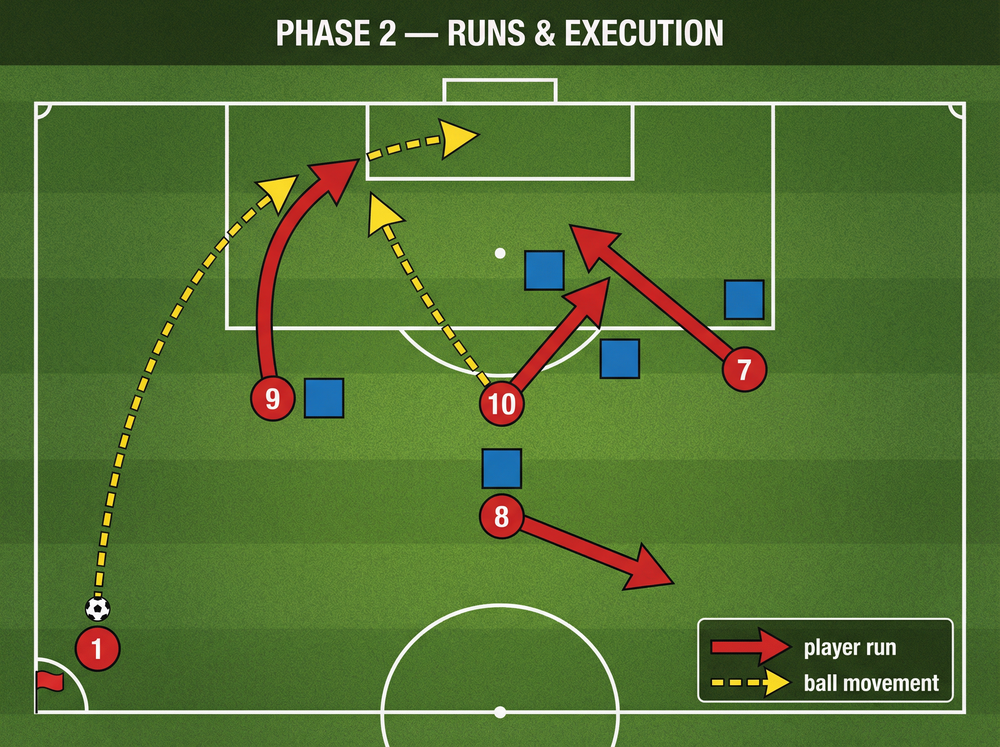
- Player 1 (Corner Taker): Positioned at the corner arc, strong foot matching the side.
- Player 9 (Target Striker): Starting on the edge of the 6-yard box, near post side.
- Player 10 (Attacking Midfielder): Starting near the penalty spot.
- Player 7 (Far Post Runner): Starting wide at the far post edge of the penalty area.
- Player 8 (Edge of Box): Positioned centrally, just outside the 18-yard box.
- Player 6 (Holding Midfielder): Deeper, ready to collect second balls and prevent counter-attacks.

3. Step-by-Step Instructions

- The Trigger: Player 1 places the ball and raises one arm to signal the near-post routine.
- The Primary Run (Player 9): As Player 1 begins their run-up, Player 9 makes a sharp, curved run toward the near post.
- The Decoy (Player 10): Simultaneously, Player 10 makes a diagonal run from the penalty spot toward the far post, dragging central defenders away.
- The Secondary Run (Player 7): Player 7 makes a late, timed run toward the center of the goal/far post area, anticipating a flick-on from Player 9.
- The Delivery & Execution: Player 1 delivers an in-swinging cross. Player 9 attempts to head the ball directly on target or flick it across the face of the goal for Player 7.
- Second Ball Security: Player 8 and Player 6 hold the edge of the box to recycle possession or shoot from a clearance.
4. Key Coaching Points

- Delivery Quality: The cross must be driven with pace, not floated. Aim for a height between the chest and head of the near-post runner.
- Timing of the Run: Player 9 must not start too early — explode into space as the corner taker plants their non-kicking foot.
- Aggression at the Near Post: Player 9 must be fully committed to winning the header, anticipating contact from defenders.
- Far Post Anticipation: Player 7 must read the flight of the ball and Player 9's body shape to arrive exactly as the ball drops.
- Second Ball Readiness: Edge-of-box players must be on their toes, ready to react instantly to a clearance.
5. Common Mistakes

- Poor Delivery: Hitting the first defender or overhitting the cross past the near post ruins the play.
- Static Movement: Attackers standing still and waiting for the ball rather than attacking the space.
- Lack of Commitment: Player 9 hesitating or pulling out of the challenge at the near post.
- Ignoring the Second Ball: Players switching off once the initial cross is cleared, leaving the team vulnerable to a counter-attack.
6. Variations & Progressions
- The Short Corner Option: A player shows short to draw a defender out, creating more space before delivering the near-post cross.
- The Dummy Run: Player 9 makes the near-post run but intentionally ducks under the ball, allowing it to travel to Player 10 arriving late for a volley.
- Out-swinging Delivery: Use a player with the opposite strong foot — harder for the goalkeeper to claim, but requires more power from Player 9.
7. Age Adaptations
- Under 8–10: Focus on delivery technique and the basic concept of running toward the ball. Skip complex decoy runs.
- Under 12–14: Introduce the flick-on concept. Emphasize timing of runs and far-post arrival.
- Under 16–Open: Full implementation including decoy runs, blocking (where legal), and strict second-ball and transition responsibilities.
