

Football
The Decoy Curve: Direct Free Kick Set Play
Master a deceptive direct free kick routine that uses a dummy runner to freeze the goalkeeper and create a clear shooting angle.

What you need
1 Full-size goal, 4-5 Mannequins, 6-8 Footballs, Cones
1. Overview
This set play is designed to create confusion within the defensive wall and freeze the goalkeeper for a split second. By using a dummy runner who steps over the ball, we force the defensive line to adjust their body shape and the goalkeeper to shift their weight prematurely. This momentary hesitation creates the perfect window for the primary taker to bend the ball around the wall or strike it cleanly on target. This routine is highly effective when awarded a direct free kick in central or slightly wide areas, approximately 20 to 25 metres from the goal.
2. Setup

Pitch Area: Attacking third, specifically the central zone just outside the penalty area (Zone 14) or slightly offset to either half-space.
Equipment Needed:
- 1 Full-size goal
- 4-5 Mannequins (to simulate the defensive wall)
- 6-8 Footballs
- Cones (to mark starting positions for runners)
Player Positions:
- Player 9 (Primary Taker): Positioned directly behind the ball, ready to strike.
- Player 10 (Dummy Runner): Positioned 1 to 2 metres to the side of the ball, angled for a run-up.
- Player 7 & 11 (Wingers/Runners): Positioned on the edges of the penalty area, ready to crash the box for rebounds.
- Player 6 & 8 (Central Midfielders): Positioned deeper to provide defensive cover and recycle possession if the initial strike is cleared.
3. Step-by-Step Instructions
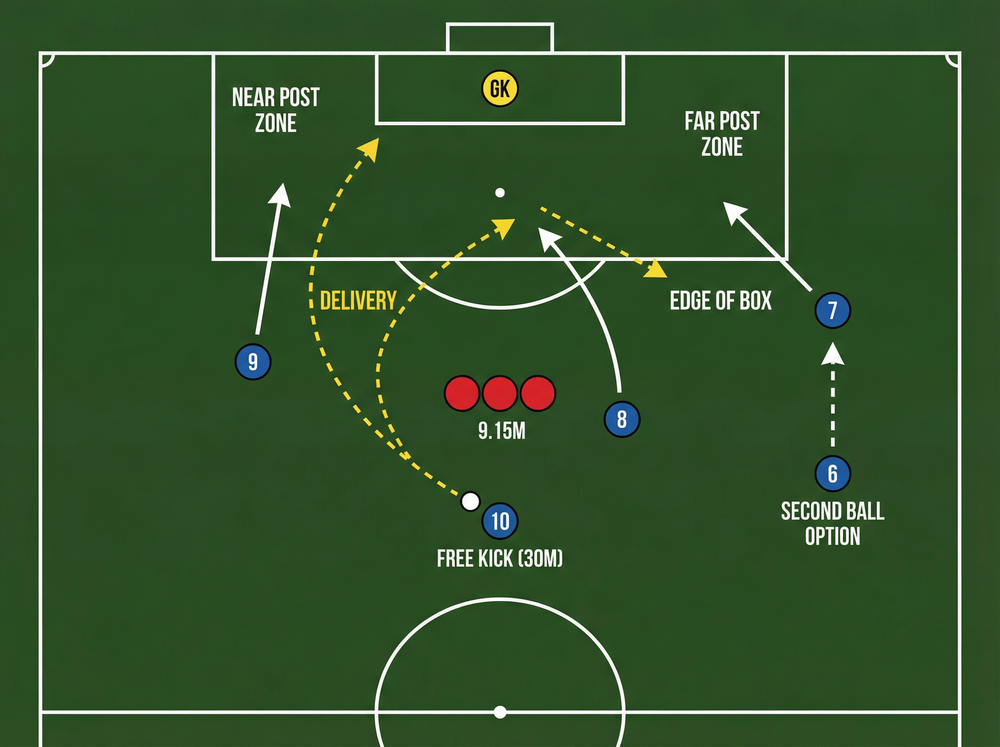
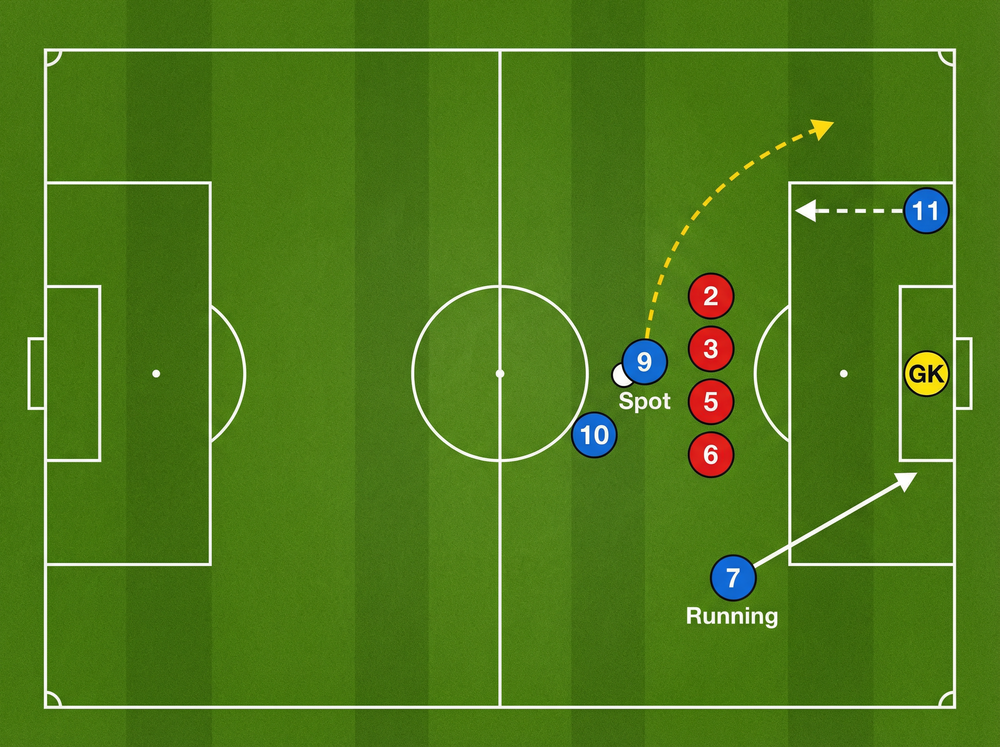
Step 1: The Setup and Stance
Both Player 9 and Player 10 must stand over the ball, projecting confidence and creating ambiguity about who will take the kick. They should discuss the play behind their hands to further sell the deception.
Step 2: The Dummy Run
On the referee's whistle, Player 10 initiates a hard, aggressive run towards the ball. They must make it look identical to a genuine striking approach. Player 10 steps entirely over the ball and continues their run into the penalty area, drawing the eyes of the wall and the goalkeeper.
Step 3: The Strike
Exactly as Player 10 steps over the ball, Player 9 begins their approach. The timing must be seamless. Player 9 strikes the ball, aiming to bend it around the outside of the wall (if offset) or over the wall (if central). The focus should be on technique and placement rather than pure power.

Step 4: Following Up
As the ball is struck, Players 7 and 11 must aggressively crash the penalty area, anticipating a spill from the goalkeeper or a rebound off the woodwork or wall. Player 10, having completed the dummy run, is also now in a prime position to react to secondary balls.
4. Key Coaching Points

- Selling the Dummy: The success of this play hinges entirely on Player 10's acting. The run-up must be explosive, and the body language must scream 'I am shooting'.
- Synchronised Timing: Player 9 must not begin their run too early. The delay is crucial. They should only start moving forward as Player 10's foot plants next to the ball for the step-over.
- Striking Technique: Emphasise clean contact. The primary taker should focus on wrapping their foot around the ball to generate top-spin or side-spin, ensuring the ball dips quickly after clearing the wall.
- Aggressive Follow-up: Players must expect a rebound. The mindset should be proactive, not reactive. Attack the spaces immediately after the strike.
5. Common Mistakes

- Poor Acting from the Dummy: If Player 10 jogs half-heartedly or clearly avoids the ball, the goalkeeper will not shift their weight, rendering the play useless.
- Rushed Approach by the Taker: Player 9 starting their run before the dummy is complete ruins the deception and often leads to a poorly struck ball.
- Ball Watching: Attackers standing and admiring the shot instead of following up for potential rebounds.
6. Variations & Progressions
- The Lay-off: Instead of stepping over, Player 10 taps the ball slightly to the side for Player 9 to strike a moving ball, changing the angle and bypassing the wall entirely.
- The Reverse Dummy: Player 9 runs over the ball, and Player 10 (the presumed dummy) actually takes the shot. This works brilliantly if you have established the standard routine earlier in the match.
7. Age Adaptations
- Under 10 - Under 12: Focus heavily on the basic striking technique and the concept of a simple dummy run. Keep the distances shorter (15-18 metres) and use fewer mannequins for the wall.
- Under 14 - Under 16: Introduce the synchronised timing and more complex variations like the lay-off. Emphasise the importance of the follow-up runs.
- Open/Senior: Perfect the finer details—body shape manipulation, exploiting specific goalkeeper weaknesses, and executing the reverse dummy under high pressure.
