

Football
Slalom Dribble & Finish: Mastering Close Control in the Final Third
Develop your players' close-quarters ball mastery, explosive acceleration, and clinical finishing under pressure with this essential attacking drill.
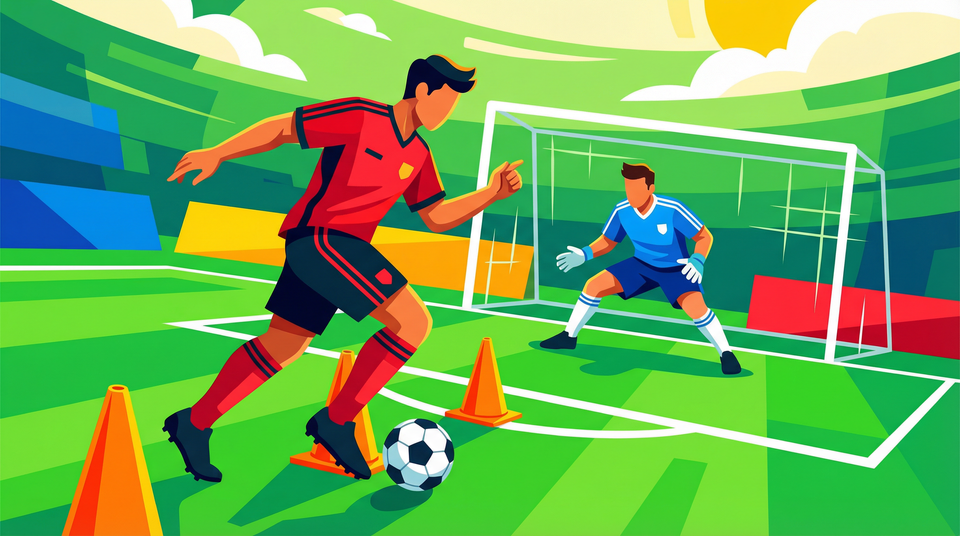
What you need
6-8 training cones, 1 full-size goal, Minimum 6 footballs, Training bibs
Overview
The 'Slalom Dribble & Finish' is a fundamental attacking drill designed to improve a player's close ball control, agility, and composure in front of goal. In modern football, the ability to navigate tight spaces in the final third and quickly transition into a shooting motion is what separates good attackers from great ones. This drill isolates that specific skill set, forcing players to keep the ball close to their feet while weaving through obstacles, before demanding a precise finish past the goalkeeper.
This exercise is highly versatile and can be used as a technical warm-up for advanced teams or as a core developmental drill for youth squads. By adjusting the distance between the cones or adding defensive pressure, coaches can easily scale the difficulty to match their team's current ability level.
Setup
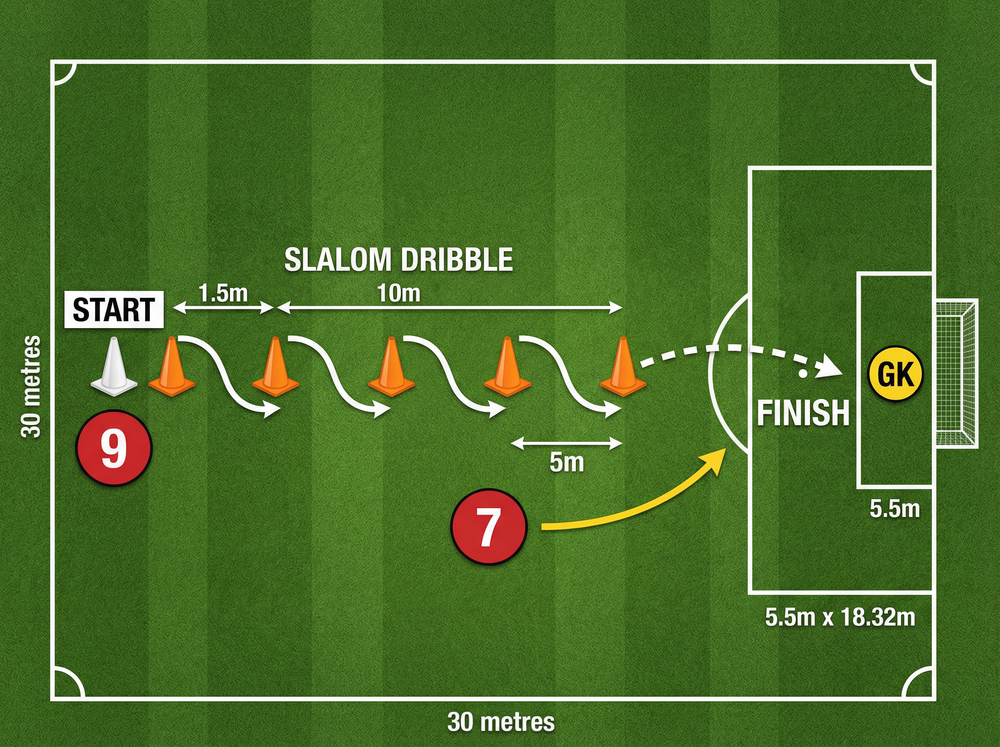
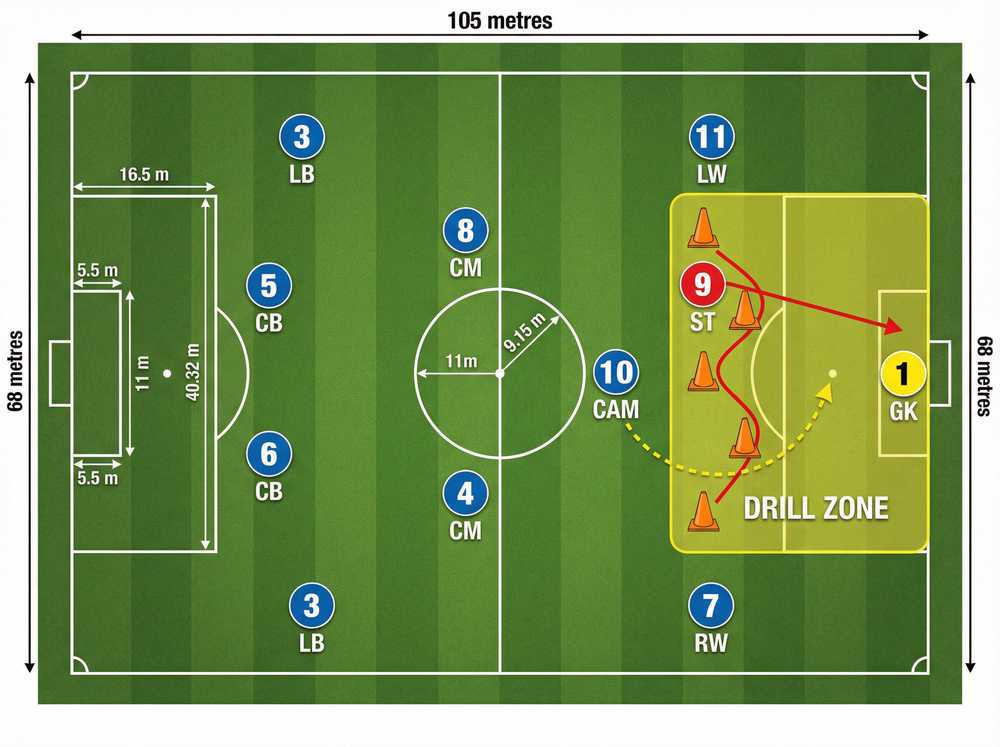
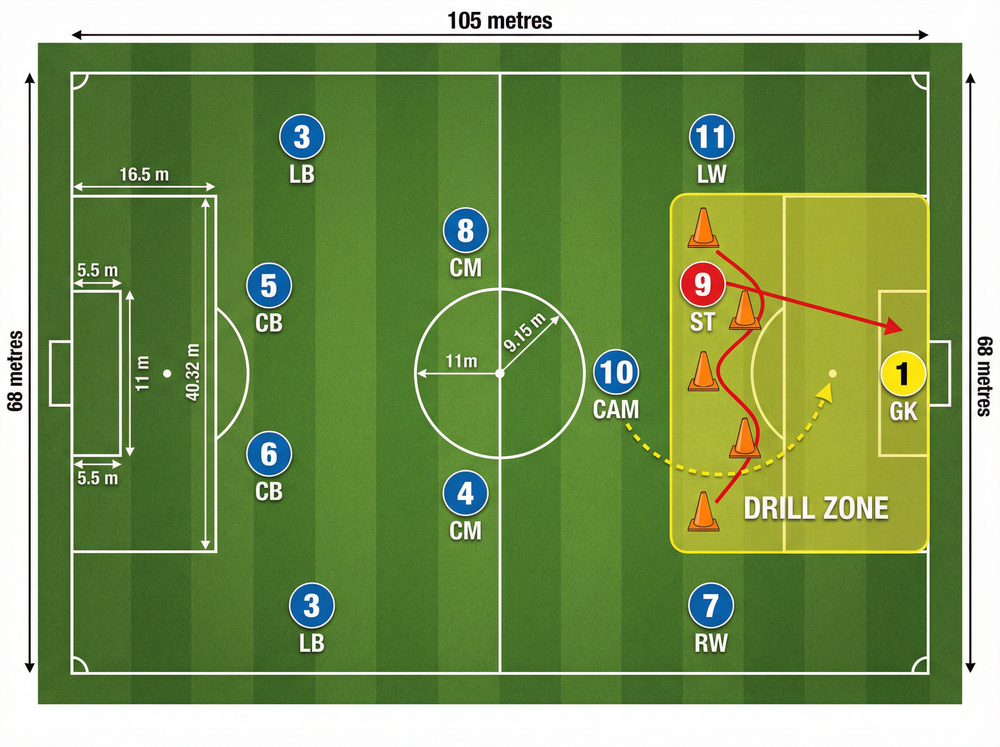
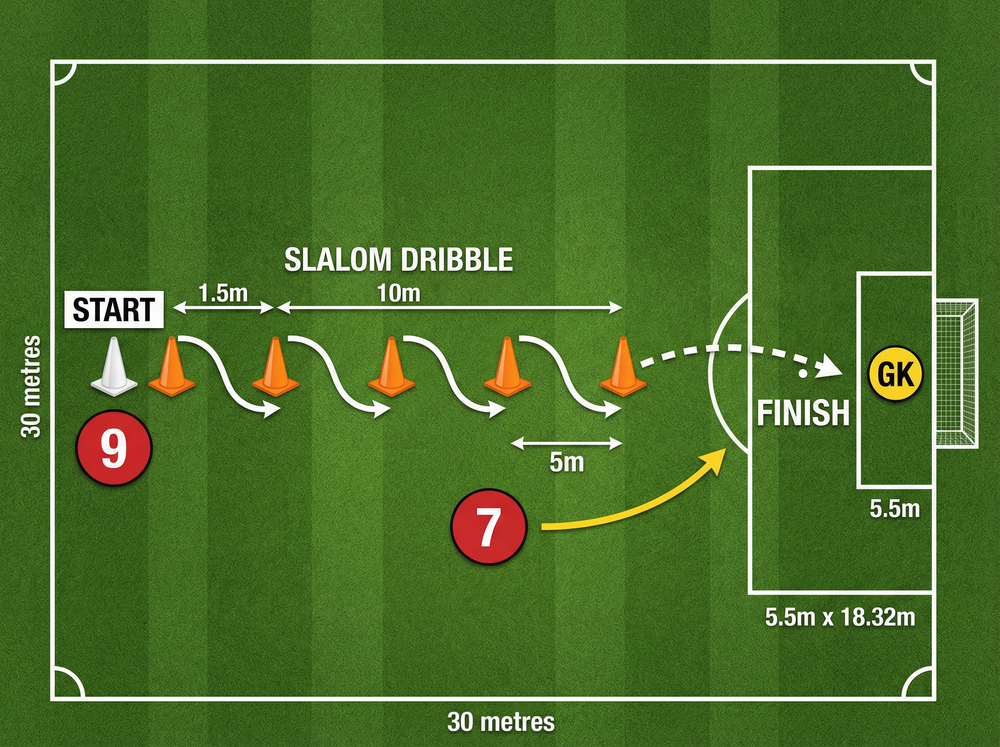
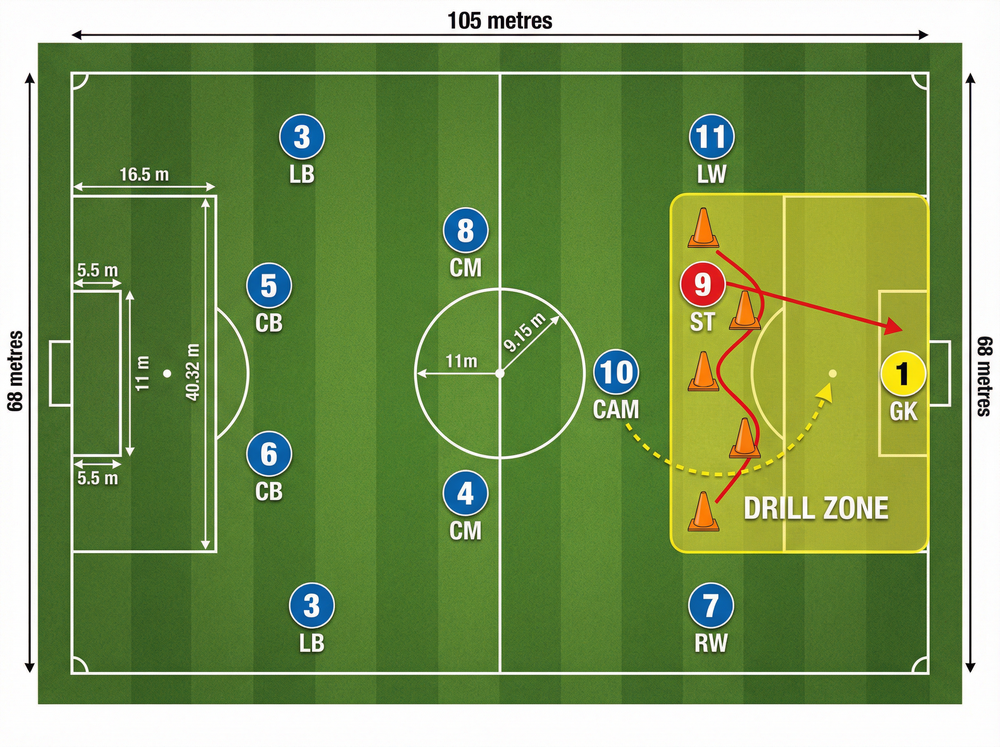
To run this drill effectively, you will need a section of the pitch approximately 30 metres wide by 40 metres long, ideally situated in the attacking third to utilize a full-size goal and penalty area.
Equipment Required:
- 6-8 training cones (preferably bright orange for visibility)
- 1 full-size goal
- An adequate supply of footballs (minimum 6) placed at the starting position
- Training bibs (if incorporating defenders in progressions)
Pitch Layout:
- Place a starting marker (or cone) approximately 25-30 metres from the goal line, central to the goal.
- Set up a straight line of 5 to 6 cones starting 1.5 metres ahead of the start marker. Space these cones exactly 1.5 metres apart. This forms the slalom course.
- Position a goalkeeper in the full-size goal.
- Have your attacking players (e.g., Strikers [9], Wingers [7, 11]) line up behind the starting marker, each with a ball.
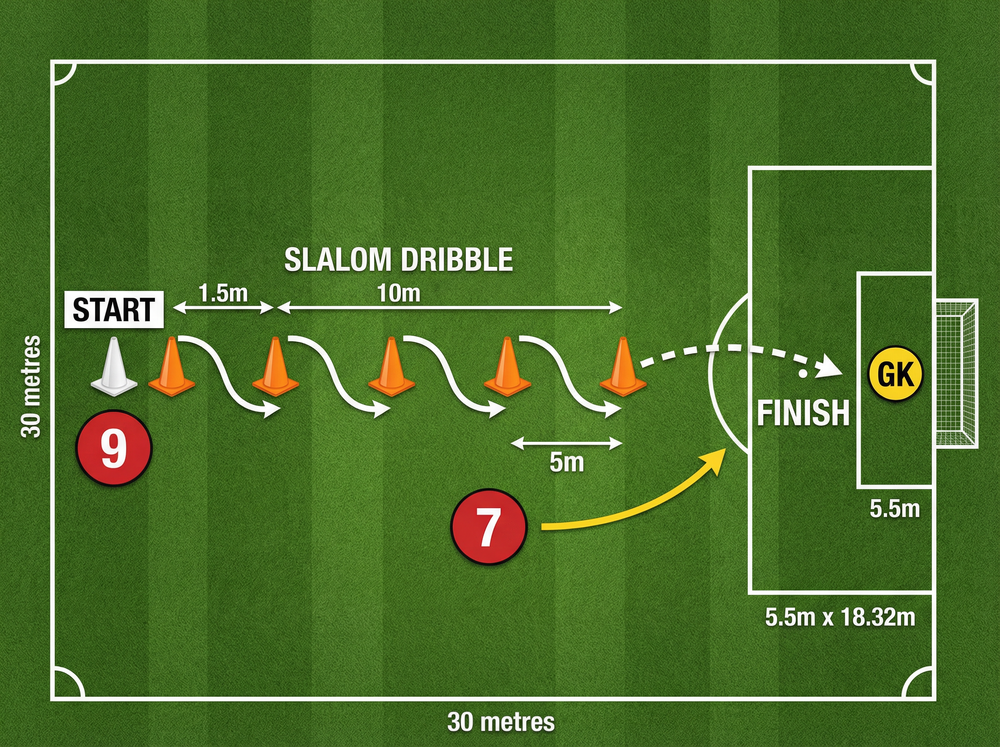
Step-by-Step Instructions
- The Approach: On the coach's whistle, the first player in line (Player 9) approaches the first cone at a controlled pace, keeping the ball close to their feet.
- The Slalom: The player weaves in and out of the cones, using both the inside and outside of both feet. The focus here is on quick, short touches rather than speed.
- The Exit: As the player clears the final cone, they must take a slightly heavier touch out of their feet at an angle, setting themselves up for a strike.
- The Finish: Without breaking stride, the player looks up to assess the goalkeeper's position and strikes the ball towards the corners of the net. Power should be secondary to placement.
- The Reset: After the shot, the player jogs back to the starting line or rotates to a supporting position, and the next player begins their run.
Key Coaching Points
- Close Ball Control: Emphasize keeping the ball within a one-metre radius of the feet during the slalom. If the ball gets too far away, the player loses control of the rhythm.
- Use of Both Feet: Encourage players to use the inside and outside of both the left and right foot to navigate the cones, promoting two-footedness.
- Head Up Before Striking: The transition from dribbling to shooting is critical. Players must take a quick glance up after the final cone to spot the goalkeeper's positioning before committing to the shot.
- Pace Variation: The dribble through the cones should be controlled and rhythmic, but the touch exiting the final cone should be explosive, mimicking a sudden burst of pace to lose a defender.
- Placement Over Power: When finishing, accuracy is paramount. Instruct players to aim for the bottom corners, passing the ball into the net rather than striking it blindly with maximum force.
Common Mistakes
- Looking Down at the Ball: Players often stare exclusively at their feet while dribbling, making them unaware of the goalkeeper's position when it's time to shoot.
- Taking Too Big of a Touch: A heavy touch during the slalom breaks the rhythm and forces the player to stretch, compromising their balance for the shot.
- Rushing the Finish: After completing the cones, players sometimes panic and shoot off-balance. Remind them to take that crucial setup touch before striking.
- Using Only One Foot: Relying solely on the dominant foot makes the player predictable and slows down the slalom process.
Variations & Progressions
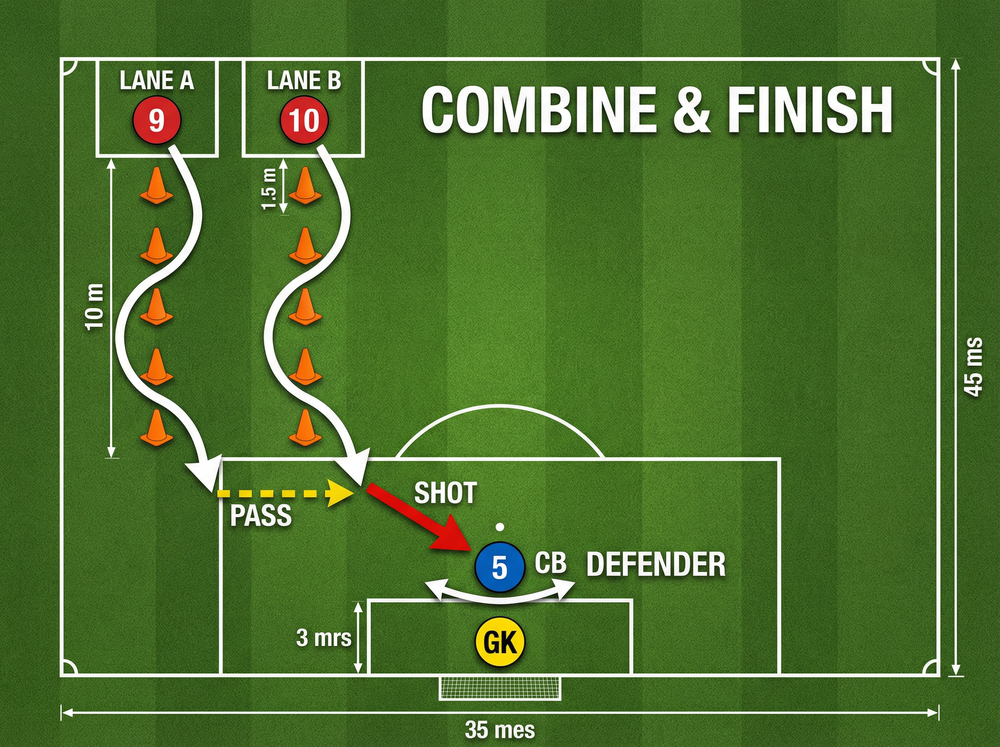
To keep the drill engaging and challenging, introduce these variations once the basic mechanics are mastered:
Progression 1: The Passing Combination
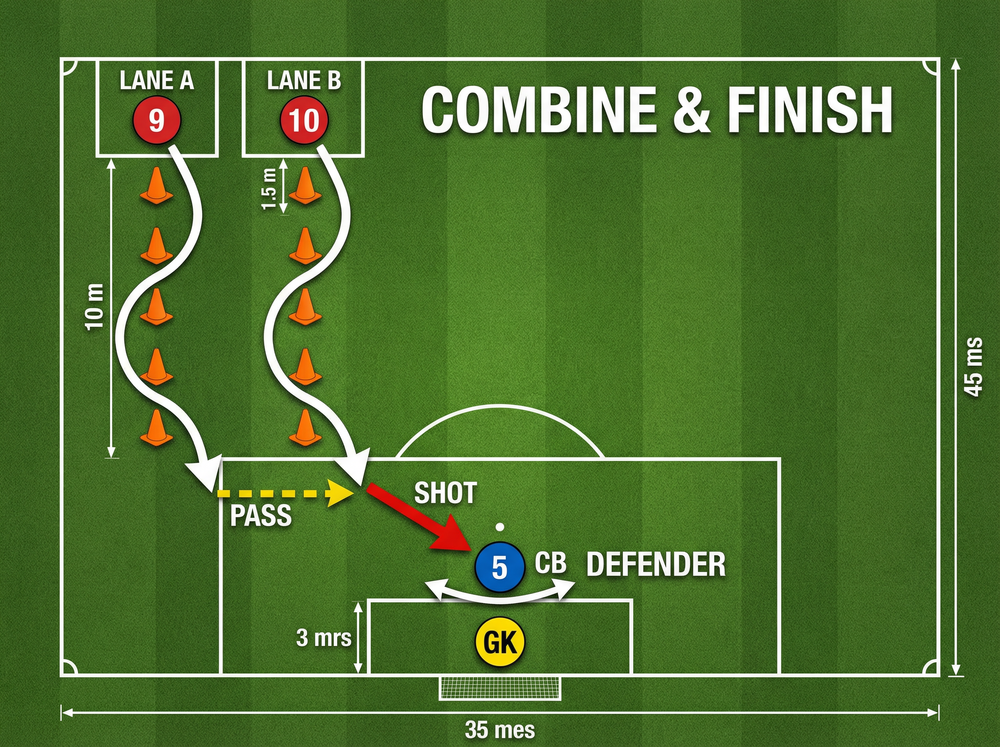
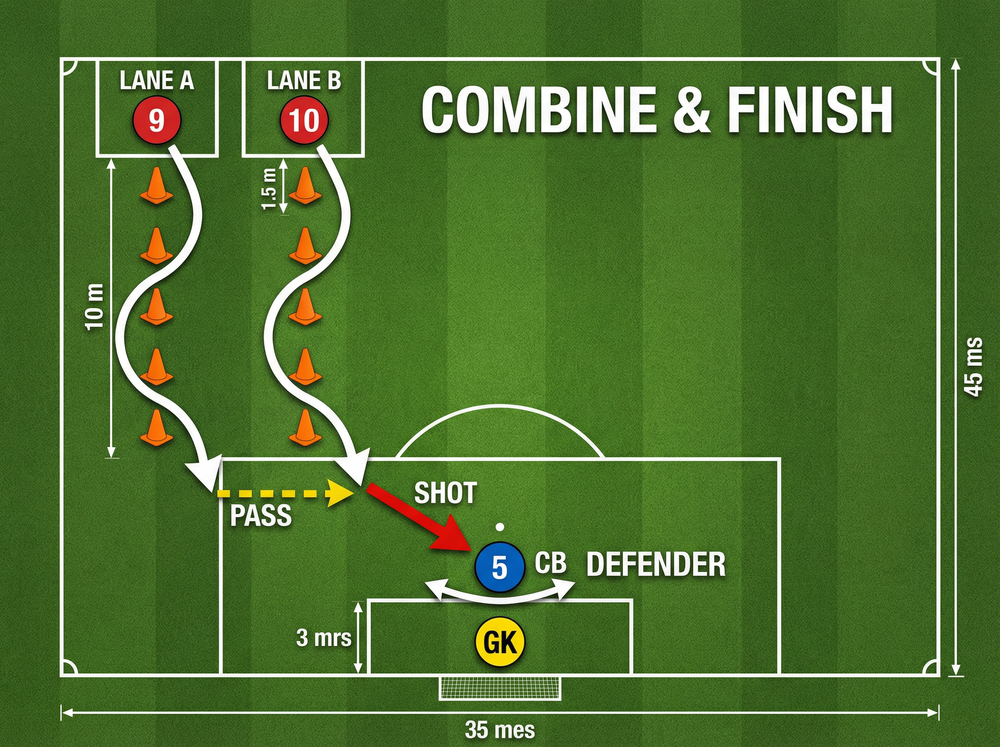
Set up two parallel slalom lanes (Lane A and Lane B). Two players run the slalom simultaneously. Upon exiting the cones, Player A passes to Player B, who finishes first-time. This introduces timing and teamwork into the final third.
Progression 2: Adding Defensive Pressure
Introduce a passive or semi-active Central Defender (CB) positioned just inside the penalty area. After the attacker clears the final cone, the defender is allowed to close down the space, forcing the attacker to make a quick decision—shoot early, take an extra touch, or attempt to beat the defender.
Variation: Weak Foot Only
Mandate that the entire drill—both the slalom dribble and the final shot—must be executed using only the player's non-dominant foot. This is excellent for long-term technical development.
Age Adaptations
- Under 8 / Under 10: Widen the gap between the cones to 2 or 2.5 metres to allow for larger touches. Focus purely on having fun and making contact with the ball. Do not enforce strict two-footed rules yet.
- Under 12 / Under 14: Standardize the 1.5-metre cone spacing. Begin emphasizing the transition speed between the final cone and the shot. Introduce the 'head up' concept.
- Under 16 / Open: Decrease the cone spacing to 1 metre for a severe technical challenge. Always include a reactive element, such as a closing defender or a goalkeeper who starts off their line, to simulate match conditions.
