

Football
Mastering the Goal Kick Build-Up Play: A Tactical Blueprint
Learn how to structure your team to confidently play out from the back, breaking the first line of pressure and establishing controlled possession.
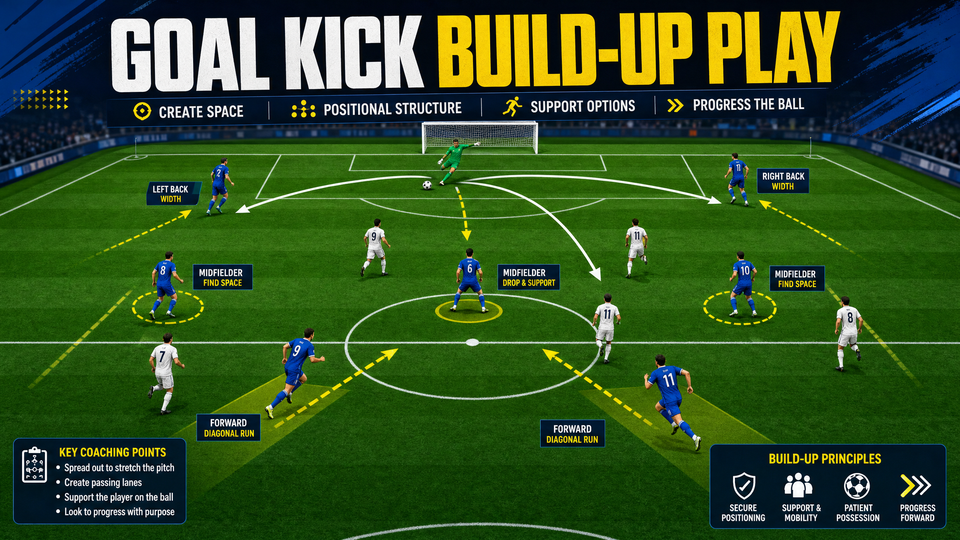
What you need
Full size goal, Footballs, Bibs, Cones
1. Overview
Building out from the back starting with a goal kick is a fundamental aspect of modern football. The objective of this set play is to create numerical superiorities, draw the opposition's press, and bypass their first line of defense with controlled possession. By establishing a structured positional shape, your team can manipulate the opponent's defensive block and progress the ball into the midfield with purpose. This play is highly effective against teams that employ a high press, as well as those that sit in a mid-block, provided the ball speed and player movements are executed correctly.
2. Setup
Pitch Area: Full pitch (100–110m x 64–75m) or a marked working area.
Equipment: Full size goal, footballs, bibs (for opposed variations), and cones (to mark reference points if needed).
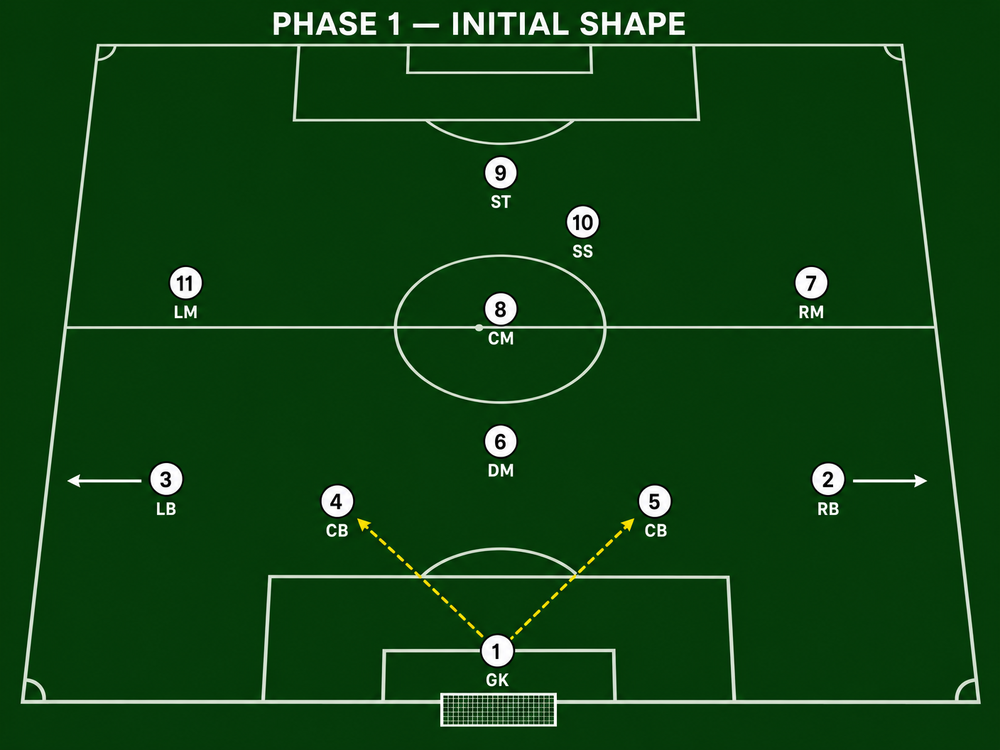
Player Positions: Standard 11v11 setup (e.g., 4-3-3 or 4-2-3-1). Key players include the Goalkeeper (1), two Center Backs (4, 5), two Fullbacks (2, 3), and a Defensive Midfielder (6).
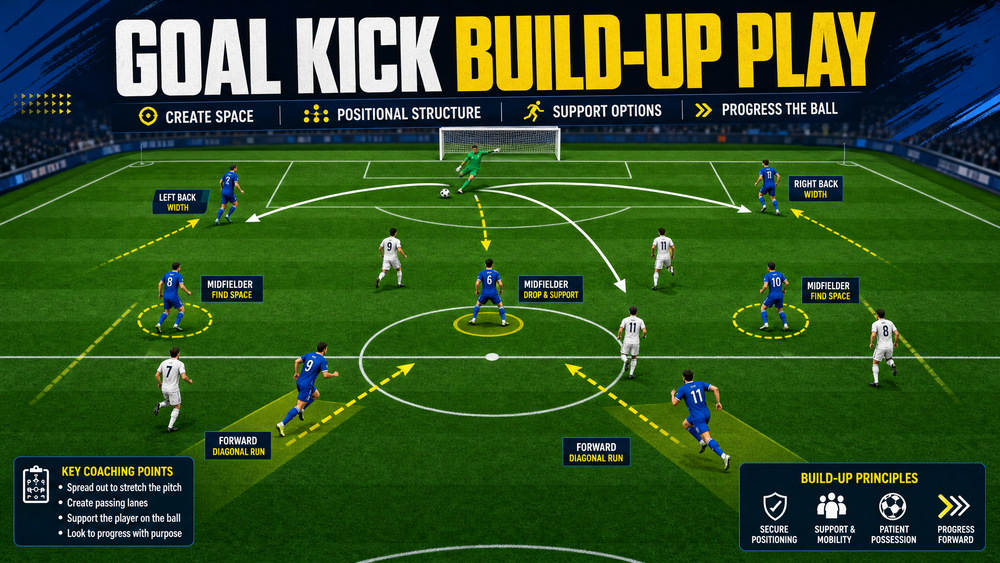
3. Step-by-Step Instructions
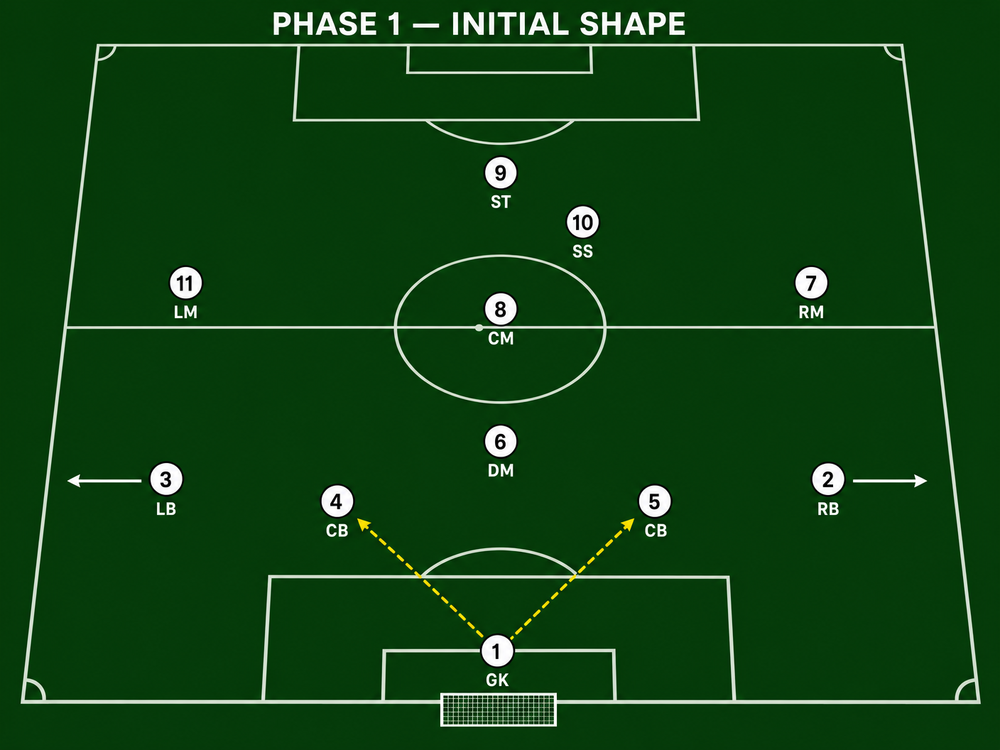
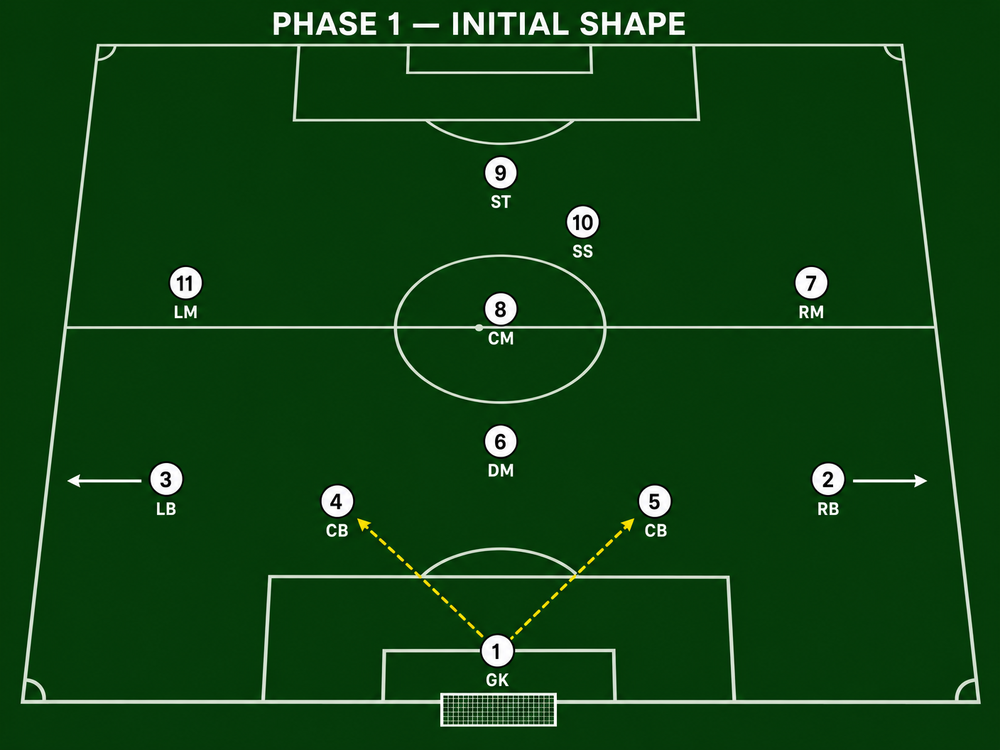
- Initial Shape: The Goalkeeper (1) places the ball on the six-yard line. The Center Backs (4 and 5) split wide, dropping to the edge of the penalty area or slightly inside it, approximately 20–25m from goal.
- Stretching the Pitch: The Fullbacks (2 and 3) push high and wide, hugging the touchlines at approximately 50–55m from goal to maximize pitch width.
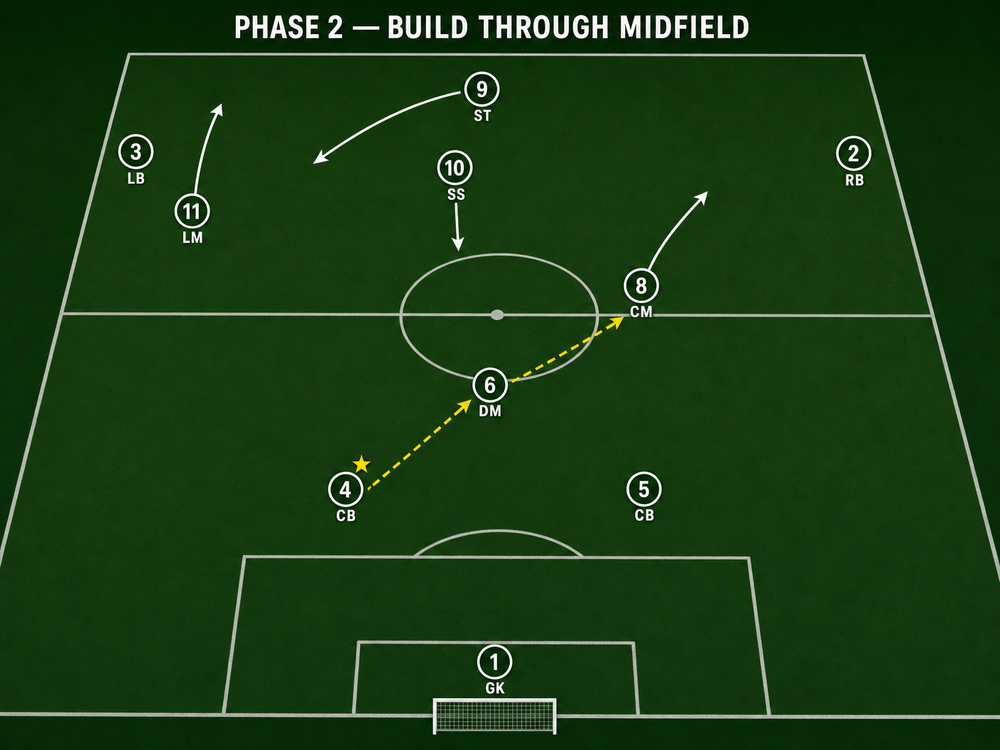
- Central Support: The Defensive Midfielder (6) drops into the central channel at 35–40m, creating a passing triangle with the two Center Backs.
- The Trigger: The Goalkeeper initiates the play by playing a firm, accurate pass to one of the Center Backs (e.g., CB 4). The pass should be played to the receiving player's back foot to allow them to turn.
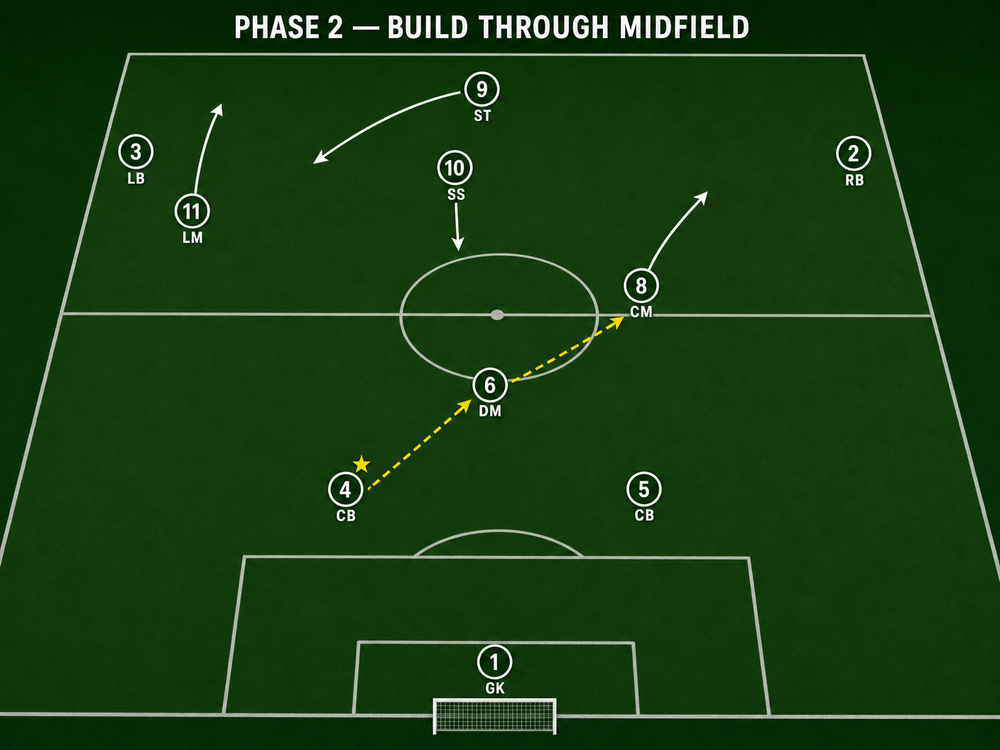
- Drawing the Press: The receiving Center Back takes a positive first touch forward, inviting the opposition forward to press. This deliberate action is designed to create space elsewhere.
- Progression: Depending on the pressure, the Center Back has three primary options:
- Play wide to the advancing Fullback (3) if the wide channel is free.
- Play centrally to the dropping Defensive Midfielder (6) if the central lane is open.
- Play a longer, diagonal pass to the Central Midfielders (8 or 10) who are finding pockets of space between the opposition's lines.
4. Key Coaching Points
- Body Shape: Receivers must adopt an open body shape before the ball arrives, allowing them to see the ball, the opponent, and their next passing option simultaneously.
- Ball Speed: Passes must be firm and accurate to give the receiver maximum time on the ball and reduce the risk of interception.
- Movement off the Ball: Players without the ball must constantly adjust their positioning to create clear passing lanes. If a lane is blocked, move to open a new one.
- Decision Making: The player on the ball must quickly assess the opposition's press and choose the safest, most progressive option available. Do not force the play.
- Courage in Possession: Players must be confident in possession, even under pressure near their own goal. Hesitation is the biggest enemy of this build-up pattern.
- Goalkeeper as a Sweeper-Keeper: The Goalkeeper must be positioned to receive a back-pass at all times, acting as an additional outfield player when needed.
5. Common Mistakes
- Static Positioning: Players waiting for the ball to arrive rather than moving to create passing angles. Remind players that movement creates space.
- Poor First Touch: A negative or heavy first touch that immediately invites pressure and limits options. Emphasize a positive, directional first touch in training.
- Forcing the Play: Attempting risky passes through the center when the wide channels are open. Teach players to always take the safe option and recycle if the progressive pass is not on.
- Lack of Communication: Players failing to instruct the ball carrier with clear verbal cues such as "Time!", "Man on!", or "Turn!".
- Goalkeeper Hesitation: The Goalkeeper taking too long to play the ball, allowing the opposition to organize their press and reduce available options.
6. Variations & Progressions
- Variation 1 — The Bounce Pass: If the Center Back is immediately pressed, they play a quick one-touch pass back to the Goalkeeper, who then switches the play to the opposite Center Back. This resets the press and exploits the space created on the far side.
- Variation 2 — Midfield Rotation: The Defensive Midfielder (6) rotates out of the central space, allowing a Central Midfielder (8) to drop in and receive the ball. This creates unpredictability and makes it harder for the opposition to track runners.
- Progression — Opposed Build-Up: Introduce 3–4 opposition forwards to actively press the build-up, forcing game-realistic decision making. Increase to a full 11v11 press as players become more comfortable.
7. Age Adaptations
| Age Group | Focus | Shape | Opposition |
|---|---|---|---|
| Under 8 – Under 10 | Technical execution of pass and first touch | GK + 2 defenders + 1 midfielder | No opposition |
| Under 12 – Under 14 | Scanning, body shape, and decision making | Full defensive unit + DM | Light passive pressure |
| Under 16 – Open | Full tactical structure with coordinated rotations | Full 11-player shape | Full active press |
