

Football
High-Speed Counter-Attack: Mid-Block Transition Drill
Master the art of rapid transition from a compact mid-block into a devastating counter-attack, focusing on forward passing, supporting runs, and clinical finishing.

What you need
Full-size goals (2), Footballs (10+), Cones or flat markers, Bibs (2 contrasting colours)
Overview
In modern football, the ability to transition quickly from defence to attack is often the difference between winning and losing. This comprehensive drill focuses on the exact moment possession is won within a compact mid-block. The primary objective is to exploit the disorganized opponent by launching a rapid, vertical counter-attack before they can recover their defensive shape.
This session is designed to train players to recognize the 'trigger' moment—the instant the ball is turned over—and to execute explosive, synchronized forward movements. By practicing this specific phase of play, your team will develop the tactical awareness to secure the ball, the technical precision to play the crucial first forward pass, and the physical intensity required to arrive in the penalty area in numbers.
Setup

To effectively run this drill, you will need a full-sized or slightly condensed pitch (approximately 100m x 64m) to ensure the distances reflect match reality.
Equipment Required:
- Full-size goals (2)
- Footballs (minimum 10, placed strategically around the pitch for quick restarts)
- Cones or flat markers (to outline starting zones if necessary)
- Bibs (2 contrasting colours, e.g., Red and Blue)
Player Positions:
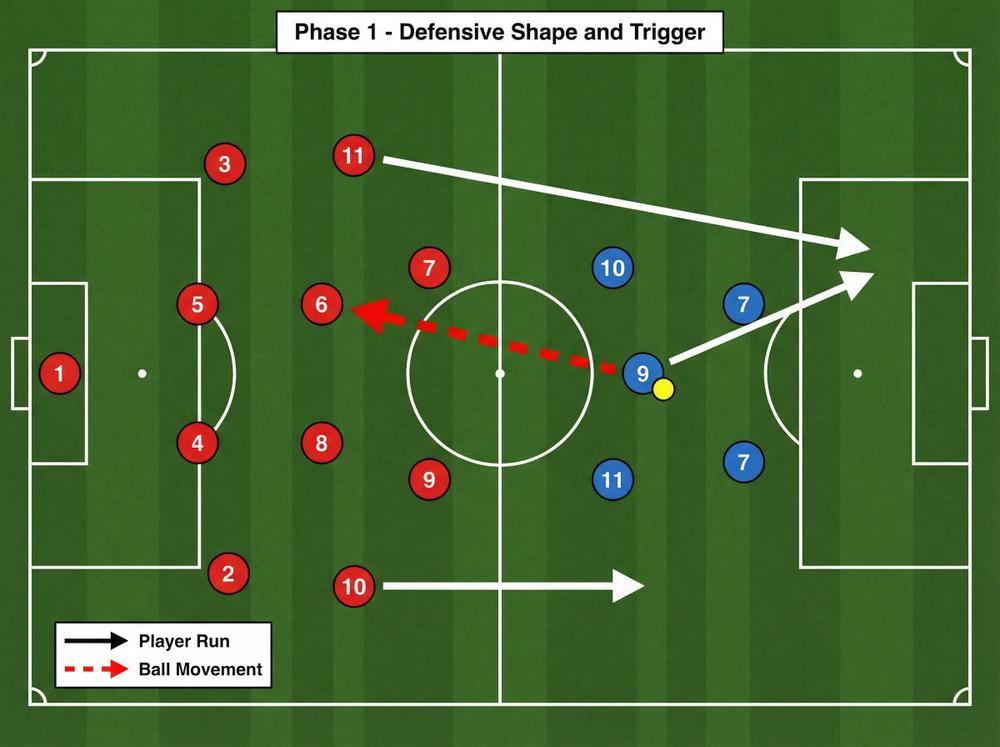
Set up an 11v11 scenario, or adapt to 11v8 if you want to focus heavily on the attacking team's success rate. The primary team (Red) should set up in a 4-4-2 mid-block formation. The opposing team (Blue) should be positioned as if they are in the attacking phase, circulating the ball in the middle third of the pitch.
Step-by-Step Instructions

- The Defensive Block: The drill begins with the Red team maintaining a disciplined, compact 4-4-2 shape in the middle third of the pitch. The Blue team circulates the ball, attempting to find a way through the block.
- The Trigger: The coach blows the whistle or calls "Press!", which acts as the trigger. Alternatively, the trigger can be a poorly executed pass by the Blue team. A designated Red midfielder (e.g., the number 6) aggressively steps out to intercept the ball or tackle the opponent.

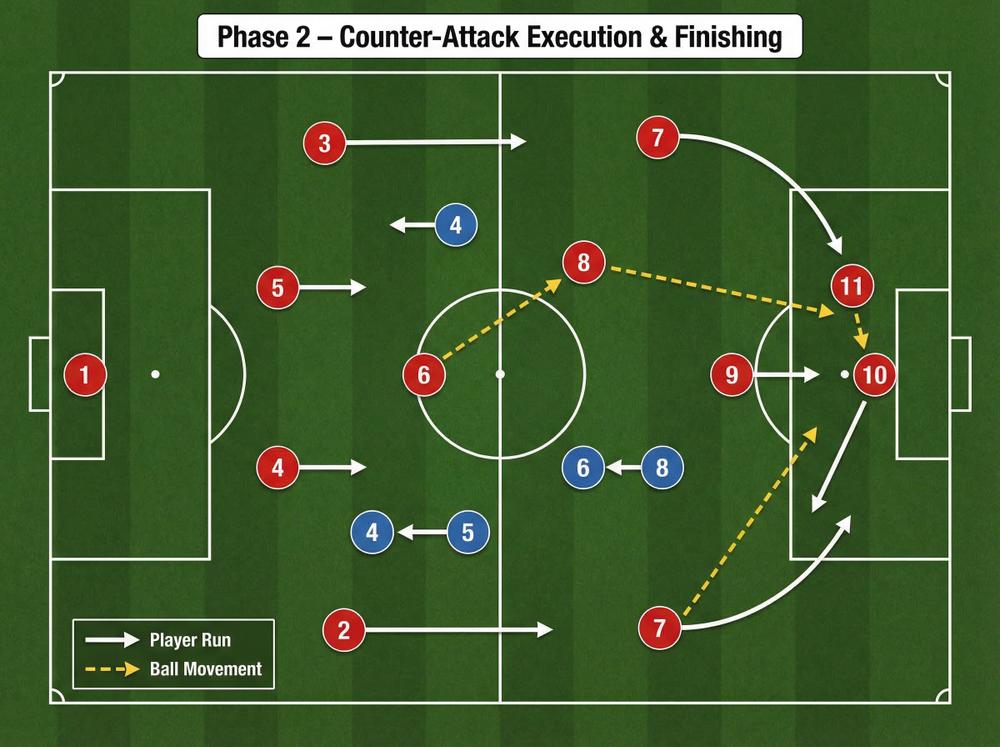
- Securing Possession: Upon winning the ball, the Red number 6 must immediately secure possession. The crucial first action is to look forward. If a direct forward pass is not available, they must play a quick lateral pass to a supporting teammate (e.g., the number 8) who is facing forward.
- Explosive Runs: The moment the ball is won, the Red forwards (9 and 10) and wide midfielders (7 and 11) must make immediate, explosive runs into the space behind the Blue team's defensive line. The runs should be diagonal to stretch the remaining defenders.
- The Forward Pass: The player on the ball (6 or 8) executes a decisive, penetrating pass into the path of one of the sprinting attackers. The pass must be weighted correctly to allow the attacker to take it in their stride without breaking momentum.

- Attacking the Box: As the ball travels into the final third, the remaining attacking players must sprint to fill the penalty area. The striker who receives the ball can either shoot directly or deliver a cross/cut-back to the supporting runners arriving at the near post, far post, and edge of the box.
- Finishing and Reset: The sequence concludes with a shot on goal. Regardless of the outcome (goal, save, or miss), the players must immediately jog back to their starting positions in the mid-block to reset for the next repetition. The Blue team restarts the drill from the middle third.
Key Coaching Points
- The First Pass Must Go Forward: The success of a counter-attack relies on speed. The player who wins the ball must prioritize playing a forward pass to break the opponent's lines instantly. If they pass backwards, the momentum is lost.
- Explosive Reactions: The transition from defending to attacking must be instantaneous. Players off the ball cannot wait to see if possession is secured; they must anticipate the turnover and start their sprints immediately.
- Width and Depth: The attacking runs must stretch the pitch both vertically and horizontally. Wide players should stay wide to create space centrally, while strikers must threaten the space behind the defensive line.
- Arriving in the Box: A successful counter-attack requires numbers in the penalty area. Ensure that at least three players (e.g., opposite winger, second striker, and an advancing midfielder) arrive in the box to finish the move.
- Weight of Pass: The penetrating pass must be played into space, not to feet, allowing the runner to maintain their maximum sprinting speed.
Common Mistakes
- Delaying the First Pass: Taking too many touches after winning the ball allows the opposition time to recover their defensive shape.
- Lack of Supporting Runs: If only one or two players sprint forward, the counter-attack will easily be isolated and defended.
- Poor Decision Making in the Final Third: Players often rush the final action, resulting in a poor shot or inaccurate cross. Encourage composure once they enter the penalty area.
- Failing to Secure the Ball: Attempting a difficult forward pass when under intense immediate pressure can lead to a quick turnover. Sometimes, a simple pass to a teammate facing forward is the better option.
Variations & Progressions

- Time Limit: Introduce a strict time limit (e.g., 8-10 seconds) from the moment the ball is won to the moment a shot is taken. This emphasizes the need for extreme speed and directness.
- Overload the Defence: Start the drill with the defending team (Blue) having fewer players (e.g., 11v8) to increase the likelihood of a successful counter-attack and build confidence.
- Different Starting Zones: Instead of winning the ball in a mid-block, initiate the counter-attack from a deeper defensive position (low block) or from a goalkeeper distribution after a corner kick.
Age Adaptations

- Under 10s / Under 12s: Reduce the pitch size significantly and focus primarily on the concept of passing forward immediately upon winning the ball. Do not worry too much about complex tactical shapes.
- Under 14s / Under 16s: Introduce the specific positional roles and emphasize the timing of the runs. Focus on the quality and weight of the penetrating pass.
- Open / Senior: Run the drill at maximum match intensity. Demand tactical perfection in the defensive block and clinical finishing at the end of the counter-attack.
