

Football
High-Intensity Counter-Attack Transition: From Mid-Block to Finishing
Master the art of rapid transition by training your team to win the ball in a mid-block and execute lethal counter-attacks within 8 seconds.

What you need
1 full-size goal, 2 mini-goals, Training bibs (Blue and Red), Footballs, Cones
1. Overview
In modern football, the most dangerous moments occur during the transition of possession. This drill is designed to train your team to execute devastating counter-attacks immediately after regaining the ball from a compact mid-block. By focusing on rapid forward passing, explosive off-the-ball movement, and clinical finishing, coaches can instill a counter-attacking mindset that exploits the opponent's disorganized defensive shape.
This session is ideal for teams that prefer to absorb pressure in the middle third and strike with speed, utilizing pacy wingers and a dynamic center forward. The objective is to transition from defense to a shot on goal within 8 seconds of winning the ball.
2. Setup
Pitch Dimensions: 100m x 70m (Full Pitch)
Players Required: 16–20 players (including 2 Goalkeepers)
Equipment: 1 full-size goal, 2 mini-goals (or target zones), training bibs (Blue and Red), plenty of footballs, cones to mark zones.
Pitch Layout:
- Mark a clear line 40m from the defending team's goal to establish the "Trigger Line" for the mid-block.
- Place 2 mini-goals on the halfway line for the attacking team (Red) to score into if they bypass the press.
- The Defending Team (Blue) sets up in a 4-4-2 or 4-2-3-1 formation within their defensive half.
- The Attacking Team (Red) starts with possession near the halfway line.
3. Step-by-Step Instructions
Phase 1: Defensive Shape & Trigger
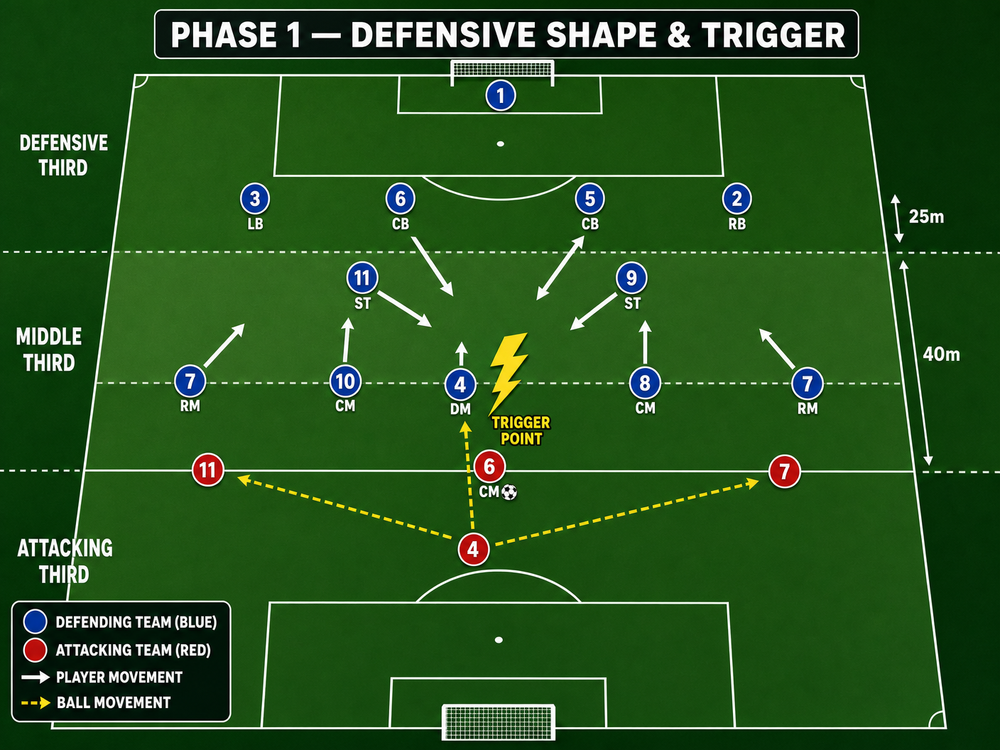
- Starting Position: The coach feeds the ball to the Red team's central midfielder near the halfway line.
- The Mid-Block: The Blue team maintains a compact shape, allowing the Red team to possess the ball in front of them but denying central penetration.
- The Trigger: As soon as a Red player takes a heavy touch or plays a predictable square pass, the Blue central midfielders (No. 4 and No. 8) aggressively press to win the ball.
- Regaining Possession: The critical moment occurs when the Blue team intercepts or tackles to win the ball (The Trigger Point).
Phase 2: Counter-Attack Transition Runs
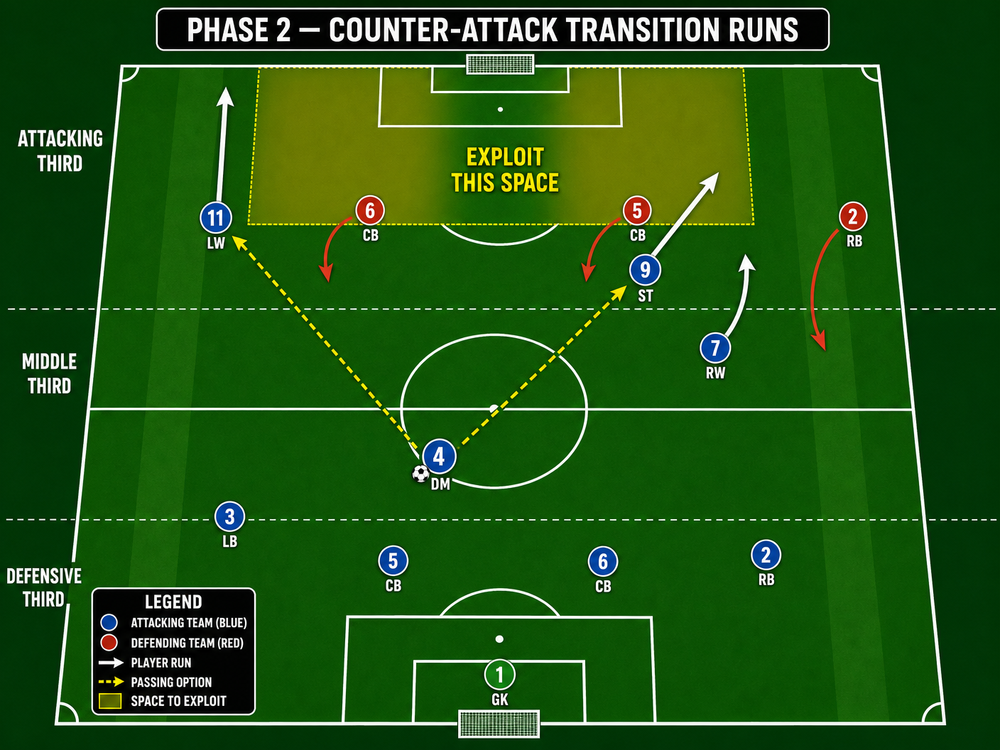
- The First Pass: Immediately upon winning the ball, the Blue player must look forward. The priority is a penetrating forward pass to the striker (No. 9) or the wide players (No. 7 or No. 11).
- Explosive Movement: The moment possession changes, the Blue forwards and wingers must sprint into the space left behind the retreating Red defenders.
- Exploiting Space: The striker (No. 9) makes a diagonal run to stretch the center-backs, while the winger (No. 11) sprints down the flank to offer a wide outlet.
- Support Runs: The central midfielders must push up to support the attack, ensuring options for a cut-back or a secondary wave of attack.
Phase 3: Finishing the Counter-Attack
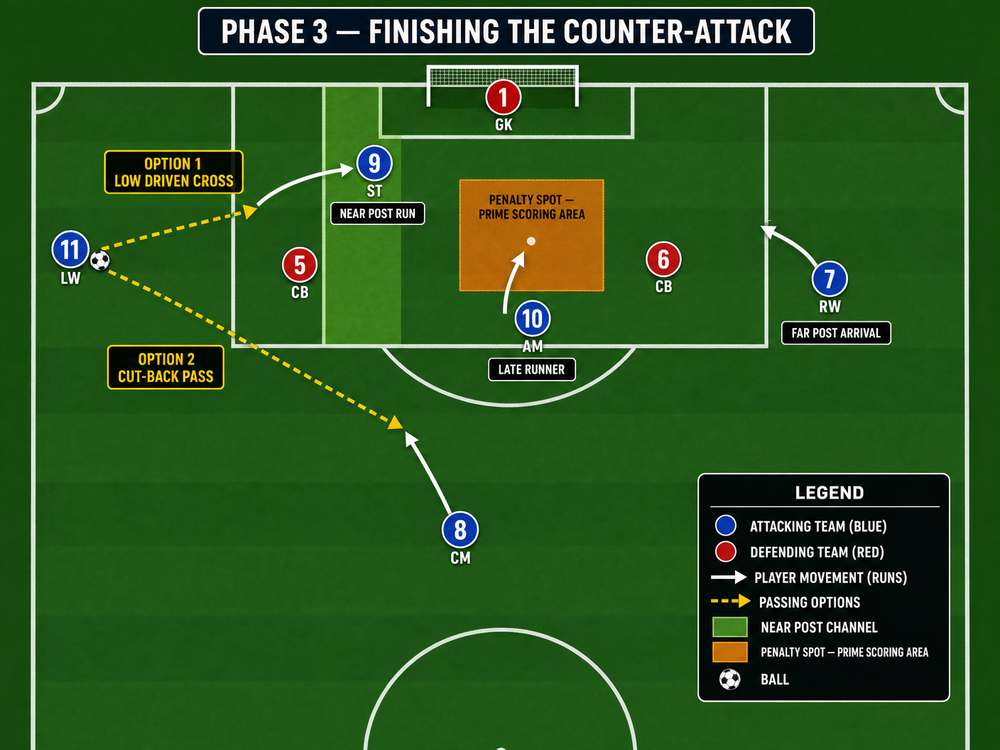
- Entering the Final Third: The ball carrier (e.g., No. 11 on the wing) assesses the options in the penalty area.
- Coordinated Box Arrivals:
- Near Post Run: The striker (No. 9) attacks the near post area to draw defenders.
- Far Post Arrival: The opposite winger (No. 7) attacks the back post.
- Late Runner: The attacking midfielder (No. 10) arrives at the penalty spot for a cut-back.
- The Delivery: The wide player delivers a low driven cross or a precise cut-back pass into the prime scoring area.
- The Finish: A quick, clinical finish on goal. The entire sequence from regaining the ball to the shot should take no more than 8 seconds.
4. Key Coaching Points
- Aggressive Pressing on Triggers: Players must recognize the trigger (poor touch, slow pass) and hunt in packs to win the ball cleanly.
- Forward First Mentality: The first thought upon winning the ball must be "Can I play forward?" Avoid unnecessary square or backward passes.
- Pace and Intent: Off-the-ball runs must be explosive. Attackers need to sprint at maximum speed to exploit the disorganized defense.
- Quality of the Final Ball: The speed of the attack is useless without a precise final pass or cross. Players must keep their heads up to pick out the right option.
- Box Occupation: Ensure at least three players arrive in the penalty area (near post, far post, and penalty spot) to maximize scoring chances.
5. Common Mistakes
- Hesitation on the First Pass: Taking too many touches after winning the ball allows the opposition to recover their defensive shape.
- Lack of Width: Attackers running in straight lines centrally, making it easy for defenders to compact the space. Wingers must stay wide to stretch the play.
- Poor Timing of Runs: Attackers arriving in the box too early, ending up static or offside. Runs must be timed to meet the ball.
- Over-Committing: Too many players joining the attack, leaving the team vulnerable to a counter-counter-attack if the ball is lost.
6. Variations & Progressions
- Time Limit: Introduce a strict 8-second countdown from the moment the ball is won to the shot. If they fail to shoot in time, the play is dead.
- Numerical Disadvantage: Start the drill with the defending team (Blue) having one less player to increase the difficulty of winning the ball and transitioning.
- Different Starting Zones: Move the trigger point deeper into the defensive third to simulate a low-block counter-attack, requiring longer, more sustained sprints.
7. Age Adaptations
- Under-10 / Under-12: Focus heavily on the "Forward First Mentality." Reduce pitch size and allow more time (e.g., 12 seconds) for the transition. Emphasize basic passing and running into space.
- Under-14 / Under-16: Introduce the strict 8-second rule. Focus on the coordinated box arrivals (near post, far post, cut-back). Begin teaching specific positional roles in the transition.
- Open / Senior: Full pitch, high intensity. Demand perfection in the timing of runs and the quality of the final ball. Implement complex pressing triggers and varied counter-attacking patterns.
