

Basketball
High-Pressure Passing Circuit: Precision Under Defensive Duress
Develop your players' ability to execute crisp, accurate passes while handling intense defensive pressure in a realistic half-court setting.

What you need
Basketballs (minimum 2, ideally 3), Cones (optional, for marking starting positions), Pinnies/Bibs (to distinguish offense from defense)
Overview
One of the most common issues teams face in competitive play is the deterioration of passing accuracy when confronted with aggressive defensive pressure. The High-Pressure Passing Circuit is designed to simulate game-like intensity, forcing players to make quick decisions, protect the basketball, and deliver pinpoint passes while being actively defended. By incorporating continuous movement and rotating defensive roles, this drill builds composure, improves peripheral vision, and reinforces fundamental passing mechanics under duress.
This drill is best used in the middle portion of a training session, after a thorough warm-up and before full-court scrimmage work. It is equally effective as a pre-game activation tool for experienced squads.
Setup

To effectively run this drill, you will need to utilize a standard FIBA half-court (28m x 15m). Ensure you have at least one basketball, though having two or three spares on the sideline is recommended to keep the drill flowing if a ball goes out of bounds.
Equipment Required:
- 2–3 Basketballs
- Cones (optional, for marking starting positions)
- Pinnies/Bibs (to distinguish offense from defense)
Player Positions:
| Position | Label | Starting Location |
|---|---|---|
| Point Guard | 1 | Top of the key with the ball |
| Shooting Guard | 2 | Right wing, near three-point line |
| Small Forward | 3 | Left wing, near three-point line |
| Power Forward | 4 | Right elbow (approx. 5m from basket) |
| Center | 5 | Low post / paint area |
| Defender 1 | D1 | On-ball pressure on Player 1 |
| Defender 2 | D2 | Denying the primary passing target |

Step-by-Step Instructions
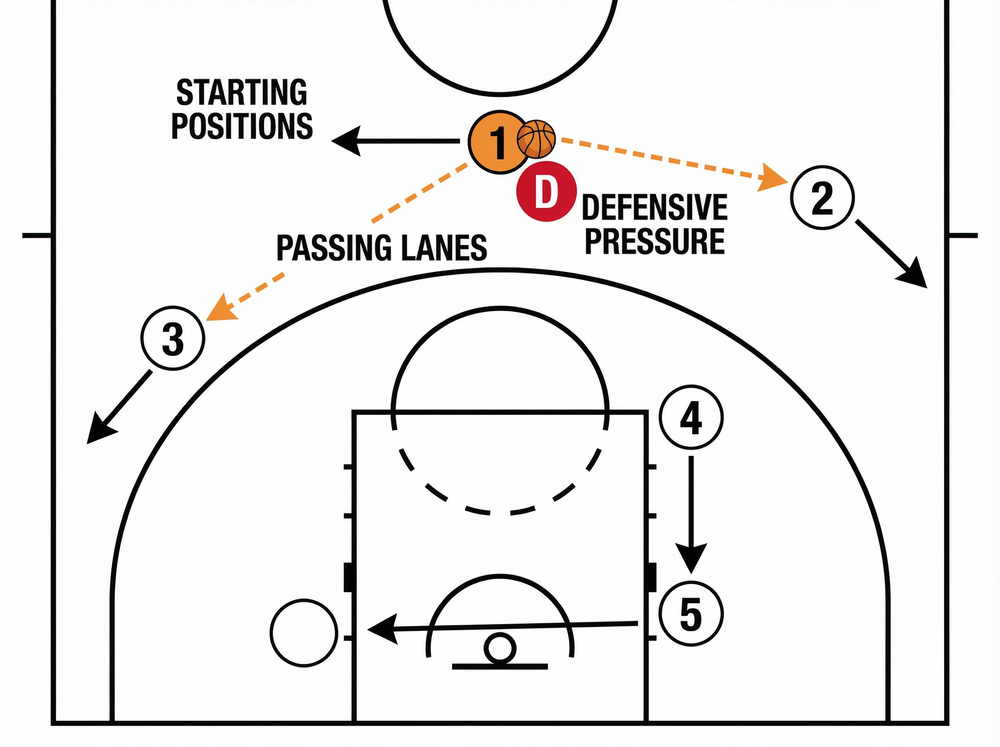
Initiate the Drill. Player 1 begins with the basketball at the top of the key, approximately 6m from the basket. Defender D1 immediately applies tight, aggressive on-ball pressure, forcing Player 1 to protect the ball using pivots and a strong, low stance.
Create the Passing Lane. Player 2 (right wing) or Player 3 (left wing) must work to get open by executing a sharp V-cut or L-cut — a hard two-step drive toward the basket followed by a quick cut back to the wing — to shake off their defender.
Execute the Pass. Under pressure from D1, Player 1 must deliver a crisp, accurate chest pass or bounce pass to the open teammate. The pass should be thrown to the receiver's outside hand (away from the defender), at chest height.
Follow the Pass. After releasing the ball, Player 1 immediately sprints to replace the position vacated by the player they just passed to (Player 2's wing spot). This ensures constant court spacing.
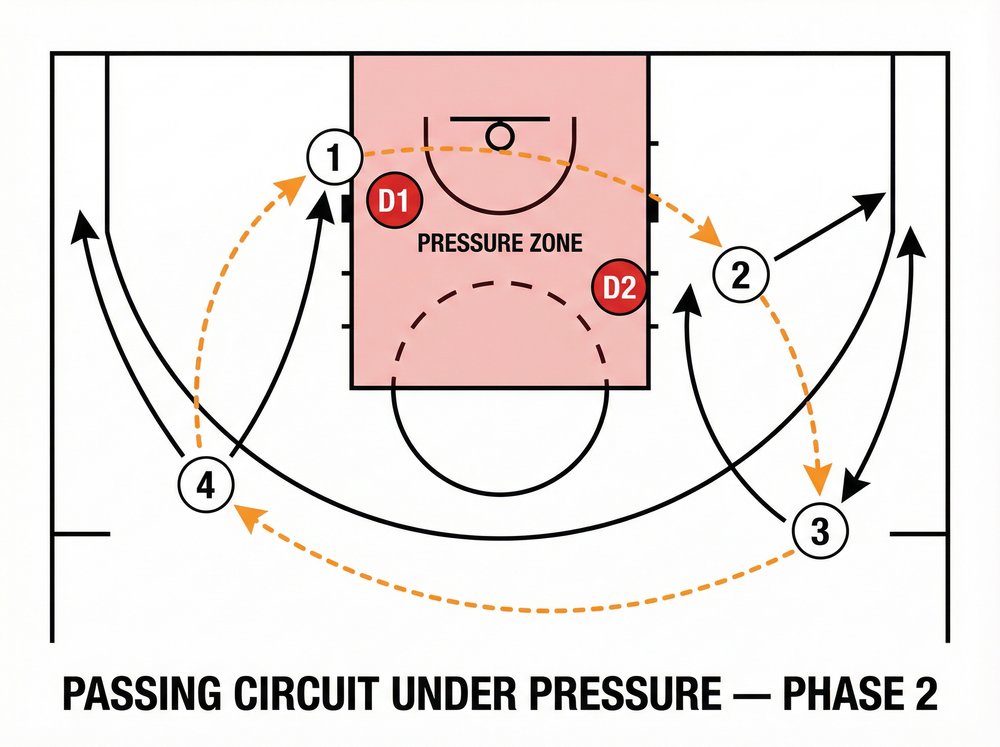
Continuous Rotation. Upon receiving the pass, Player 2 is now pressured by D2 or a rotating defender. Player 2 must quickly survey the court — using a quick pivot to see the floor — and pass to the next designated player in the sequence (e.g., Player 4 at the elbow or Player 3 on the opposite wing).
Complete the Circuit. The passing and replacing sequence continues until the ball has touched every offensive player's hands. The circuit culminates in a high-percentage shot (layup or short mid-range jumper) by the final receiver, who attacks the basket off the catch.
Rotate Roles. After each completed circuit, rotate one offensive player into a defensive role and one defender into the offensive rotation. Every player should experience both roles within a 15-minute session.

Key Coaching Points
Ball Protection First. Emphasize the use of strong pivots, keeping the ball ripped low (below the knees) or chinned high (under the chin with elbows out) away from the defender's reach. A player who loses the ball to a deflection has failed the drill's primary objective.
Pass Quality Over Pass Speed. Passes must be sharp, flat, and on target. A pass thrown at 80% power that arrives accurately is far more valuable than a 100% power pass that sails wide. Avoid looping or arcing passes, which give defenders time to recover and intercept.
Meet the Pass. Receivers must aggressively step toward the incoming ball with two hands extended as a target. Waiting for the ball to arrive shortens the passing window and invites deflections.
Eyes Up, Read the Defense. Ball handlers must keep their eyes up and chin level at all times to survey the entire court. Players who look down at the ball or stare at their feet cannot process defensive positioning and will consistently make poor decisions.
Communicate Loudly. Players should call out names before receiving a pass and use non-verbal cues — open target hands, a nod of the head — to signal readiness. Silent teams are slow teams.
Footwork on the Catch. Receiving players should aim to catch the ball in a jump stop (two feet landing simultaneously) or a 1-2 step, establishing a legal pivot foot immediately to maximize their passing and driving options.
Common Mistakes

Panicking Under Pressure. Players often rush their decisions when heavily guarded, leading to wild or off-target passes. Remind them that they have up to 5 seconds before a violation is called — use that time to pivot, find the right angle, and make a composed decision.
Telegraphing Passes. Staring down the intended receiver for more than a split second allows the defense to anticipate and jump the passing lane. Teach players to use ball fakes and look off defenders by briefly glancing in the opposite direction before delivering the actual pass.
Fading Away on the Pass. Instead of stepping into the pass to generate power and accuracy, players under pressure sometimes lean backward to avoid the defender. This results in weak, floaty passes that are easy to deflect. Insist on a positive step into every pass.
Stationary Receivers. Teammates who stand still waiting for the ball make the passer's job significantly harder. Every player without the ball should be in constant motion, cutting and relocating to create open passing angles.
Ignoring the Post. Under wing pressure, players frequently overlook the high-percentage pass into the post (Player 5). Encourage ball handlers to look inside first before swinging the ball to the perimeter.
Variations & Progressions

Add a Shot Clock (Easier → Harder). Introduce a 5-second limit for the ball handler to make a decision and execute the pass. As players improve, reduce this to 3 seconds. This forces faster processing and punishes hesitation.
Trapping Defense (Advanced). Instead of 1-on-1 pressure, have two defenders trap the ball handler simultaneously. This forces the offensive player to find the open player out of a double team — a critical skill for handling full-court press situations.
Multiple Basketballs (Elite Level). Run the circuit with two basketballs simultaneously, with two separate passing sequences operating at the same time. This demands a significantly higher level of concentration, spatial awareness, and communication from all players.
Age Adaptations

Under 10s / Under 12s: Remove the active defenders initially. Focus purely on the passing sequence, correct footwork, and the habit of following the pass. Introduce "dummy" defense — defenders with hands up but not actively contesting — once players are comfortable with the movement pattern. Use a larger ball (size 5) and reduce the court dimensions if necessary.
Under 14s / Under 16s: Implement full, active defense from the outset. Introduce the shot clock variation and strict time limits to challenge decision-making speed. Begin incorporating the trapping variation once the 1-on-1 pressure phase is mastered.
Open / Advanced: Demand specific pass types to elevate the difficulty — for example, weak hand only, skip passes over the defense, or overhead passes to simulate passing over taller defenders. Combine with the multiple basketballs variation for maximum cognitive load.
