High-Speed Counter-Attack: The 8v5 Transition Drill
Master the art of rapid transitions with this game-realistic 8v5 drill designed to teach quick distribution, exploiting wide overloads, and ruthless finishing.
Equipment Needed
1. Overview
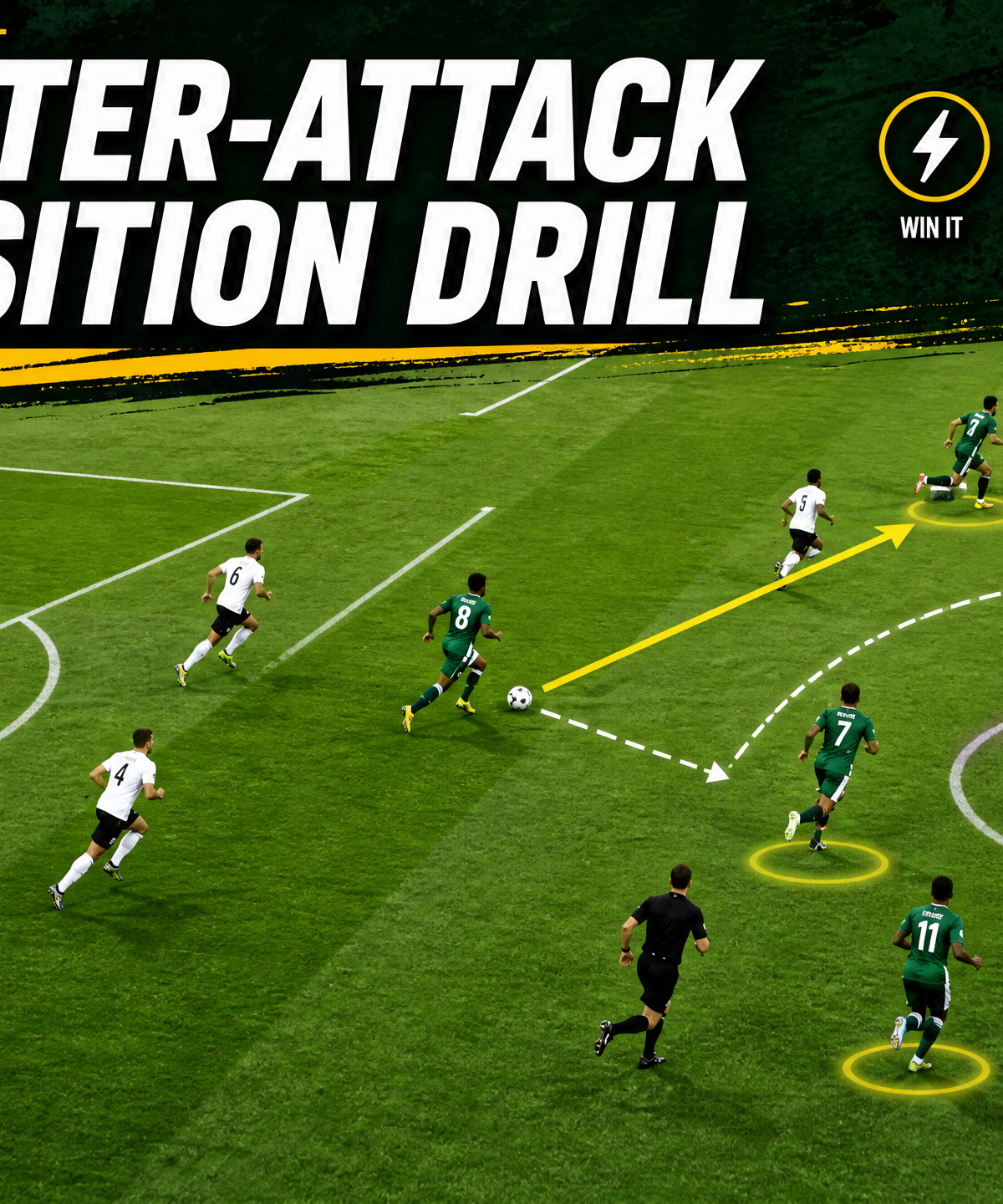
In modern football, the ability to transition rapidly from defense to attack is often the difference between winning and losing. This high-intensity, game-realistic drill focuses on exploiting disorganized defenses immediately after regaining possession.
By simulating an 8v5 scenario in the attacking half, this drill trains your players to recognize triggers, execute quick forward passes, and make aggressive runs into the final third before the opposition can establish their defensive block. It is highly effective for teams that employ a mid-to-low block and rely on explosive counter-attacks to create scoring opportunities.
2. Setup
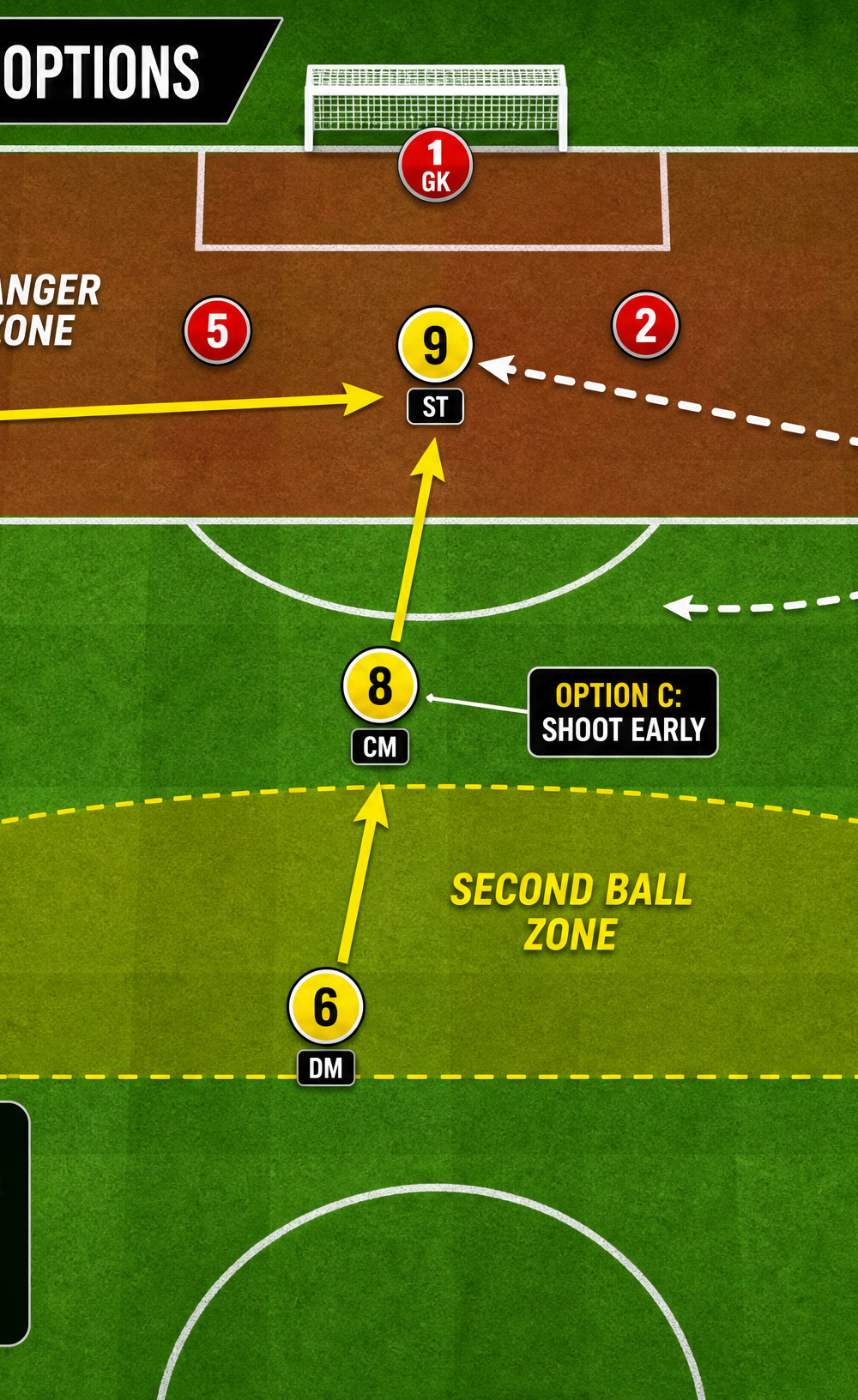
- Pitch Dimensions: Full pitch (105m x 68m) or adapt to your standard pitch size. Use the area from your defensive penalty box to the opposite goal.
- Players: 13 players total (8 Attackers vs 5 Defenders) + 1 Goalkeeper.
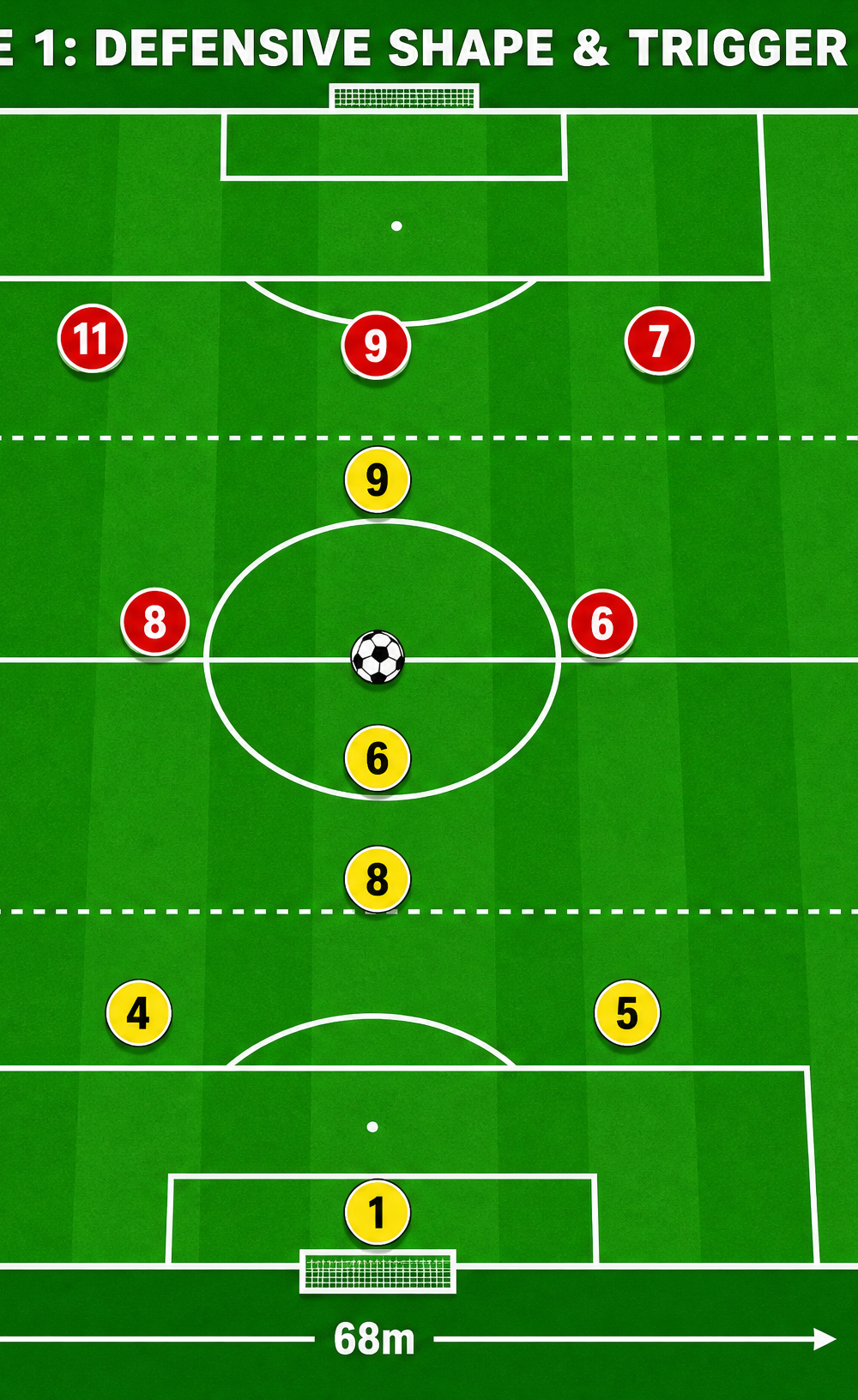
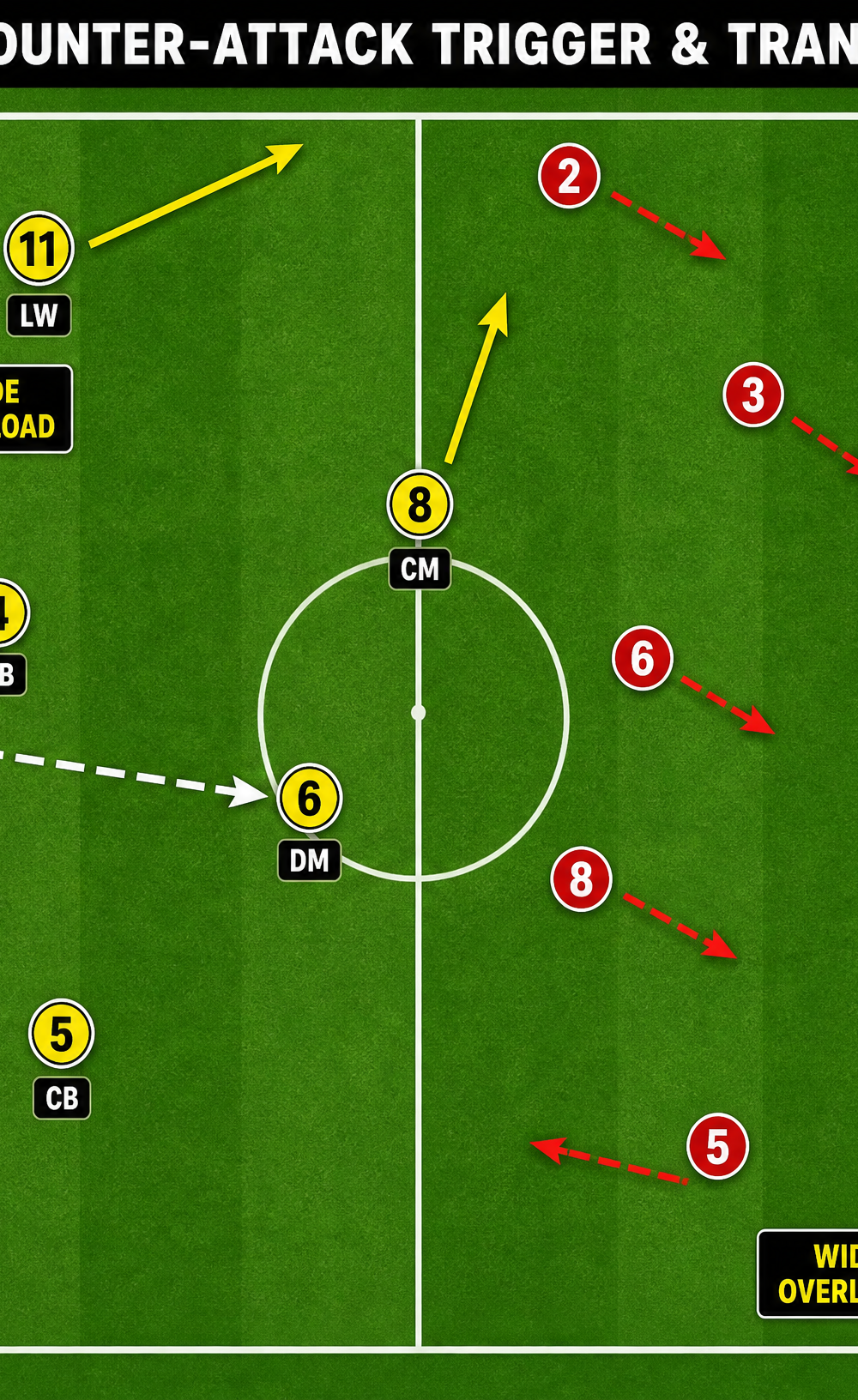
- Attacking Team (Yellow): GK (1), 2x CBs (4, 5), DM (6), CM (8), LW (11), RW (7), ST (9).
- Defending Team (Red): 3x Defenders, 2x Midfielders.
- Equipment: 1 full-size goal, 10-12 balls positioned in the defensive penalty area, cones to mark starting zones if necessary, and two sets of bibs (Yellow and Red).
3. Step-by-Step Instructions
Phase 1: The Trigger
- The drill begins with the Goalkeeper (1) who has a supply of balls in the defensive penalty area.
- The Attacking team (Yellow) starts in a structured defensive shape. The Defending team (Red) starts in an advanced, high-pressing position, simulating a team that has just lost possession deep in the attacking half.
- On the coach's whistle, the GK initiates the counter-attack with a rapid, varied distribution (thrown, rolled, or driven pass) to the DM (6) or one of the fullbacks/wingers.
Phase 2: The Transition
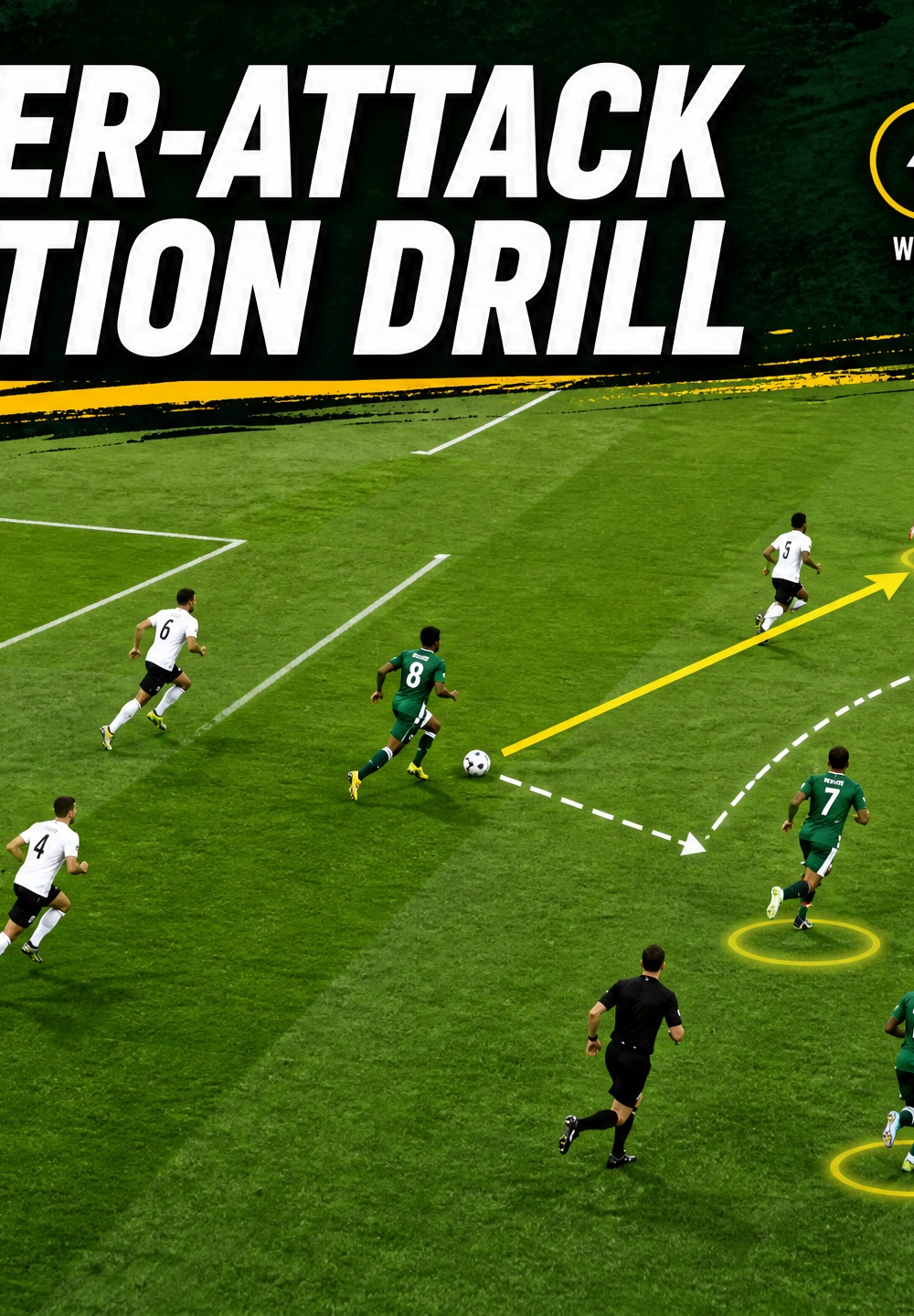
4. Upon receiving the ball, the DM (6) must look to play forward immediately. The primary objective is to bypass the two Red midfielders with a single vertical or diagonal pass.
5. Simultaneously, the wide players (LW 11, RW 7) and the CM (8) must make explosive, aggressive runs into the attacking half.
6. The ST (9) makes a "third-man run" or drops slightly to link play before spinning in behind the three Red defenders.
Phase 3: The Finish
7. The Yellow team now has a numerical advantage (5 attackers vs 3 defenders) approaching the final third.
8. The ball carrier must commit a defender and then execute the correct final action: a through ball, a wide overload resulting in a low cross, or a cut-back.
9. Attackers must arrive in the "Danger Zone" (inside the penalty area) and the "Second Ball Zone" (edge of the box) with timing and intent.
10. The phase concludes with a shot on goal. The entire sequence from GK distribution to shot should take no more than 10-12 seconds.
4. Key Coaching Points
- Speed of Thought and Execution: The first pass after winning the ball must be forward and accurate. Hesitation allows the defense to recover.
- Explosive Forward Runs: Players off the ball must sprint at maximum intensity. Wide players must stretch the pitch to create gaps centrally.
- Commit the Defender: The ball carrier in the final third must drive directly at the retreating defenders to force a decision, thereby opening space for teammates.
- Arrive in the Box: Ensure players attack the near post, far post, and penalty spot. The CM (8) should always arrive late for cut-backs or second balls.
- Ruthless Finishing: Encourage first-time finishes. In transition, the goalkeeper is often scrambling; early, low shots are highly effective.
5. Common Mistakes
- Playing Backwards or Laterally: The DM receiving the ball from the GK takes too many touches or plays a safe, lateral pass, killing the momentum of the counter-attack.
- Runs Lacking Intensity: Attackers jog rather than sprint, allowing the recovering Red midfielders to get back behind the ball and neutralize the numerical advantage.
- Poor Decision Making in the Final Third: The ball carrier shoots from a poor angle instead of sliding in a teammate who is in a better position, or delays the final pass until the defender recovers.
- Overcrowding the Ball: Players run toward the ball carrier instead of attacking the empty space behind the defensive line.
6. Variations & Progressions
- Add Recovering Defenders (Progression): Start two additional Red midfielders near the Yellow penalty area. Once the GK distributes the ball, these two players sprint back to help defend, putting a strict time limit on the Yellow team's attack.
- Conditioned Touches (Progression): Limit players to a maximum of 2 or 3 touches to force quicker decision-making and faster ball circulation.
- Different Starting Triggers (Variation): Instead of the GK starting with the ball, begin with a Red player shooting wide or losing the ball in a 1v1 duel against a Yellow CB.
7. Age Adaptations
- Under 10s / Under 12s: Reduce the pitch size (e.g., half pitch). Focus heavily on the basic concept of running forward quickly when the ball is won. Do not worry about complex tactical shapes; simply encourage the "first pass forward" mentality.
- Under 14s / Under 16s: Introduce the concept of specific runs (e.g., overlapping, underlapping, third-man runs). Emphasize the quality and weight of the final pass.
- Open / Senior: Run the drill at absolute match intensity. Focus on the tactical nuances of exploiting specific zones (e.g., the half-spaces) and demand clinical finishing under pressure.