

Football
High-Velocity Counter-Attack Transition Drill
Train your team to exploit spaces immediately after winning the ball with rapid, vertical transitions.
What you need
Footballs, Cones, Pinnies/Bibs, Full-size goals
1. Overview
This high-velocity counter-attack transition drill is designed to train your team to react instantaneously upon regaining possession. The primary objective is to shift from a compact defensive block into a devastating attacking force within seconds. This drill emphasizes verticality, rapid decision-making, and synchronized off-the-ball movement. It is particularly effective for teams that employ a mid or low block and look to punish opponents who overcommit players forward. By simulating realistic game scenarios, players learn to identify the 'trigger' moment—when the ball is won—and immediately execute pre-planned attacking patterns to exploit the disorganized opposition defense.
2. Setup

Pitch Dimensions: Use a full-size pitch (100-110m x 64-75m) to ensure realistic distances for sprinting and passing.
Equipment Needed:
- Full-size goals at each end.
- Cones to mark the 'Trigger Zone' and 'Wide Channels'.
- Pinnies/bibs for two teams (e.g., Red and Blue).
- An adequate supply of footballs placed around the pitch perimeter for quick restarts.
Player Positions:
- Attacking Team (Red - 11 players): Set up in a 4-4-2 or 4-2-3-1 formation. They start in a compact mid-block defensive shape in their own half.
- Defending Team (Blue - 6-8 players): Positioned in the attacking half, simulating a team that has pushed forward and is circulating the ball. Include a goalkeeper for the Red team to attack.

3. Step-by-Step Instructions
- Starting Position: The Blue team begins with possession in the Red team's half, passing the ball to probe the Red team's compact defensive block.
- The Trigger: The coach blows the whistle or calls "Press!" to initiate the sequence. Alternatively, the drill can start organically when a Red player intercepts a pass or tackles a Blue player within the designated 'Trigger Zone'.
- Securing Possession: Upon winning the ball, the first priority for the Red player is to secure possession. They must immediately look for a forward pass or carry the ball out of pressure.
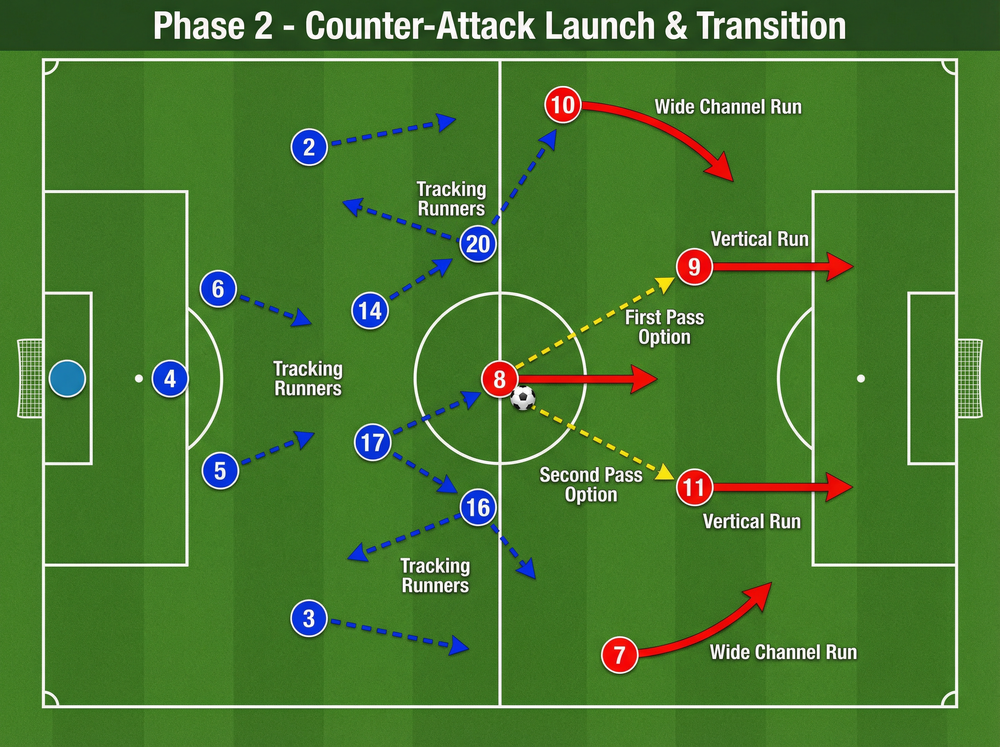
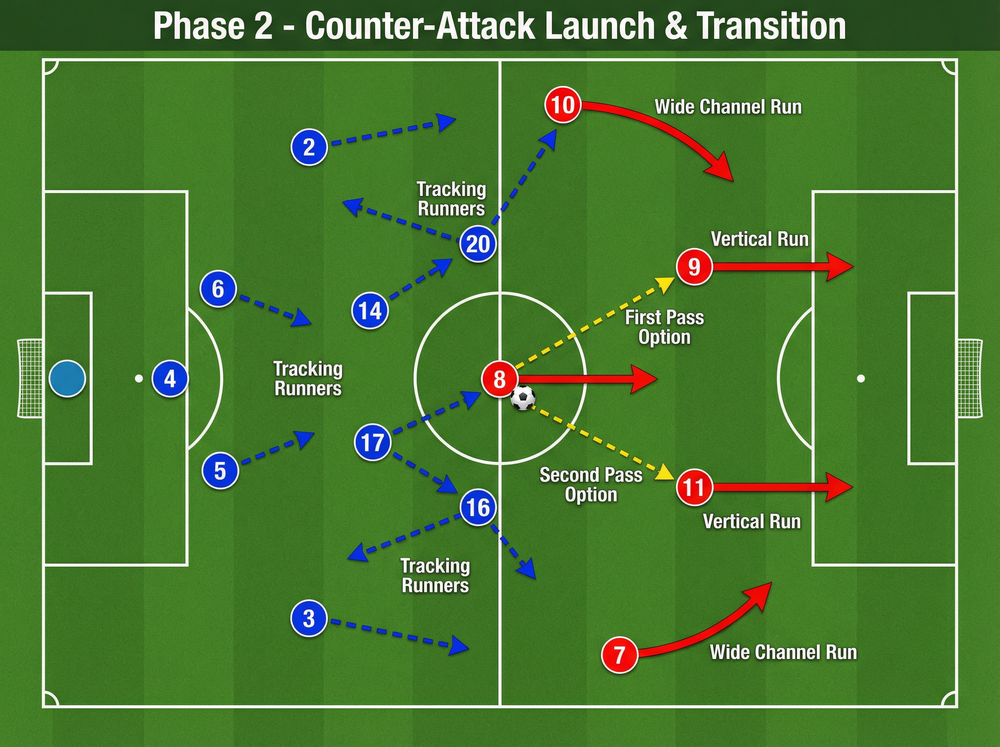
- The Launch: The central midfielder (e.g., #8 or #10) receives the first pass. They must take a positive first touch forward and scan the field for runners.
- Synchronized Movement: Simultaneously, the forwards (#9, #11) make explosive vertical runs into the space behind the Blue defenders. The wide midfielders (#7, #11) sprint diagonally into the wide channels to stretch the defense.
- Execution: The ball carrier selects the best option—either a through ball to a forward, a pass into the wide channel, or driving forward themselves if space permits.
- Finishing: The Red team must aim to get a shot on goal within 8-10 seconds of winning the ball. Speed and precision are paramount.
- Reset: After a shot, a goal, or if the Blue team regains possession, the drill resets to the starting position.
4. Key Coaching Points

- First Pass Forward: The first pass after winning the ball must be forward whenever possible to break lines and catch the opposition off guard.
- Explosive Reactions: Players must switch from defensive to attacking mindsets instantly. Off-the-ball runners need to sprint at maximum speed to create options.
- Decision Making: The ball carrier must quickly assess the situation and choose the right pass (weight, timing, and direction).
- Width and Depth: Runners must provide both width (to stretch the defense) and depth (to offer penetrating passing options).
- Ruthless Finishing: The ultimate goal of a counter-attack is to score. Players must be composed and clinical in front of goal.
5. Common Mistakes

- Delayed First Pass: Taking too many touches or playing backward after winning the ball allows the opposition time to recover.
- Lack of Supporting Runs: If forwards and wide players do not make immediate, aggressive runs, the ball carrier will be isolated.
- Poor Pass Quality: Inaccurate or under-hit passes break the momentum of the counter-attack.
- Overcomplicating the Finish: Trying to make the perfect pass in the penalty area instead of taking a clear shot on goal.
6. Variations & Progressions
- Time Limit: Introduce a strict time limit (e.g., 8 seconds) for the attacking team to get a shot away after winning the ball.
- Overload: Add an extra defender to the Blue team to increase the difficulty for the Red team during the transition.
- Specific Triggers: Condition the drill so the counter-attack can only start from a specific type of turnover (e.g., an interception in the central channel).
7. Age Adaptations
- Under 10s: Focus on the basic concept of winning the ball and running forward. Use a smaller pitch and fewer players (e.g., 5v5 or 7v7).
- Under 14s: Introduce more structured movement patterns and emphasize the quality of the first pass. Increase the pitch size to challenge their physical capacity.
- Under 18s/Open: Run the drill at full match intensity with complex tactical variations and strict time constraints. Demand high-level decision-making and execution.
