

Basketball
Horns Set Play: The Double Screen for a Wide-Open Three-Pointer
Master the Horns set play to exploit defensive coverages, create floor spacing, and generate high-percentage three-point opportunities for your best shooters.

What you need
Basketball, Half-court (minimum), Cones (optional, for marking spots during walkthroughs)
Overview
The Horns set play is a staple in modern basketball at all levels, from youth leagues to the professional ranks. Its defining characteristic is the initial alignment: two post players positioned at the elbows (the "horns") and two shooters spaced wide in the corners, leaving the middle of the floor completely open for the point guard. This specific variation focuses on leveraging the double high ball screen to collapse the defence and generate a clean, in-rhythm three-point shot for a wing player.
By forcing the defence to make difficult decisions at the point of the screen, the Horns set creates a numerical advantage on the perimeter. If the defence sags to protect the paint against the rolling big man, the perimeter opens up. If they switch or aggressively hedge the screen, passing lanes to the corners and wings become available. This play is particularly effective against man-to-man defensive schemes and serves as an excellent late-game option when a crucial three-pointer is required.
Setup
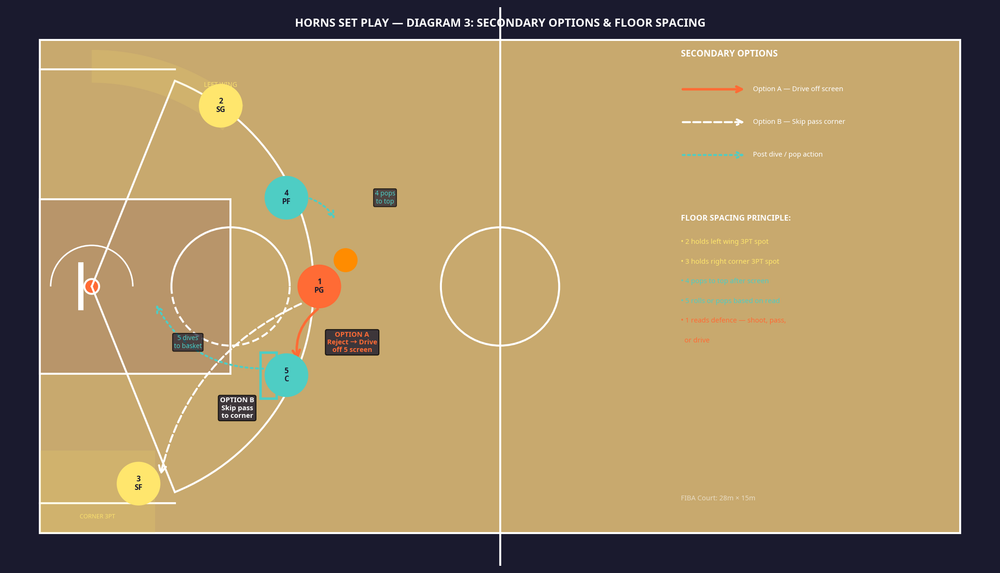
To execute this play effectively, you need a standard basketball court (FIBA dimensions: 28m x 15m) and a minimum of five players. The success of the play heavily relies on precise spacing and timing.
Player Positions
- 1 (Point Guard): Starts at the top of the key, slightly beyond the three-point line, initiating the offense with the ball.
- 4 (Power Forward): Positioned at the left elbow (the intersection of the free-throw line and the lane line).
- 5 (Center): Positioned at the right elbow.
- 2 (Shooting Guard): Spaced deep in the left corner, stretching the defence.
- 3 (Small Forward): Spaced deep in the right corner, mirroring the 2-guard.
Step-by-Step Instructions
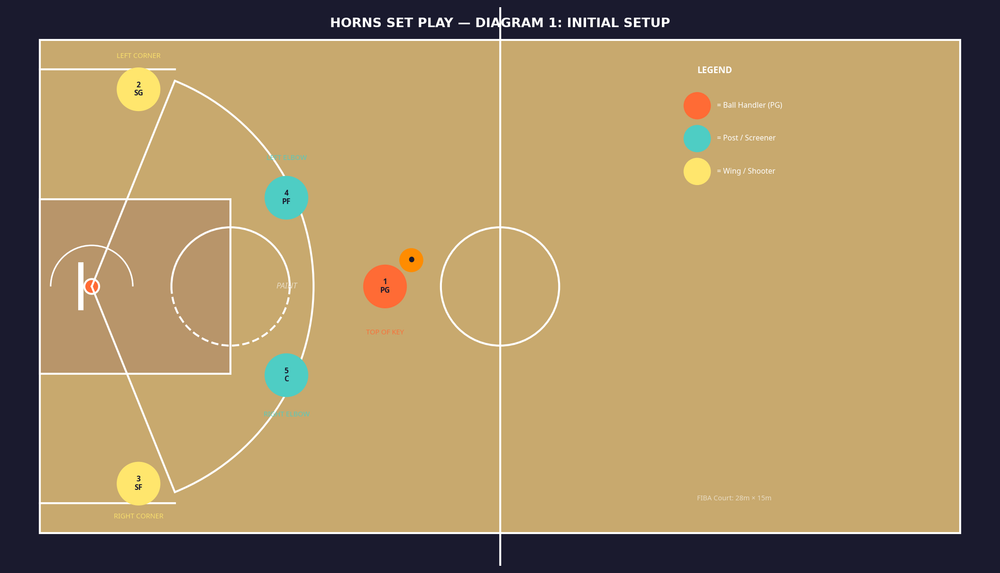
The execution of the Horns set for a three-pointer requires coordinated movement and sharp passing. Follow these steps to run the primary action:
Phase 1: The Initiation
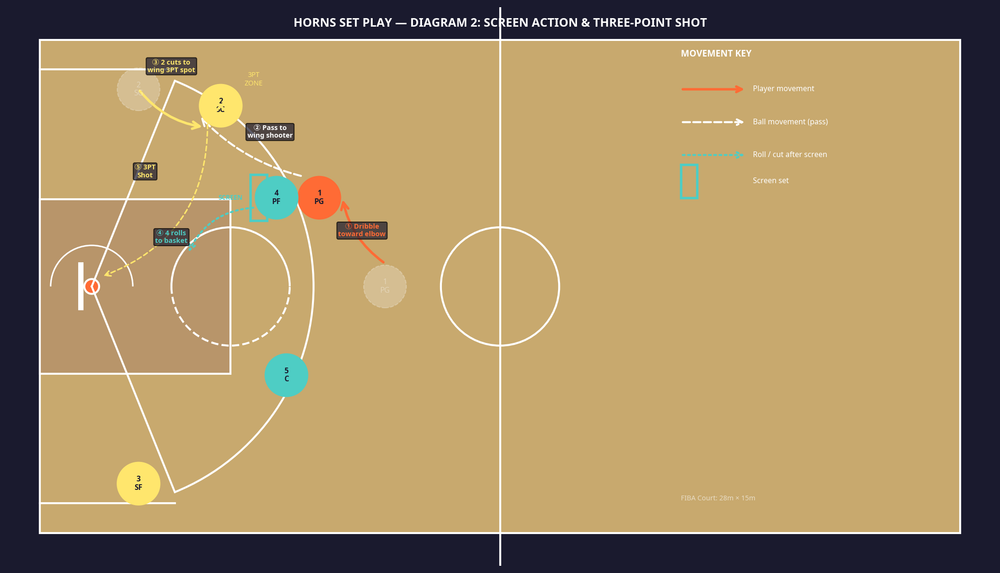
- The Dribble Entry: The Point Guard (1) initiates the play by dribbling toward one of the elbows — in this primary action, toward the left elbow where Player 4 is stationed.
- The Screen: As 1 approaches, the Power Forward (4) steps up slightly to set a solid, legal ball screen on 1's defender. The Center (5) remains at the right elbow as a safety valve and secondary screener.
Phase 2: The Action and The Read
- Using the Screen: The Point Guard (1) uses the screen set by 4, attacking the middle of the floor or driving hard off the screen to force the defence to commit to stopping the penetration.
- The Roll and The Lift: Immediately after setting the screen, 4 rolls hard to the basket. Simultaneously, the Shooting Guard (2) lifts from the deep left corner to the left wing, positioning themselves behind the three-point arc at approximately 6.75m from the basket.
- The Pass: As 1 turns the corner off the screen, they read the defence. If 2's defender has dropped to help on the rolling 4 or to contain 1's drive, 1 delivers a crisp, accurate pass to 2 on the wing.

Phase 3: The Shot or Secondary Options
- The Shot: Player 2 catches the ball in rhythm, squared to the basket, and takes the open three-point shot.
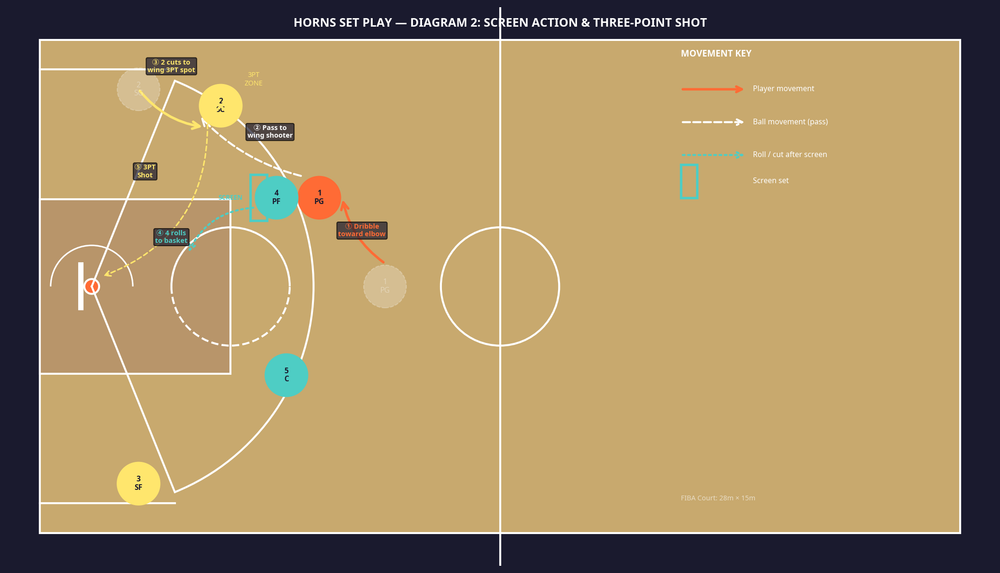
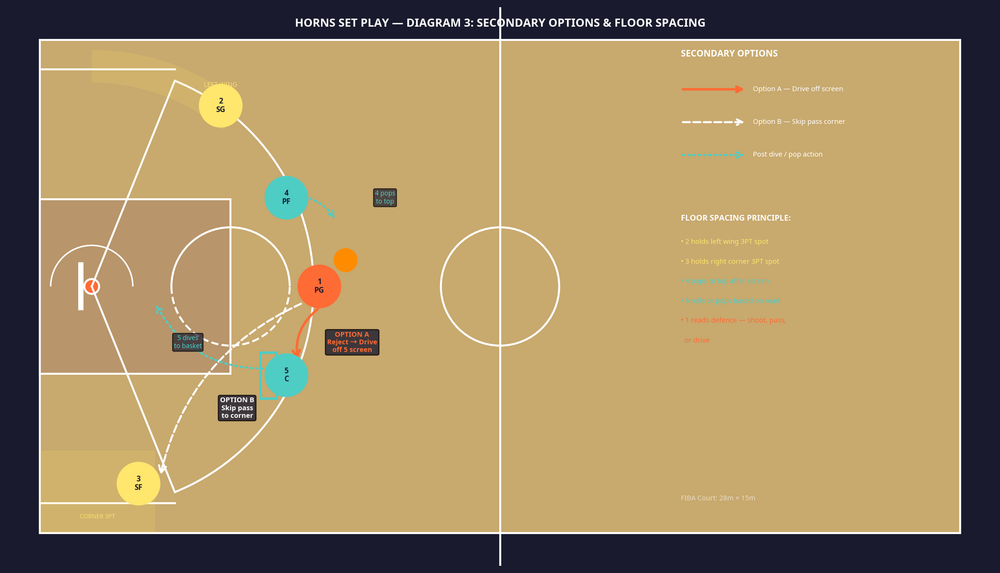
- Secondary Options: If the defence recovers quickly to 2, the play flows into secondary actions. Player 1 can reject the initial screen and use 5's screen on the right side (Option A). Alternatively, if the defence heavily overloads the strong side, 1 can execute a skip pass to the Small Forward (3) in the right corner, while 5 dives to the rim and 4 pops to the top of the key (Option B).
Key Coaching Points
To ensure the Horns set is executed flawlessly, focus on these critical details during practice:
- Screen Angle and Solidity: The screener (4) must set the screen at an angle that forces the defender to go over the top, not under. The screen must be stationary and wide to create true separation.
- Patience by the Ball Handler: The Point Guard (1) must wait for the screen to be fully set before attacking. Rushing the action will result in an offensive foul or a poorly executed pick-and-roll.
- Timing of the Lift: The wing player (2) must time their lift from the corner perfectly. If they lift too early, their defender can easily recover. If they lift too late, the passing window closes. The lift should occur just as 1 is turning the corner off the screen.
- Target Hands: The shooter (2) must show clear target hands ready to catch and shoot. The pass from 1 should hit the shooter directly in the shooting pocket.
- Spacing Discipline: Players 3 and 5 must maintain their spacing. If they drift toward the ball, they bring their defenders into the primary action area, clogging the passing lanes.
Common Mistakes
Watch out for these frequent errors that can disrupt the timing and effectiveness of the play:
- Slipping the Screen Too Early: The screener (4) rolls to the basket before making solid contact with the defender, failing to create an advantage for the ball handler.
- Poor Spacing in the Corners: The corner players (2 and 3) start too high on the wings rather than deep in the corners. This allows their defenders to easily stunt and recover on the pick-and-roll action.
- Telegraphing the Pass: The Point Guard stares down the intended target (2) the entire time, allowing the defence to anticipate the pass and jump the passing lane.
- Lack of Aggressiveness off the Screen: The ball handler does not attack the rim hard enough off the screen, failing to force the defence to collapse and commit.
Variations & Progressions

Once your team has mastered the basic Horns set for a three-pointer, introduce these variations to keep the defence guessing:
- Horns Flare (Pick and Pop): Instead of rolling to the basket, the screener (4) pops to the three-point line while the corner player (2) stays low or cuts baseline. This is highly effective if your Power Forward is a capable outside shooter.
- Horns Twist: The Point Guard uses the first screen (from 4), but immediately crosses over and uses a second screen from the other post player (5). This "twist" action often confuses switching defences and creates mismatches.
- Horns DHO (Dribble Hand-Off): Instead of a traditional pick-and-roll, the Point Guard dribbles directly at the elbow player (4) and executes a dribble hand-off. The wing player (2) then curls off a staggered screen set by 5.
Age Adaptations

The Horns set can be adapted for various age groups and skill levels:
- Under 10s / Under 12s: Focus heavily on the basic spacing (two high, two wide) and simple pass-and-cut actions rather than complex pick-and-rolls. Teach the concept of passing to the open player when the defence helps.
- Under 14s: Introduce the basic pick-and-roll action at the elbow. Emphasise setting legal screens and the timing of the roll. The "lift" for the three-pointer might be a lift for a mid-range jump shot depending on the players' strength.
- Under 16s and Open: Run the full play with all reads and secondary options. Defences will be more sophisticated, so the Point Guard must be adept at reading hedges, switches, and drop coverages. Emphasise the speed of execution and the precision of the skip pass.
