

Rugby
Kick-Off Reception and Counter-Attack: The 'Wide Strike' System
Master the transition from kick-off reception to an immediate, lethal counter-attack by securing the ball and exploiting the wide channels before the defensive line resets.
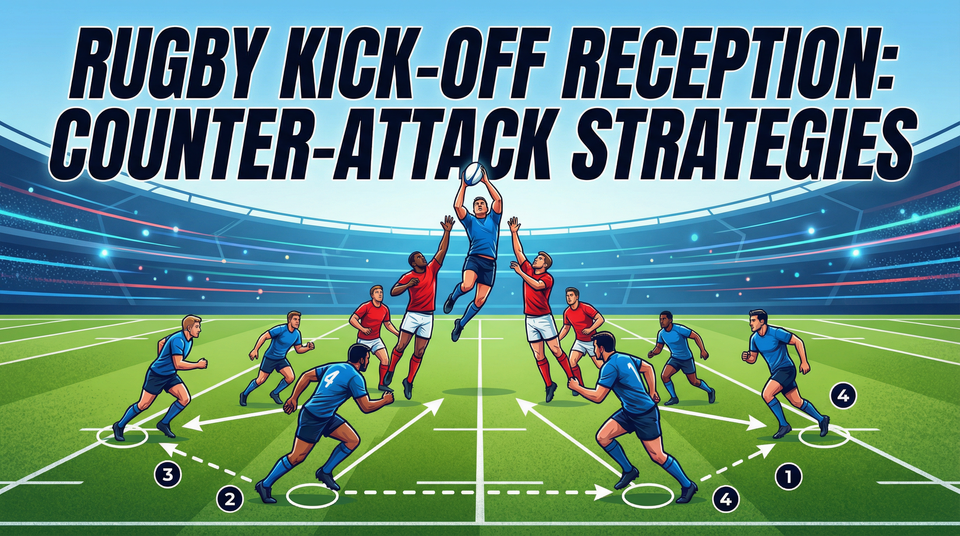
What you need
Rugby balls (minimum 5), Cones (for marking zones and defensive starting points), Bibs (two contrasting colors)
1. Overview
The kick-off reception is often viewed merely as a restart, but for a well-drilled team, it is the first opportunity to launch a structured counter-attack. The 'Wide Strike' system is designed to secure possession deep in your own half, draw the defensive chase into a narrow corridor, and rapidly shift the ball to the wide channels where space is abundant.
This play achieves two primary goals: it ensures safe retention of the ball under high-pressure kick-offs, and it immediately puts the opposition on the back foot by transitioning into attack before their defensive line can organize and spread. Use this play when the opposition tends to employ a narrow, aggressive chase line or when you have identified a mismatch in pace on the edges of the field.
2. Setup
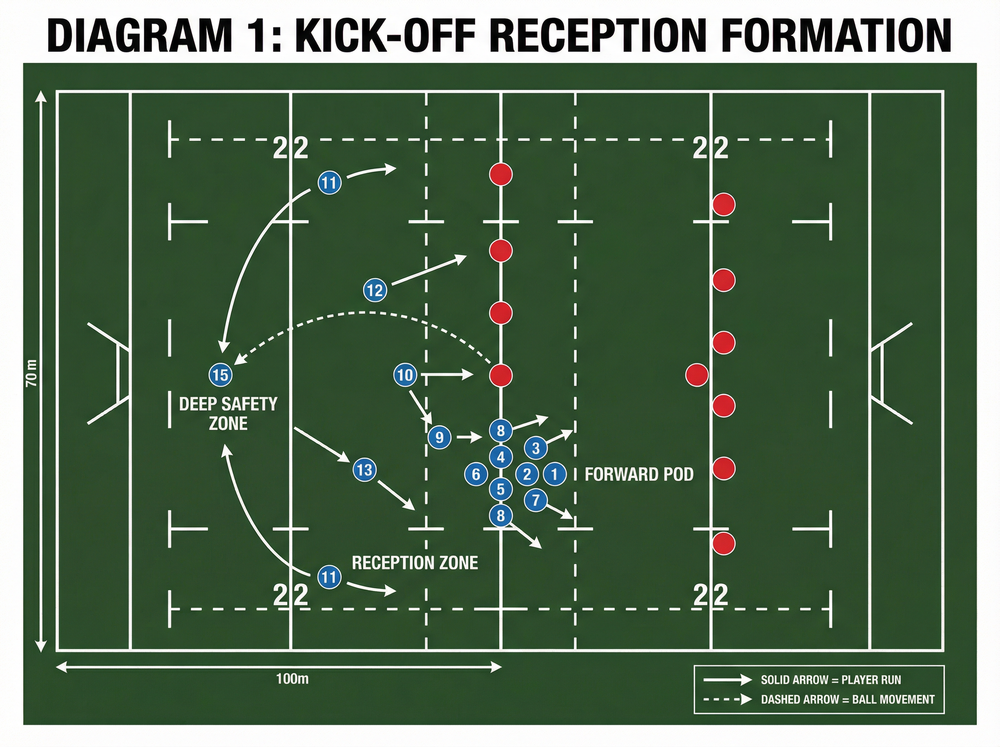
To effectively run this set play in training, you will need a full pitch setup or at least a 60m x 70m area, representing your defensive half.
Pitch Setup:
Utilize the standard Rugby pitch markings (100m x 70m). The drill focuses on the area from your own 22-metre line up to the halfway line.
Player Positions:
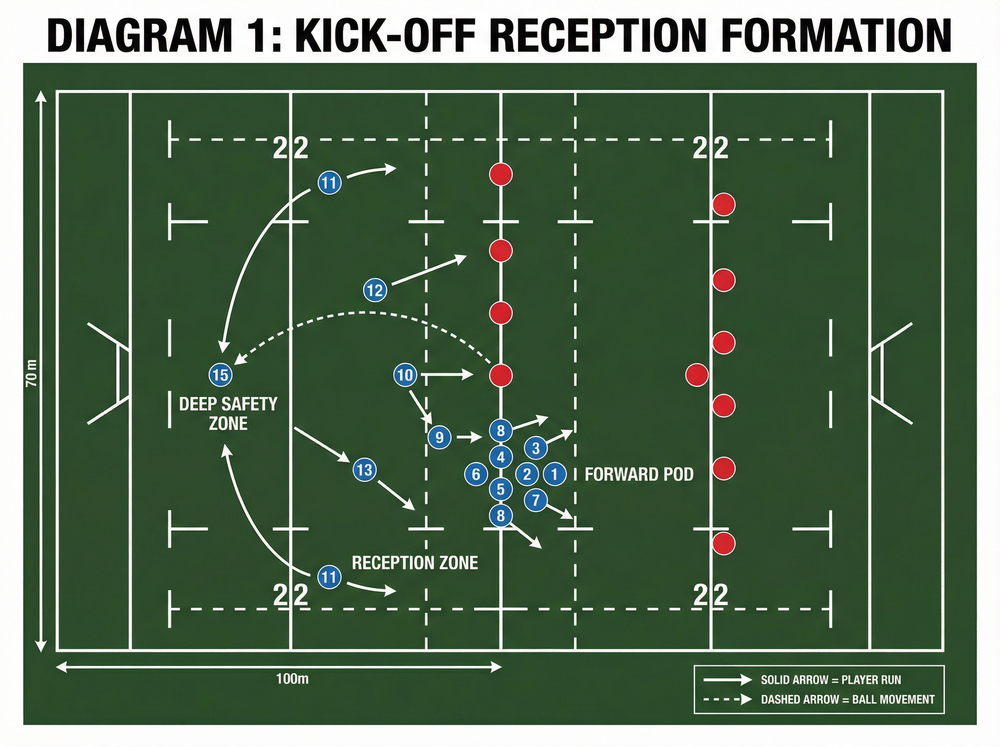
The receiving team sets up in a classic deep reception formation. The Full-back (15) anchors the deep safety zone around the 35m mark. The Wings (11, 14) provide width at the 20m mark, while the Centres (12, 13) cover the mid-range kicks at the 15m mark. The Fly-half (10) and Scrum-half (9) orchestrate from the 10-12m area. The Forwards (1-8) form a protective pod near the 10m line, ready to secure the breakdown or provide lifting support if the kick is short.
3. Step-by-Step Instructions
Executing the 'Wide Strike' requires precise timing, clear communication, and aggressive running lines. Follow these steps to drill the movement:
Step 1: The Catch and Secure
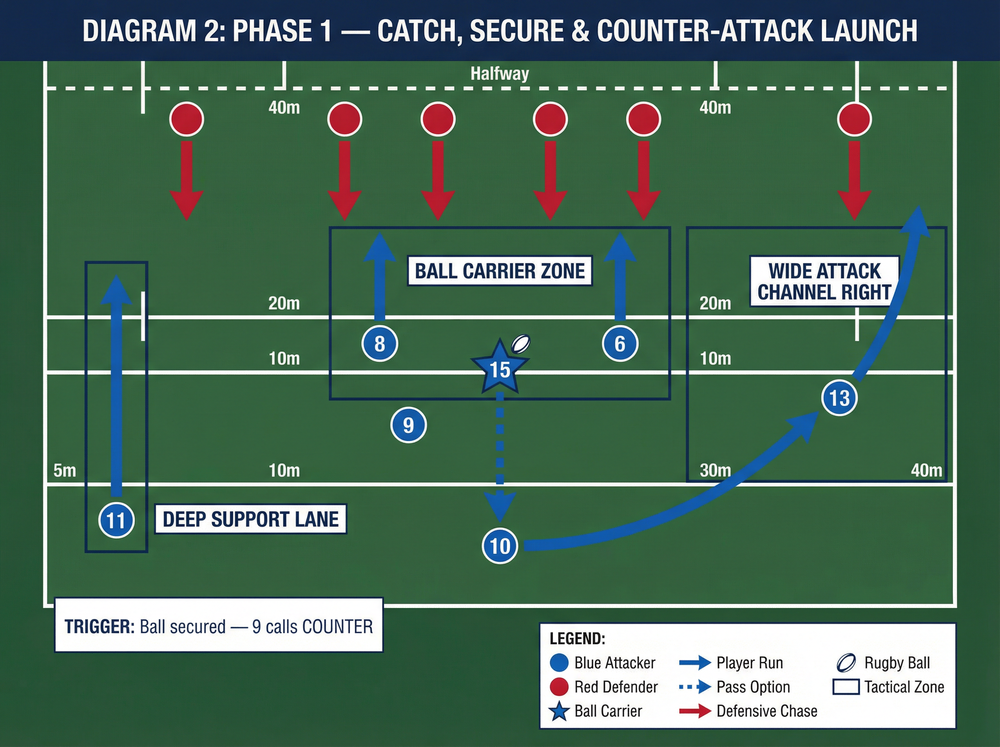
As the ball is kicked, the designated catcher (typically the Full-back, 15) must communicate early and loudly (e.g., "Mine, Mine!"). The surrounding players immediately transition into support roles. Two designated forwards (e.g., 6 and 8) must sprint to flank the catcher, providing a protective barrier against the advancing defensive chase.
Step 2: The Counter-Attack Trigger
Once the Full-back (15) secures the ball, they take two aggressive steps forward to set a positive target. The Scrum-half (9) arrives at the base and assesses the defense. If the chase is narrow, the 9 calls "Counter!" to trigger the wide attack.
Step 3: The Wide Distribution
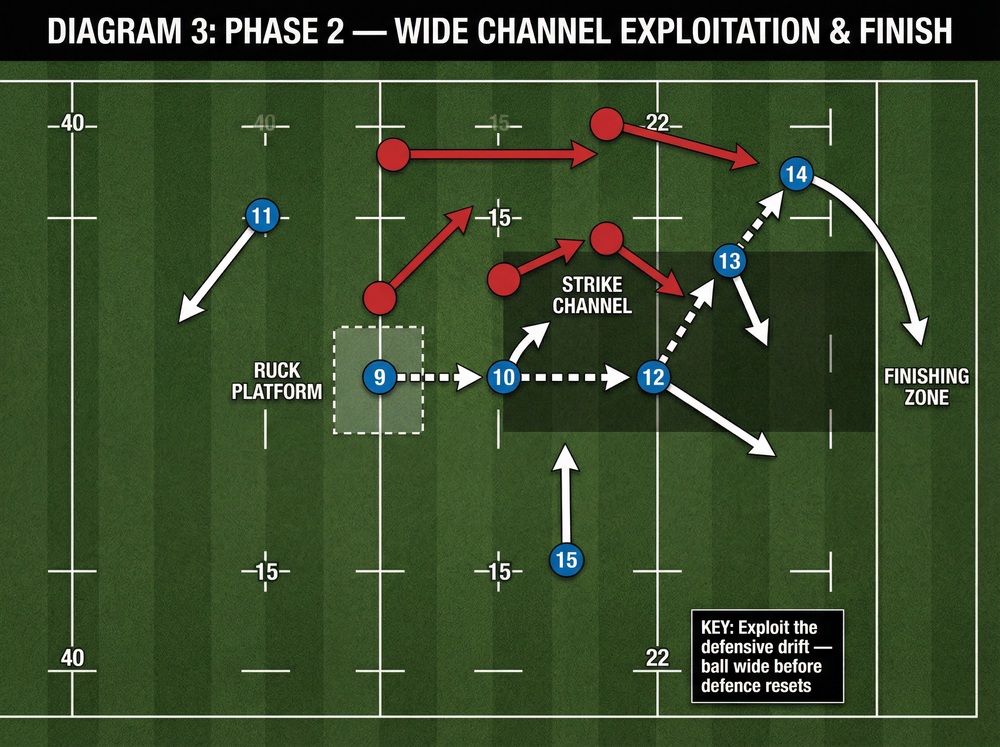
The Full-back (15) can either take contact and present the ball cleanly for the 9, or if space allows, execute a quick offload to the Fly-half (10) who has dropped into a deep support pocket. The 10 then initiates the wide movement, firing a flat, fast pass to the Inside Centre (12).
Step 4: Exploiting the Strike Channel
The Inside Centre (12) runs a hard, straight line to fix the drifting defenders, before passing wide to the Outside Centre (13). The 13 aims for the outside shoulder of the final defender, drawing them in to release the Right Wing (14) down the touchline.
Step 5: The Finish
The Right Wing (14) accelerates into the finishing zone, utilizing the sideline as an extra defender. The Full-back (15) and Left Wing (11) must track across the field to provide inside support options should the 14 be covered.
4. Key Coaching Points

- Early Communication: The catcher must claim the ball while it is at the apex of its flight to prevent confusion and collisions.
- Aggressive Support: The flanking forwards must not wait for the catch; they must anticipate the landing zone and arrive simultaneously with the ball to secure the ruck.
- Depth in Attack: The backline must maintain sufficient depth. If the 10, 12, and 13 are too flat, the defensive drift will easily shut down the wide pass.
- Fixing Defenders: Every ball carrier in the backline must run a credible attacking line to commit a defender before passing. Drifting sideways with the ball will simply push the defense toward the touchline.
- Speed of Ball: The transition from the initial catch to the wide pass must be instantaneous. A slow ruck at the point of reception allows the defense to spread.
5. Common Mistakes

- Static Catching: Players waiting flat-footed for the ball to drop, allowing the defense to arrive at the same time as the ball.
- Over-Committing to the Ruck: Too many backs joining the initial reception ruck, leaving no attacking options out wide.
- Lateral Passing: The backline passing the ball while running sideways, failing to engage the defensive line and running out of space.
- Ignoring the Kick Option: Forcing the wide play even when the defense has covered the edges perfectly. Players must recognize when to kick for territory instead.
6. Variations & Progressions
- Progression 1: Live Defense: Introduce a live, full-speed defensive chase line (5-7 players) to increase pressure on the catcher and force quicker decision-making from the Scrum-half.
- Progression 2: The Switch Play: If the defense over-commits to the wide drift, the Inside Centre (12) can execute a switch pass back inside to a trailing forward or the blindside Wing (11).
- Variation: Short Kick Reception: Adapt the drill for a short, contestable kick where the forward pod must execute a clean lift and immediate maul to secure possession before releasing the backs.
7. Age Adaptations
- Under 10s / Under 12s: Focus primarily on the mechanics of a safe catch (calling for the ball, creating a basket with the arms) and immediate presentation. Simplify the counter-attack to a single pass to the fastest player.
- Under 14s / Under 16s: Introduce the concept of fixing defenders and drawing the man before passing. Emphasize the importance of depth and running straight lines.
- Open / Senior: Execute the full 'Wide Strike' system with complex variations, focusing on the speed of the breakdown and reading the defensive alignment to choose between running, passing, or kicking.
