

Netball
Mastering Footwork and Landing Technique
Develop impeccable balance, control, and agility with this comprehensive footwork and landing drill designed to eliminate stepping calls and improve passing accuracy.
What you need
Netballs (1 per group), Marker Cones (6-8), Court Line Markings
1. Overview
Footwork is the foundational skill of netball. A player who cannot land balanced and securely will struggle to execute accurate passes, dodge effectively, or maintain possession under pressure. This comprehensive drill resource is designed to teach and reinforce the critical mechanics of single-foot and two-foot landings. By progressing from static, unchallenged environments to dynamic, full-court scenarios with defensive pressure, coaches can ensure players develop the muscle memory required to eliminate stepping calls and transition smoothly into their next movement.
Use this drill during the early stages of a season to establish fundamental habits, or integrate it into your regular conditioning and skills rotation to maintain sharp footwork throughout the year. It is highly effective for warming up the lower body while simultaneously engaging the players' cognitive processing regarding the footwork rule.
2. Setup
Proper setup is essential to maximize repetitions and keep players engaged. This drill utilizes the middle third for the initial stages before expanding to a full-court application.
- Court Area: Initially the Middle Third (15.25m x 10.16m), progressing to Full Court.
- Equipment: 1 Netball per group of 3-4 players, 6-8 marker cones.
- Player Positions:
- Feeder (F): Positioned centrally to deliver varied passes.
- Worker (W): The active player executing the landings.
- Defender (D): Introduced in later progressions to apply pressure.
3. Step-by-Step Instructions
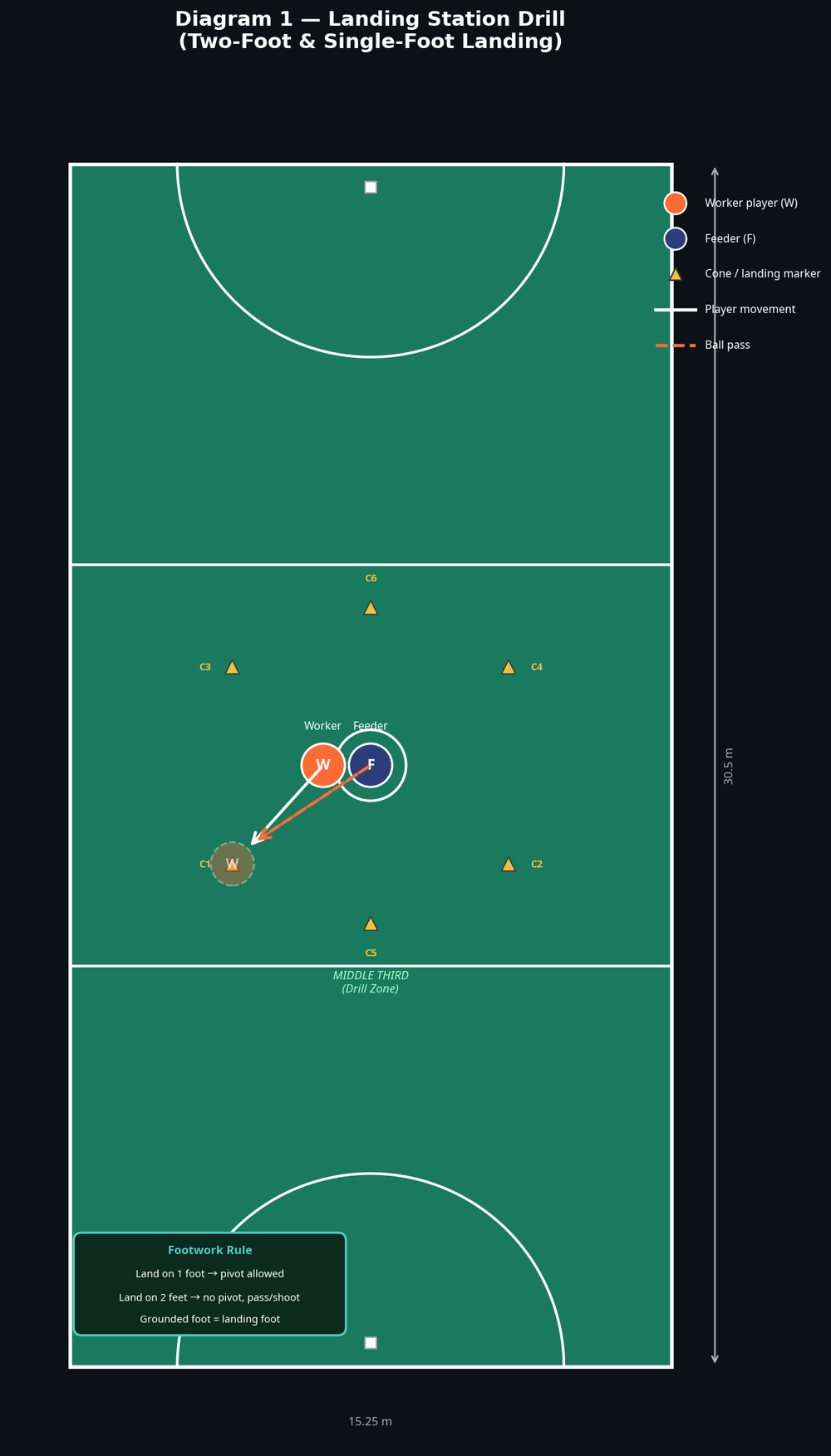
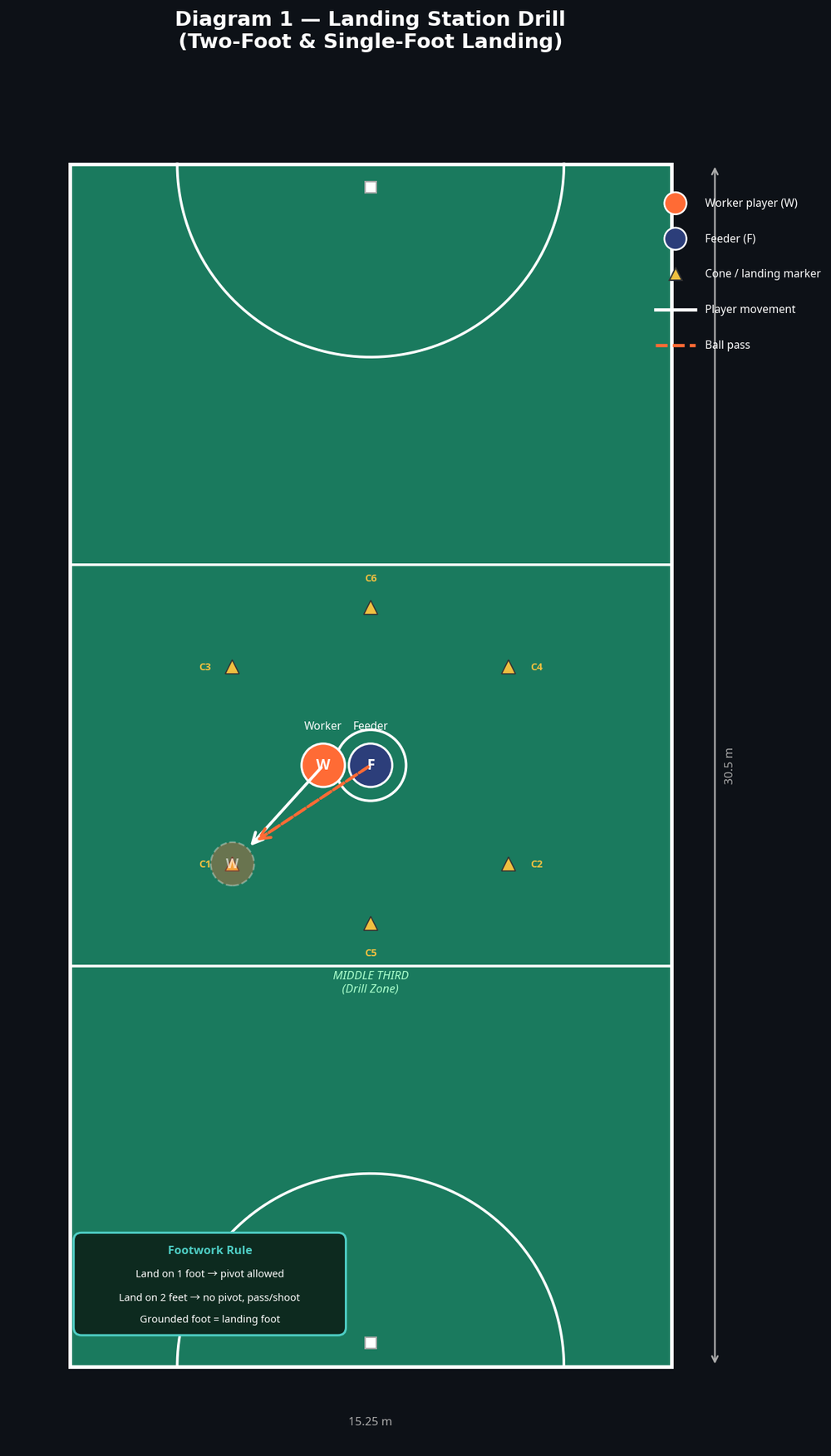
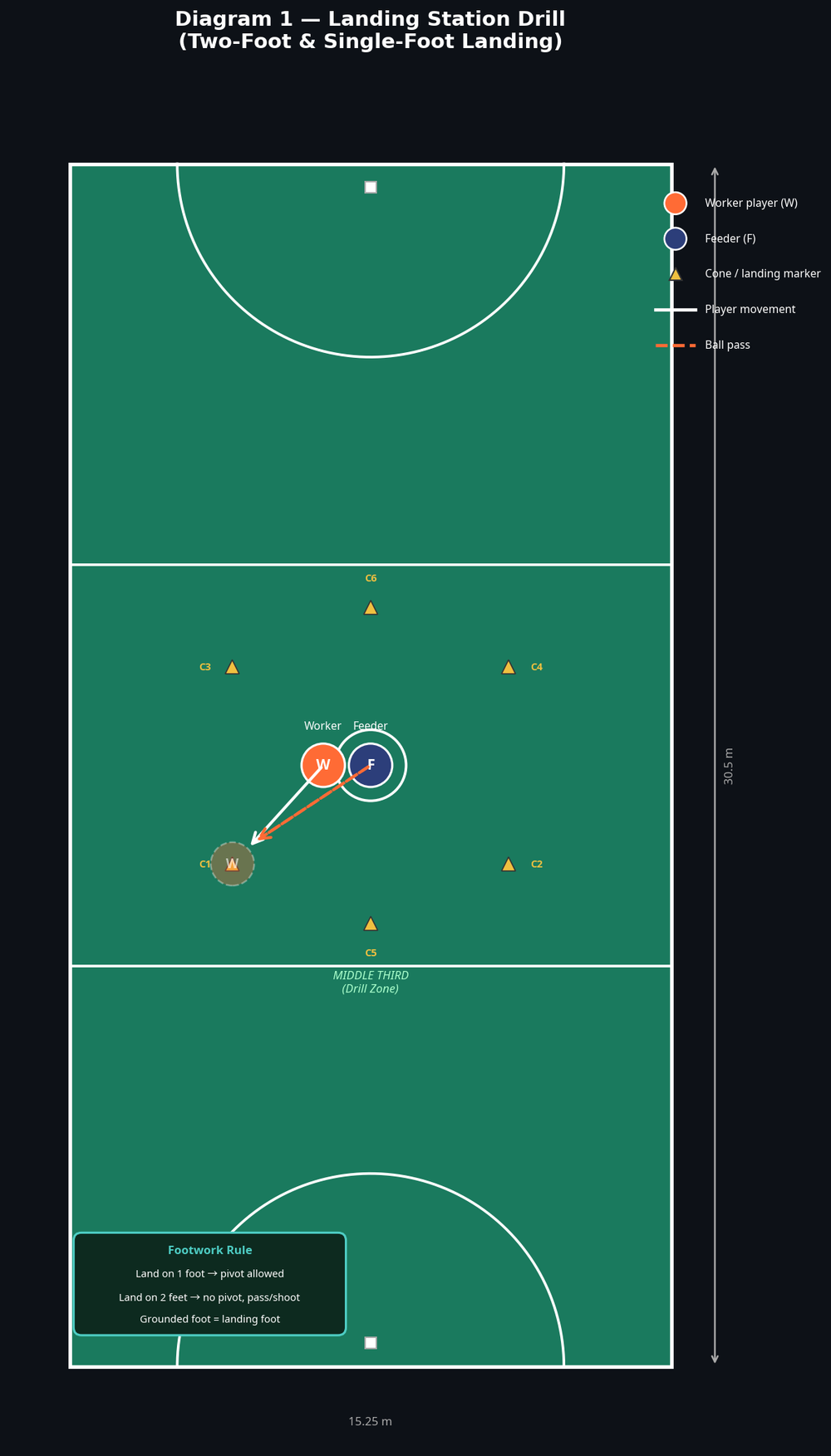
Phase 1: The Landing Station (Diagram 1)
- Positioning: Place the Feeder (F) in the center of the middle third. Set up a semi-circle of 6 cones approximately 3-4 meters away from the Feeder.
- The Drive: The Worker (W) starts 1 meter away from the Feeder. On the Feeder's command, the Worker drives aggressively towards one of the designated cones (e.g., C1).
- The Catch and Land: The Feeder delivers a firm chest pass aimed at the space slightly ahead of the Worker. The Worker must catch the ball in the air and land exactly at the cone.
- The Execution: The Worker executes a clean landing. Alternate between specifying a one-foot landing (landing on the outside foot, then bringing the inside foot down to balance) and a two-foot landing (landing simultaneously on both feet with a wide, stable base).
- The Reset: After holding the balanced landing for a full two seconds, the Worker pivots (if a one-foot landing was used) to face the Feeder, returns the pass, and jogs back to the start. Repeat 10 times before swapping roles.
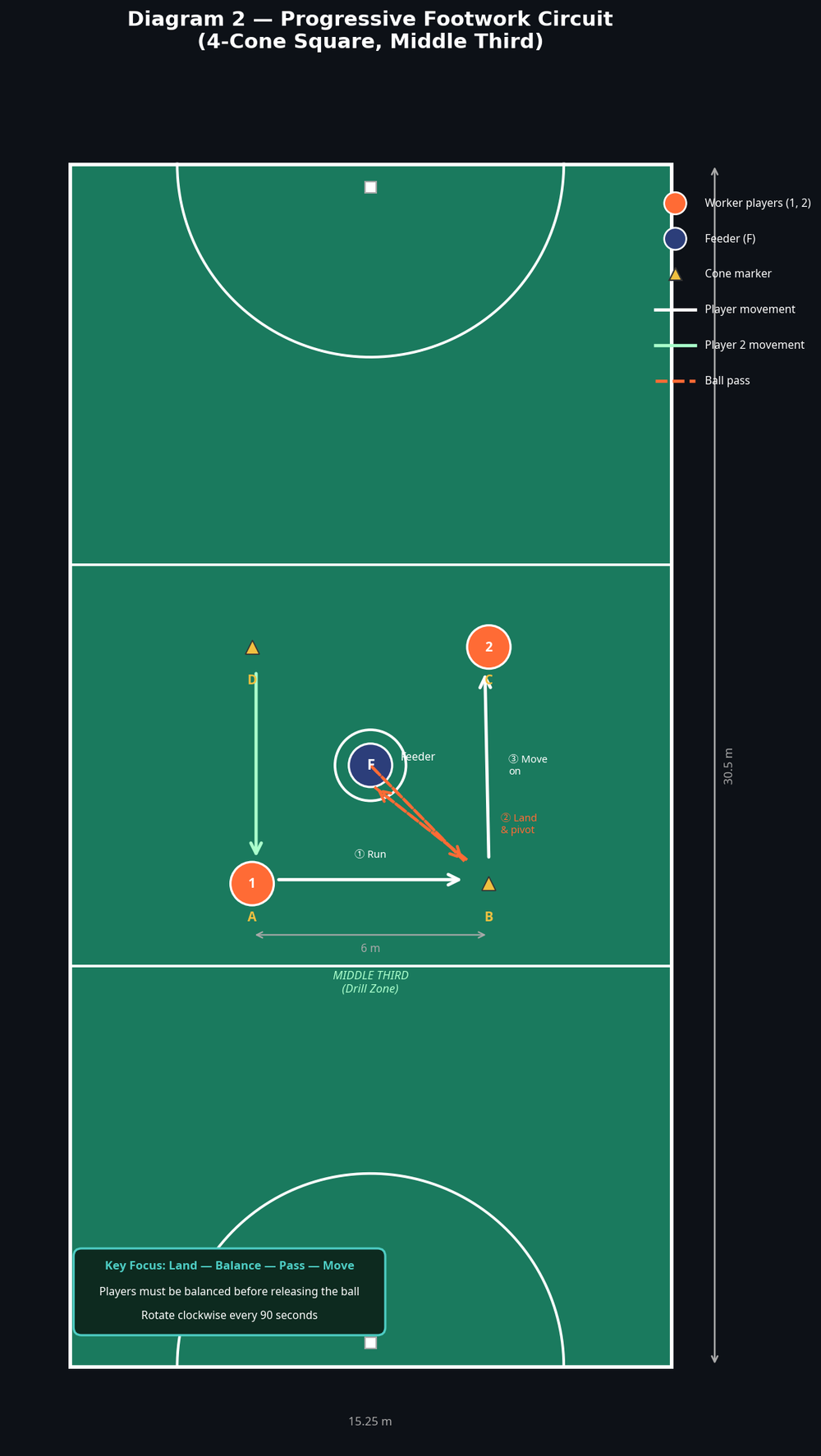
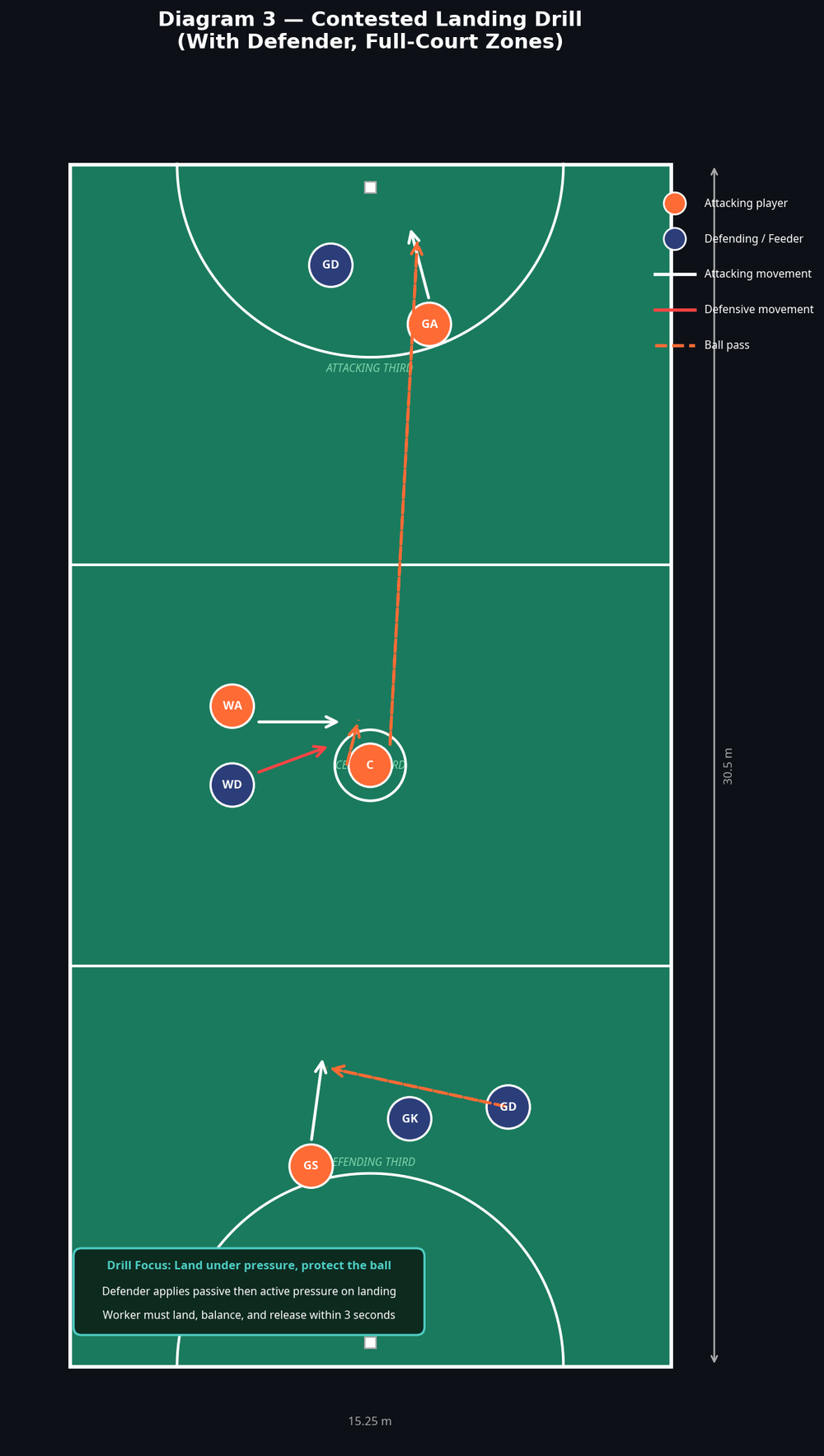
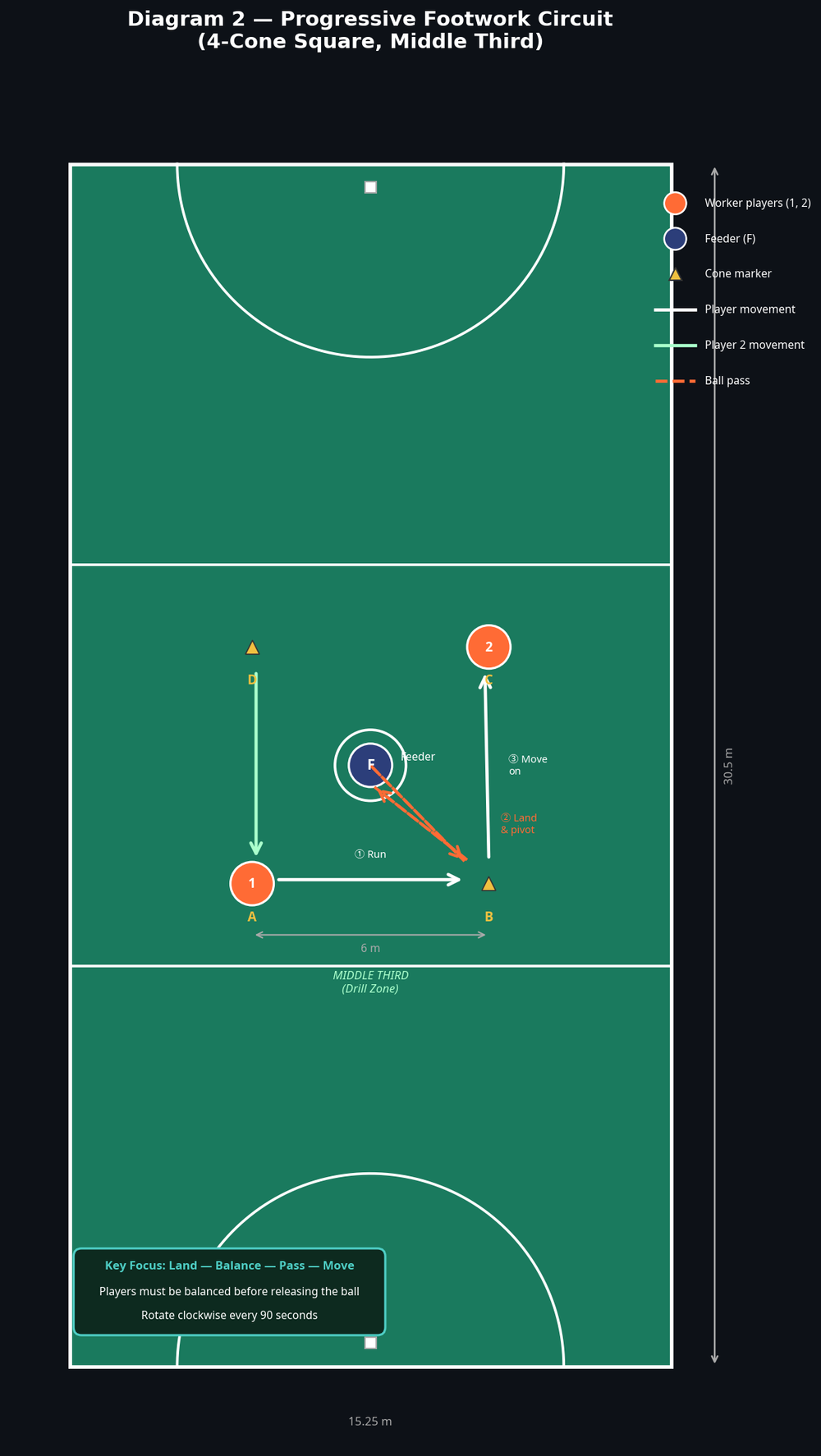
Phase 2: Progressive Footwork Circuit (Diagram 2)
- Square Setup: Create a 6m x 6m square using four cones (A, B, C, D) in the middle third. The Feeder remains in the center.
- Continuous Movement: Player 1 starts at Cone A and drives hard to Cone B.
- Receive and Pivot: The Feeder passes to Player 1 as they arrive at Cone B. Player 1 must execute a strong one-foot landing, grounding their outside foot. They immediately pivot on that grounded foot to face the Feeder.
- Release and Drive: Player 1 passes back to the Feeder and immediately drives to Cone C.
- Rotation: As Player 1 moves to Cone C, Player 2 begins their drive from Cone D to Cone A. Continue this continuous rotation for 90 seconds, emphasizing speed of movement between cones and absolute stillness upon landing.
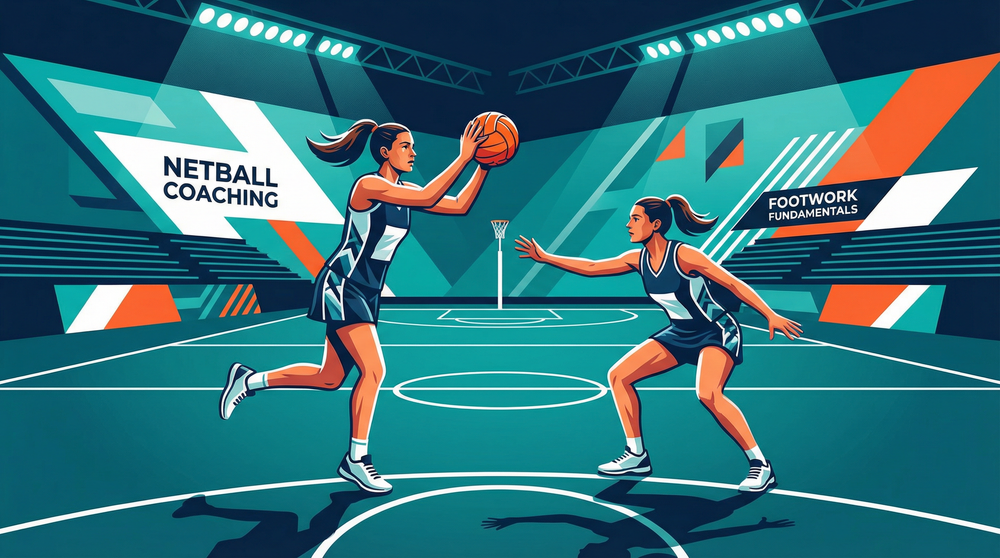
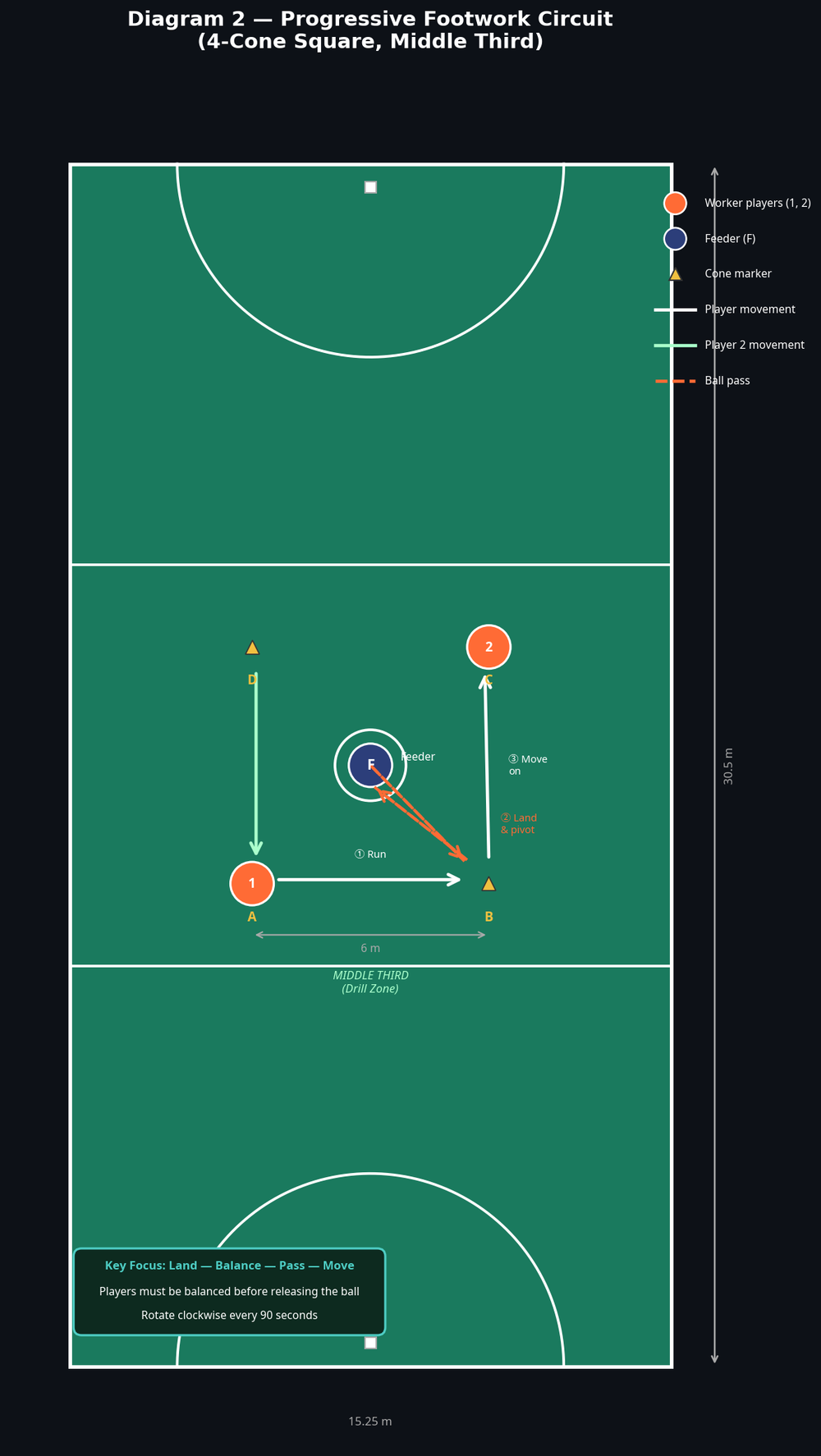
Phase 3: Contested Full-Court Landing (Diagram 3)
- Full Court Integration: Utilize the entire court (30.5m x 15.25m). Set up pairs of Attackers and Defenders in each third (e.g., GS/GK in the goal third, WA/WD in the center third).
- The Contest: A Feeder (e.g., GD) initiates the play. The Attacker (e.g., GS) must use strong preliminary movements to lose their Defender and drive into open space.
- Pressure Landing: The Feeder delivers the pass. The Attacker must focus on catching the ball at the highest point and landing strongly, anticipating physical pressure from the recovering Defender.
- Ball Protection: Upon landing, the Attacker must immediately establish a strong, wide base and use their body to protect the ball from the Defender's reach while scanning for the next pass.
- The Release: The Attacker must execute a clean pass to the next designated receiver within the standard 3-second rule, maintaining balance throughout the release.
4. Key Coaching Points
- Eyes on the Ball: Players must track the ball into their hands before focusing on the landing. Dropped balls often result from looking down at the feet prematurely.
- Strong Core and Base: A balanced landing requires a strong, engaged core. Players should land with feet shoulder-width apart, knees slightly bent to absorb the impact, and chest up.
- The 1-2 Rhythm: For single-foot landings, emphasize the distinct "1-2" auditory rhythm. The first foot grounds firmly, followed quickly by the second foot to establish the base.
- Ground the Pivot Foot: Clearly identify which foot landed first. This foot becomes the pivot foot and must remain glued to the floor until the ball is released.
- Absorb the Impact: Teach players to bend their knees and sink their hips upon landing, rather than landing with stiff, straight legs. This lowers the center of gravity and improves stability.
5. Common Mistakes
- The "Hop" Landing: Players catching the ball and then taking a small hop on both feet. This is a clear stepping violation. Emphasize catching the ball in the air before the feet touch the ground.
- Dragging the Pivot Foot: When pivoting, players often drag their grounded foot rather than rotating purely on the ball of the foot.
- Narrow Base: Landing with feet too close together, resulting in poor balance and making the player vulnerable to being pushed off the ball by a defender.
- Reaching for the Ball: Reaching out to catch the ball while the body weight is still moving backward, making it impossible to establish a forward-driving, balanced landing.
6. Variations & Progressions
- Make it Easier: Remove the ball initially. Have players practice the running, leaping, and landing mechanics without the cognitive load of catching a pass. Add a stationary catch before progressing to a moving catch.
- Make it Harder (Aerial Challenge): The Feeder delivers high, looping passes that require the Worker to jump aggressively, catch the ball at full extension, and land cleanly under control.
- Make it Harder (Defensive Shadow): Introduce a passive defender who shadows the Worker's movements, applying visual pressure and forcing the Worker to protect the ball upon landing.
7. Age Adaptations
- Under 8s / Under 10s: Focus heavily on the "1-2" rhythm and the two-foot "jump stop." Use flat, soft passes. Emphasize the concept of "statue" – freezing completely still once the ball is caught.
- Under 12s / Under 14s: Introduce the pivot. Ensure they understand why they must pivot (to open up the court and protect the ball). Begin adding light, passive defensive pressure.
- Under 16s / Open: High-intensity, continuous movement. Demand absolute precision in the landing mechanics even when fatigued. Integrate contested, full-court scenarios with active, physical defense.
