

Football
Mastering the Goal Kick Build-Up: A Modern Approach
Learn how to structure your team to confidently play out from the back, beat the high press, and transition smoothly into attack.
What you need
Full-size pitch, 10+ footballs, Cones/markers, Training bibs
1. Overview
Playing out from the back has become a fundamental aspect of modern football. This set play focuses on establishing a structured, numerical advantage deep in your own half during a goal kick. By drawing the opposition forward, your team can exploit the space left behind their pressing lines. This routine is ideal when facing a team that commits players forward to press high, allowing you to transition from defence to attack with control and purpose.
2. Setup
Equipment Needed:
- Full-size or age-appropriate pitch (e.g., 100-110m x 64-75m for seniors)
- Minimum 10 footballs in the goal to ensure quick restarts
- Cones or markers (optional, for visual reference zones during practice)
- Bibs for two distinct teams (if running as a phase of play)
Player Positions & Pitch Setup:
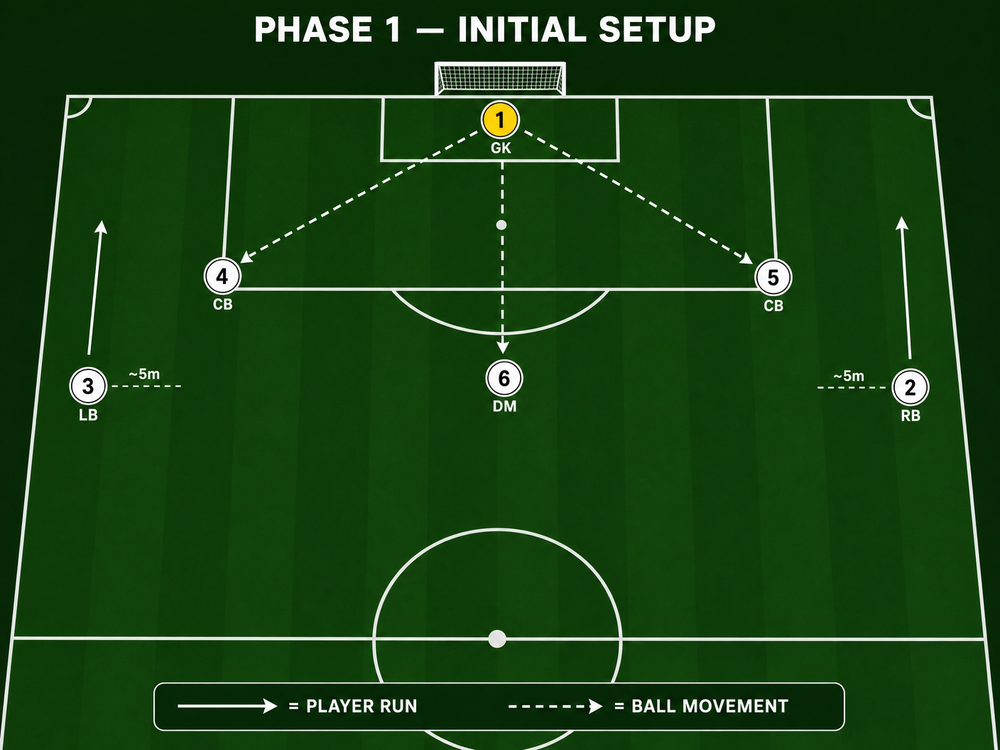
- Goalkeeper (1): Positioned centrally with the ball inside the 6-yard box.
- Centre-Backs (4 & 5): Split wide, dropping to the edge of the 18-yard penalty area.
- Full-Backs (2 & 3): Pushed higher and wider, approximately 5-10 metres outside the penalty box, hugging the touchlines.
- Defensive Midfielder (6): Positioned centrally, about 10 metres outside the penalty area, acting as the primary pivot.
- Central Midfielders (8 & 10): Occupying the half-spaces higher up the pitch to offer progressive passing options.
- Forwards (9 & 11): Pinned high to stretch the opposition defence and create depth.
3. Step-by-Step Instructions
Phase 1: The Initial Setup and Trigger
- The Goalkeeper (1) places the ball centrally in the 6-yard box, signaling the start of the play.
- The Centre-Backs (4 & 5) immediately split to the edges of the penalty area, creating maximum width at the back.
- The Defensive Midfielder (6) drops into the central pocket, offering a short, direct passing lane.
- The Trigger: The GK assesses the opposition's press. If the opposition striker splits the CBs, the GK plays directly to the DM (6). If the opposition presses the DM, the GK plays to the open CB (4 or 5).
Phase 2: Beating the First Line of Pressure
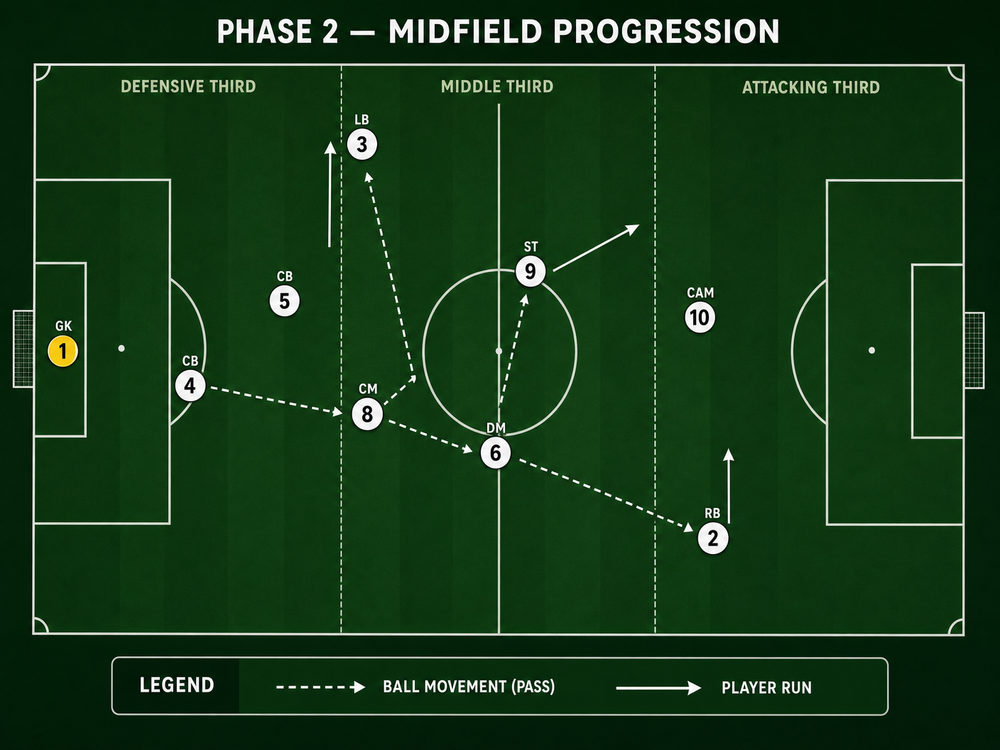
- Assuming the ball is played to the Left Centre-Back (4).
- As CB (4) receives, the Left-Back (3) pushes higher up the flank to drag the opposing winger wide.
- The Central Midfielder (8) drops into the left half-space to create a passing triangle with CB (4) and DM (6).
- CB (4) has three primary options: a line-breaking pass to CM (8), a safe pass to DM (6) to switch play, or a wide pass to LB (3) if the channel is open.
Phase 3: Progression and Attacking Transition
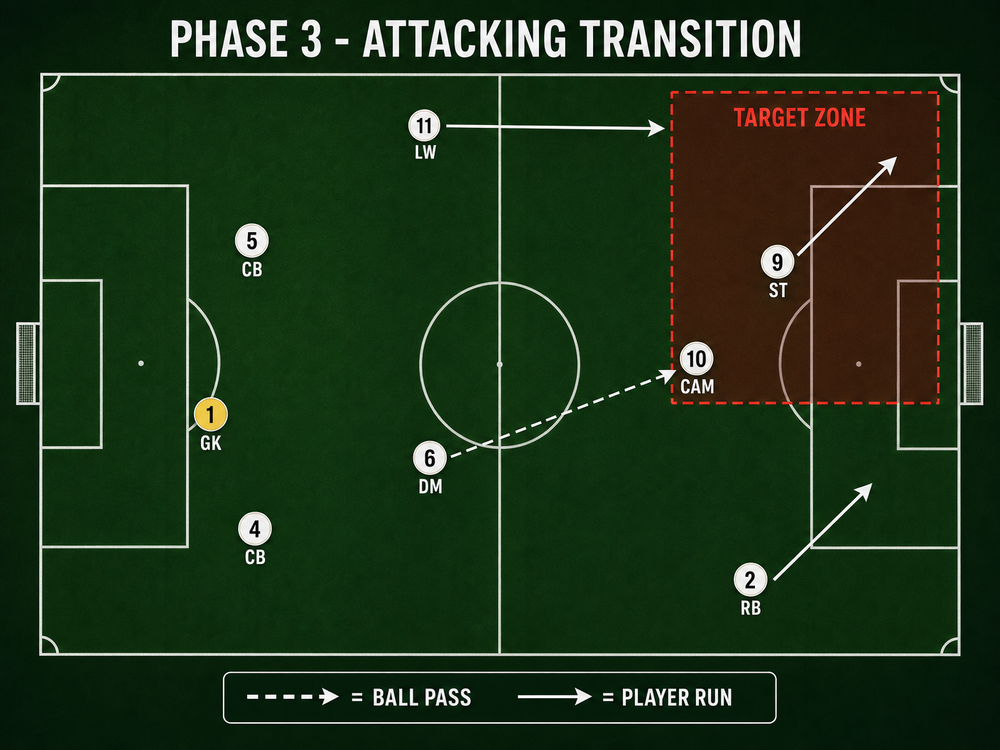
- The ball is progressed to the central pivot, DM (6).
- Upon receiving, DM (6) turns and looks forward. The Attacking Midfielder (10) drops slightly into the pocket to receive between the lines.
- Simultaneously, the Striker (9) makes a diagonal run behind the opposition's defensive line, exploiting the space created by the high press.
- The Wingers/Full-Backs make overlapping runs to provide width.
- DM (6) plays a penetrative pass to CAM (10) or directly into the path of ST (9) in the target zone.
4. Key Coaching Points
- Body Shape and Awareness: Players receiving the ball (especially the CBs and DM) must adopt an open body shape to see the whole pitch and play forward quickly.
- Patience in Possession: Do not force the forward pass if it isn't there. Circulate the ball between the GK and CBs to draw the press before exploiting the gaps.
- Weight of Pass: Passes in the defensive third must be crisp and played to the correct foot (usually the back foot) to allow the receiver to turn away from pressure.
- Movement Off the Ball: Midfielders must constantly adjust their positioning to create passing triangles and offer support angles.
- The Goalkeeper as an Outfield Player: The GK must be comfortable with the ball at their feet and act as the crucial +1 in the build-up.
5. Common Mistakes
- Static Midfielders: Midfielders hiding behind opposition players instead of actively seeking space to receive.
- Playing Blind Passes: Defenders clearing the ball out of panic or playing passes without scanning, leading to immediate turnovers in dangerous areas.
- Full-Backs Dropping Too Deep: If the FBs drop too close to the CBs, it congests the space and makes it easier for the opposition to press effectively.
- Poor First Touch: A heavy first touch in the defensive third is the biggest trigger for an opposition press.
6. Variations & Progressions
- Variation 1 (The False Full-Back): Instead of staying wide, one Full-Back inverts into central midfield alongside the DM, creating a double pivot and overloading the central areas.
- Variation 2 (Direct to the Target Man): If the opposition commits to a man-to-man high press, bypass the midfield entirely. The GK plays a clipped, driven pass directly to the Striker (9) who drops deep to hold up play, while midfielders run off them.
- Progression 1: Introduce a time limit (e.g., 8 seconds) for the team to progress the ball out of the defensive third into the middle third.
- Progression 2: Add an overload of attackers (e.g., 6 attackers vs 4 defenders) pressing the build-up to increase the difficulty and pressure.
7. Age Adaptations
- Under 8 - Under 10: Focus heavily on the technical basics: receiving on the back foot and accurate passing. Simplify the setup to just GK, 2 CBs, and 1 central player. Encourage bravery on the ball.
- Under 12 - Under 14: Introduce the concept of passing triangles and the role of the pivot (DM). Begin teaching the triggers for when to play short vs. when to clear.
- Under 16 - Open: Full tactical implementation. Focus on manipulating the opposition's pressing structures, complex rotations (like inverting full-backs), and high-speed transitions.
