

Rugby
Mastering the Low Tackle: Body Height and Technique Drill
Equip your players with the essential skills to safely and effectively execute low tackles, focusing on proper body height, strong shoulder contact, and dominant leg drive.

What you need
4-6 Orange cones, 2-3 Rugby balls, Tackle shields (optional)
1. Overview
The modern game of Rugby demands precise tackle technique, not only for defensive dominance but crucially for player safety. With the global emphasis on lowering the tackle height to reduce the risk of head impacts, coaches must prioritize drills that instill the muscle memory for low, driving tackles. This drill is designed to isolate the key components of the tackle—specifically dropping body height, making strong shoulder contact below the sternum, and finishing with an aggressive leg drive. It is an essential progression for players of all levels, from grassroots to senior rugby, ensuring they can confidently execute tackles in tight channels and open play.
2. Setup
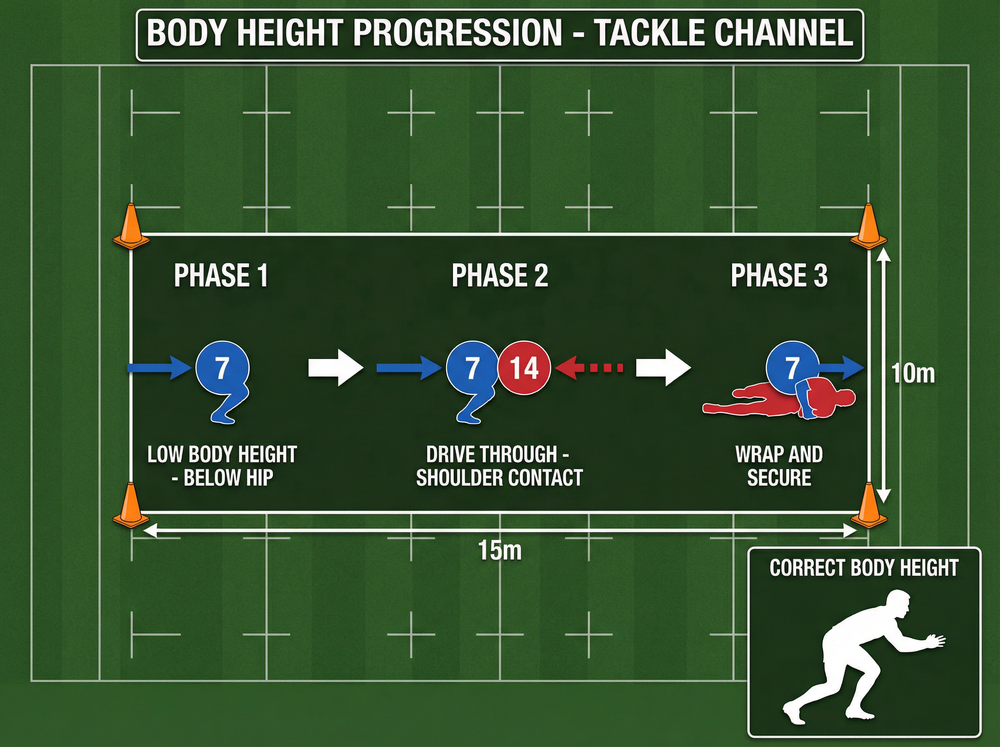
To run this drill effectively, you will need a designated area on the pitch, ideally a 100m x 70m pitch, though a smaller section will suffice. Set up a 20m x 15m grid using orange cones to define the boundaries. This creates a realistic channel that mimics the constraints of a match situation.
Equipment Needed:
- 4-6 Orange cones to mark the grid
- 2-3 Rugby balls
- Tackle shields or hit shields (optional for early progressions)
Player Positions:
Divide your players into attackers and defenders.
- Attackers (e.g., Number 14, 15): Positioned at one end of the grid with a ball.
- Defenders (e.g., Number 6, 7, 8): Positioned opposite the attackers, starting 5 meters apart in a defensive line.

3. Step-by-Step Instructions
- Starting Positions: The attackers start at the top of the grid with the ball. The defenders line up opposite them, ensuring they are evenly spaced and maintaining a flat defensive line.
- The Approach: On the coach's whistle, the designated attacker (e.g., Number 14) runs forward into the tackle zone. The defender (e.g., Number 7) steps up to meet the attacker, focusing on closing the space quickly but under control.
- Dropping Body Height: As the defender approaches the tackle zone, they must drop their body height significantly. The hips should sink, knees bend, and the back must remain straight. The target area is strictly below the attacker's sternum, ideally around the waist or thighs.
- Making Contact: The defender drives forward, making initial contact with the shoulder (the 'ring of steel'). The head must be positioned on the correct side (behind or to the side of the attacker's body, never across the front).
- The Wrap and Drive: Immediately upon shoulder contact, the defender's arms must wrap tightly around the attacker's legs. The defender then utilizes a powerful leg drive to take the attacker to the ground, finishing on top to dominate the tackle area.
- Reset and Rotate: Once the tackle is completed, both players quickly return to their feet. Rotate the attackers and defenders so everyone gets repetitions on both sides of the ball.

4. Key Coaching Points
- Eyes on the Target: Defenders must keep their eyes open and focused on the target area (waist/thighs) throughout the approach and contact.
- Cheek to Cheek: Emphasize the 'cheek to cheek' principle—the tackler's cheek should be tight against the ball carrier's shorts/thigh to ensure the head is in a safe position.
- Strong Core and Straight Back: A strong, straight back is vital for transferring power and protecting the spine during the collision.
- Punch the Arms: The arm wrap must be aggressive. Cue players to 'punch' their arms around the ball carrier to secure the legs tightly.
- Relentless Leg Drive: The tackle doesn't end at contact. Players must continue to pump their legs to drive the ball carrier backward or straight to the ground.
5. Common Mistakes
- Hinging at the Waist: Players often bend at the waist rather than dropping their hips, leading to a weak tackling position and a rounded back.
- Head in the Wrong Position: Placing the head across the ball carrier's body is a major safety risk and a common error that must be corrected immediately.
- Arm Tackling: Relying solely on the arms to bring the player down without using shoulder contact or leg drive.
- Planting Feet: Stopping the feet before contact, which results in absorbing the tackle rather than dominating it.
6. Variations & Progressions
- Progression 1: Walking Pace. Start the drill at a walking pace to focus entirely on the mechanics of body height, head placement, and the wrap. This is crucial for building confidence, especially in younger or less experienced players.
- Progression 2: Tackle Shields. Introduce tackle shields for the attackers to hold. This allows defenders to practice hitting with full force and practicing their leg drive without the risk of full player-on-player contact.
- Variation 1: Multi-Directional Attack. Instead of the attacker running straight, have them step left or right just before the tackle zone. This forces the defender to adjust their feet, maintain their low body height, and track the moving target.
7. Age Adaptations
- Under 8 - Under 10: Focus heavily on the 'hug' tackle. Emphasize getting low, wrapping arms tightly, and falling safely. Avoid high-impact collisions and prioritize the fun and safety aspects of the movement.
- Under 12 - Under 14: Introduce more dynamic movement. Focus on the approach speed, footwork before contact, and the transition from the wrap to the leg drive. Ensure head placement is consistently correct.
- Under 16 - Open: Run the drill at full match intensity. Incorporate decision-making elements, such as the attacker having the option to pass or step, forcing the defender to read the play while maintaining impeccable technique.
