

Football
Mastering Possession: The Ultimate 6v2 Rondo Drill
Develop your team's passing speed, spatial awareness, and quick decision-making under pressure with this essential 6v2 Rondo progression.

What you need
4 cones, Training bibs (2 colors), Supply of footballs
1. Overview
The Rondo is the foundational building block of possession-based football. While often seen merely as a warm-up, a properly structured Rondo teaches players critical habits: receiving on the back foot, identifying passing lanes, playing one-touch under pressure, and quick defensive transitions. The 6v2 format provides a significant numerical advantage (overload) for the attacking team, allowing them to focus on ball speed and combination play, while demanding intense, coordinated pressing from the two defenders.
2. Setup
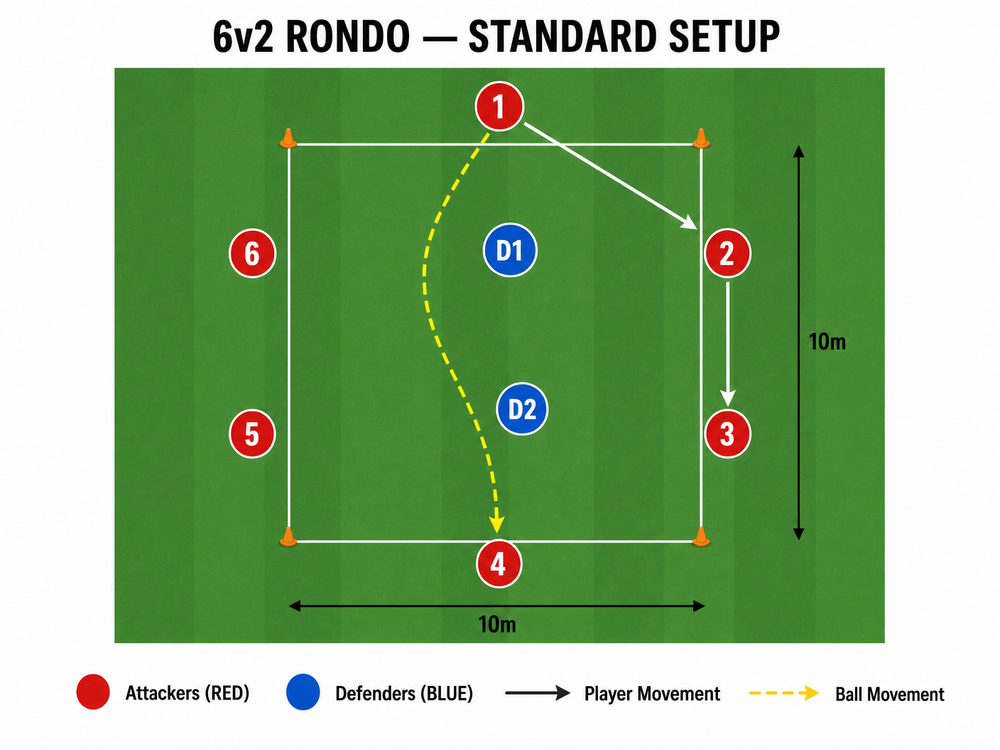
- Pitch Dimensions: 10m x 10m grid (adjust based on age and ability).
- Players: 8 players total (6 attackers, 2 defenders).
- Equipment: 4 cones to mark the grid corners, bibs for defenders (e.g., blue), and an ample supply of footballs with the coach to keep the drill flowing.
- Positions: Attackers are positioned on the perimeter (two on each long side, one on each short side). Defenders start inside the grid.
3. Step-by-Step Instructions
- Start the Play: The coach feeds a ball to one of the attacking players on the perimeter to initiate the drill.
- Possession Objective: The 6 attackers must maintain possession by passing the ball around the outside of the grid. They are limited to a maximum of two touches (progressing to one touch as quality improves).
- Defensive Objective: The 2 defenders inside the grid must work together to intercept the ball or force a mistake (a pass out of bounds).
- Transition: If a defender wins the ball or forces an error, the attacker who made the mistake switches roles with the defender who won it.
- Scoring System: Attackers score a point for completing 10 consecutive passes. Defenders score a point for winning possession.
4. Key Coaching Points
- Body Shape & Receiving: Attackers must open their bodies to the pitch, receiving on the back foot to ensure they can see the whole grid and play forward quickly.
- Ball Speed & Weight of Pass: Passes must be firm and accurate. Slow passes allow the defenders to shift and press effectively.
- Support Angles: Players adjacent to the ball carrier must provide clear, immediate passing options, constantly adjusting their positioning as the ball moves.
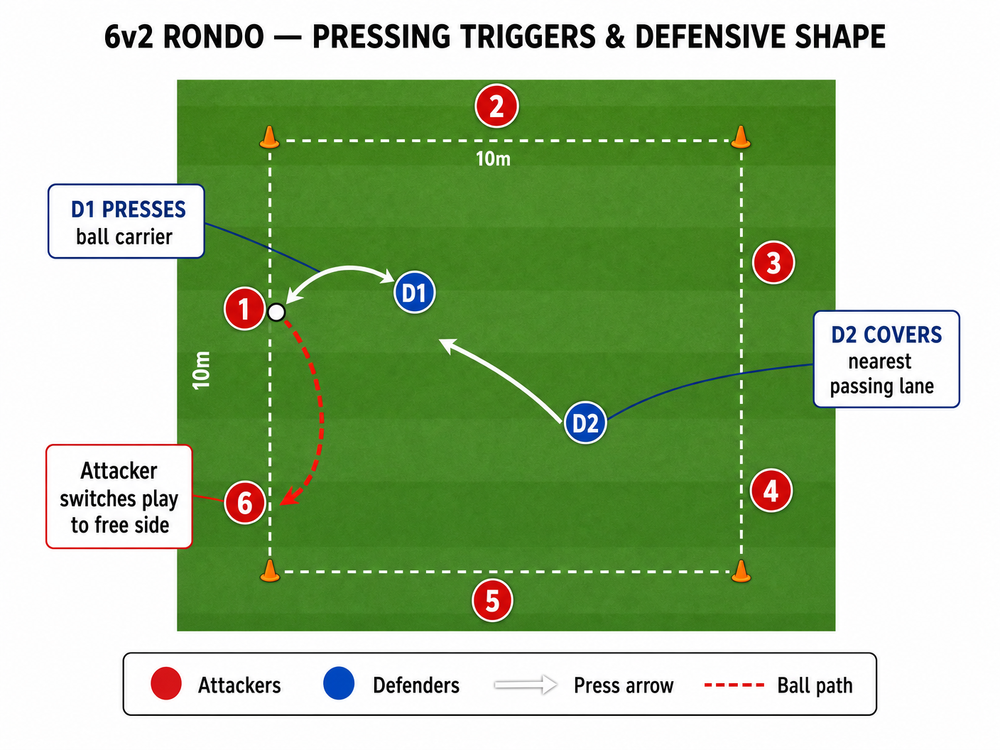
- Defensive Coordination (The Press): D1 must aggressively press the ball carrier to force the play one way, while D2 covers the most dangerous passing lane.
5. Common Mistakes
- Static Positioning: Attackers standing flat-footed instead of being on their toes and making subtle movements to create passing angles.
- Poor First Touch: Taking a touch that kills the ball dead or goes into the defender's path, rather than a directional touch away from pressure.
- Defending as Individuals: Defenders chasing the ball randomly rather than working as a cohesive unit.
- Silence: Lack of communication among attackers (calling for the ball, giving instructions like 'man on' or 'turn').
6. Variations & Progressions
- Touch Restrictions: Reduce the attackers to one-touch play only.
- Split Pass Reward: Award extra points if the attackers successfully play a pass that splits the two defenders.
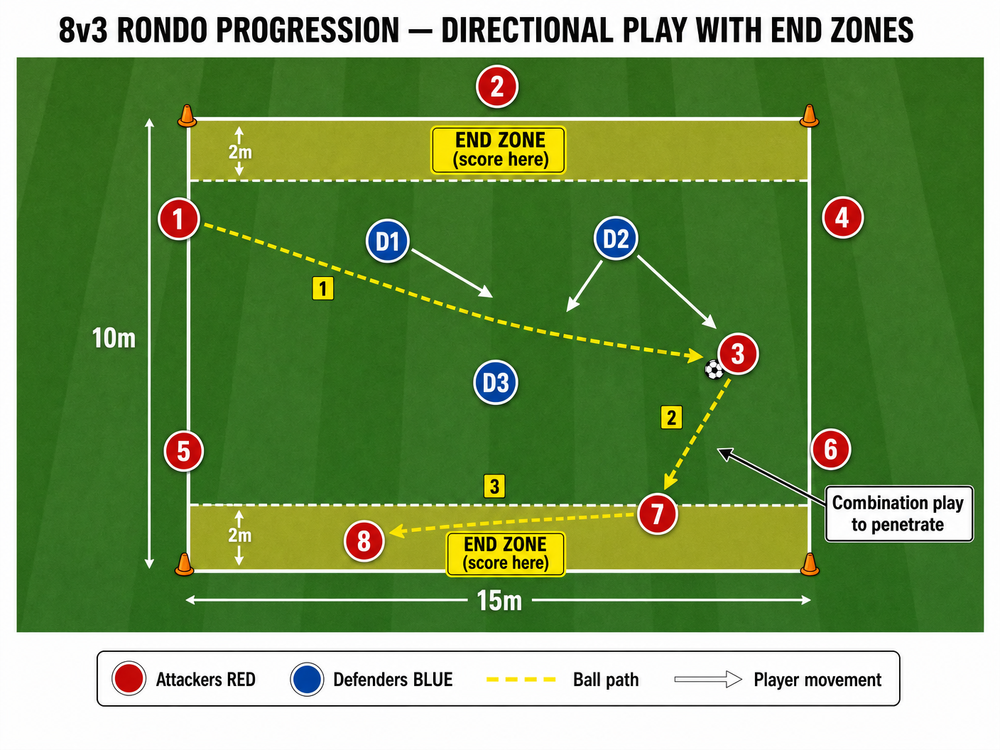
- Directional Rondo (8v3 with End Zones): Expand the grid to 15m x 10m. Play 8v3 with small end zones to introduce directional intent.
7. Age Adaptations
- Under 8–10: Increase grid to 12–15m. Allow unlimited touches. Focus on basic passing and receiving technique.
- Under 12–14: Standard 10m x 10m. Introduce two-touch restriction. Emphasise body shape and defensive coordination.
- Under 16–Open: Reduce grid to 8m x 8m. Enforce one-touch rules. Demand high intensity and rapid transitions.
