

Football
Mastering the Rondo: High-Intensity Possession & Pressing Drill
A fundamental possession drill that teaches players how to keep the ball under pressure, recognize passing lanes, and execute quick transitions.
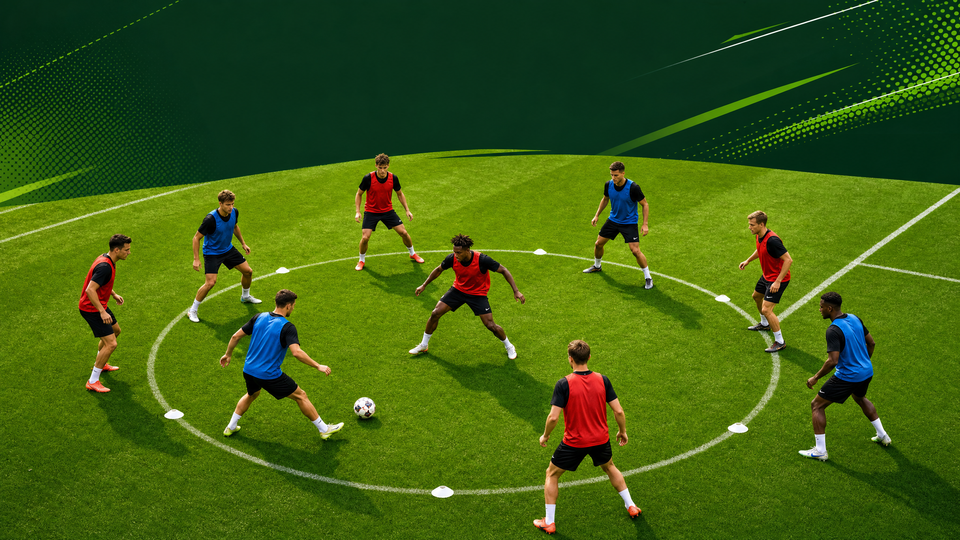
What you need
8-10 Cones or flat markers, 4-5 Footballs, Training bibs (2 colors)
1. Overview
The Rondo is the cornerstone of modern possession-based football. Popularized by Johan Cruyff and Pep Guardiola, it is far more than just a warm-up exercise. This drill forces players to make rapid decisions under pressure, improves first-touch passing, and teaches the fundamental concepts of positional play (Juego de Posición). For defenders, it provides intense, game-realistic pressing scenarios where they must work in tandem to cut off passing lanes.
By running this drill consistently, you will see a dramatic improvement in your team's ability to retain the ball in tight spaces, switch the point of attack, and transition instantly when possession is lost or won.
2. Setup
Equipment Needed:
- 8-10 Cones or flat markers
- 1 Football (have 3-4 spare balls ready on the outside to maintain intensity)
- Training bibs in two distinct colors (e.g., 6 Red, 2 Yellow)
Pitch Dimensions:
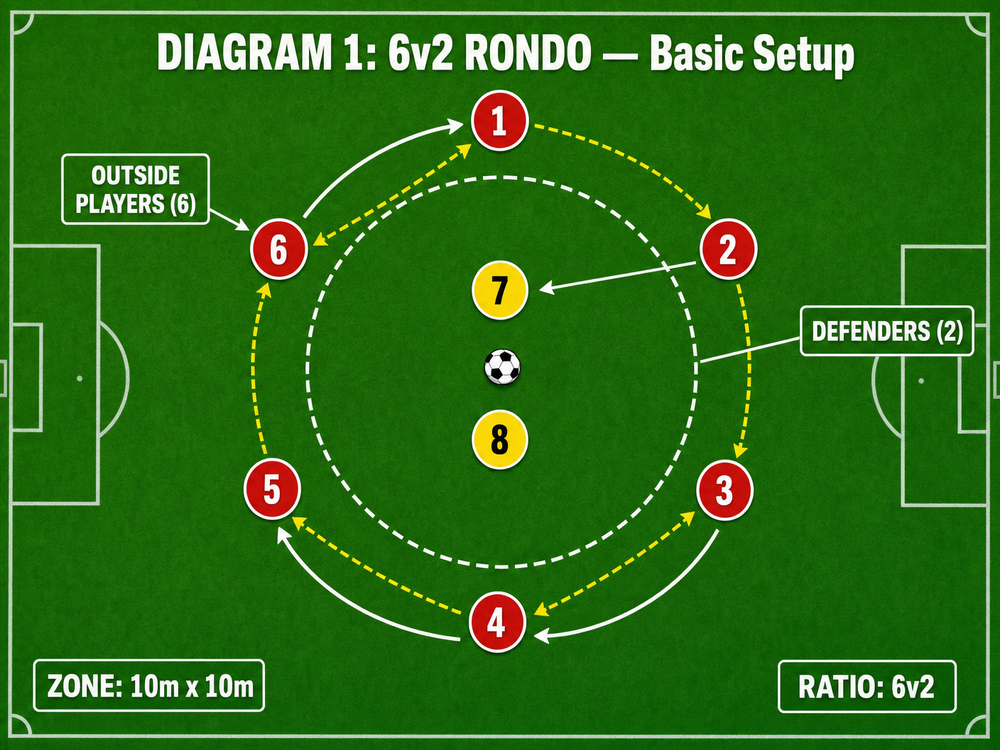
- For a standard 6v2 Rondo, create a 10m x 10m grid or a 10m diameter circle.
- Adjust the size based on player ability: larger for beginners (12m x 12m) to allow more time on the ball, tighter for advanced players (8m x 8m) to increase the challenge.
Player Positions:
- 6 attacking players position themselves on the perimeter of the grid.
- 2 defending players start inside the grid.
3. Step-by-Step Instructions
- Starting the Drill: The coach plays a ball into one of the perimeter players to begin the exercise. The objective for the outside players is to maintain possession by passing the ball around or through the grid.
- The Press: The two inside defenders must immediately press the ball carrier. One defender should apply direct pressure while the second defender covers the passing lanes, particularly the splitting pass through the middle.
- Pass Restrictions: Depending on the level, limit the outside players to one or two touches. This forces players to scan the field before receiving the ball.
- Turnover Transition: If a defender intercepts the ball, wins a tackle, or forces the ball out of play, they swap places with the player who lost possession (and that player's teammate, if playing in pairs).
- Intensity Maintenance: If the ball goes out of bounds, the coach immediately feeds a new ball in to keep the tempo high and prevent rest periods.
4. Key Coaching Points
- Body Shape and First Touch: Players must receive the ball on their back foot with an open body shape, allowing them to see the entire grid and play the ball quickly to either side.
- Passing Speed and Accuracy: Passes should be punched in with pace. A slow pass allows the defenders to shift and intercept. Passes must be to the correct foot (the one furthest from the defender).
- Angles of Support: Perimeter players must constantly adjust their positioning to provide clear passing lanes. The player on the ball should always have at least two immediate options (left and right) and ideally a third (the splitting pass).
- Defensive Coordination: The two defenders must work as a unit. The first defender dictates the play by forcing the ball one way, while the second defender anticipates the next pass and cuts off the central channel.
- Anticipation (Scanning): Players must constantly check their shoulders and scan the area before the ball arrives, so they already know their next action.
5. Common Mistakes
- Standing Flat-Footed: Outside players standing still after making a pass. They must constantly move to recreate passing angles.
- Closing the Body: Receiving the ball facing the outside of the grid, which limits passing options and invites pressure.
- Individual Pressing: Defenders chasing the ball individually rather than pressing as a coordinated pair, leaving massive gaps through the middle.
- Lack of Communication: Silence on the pitch. Players must demand the ball, communicate pressure (e.g., "Man on!", "Time!"), and direct the defenders.
6. Variations & Progressions
- The Split Pass Reward: To encourage progressive passing, award an extra point or force the defenders to stay in for an extra turn if the attacking team successfully plays a pass that splits the two defenders.
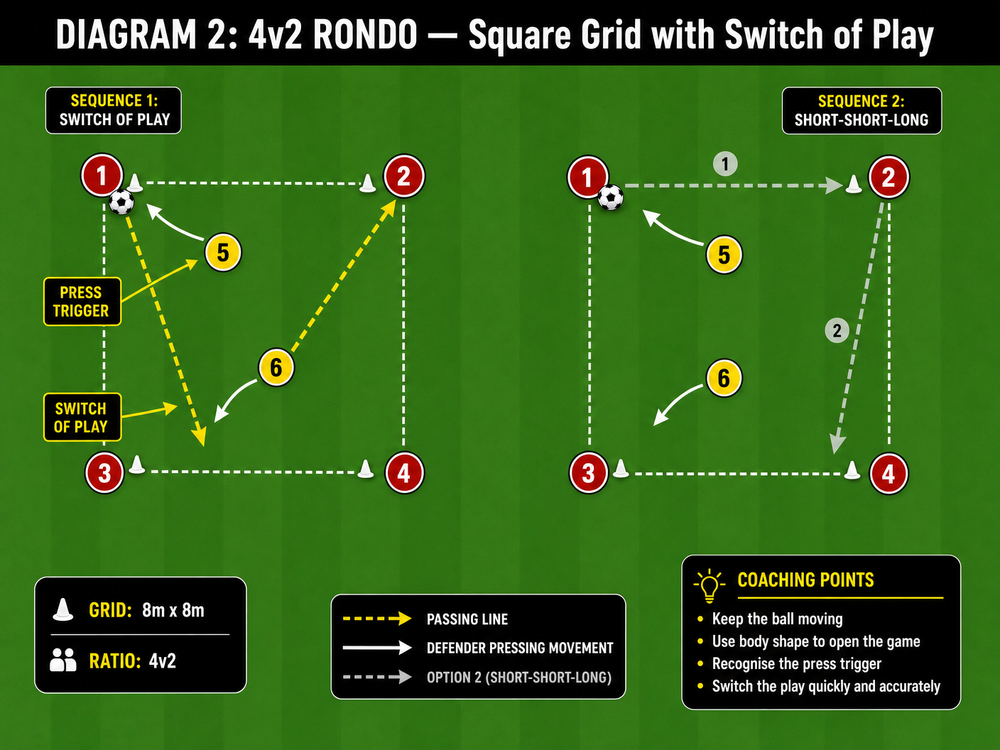
- 4v2 Square Grid: Reduce the numbers to 4v2 in an 8m x 8m square. This increases the physical demand on the attackers and emphasizes the "short-short-long" passing pattern to switch play.
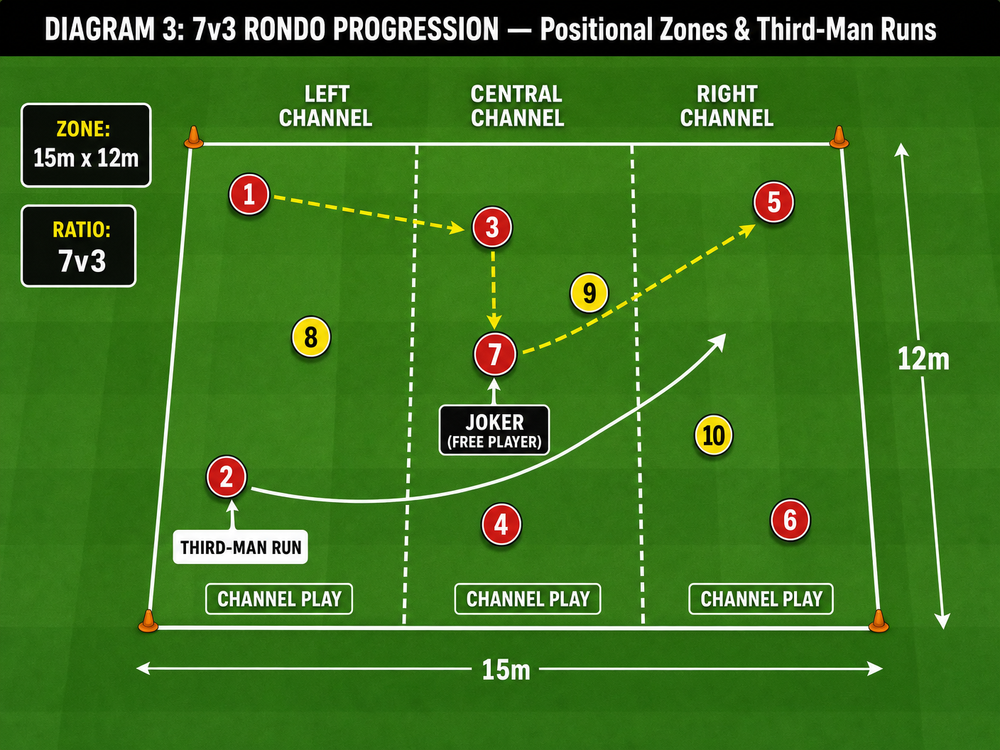
- 7v3 Positional Rondo: Create a larger 15m x 12m grid divided into three channels. Introduce a 'Joker' (neutral player) who always plays for the team in possession. This variation focuses on breaking lines, third-man runs, and positional discipline.
7. Age Adaptations
- Under 8s - Under 10s: Focus on a 4v1 or 5v1 setup in a larger area (12m x 12m). Allow unlimited touches. The main goal is basic passing mechanics and understanding the concept of keeping the ball away from the defender.
- Under 12s - Under 14s: Introduce the 5v2 or 6v2 format. Implement a two-touch limit. Focus heavily on body shape, scanning, and the defensive pressing trigger.
- Under 16s - Open (Adult): Play 4v2 or advanced positional rondos (7v3, 8v2). Strict one or two-touch limits. High intensity, rapid transitions, and complex tactical concepts like third-man combinations and switching the point of attack.
