

Netball
Mastering the Wing Attack (WA) Feeding Patterns
Develop your Wing Attack's ability to dominate the attacking third with precise leads, sharp changes of direction, and perfectly timed feeds into the goal circle.

What you need
2-3 Netballs, Bibs (2 sets of contrasting colors), 4-6 Marker Cones, 1 Netball Goal Post
1. Overview
The Wing Attack (WA) is the primary playmaker in the attacking third. Their ability to transition the ball smoothly from the centre third and deliver perfectly weighted passes to the shooters dictates the flow of the game. This comprehensive drill focuses on developing the WA's spatial awareness, timing, and passing execution under pressure. It simulates game-like scenarios where the WA must execute strong leads, re-offers, and precise feeds into the goal circle while reading the movements of the Goal Attack (GA) and Goal Shooter (GS).
By running this drill, coaches will help their WA players understand how to dictate the pace of the attack, use the full width of the court, and create high-percentage scoring opportunities. The drill emphasizes the crucial connection between the midcourt and the shooting circle, ensuring that the transition of the ball is seamless and effective.
2. Setup
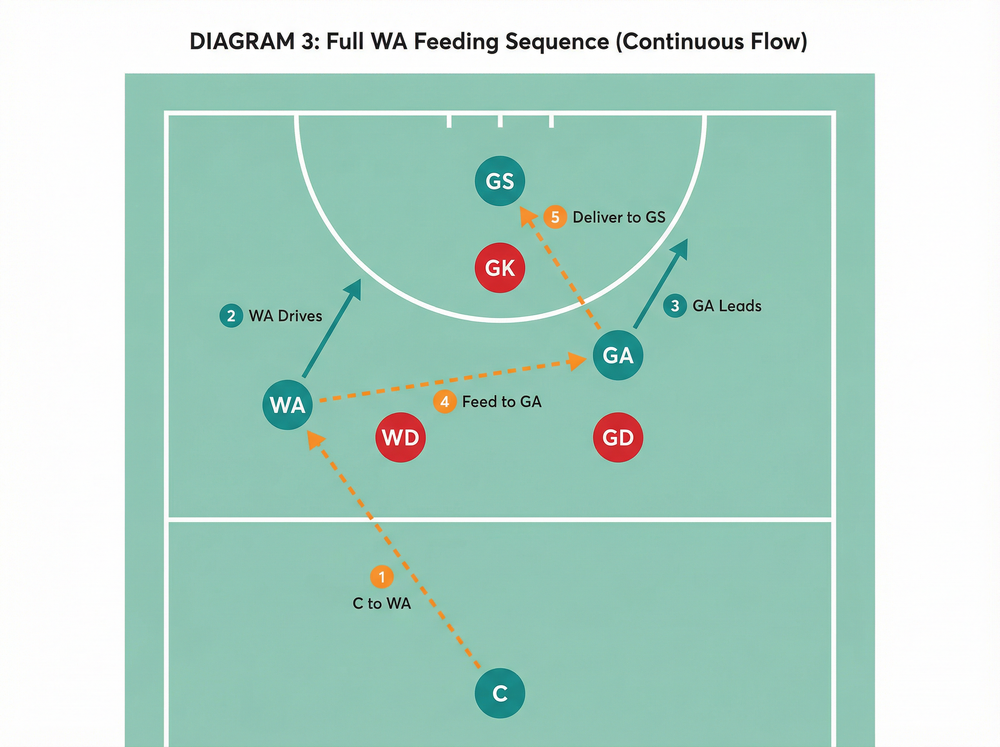
To run this drill effectively, you will need the following setup:
- Court Space: One full attacking third, including the transverse line and the goal circle (30.5m x 15.25m total court area).
- Equipment: 2-3 netballs, bibs for all active players, and 4-6 marker cones to designate starting positions and movement zones.
- Players Required: Minimum of 6 players (1x Centre [C], 1x Wing Attack [WA], 1x Goal Attack [GA], 1x Goal Shooter [GS], and 2x Defenders [WD/GD]).
- Starting Positions:
- Place the C just behind the transverse line in the centre third.
- Position the WA on the left side of the attacking third, ready to receive the centre pass or transition ball.
- Set up the GA near the top of the goal circle, slightly to the right.
- Place the GS deep inside the goal circle, near the post.
- Position the defenders (WD and GD) marking the WA and GA, respectively.
3. Step-by-Step Instructions
Follow these sequential steps to execute the WA Feeding Patterns drill:

Phase 1: The Initial Drive and Re-offer
- The drill begins with the C in possession of the ball at the transverse line.
- The WA executes a strong, diagonal drive (Drive 1) toward the top of the goal circle to receive the pass from the C. The WD applies passive pressure.
- If the initial drive is covered, the WA must quickly change direction, pushing off their outside foot to execute a sharp 'Lead Back' toward the transverse line or sideline to create space.
- The C delivers a crisp, flat pass to the WA as they hit the open space.
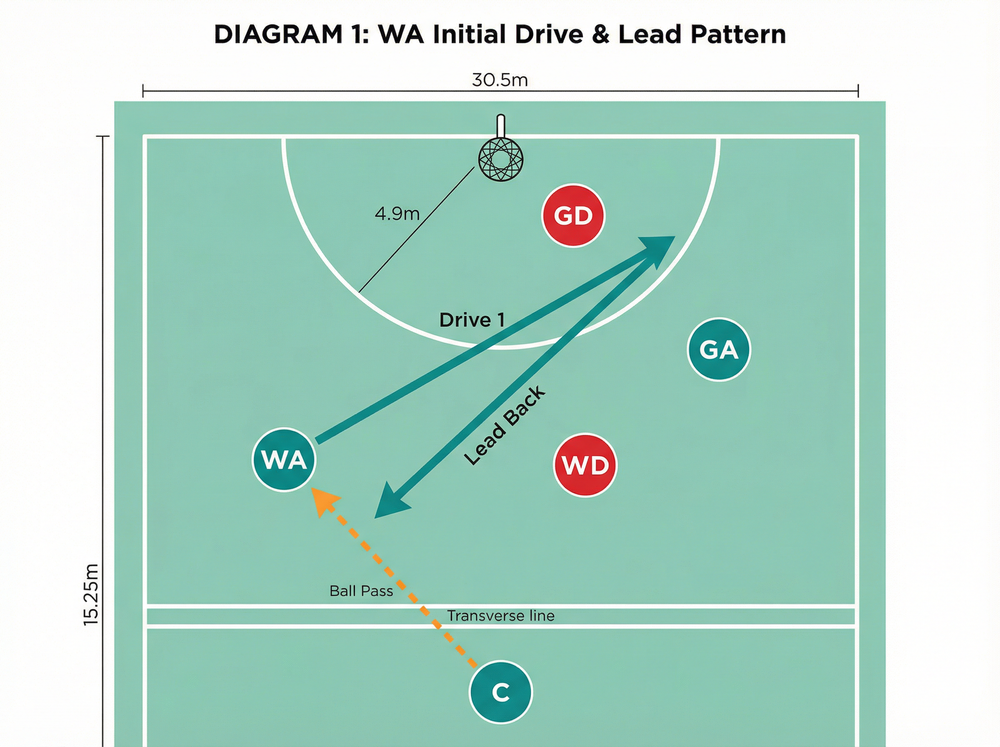
Phase 2: Connecting with the Goal Attack
5. As the WA receives the ball, they must immediately turn and face the goal circle, adopting a balanced, ready position.
6. Simultaneously, the GA initiates a 'double-movement'. They first make a strong 'Lead Away' from the circle edge to draw the GD out.
7. The GA then plants their foot and makes a sharp 'Cut to Circle' back toward the top of the goal circle or into the 'Shooting Zone'.
8. The WA reads the GA's movement and delivers a perfectly timed 'Feed Pass' (chest or bounce pass) into the space the GA is driving into.
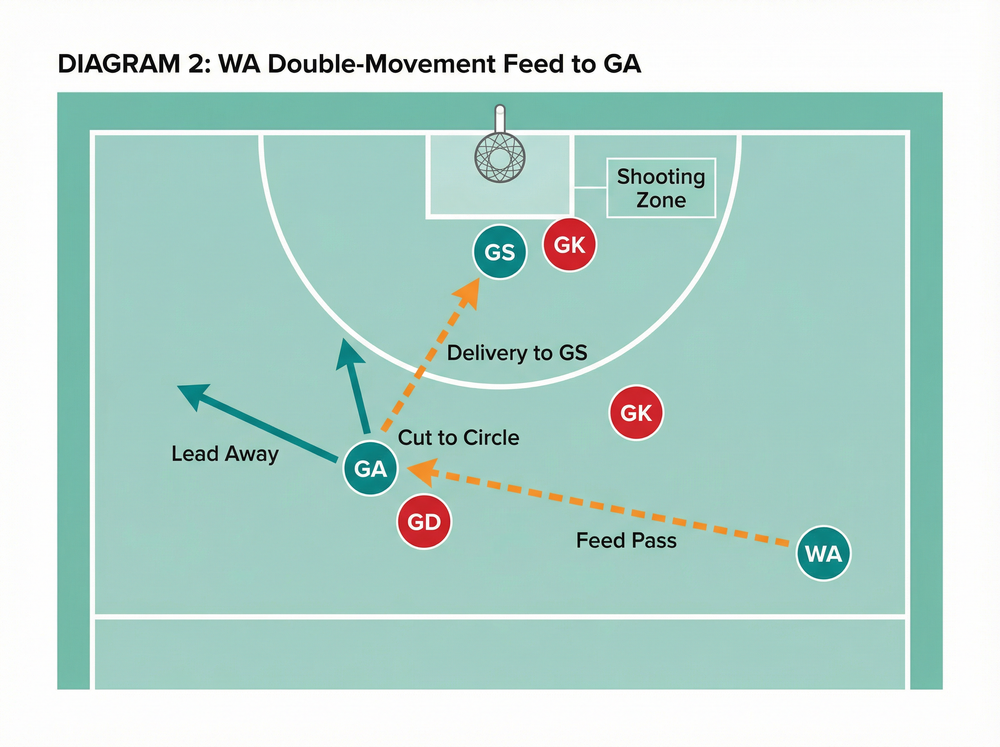
Phase 3: The Final Delivery
9. Upon receiving the ball, the GA quickly assesses the circle.
10. The GS, holding their position against the GK, presents a clear target.
11. The GA executes a final 'Delivery to GS' pass (often a lob or a quick bounce pass) to set up the shot.
12. The sequence resets, and players rotate positions to ensure everyone practices both attacking and defending roles.
4. Key Coaching Points
To maximize the effectiveness of this drill, focus on the following coaching points:
- Strong, Decisive Leads: Ensure the WA and GA are making sharp, angled leads rather than curving their runs. They must sprint to the space and demand the ball.
- Vision and Awareness: The WA must have their head up before receiving the ball, scanning the court to anticipate the GA's movement. 'Look before you leap' is crucial.
- Pass Execution: Emphasize the quality of the pass. The feed into the circle must be placed out in front of the driving player, away from the defender. Use chest passes for speed and bounce passes to bypass taller defenders.
- Timing is Everything: The WA must not release the ball until the GA has committed to their final cut. Releasing too early results in interceptions; releasing too late allows the defense to recover.
- Balance on Landing: The WA must land cleanly, ideally on one foot, to pivot and open up their passing options quickly without stepping.
5. Common Mistakes
Watch out for these frequent errors and correct them immediately:
- Running Flat: The WA running straight across the transverse line instead of driving on an angle toward the goal circle, making it easy for the WD to intercept.
- Forcing the Pass: The WA passing to the GA even when they are heavily defended, instead of resetting the play or looking for the GS directly.
- Lack of Eye Contact: The WA and GA not communicating non-verbally. The WA must see the GA's eyes before releasing the feed.
- Poor Spacing: Players crowding the top of the circle, bringing their defenders together and eliminating passing lanes.
6. Variations & Progressions
Keep the drill challenging by introducing these variations:
- Progression 1: Active Defense. Transition from passive to active defense. The WD and GD should now actively attempt to intercept the ball, forcing the attackers to work harder for space.
- Progression 2: The 'Over the Top' Feed. Introduce the GK into the drill. If the GA is covered, the WA must practice reading the GS's hold and delivering a high, lobbed pass directly into the circle.
- Variation 1: Time Pressure. Implement a 3-second rule. The WA must receive the ball, turn, and feed the circle within 3 seconds to simulate game intensity.
- Variation 2: Restricted Zones. Place cones to create 'no-go zones' on the court, forcing the WA to find alternative feeding positions and the GA to use different areas of the circle edge.
7. Age Adaptations
Tailor the drill to suit different age groups and skill levels:
- Under 10s / Under 12s: Focus heavily on the basic mechanics of the pass and the landing. Remove the defenders initially. Emphasize simple, straight leads and basic chest passes. Use a smaller ball if necessary.
- Under 14s / Under 16s: Introduce passive defense and focus on the timing of the 'double-movement' by the GA. Emphasize the WA's ability to turn quickly and read the play. Practice different types of passes (bounce, shoulder).
- Open / Advanced: Run the drill at full match intensity with active defense. Incorporate complex tactical scenarios, such as the WA having to reset the ball with the C before feeding, or dealing with a zone defense setup by the opposing team.
