

Football
Mastering the Wing Overload Attacking Play
Learn how to systematically create and exploit numerical advantages on the flanks to generate high-quality scoring opportunities.
What you need
Full-size goal, 10-15 cones, Training bibs (two colours), Adequate supply of footballs
1. Overview
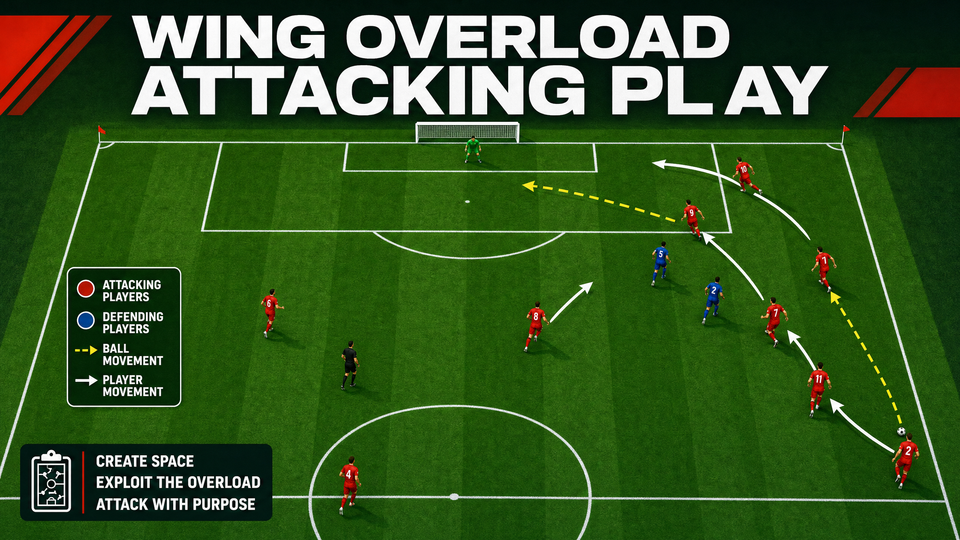
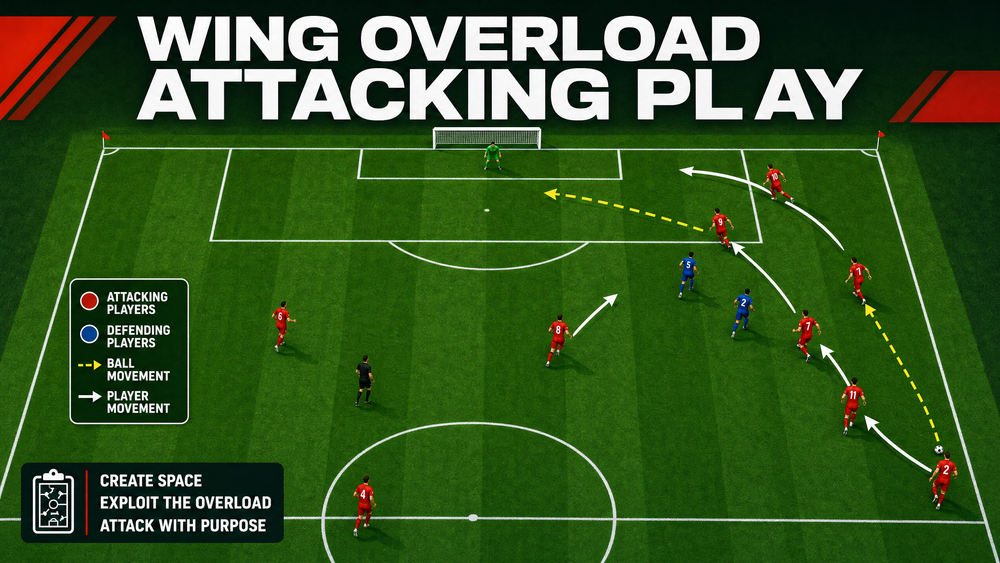
The Wing Overload is a fundamental attacking strategy designed to draw the opposition's defensive block toward one side of the pitch, creating a numerical advantage (e.g., a 3v2 or 4v3) on the flank. By committing the full-back, winger, and a central midfielder to the wide area, your team can force the defense to shift aggressively. This creates two primary avenues of attack: exploiting the overload through quick combination play to penetrate down the flank, or rapidly switching play to the isolated winger on the opposite side. It is particularly effective against teams that defend narrow or utilize a low block.
2. Setup
Pitch Dimensions: Use the attacking half of a standard pitch (approx. 50-55m x 64-75m). For training, cone off the central and opposite flank to focus solely on the overload zone if desired.
Players Required: Minimum 8 attackers (GK, RB, CB, LB, 3 CMs, RW, ST, LW) vs 4-6 defenders.
Equipment: Full-size goal, 10-15 cones (to mark the overload zone), training bibs (two colours), and an adequate supply of footballs.
Initial Positions:
- Set up your team in a standard 4-3-3 or 4-2-3-1 shape.
- The right full-back (RB) and right winger (RW) should maintain maximum width.
- The central midfielders (CM) position themselves to support the play.
3. Step-by-Step Instructions
Step 1: The Trigger Pass
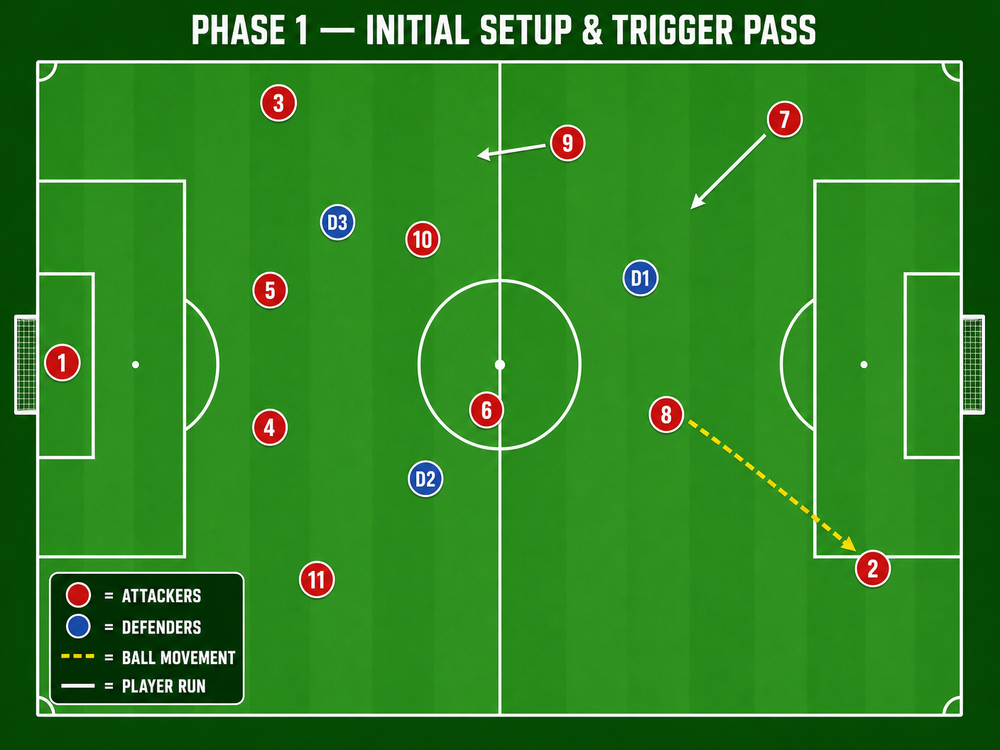
The play initiates when a central midfielder (CM 8) plays a firm, accurate pass out to the right full-back (RB 2) who has advanced into the opposition half.
Step 2: Creating the Overload
As the ball travels to the RB, the right winger (RW 7) makes a sharp diagonal run inside, drawing the opposing full-back with them. Simultaneously, the attacking midfielder (CM 10) drifts into the space created on the right flank, establishing a 3v2 numerical superiority.
Step 3: Penetration
The RB now has multiple options. They can play a quick one-two with the RW, slide a pass down the line for the overlapping CM, or drive inside if the space opens up. The objective is to break the defensive line and reach the byline.
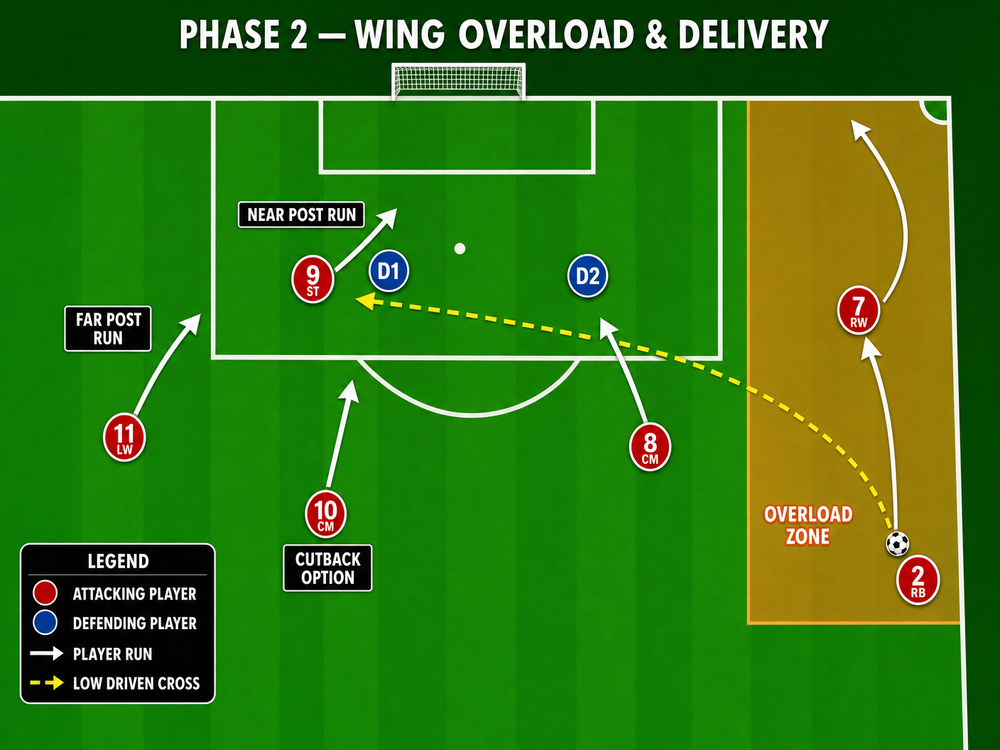
Step 4: The Delivery
Once penetration is achieved and the player reaches the crossing zone, they must deliver a high-quality ball into the penalty area. The delivery should be tailored to the runs of the forwards.
Step 5: Coordinated Box Runs
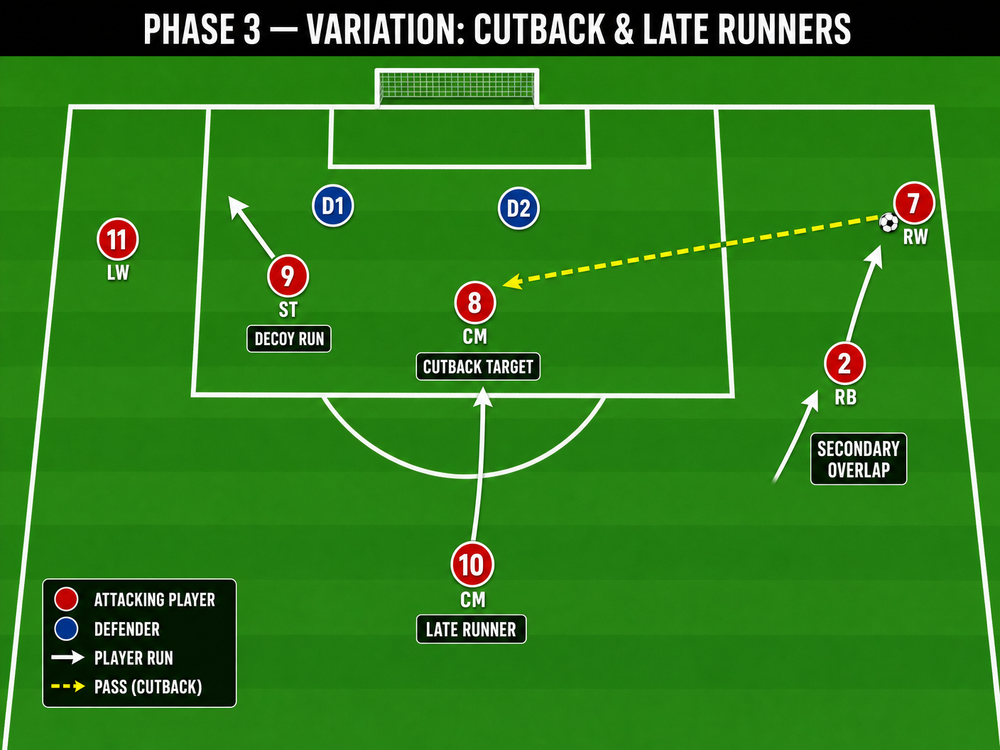
As the cross is prepared, the striker (ST 9) makes a near-post run to drag the center-backs. The opposite winger (LW 11) attacks the far post. A central midfielder (CM 8) arrives late into the box for a potential cutback.
4. Key Coaching Points
- Speed of Play: The ball must be moved quickly to prevent the defense from shifting and neutralizing the overload.
- Timing of Runs: Overlapping and underlapping runs must be timed perfectly. Arriving too early closes the space; arriving too late misses the opportunity.
- Quality of Delivery: Crosses must be driven with purpose. Avoid floated crosses that allow the goalkeeper to claim the ball easily.
- Opposite Side Discipline: The winger on the far side must maintain their width until the final moment to stretch the defense and be ready for a switch of play.
- Rest Defense: Ensure the remaining defenders and holding midfielder are positioned correctly to prevent counter-attacks if possession is lost.
5. Common Mistakes
- Crowding the Space: Players moving into the overload zone without a clear purpose, bringing extra defenders and congesting the area.
- Poor Decision Making: Forcing the play down the overloaded side when the defense has successfully shifted, instead of switching the play to the underloaded side.
- Static Box Movement: Attackers waiting for the cross rather than making dynamic, coordinated runs to disrupt the defensive line.
- Lack of Width: Full-backs and wingers failing to stay wide, making it easier for the defense to remain compact.
6. Variations & Progressions
- The Switch: If the defense overcommits to the overload, train the players to recognize this and execute a rapid switch of play to the isolated winger on the far side.
- Underlapping Runs: Instead of the full-back overlapping, have the winger stay wide and the full-back make an underlapping run into the half-space.
- Adding Defenders: Start with passive defending and gradually increase the number and intensity of defenders until it is a fully opposed scenario.
7. Age Adaptations
- Under 8 - Under 10: Focus on the basic concept of passing and moving. Simplify the overload to a 2v1 scenario on the wing.
- Under 12 - Under 14: Introduce the concept of overlapping runs and the timing of the final pass. Emphasize the quality of the cross.
- Under 16 - Open: Implement the full tactical complexity, including coordinated box runs, reading the defensive shift, and executing the switch of play.
