

Netball
Mastering the Circle Edge Rotation: A Netball Set Play
A detailed guide for netball coaches on how to teach and execute the Circle Edge Rotation, a powerful attacking set play designed to unlock tight defences and create high-percentage shooting opportunities.
What you need
Netballs, Bibs, Cones
1. Overview
The Circle Edge Rotation is a fundamental attacking set play in netball designed to break down a zonal or tight player-on-player defence around the shooting circle. Its primary objective is to create a clear and direct passing lane to a shooter moving into a high-percentage scoring position. By using coordinated movement and a quick rotation of players, the play systematically pulls defenders out of position, creating space and confusion. This play is most effective when the attacking side is struggling to penetrate the circle due to defensive pressure, or when the Goal Attack (GA) is being double-teamed or blocked from making their preliminary drive. It relies on precise timing, clear communication, and sharp, decisive movements from the Centre (C), Wing Attack (WA), and Goal Attack (GA).
2. Setup
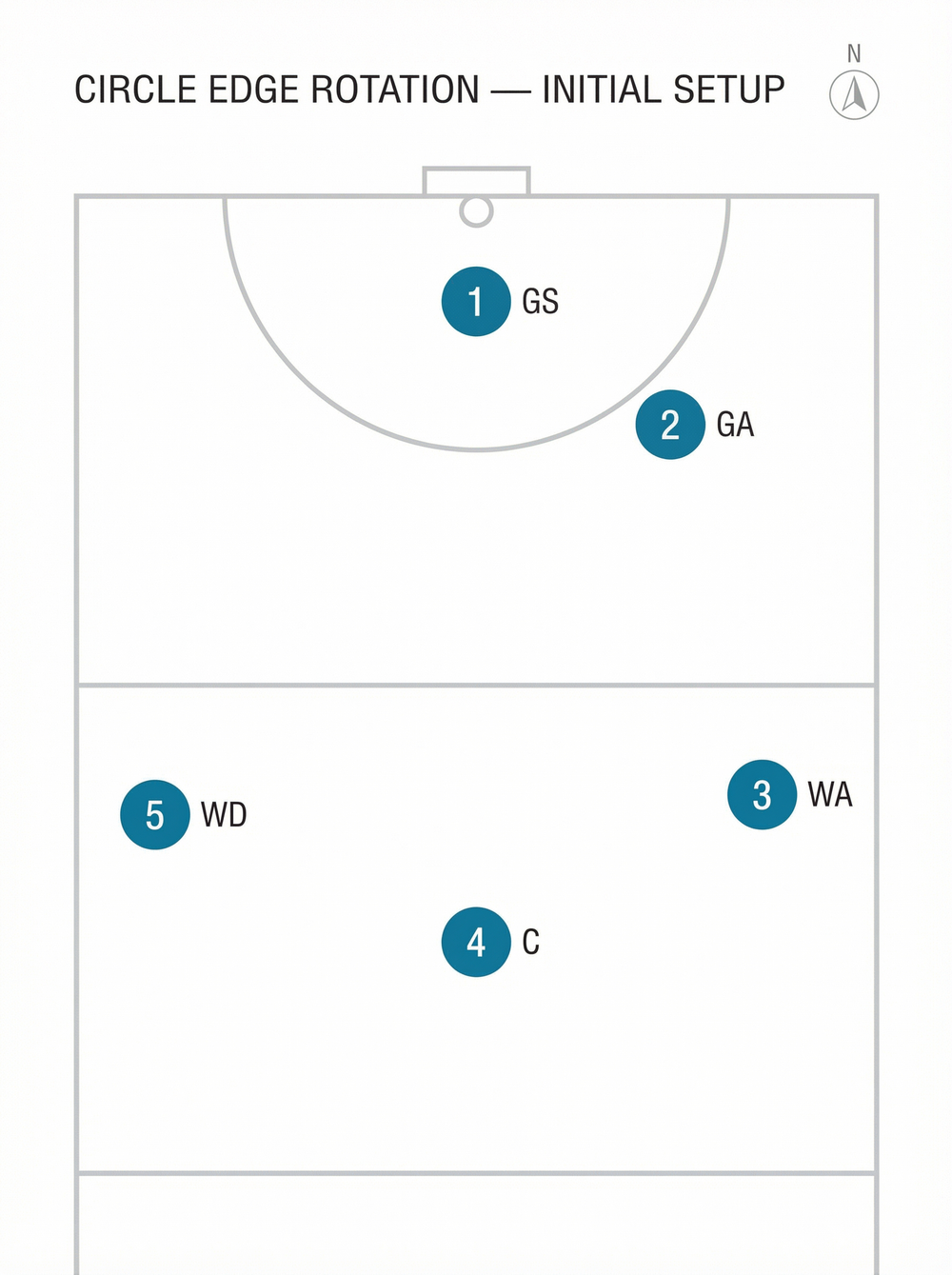
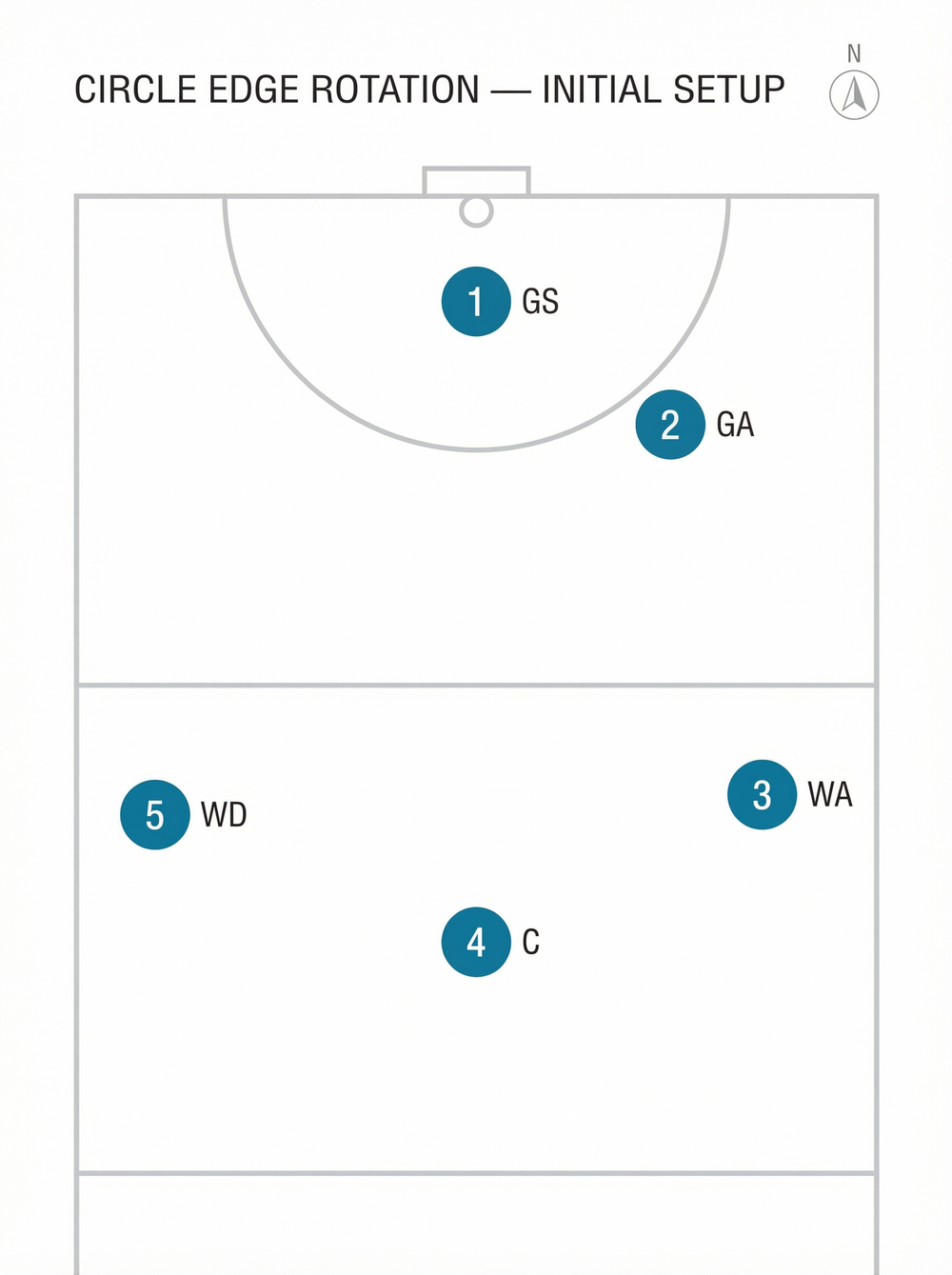
To effectively run this set play in a training session, coaches will need a standard court setup. The focus is on the attacking third, but it's beneficial to have players in their natural positions to simulate a real-game scenario.
- Equipment: A full set of bibs for at least 7 players (differentiating attackers and defenders), 5-10 netballs, and 4 cones to mark starting positions if needed.
- Court Setup: A full-sized netball court (30.5m x 15.25m). The play primarily occurs in the attacking third and the shooting circle (4.9m radius).
- Player Positions:
- Goal Shooter (GS): Starts under the post, holding their defender to create space.
- Goal Attack (GA): Positioned on the edge of the shooting circle.
- Wing Attack (WA): Positioned wide in the attacking third, near the transverse line.
- Centre (C): Starts in the centre third, ready to drive towards the attacking transverse line with the ball.
- Defenders (for progression): Goal Defence (GD), Wing Defence (WD), and Centre (C) to apply pressure.
3. Step-by-Step Instructions
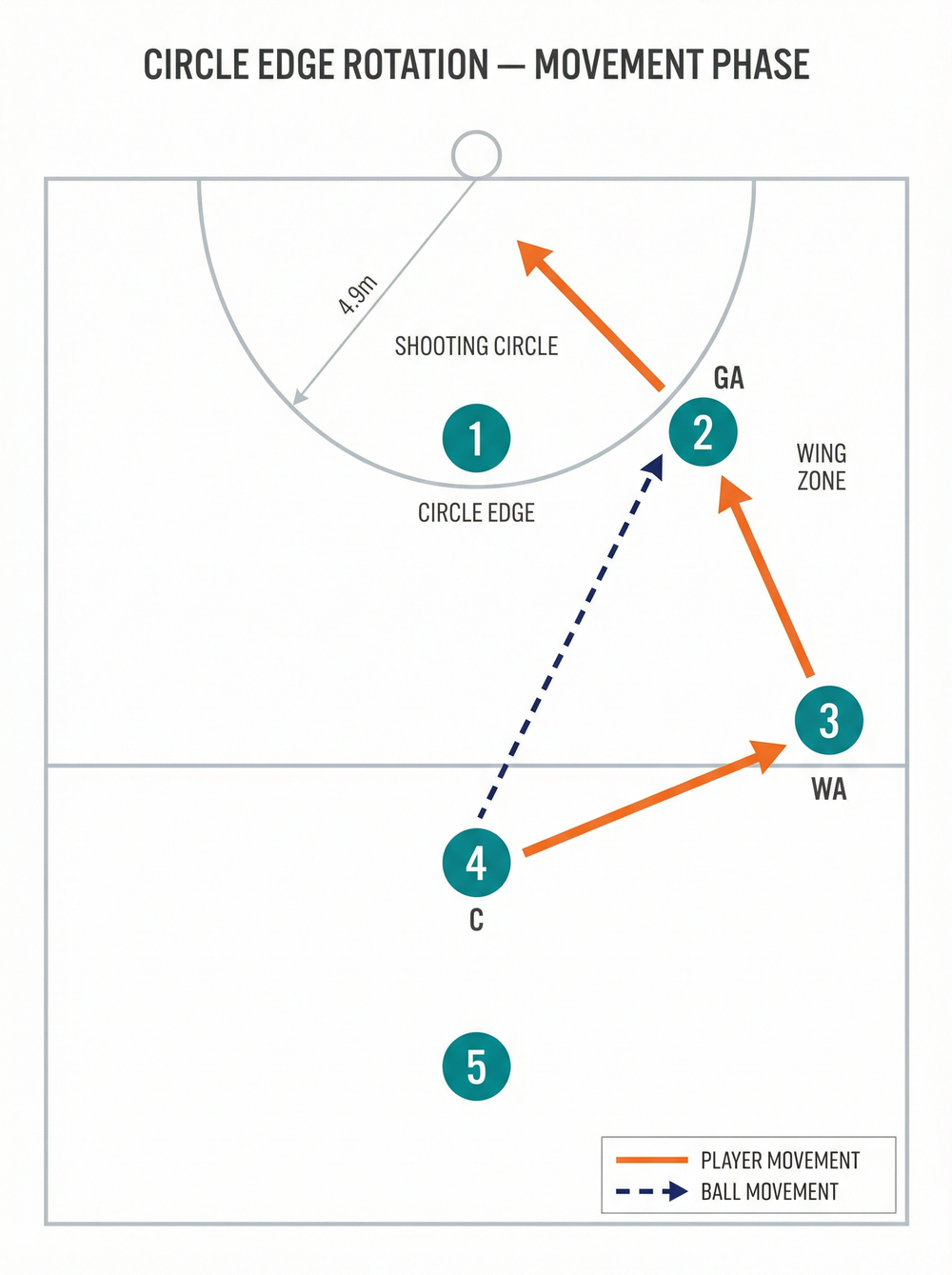
This play unfolds in a quick, sequential series of movements. Each step must be executed with precision for the play to succeed.
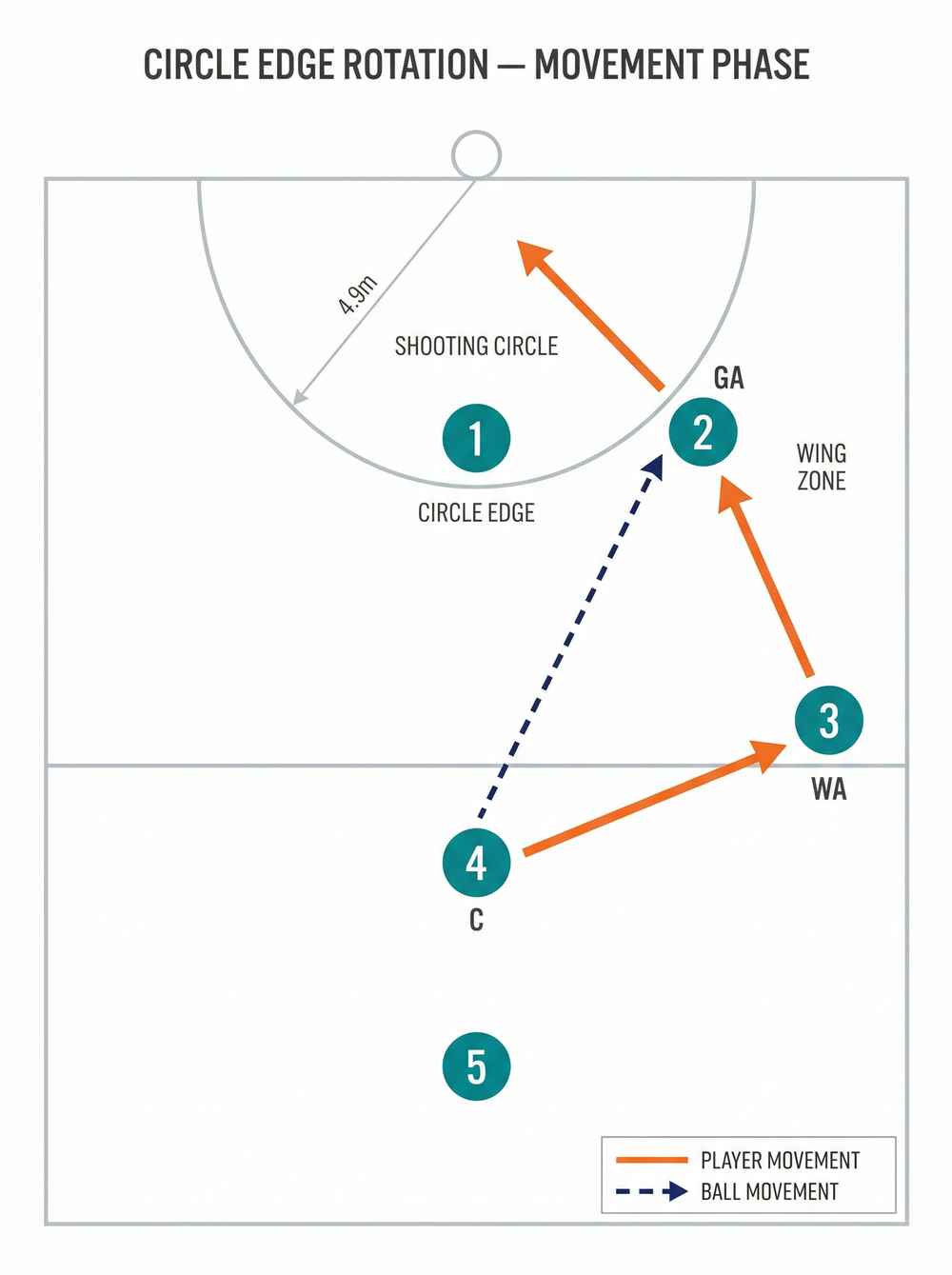
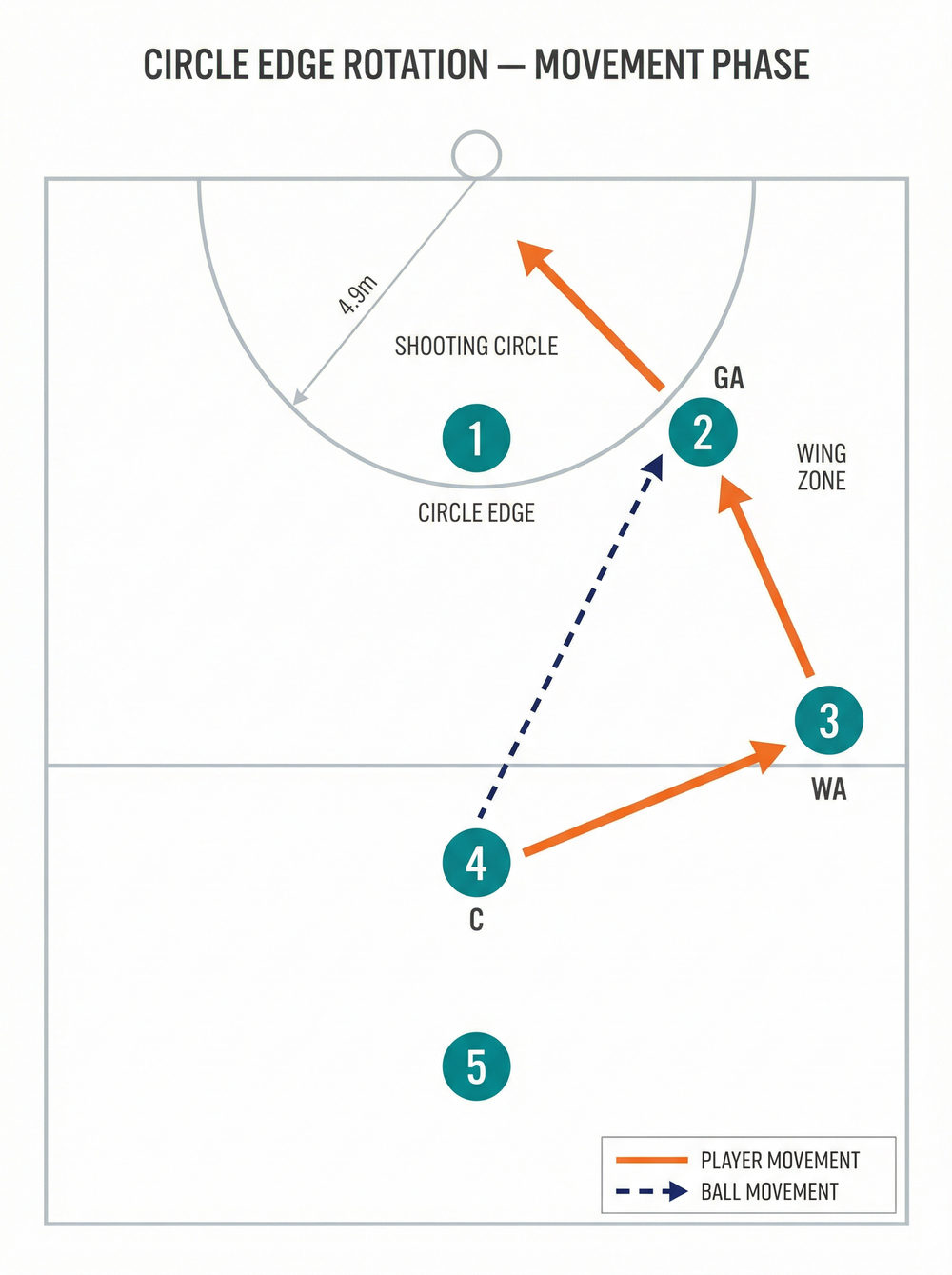
- The Trigger: The play begins with the Centre (C) in possession, driving towards the attacking transverse line. This is the visual cue for the rotation to start.
- The First Drive (GA): As the C approaches the line, the Goal Attack (GA) makes a sharp, decisive drive away from the circle edge, diagonally towards the wing. This movement is crucial as it is designed to pull the Goal Defence (GD) with them, clearing the primary space.
- The Rotation (WA): The Wing Attack (WA) reads the GA's movement and immediately cuts into the space vacated by the GA at the top of the circle. This must be a full-sprint effort to ensure they are a viable passing option.
- The Replacement (C): After passing the ball, the Centre (C) continues their drive to fill the space left by the WA on the wing. This ensures the attacking structure is maintained and provides a defensive balance.
- The Pass & Feed: The C passes the ball to the WA, who has now established a strong position on the circle edge. The WA, with a clear view into the circle, then delivers a sharp, direct pass (the 'feed') to the Goal Shooter (GS) who has held their space under the post, or to the GA who may re-offer after their initial drive.
4. Key Coaching Points

To ensure the play is effective, coaches should focus on these critical details during training sessions.
- Timing is Everything: The rotation must be seamless. The WA cannot move before the GA, and the C must time their pass to hit the WA as they arrive at the circle edge. Drill this without defenders first to perfect the timing.
- Sharp, Decisive Movements: Players must use explosive speed. Drives should be sprints, not jogs. Changes of direction must be sharp to wrong-foot defenders. Emphasize driving into space with intent.
- The Preliminary Move: Encourage the GA to use a small preliminary move (a step one way before driving the other) to unbalance their defender before starting the main drive.
- Ball-Side Focus: The entire play should ideally happen on one side of the court (e.g., the right side). This concentrates the defenders and makes the space creation more effective.
- Vision and Communication: The WA must have their head up, reading the play and anticipating the pass. A quick shoulder pass or bounce pass can be effective. Non-verbal cues like eye contact are essential.
- Pass Placement: The final pass to the shooter must be placed into the space, away from the defender. A high lob or a sharp chest pass might be required depending on the defensive picture.
5. Common Mistakes
Coaches should be vigilant for these common errors and correct them immediately.
- Slow Rotation: If the WA is slow to move into the circle edge position, the passing lane will close, and the play will break down.
- Telegraphed Passes: The C or WA staring at their intended target allows defenders to read the play and intercept. Encourage the use of peripheral vision.
- GA Not Clearing Space: If the GA's drive is not committed, their defender can remain in the circle and easily cover the WA's rotation.
- Crowding: If players don't maintain their spacing and fill the designated lanes, the attacking third becomes congested, making it easy for defenders to cover multiple players.
6. Variations & Progressions
Once the team has mastered the basic play, introduce these variations to increase its effectiveness and unpredictability.
- Progression 1 (Add Defenders): Start by adding a GD and WD. This forces the attackers to be more precise with their timing and passing under pressure. Build up to a full 7v7 game scenario.
- Progression 2 (The Give-and-Go): Instead of passing to the GS, the WA can play a quick 'give-and-go' with the GA, who, after their initial drive, cuts back sharply into the circle to receive the return pass for a shot.
- Variation 1 (The Double Rotation): If the defence reads the initial play, the C can fake the pass to the WA and instead hit the GS, who has popped out to the circle edge as a surprise option.
7. Age Adaptations
This play can be adapted for various age groups and skill levels.
- Under-12 / Under-14: Simplify the play. Focus on the initial GA drive and the WA rotation. Use cones to guide players. Start with a 3-player drill (C, WA, GA) without defenders. The goal is to understand the concept of creating space through rotation.
- Under-16 / Open: At this level, the play should be executed at full speed. Introduce tactical decision-making. For example, if the GD doesn't follow the GA, the C should be coached to see this and pass directly to the GA. Add complex defensive scenarios and require the players to adapt the play accordingly.
