

Netball
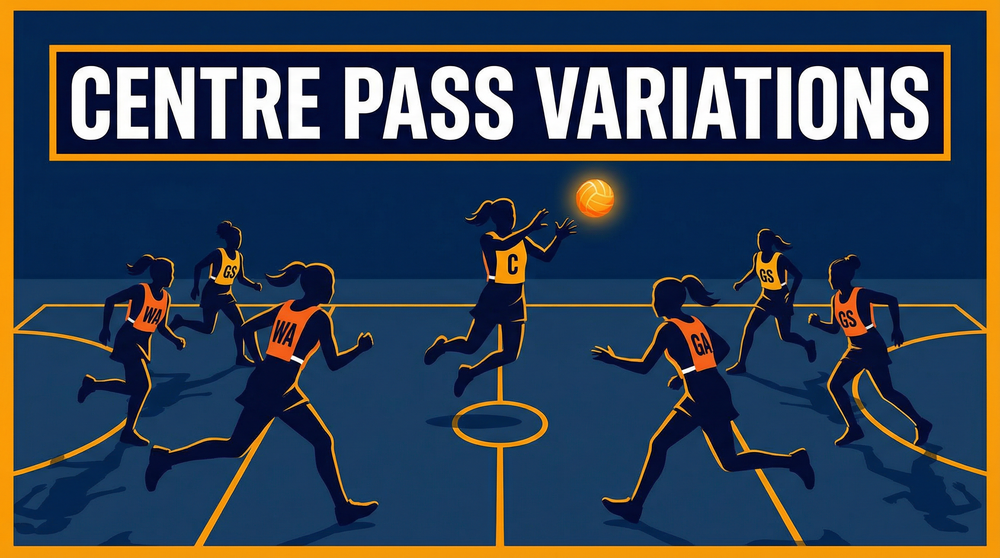
Centre Pass Variations Drill: Mastering the First Possession
Teach your team to win the first possession every quarter with three rehearsed centre pass patterns that exploit space, create mismatches, and keep the opposition guessing.

What you need
1 full-size netball court (30.5m x 15.25m), 1 match netball, 2 sets of coloured bibs (attacking and defending), 4 flat cones, Coaching whiteboard or clipboard
Overview
The centre pass is the single most repeated set piece in netball — occurring at the start of every quarter and after every goal. A team that wins and converts its centre passes efficiently can control the tempo of an entire match. Despite this, the centre pass is one of the most under-coached set pieces in the game, with many teams relying on ad hoc decisions rather than rehearsed patterns.
This drill teaches your team three distinct centre pass variations, each designed to exploit a different defensive alignment. By rotating through all three patterns in training, players develop the spatial awareness, timing, and decision-making to select and execute the right option under pressure. The drill is suitable for intermediate to advanced squads and can be adapted for younger age groups with simple modifications.
When to use this drill: Incorporate it in the set-piece block of your session (typically 15–20 minutes into training), after a general warm-up and before full-court game play. Revisit it in the week leading up to a match as a tactical rehearsal tool.
Setup

Equipment
- 1 full-size netball court (30.5m x 15.25m)
- 1 netball (match ball)
- Coloured bibs in two sets (attacking team and defending team)
- 4 flat cones to mark the centre third transverse lines if court lines are faint
- Whiteboard or coaching clipboard for pattern briefing
Court Setup
All three variations are run from the centre circle (0.9m radius) at the mid-point of the court. The drill uses the full width of the court and extends from the centre circle into the attacking third. No additional court markings are required beyond standard netball lines.
Player Positions
The drill requires 7 attacking players and up to 4 defenders, making it ideal for a squad of 10–14. Assign positions as follows:
| Position | Abbreviation | Role in Drill |
|---|---|---|
| Centre | C | Takes the centre pass from the circle |
| Wing Attack | WA | Primary first-pass receiver (Variations 1 & 3) |
| Goal Attack | GA | Secondary receiver / long option (Variations 2 & 3) |
| Goal Shooter | GS | Holds position in shooting circle, creates space |
| Wing Defence | WD | Starts in defensive half, drives into centre third post-pass |
| Goal Defence | GD | Starts in defensive half, provides second-phase outlet |
| Goal Keeper | GK | Holds defensive third, not active in initial pattern |
For the defending side, position the opposition Wing Defence (WD) and Goal Defence (GD) in the centre third to provide realistic defensive pressure on the first pass.
Step-by-Step Instructions

Phase 1 — Pattern Briefing (5 minutes)
- Gather all players at the centre circle. Use your whiteboard or clipboard to walk through each of the three variations before any movement begins.
- Assign each variation a code name or number (e.g., "One", "Two", "Three") that the Centre can call at the whistle.
- Emphasise that timing is everything — all leads must begin the moment the umpire's whistle blows, not before.
Phase 2 — Unopposed Walkthrough (10 minutes)
- Begin with Variation 1 — Short Swing to Wing Attack (see diagram below). Walk the pattern at half-pace with no defenders.
- The Centre (C) stands in the centre circle. On the coach's whistle, WA drives from the transverse line toward the centre circle at a 45-degree angle, receiving a short flat pass from C within 3–4 metres of the circle.
- Immediately after releasing the ball, C drives forward into the attacking third to provide a second-phase option.
- WA receives, pivots, and delivers to GA who has led diagonally into the attacking third.
- Reset all players. Now walk through Variation 2 — Long Diagonal to Goal Attack. WA makes a short lead to the left as a decoy, drawing the defending WD. GA simultaneously makes a long diagonal run from the centre-left to the attacking-right channel.
- C reads the decoy, holds for one beat, then delivers a long diagonal pass over the top to GA in space.
- GS holds the shooting circle and prepares to receive from GA on the second phase.

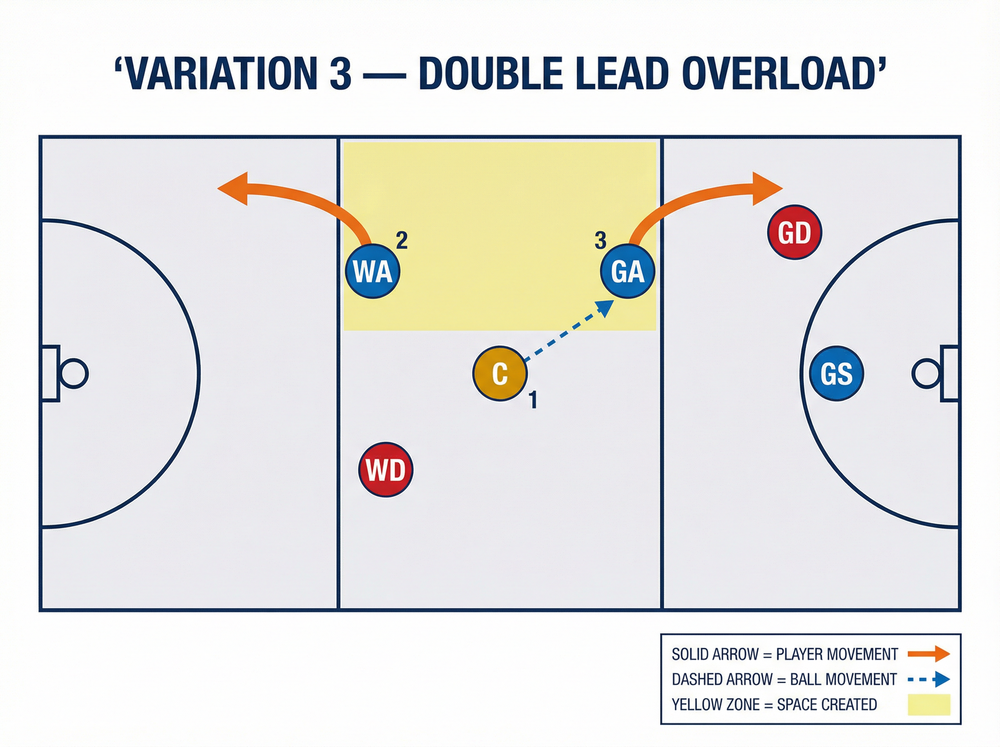
- Reset. Walk through Variation 3 — Double Lead Overload. Both WA and GA lead simultaneously in opposite directions from the centre third — WA to the left, GA to the right — creating a split in the defence.
- C reads which defender commits to which lead and delivers to the player in the greater space. The yellow highlighted zone in the diagram shows the space created between the two leads.
- After receiving, the ball carrier drives toward the attacking third and links with GS.

Phase 3 — Opposed Repetition (15 minutes)
- Introduce two defenders (WD and GD in opposition bibs) into the centre third. Defenders play at 50% intensity initially.
- The coach calls the variation number before each repetition. Run each variation a minimum of 4 times before rotating.
- After 5 minutes, allow the Centre to self-select the variation based on what they read from the defensive alignment. This is the key decision-making phase.
- Rotate the Centre role every 4 repetitions so multiple players experience the decision-making demands.
Phase 4 — Live Centre Pass Sequence (10 minutes)
- Play a live game sequence: every time a goal is scored, the scoring team restarts with a centre pass and must execute one of the three variations.
- Defenders now play at full intensity. Award a bonus point for a successful variation that leads directly to a shot within 8 seconds.
Key Coaching Points

1. Timing of the Lead is Everything
The lead must begin the instant the umpire's whistle sounds — not half a second later. A lead that starts late arrives at the same time as the defender. Drill this relentlessly: blow the whistle and watch feet, not hands.
2. The Centre Must Read the Defence Before Passing
C should scan the centre third in the 1–2 seconds before the whistle. Identify where the opposing WD is positioned — this dictates which variation gives the best chance of a clean first pass. A WD sitting deep invites Variation 1; a WD pressing high opens Variation 2.
3. Leads Must Be Committed and Decisive
Half-hearted leads are the enemy of good set pieces. Players must drive at full pace for at least 4–5 metres before changing direction. A tentative lead telegraphs the move and allows defenders to recover.
4. The Decoy Must Believe in Their Role
In Variations 2 and 3, the decoy lead is just as important as the primary lead. If WA jogs through a decoy, the defender will not commit and the space will not open. Coach WA to run the decoy as if they fully expect the ball.
5. Second-Phase Movement Starts Before the Ball Arrives
C, GS, and the non-receiving player must begin their second-phase movement as the first pass is in the air — not after it lands. This keeps the attack flowing and prevents the defence from resetting.
6. Communication Is a Weapon
Encourage players to use short, sharp calls during the pattern. A simple "mine" or "here" from WA or GA gives the Centre an audio cue as well as a visual one, reducing decision time under pressure.
Common Mistakes
Mistake 1 — Leading Too Early
Players anticipate the whistle and begin their lead 1–2 seconds before it sounds, putting them offside or arriving at the target zone too early. The fix: use a delayed whistle in training — blow it at irregular intervals so players cannot anticipate. Reinforce the rule that feet must be behind the transverse line until the whistle.
Mistake 2 — The Centre Telegraphs the Pass
C looks directly at the intended receiver before the whistle, allowing the defending WD to pre-position. Teach C to use peripheral vision and maintain a neutral head position until the moment of release. Drill this by asking C to call the variation number quietly to the coach only, not to teammates.
Mistake 3 — Crowding the Centre Circle
WA and GA both lead into the same channel, removing the width that makes the patterns effective. Emphasise court width: WA should use the left channel (within 2m of the sideline) and GA the right, or vice versa, depending on the variation. Use cones to mark the channels if necessary.
Mistake 4 — Flat Leads With No Change of Direction
A straight lead is the easiest to defend. Teach players to use a "fake and go" — a short step in the opposite direction before the explosive lead. Even a half-step fake at pace is enough to create separation from a marking defender.
Mistake 5 — Holding the Ball Too Long
C receives the umpire's whistle and hesitates, waiting for a perfect option that may not come. Establish a rule: if no clear option presents within 2 seconds, default to Variation 1 (the short swing) as the safe outlet. Decision paralysis is as costly as a bad pass.
Variations & Progressions

Progression 1 — Add a Third Defender
Introduce the opposing Centre (C) as a third defender who can pressure the ball carrier in the circle. This forces the attacking C to release the ball faster and sharpens the timing of leads. Increase to full 7v7 opposition once the pattern is fluent.
Progression 2 — Restrict the First Pass Zone
Place two cones 3m either side of the centre circle and rule that the first pass must travel beyond this zone. This eliminates the "safe dump" short pass and forces WA and GA to create genuine separation before receiving. Ideal for advanced squads who have mastered the basic patterns.
Regression — Remove Defenders and Add a Signal
For squads still learning the patterns, remove all defenders and have the coach hold up a number (1, 2, or 3) as the whistle blows. This removes the decision-making load from the Centre and allows players to focus purely on the movement pattern and timing. Gradually phase out the signal as confidence grows.
Age Adaptations

| Age Group | Key Adaptation |
|---|---|
| Under 10 | Use one variation only (Variation 1). Focus on timing of the lead and a clean catch. No defenders. |
| Under 12 | Introduce Variations 1 and 2. Add one passive defender (WD only) at 25% intensity. Emphasise width of leads. |
| Under 14 | Run all three variations unopposed, then with two defenders at 50%. Introduce the self-selection phase. |
| Under 16 | Full drill as written. Add the time pressure rule (shot within 8 seconds) and rotate the Centre role. |
| Open / Senior | Full drill with 7v7 live sequences. Encourage teams to develop a fourth variation of their own design. |
For all age groups, prioritise understanding over speed in the early learning phase. A team that can execute two variations cleanly is far more dangerous than one that attempts three variations poorly.
